
Shipyard Grants Buy Welders’ Tools, Not Their Retention
See how MARAD’s shipyard grants fund welding machines and training capacity while leaving competitive pay and worker retention to employers.
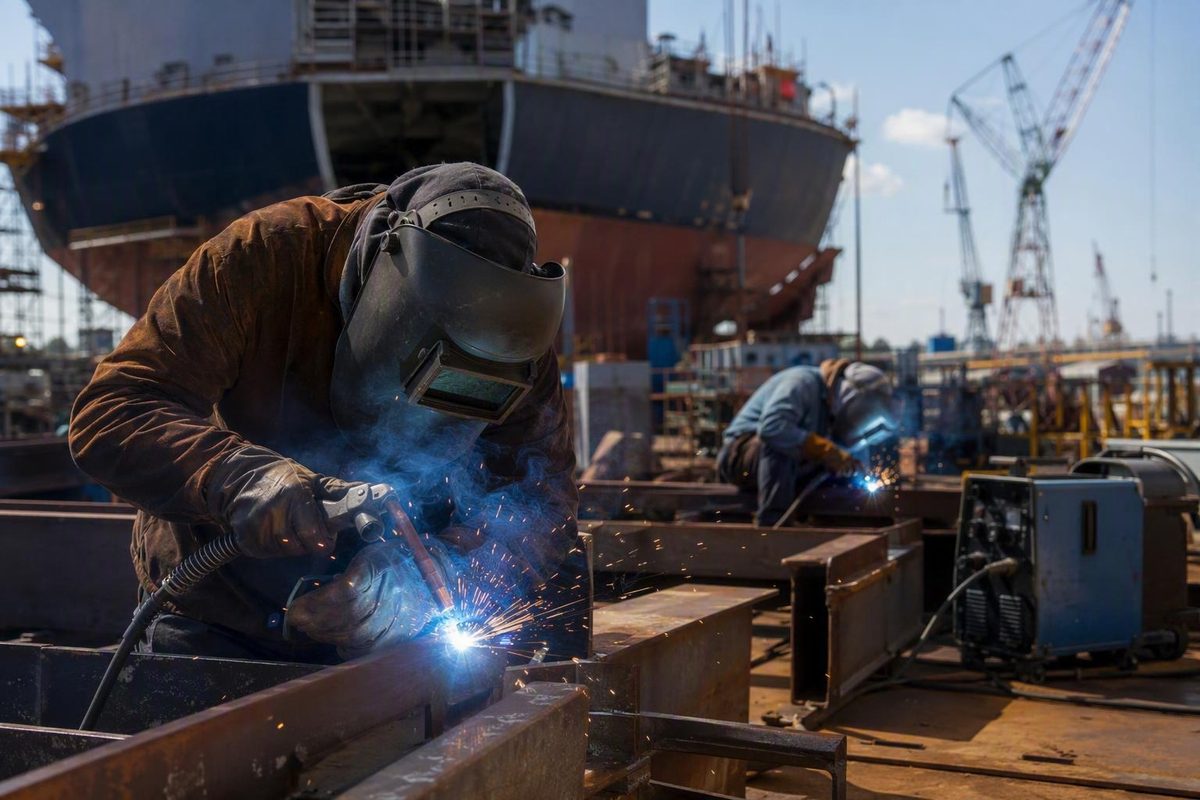
Shipyards are short on welders because their workforce pipeline loses people faster than training capacity alone can replace them. MARAD’s $35.1 million in 2026 grants will help 45 small shipyards buy equipment and expand training infrastructure, but the published awards contain no wage funding. They increase the capacity to prepare welders without directly addressing whether qualified workers stay.
That distinction matters to both shop owners and welders evaluating shipyard offers. Seventeen new welding machines can remove a training bottleneck. They cannot make an uncompetitive employment package competitive, replace a retiring mentor or keep a newly qualified welder from accepting better-paid industrial work.
Pay is not the sole cause of the shortage. Geography, retirement, qualification time, working conditions and access to instruction all narrow the labor pool. The defensible verdict is narrower: the 2026 grants treat equipment and training capacity, while retention and competitive compensation remain employer-funded problems.
The Consensus View Gets the Investment Right
Government announcements and trade coverage reasonably present the 2026 funding increase as a workforce intervention. MARAD distributed $35.1 million among 45 shipyards in 24 states and the U.S. Virgin Islands, described as a 300% program funding increase. That works out to roughly $780,000 per yard, although individual awards differ substantially (MarineLink’s itemized MARAD award report).
The investment can produce real benefits. A yard cannot enlarge a welding class without machines, booths, cutting equipment, consumables, instructors and suitable space. Production equipment and berth improvements can also increase the amount of work a yard can accept and complete.
The consensus overreaches only when the funding increase itself is treated as a cure for the labor shortage. The itemized projects show what the money buys: machinery, facility improvements and training hardware. They do not show wage supplements, retention bonuses or recurring payroll support.
Choose a funded yard, then adjust the crew size and raise percentage to compare its grant with a retention raise.
The published project descriptions allocate the selected award to equipment, facilities or training capacity—not wages. Adjust the comparison to see the annual salary at which a raise would equal the one-time grant.
Break-even formula: selected grant divided by the number of welders and the raise percentage. This is a counterfactual comparison, not evidence that MARAD funds may be used for payroll.
| Shipyard | Award | Published Project | Wage Related |
|---|---|---|---|
| Safe Boats International | $321,474.38 | 17 welding machines for an aluminum welding and fabrication training program | $0 identified |
| Signet Maritime Corporation | $387,745 | Plasma cutting table, welding tractors, crane and bandsaw | $0 identified |
| Gulf Marine Repair Corporation | $1,007,678 | Training-center equipment and berth upgrades | $0 identified |
Source: MarineLink’s itemized report of MARAD’s 2026 Small Shipyard Grants. The three rows are the welding- and training-relevant examples supplied in the article evidence; trainee counts and yard wage data were not reported.
The Award List Funds Capacity, Not Compensation
The clearest welding-specific award went to Safe Boats International: $321,474.38 for 17 welding machines supporting an aluminum welding and fabrication training program. That is a direct expansion of instructional capacity. More trainees can practice simultaneously, and the yard can align instruction with its aluminum work (MarineLink).
Signet Maritime Corporation received $387,745 for a plasma cutting table, welding tractors, a crane and a bandsaw. Those purchases can improve preparation, material handling and production. They may raise the output of the existing workforce, but the published description identifies no wage component.
Gulf Marine Repair Corporation received $1,007,678 for training-center equipment and berth upgrades. That award combines workforce-development infrastructure with physical yard capacity. Again, the published project description does not allocate money to employee pay.
These three awards should not be treated as a complete accounting of every project funded at all 45 yards. They are the welding- and training-relevant examples supplied in the itemized evidence. The announcement also does not provide the number of training seats created, graduates produced, qualifications passed or employees retained. Where those figures are absent, they cannot be inferred from award dollars.
The distinction is between a capital input and a labor outcome. A new machine can create another place to practice. A training center can provide structured instruction. Neither guarantees that a recruit finishes, qualifies for production work or remains after becoming marketable.
Competitive Pay Addresses a Different Bottleneck
Shipyards compete for welders with fabrication shops, construction contractors, manufacturers, infrastructure projects, energy work and other industrial employers. A worker compares the whole offer: base pay, benefits, overtime, shift pattern, commute, relocation, job continuity, advancement, supervision and working conditions.
Base pay is therefore neither irrelevant nor a complete explanation. A yard with competitive compensation can still struggle because it is geographically isolated or needs specialized aluminum, pipe or structural experience. Conversely, career messaging and new training equipment cannot indefinitely offset an offer that trails the local alternatives.
Ingalls Shipbuilding provides evidence that a major yard has used wages as part of its labor response. Unionized workers ratified an immediate 18% base-wage increase, with larger total gains projected over the following five years. That agreement is not a national shipyard pay benchmark, but it shows that compensation can become a material response when a yard faces labor-market pressure (Fortune’s report on the Ingalls agreement).
MARAD’s grants and an employer-funded raise solve different problems. The grant can buy a welding machine once. A raise is a recurring payroll obligation that must be sustained across contracts and production cycles. Federal capital support may free other company resources, but the award list does not establish that recipients redirected those savings to compensation.
That is why the comparison tool presents a break-even threshold rather than claiming how many raises an award could actually fund. The supplied evidence does not include each yard’s wage rate, paid hours, welder headcount or turnover. Without those figures, a precise payroll conversion would be fabricated.
More Applicants Do Not Equal More Shipyard Welders
A shipyard shortage is not merely a shortage of applications. A recruit must complete instruction, develop the relevant process and material skills, pass applicable employer qualifications, become consistently productive in shipboard conditions and remain long enough to repay the yard’s training investment.
A historical example illustrates the loss between those stages. In 2014, an Ingalls representative reported reviewing 3,200 applications to hire 80 shipfitters. The yard made 250 offers, obtained 200 starts in a four-week program and saw 120 participants fail or quit. This concerned shipfitters at one yard, not welders nationally, so it cannot be used as a current attrition rate. It does show why applicant volume is a poor proxy for durable craft capacity (Maritime Professional’s recruitment and retention roundtable).
Training equipment acts near the middle of this funnel. It can accommodate more entrants and give them more arc time. It does not by itself improve the initial offer, remove relocation barriers or change what qualified employees can earn elsewhere.
A short welding credential also is not the same as shipyard readiness. Foundational instruction can cover safety, setup, joint preparation, welding positions and basic process control. Production work may then require employer-specific assessments, unfamiliar materials, restricted access and consistent performance under the yard’s procedures. Reductions in vocational exposure and the portrayal of trades as fallback careers have weakened the broader entry pipeline, but prospective workers also weigh practical costs and expected employment terms (Arclabs’ overview of the welding training pipeline).
Retirements Reduce Output and Teaching Capacity
When an experienced shipyard welder retires, the yard can lose both production output and a mentor. Veteran welders carry practical knowledge about fit-up, sequence, distortion, heat input, inspection expectations, rework avoidance and yard-specific procedures.
A new apprentice is not an immediate one-for-one replacement. During development, the apprentice uses machine time, instructor attention and production supervision. If several experienced workers leave together, the yard can have more vacancies while also having fewer people able to prepare replacements.
The 2014 industry roundtable recorded differing retirement exposure among participating yards. Some employers were concerned about older craft workers leaving, while another described a younger workforce. That historical, employer-reported discussion is not a present national survey, but it shows why a single national explanation is inadequate.
Current analysis still identifies aging, retirement, weak recruitment, lengthy workforce development and retention as connected constraints. Its central point is that funding and machinery do not become shipyard output without trained personnel (Lowy Institute analysis). The supplied evidence does not provide a current national retirement rate specifically for shipyard welders.
Equipment grants can help preserve knowledge when they support organized, repeatable instruction. They cannot create additional mentors unless experienced employees are given time and a reason to teach. Loading mentorship onto an unchanged production quota can simply transfer pressure to the workers the yard most needs to retain.
Shipboard Work Narrows the Available Labor Pool
General welding experience can transfer into shipbuilding, but “welder” is not one interchangeable qualification. Yards work with carbon steel, stainless steel and aluminum across different processes, positions, joints and acceptance requirements. Repair work and specialized pipe or structural assignments can demand different capabilities.
Shipboard conditions add another filter. Welders may climb ladders or scaffolding, move through passageways, coordinate with other trades, manage long leads and maintain technique in heat, fumes or restricted positions. Some work areas may involve an opening roughly 24 inches in diameter, although that example does not represent every shipyard weld (Miller’s overview of shipbuilding welding conditions).
These demands do not justify weakening safety requirements or qualification standards. They explain why the theoretical population of people who can weld is larger than the population willing and able to perform a particular shipyard job at a particular location and schedule.
A qualified welder elsewhere is also not automatically an available recruit. Relocation can affect housing, a partner’s employment, childcare, schools and commuting. The evidence does not assign a national percentage of the shortage to geography, but historical yard accounts describe nationwide recruiting and difficulty retaining some younger workers who moved to smaller shipyard communities.
Compensation has to be evaluated within that complete offer. A higher rate may not overcome an impractical relocation or unstable schedule. Strong benefits and predictable work can make a somewhat lower rate viable. The relevant comparison is with the employers recruiting the same workers in the same labor market.
Training Expansion Works Only If Retention Holds
The 2026 grants can remove real constraints. Seventeen additional welding machines may allow a larger class or more practice time. A plasma table and welding tractors may improve throughput. Training-center equipment can make instruction more consistent and less dependent on production availability.
Those gains survive only when yards measure downstream outcomes. The useful figures are completion, qualification by specialty, time to independent production, remediation, mentor availability and retention after qualification. The MARAD announcement does not supply those outcomes.
This is where a shop owner should separate an equipment shortage from a retention shortage. If trainees are waiting for machines, capital investment addresses the constraint. If qualified welders leave for stronger offers, adding another class replenishes the top of a leaking pipeline. Both problems can exist at the same yard, but they require different spending.
The same distinction applies to automation. Remote and automated equipment can improve consistency, access, safety or throughput on work with stable geometry and repeatable fit-up. Shipbuilding also contains variable joints, changing access, nonrepetitive repairs and sequencing conflicts. Technology can extend skilled labor on suitable tasks; it does not eliminate the need to recruit and retain adaptable welders.
The National Welder Vacancy Count Is Unknown
The supplied evidence does not establish how many shipyard welders are currently needed in the United States. Welding projections commonly combine construction, manufacturing, energy, infrastructure and other industries. Shipbuilding workforce estimates can include electricians, pipefitters, machinists, shipfitters, managers and other occupations.
Nor does the evidence establish what share of shipyard vacancies is caused by pay, retirement, geography, qualification time or working conditions. The mix differs by yard, region, specialty and project type. Claims that one factor explains a fixed national percentage would exceed the available data.
What the award list establishes is more concrete. MARAD committed $35.1 million to capital and workforce-development projects, including identifiable welding and training equipment. The listed descriptions contain no wage allocation. The grants can increase the number of people a yard is equipped to train, but competitive pay, mentor retention and long-term employment remain separate decisions for the employer.