
Yes, You Can Weld Galvanised Steel—After Controlling the Zinc
How to weld galvanised steel: remove zinc at the joint, control fumes, set up on clean steel, diagnose porosity and restore corrosion protection.
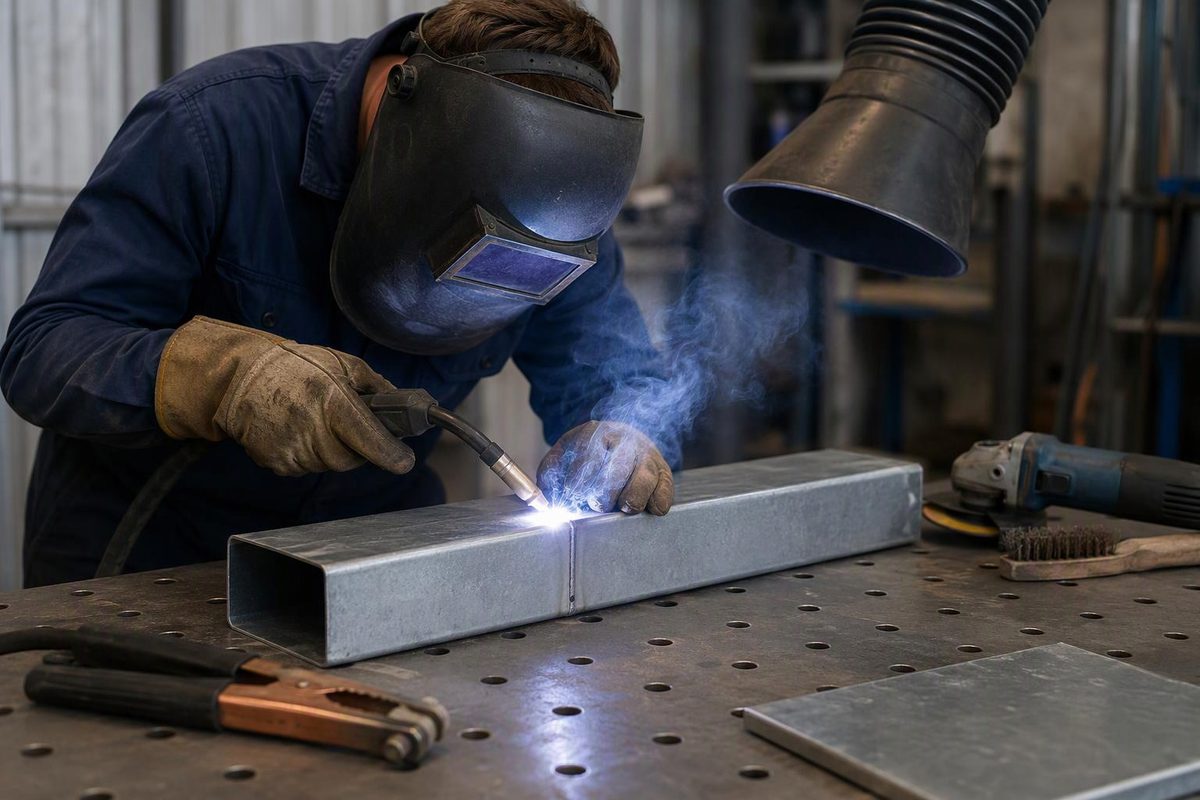
Yes. Galvanised (galvanized) steel can be welded, but the zinc coating changes the fume hazard and can affect weld quality.
The preferred sequence is to identify the coating, remove zinc from the weld zone, control the fume, weld the exposed steel using a suitable procedure, inspect the joint and restore its corrosion protection. Coating removal does not replace ventilation, and ventilation does not correct a contaminated joint.
Why zinc changes the job
Arc heat vaporises zinc near the weld. The vapour oxidises and becomes airborne zinc oxide fume. OSHA identifies galvanised steel as a source of zinc oxide and says zinc exposure is the usual cause of metal fume fever. Symptoms can include fever, nausea and coughing (OSHA guidance). The NIOSH Pocket Guide for zinc oxide also lists chills, muscle aches, metallic taste, chest tightness and breathing difficulty.
Zinc can also vaporise at the joint and become trapped as the weld solidifies, causing porosity. The risk varies with coating thickness and joint design: gases escape less readily from lap joints, tee joints and thick butt joints (Galvanizers Association of Australia). Other practical signs of zinc remaining near the pool include heavy white fume and increased spatter.
A smooth surface does not prove that a weld is internally sound. Structural, pressure-retaining and other critical work must follow the applicable welding procedure specification (WPS), inspection plan and acceptance criteria.
Prepare the joint before changing settings
First confirm the coating. A silver-grey surface alone does not prove that a part is galvanised; plated, painted and cadmium-coated metals can present different hazards. Check drawings, purchasing records, labels or supplier information before applying heat.
For hot-dip galvanised work, the preferred method is to grind the zinc from both sides of the joint and any faying surfaces that the weld will enclose. The American Galvanizers Association gives a general removal distance of 1–4 inches (25–100 mm) on each side of the intended weld zone and on both sides of the workpiece (AGA welding guidance). The exact preparation still comes from the approved procedure and joint design; specialised procedures may permit welding through a coating.
Remove grinding dust, oil and loose debris after exposing bare steel. Grinding creates airborne dust and can thin or gouge the base material, so use suitable extraction plus the eye, face, hearing and respiratory protection selected by the risk assessment.
Lap, plug and tee joints need particular attention because zinc can remain hidden between sheets. Clean the faying surfaces where the procedure permits, and reproduce the specified fit-up. Do not add a gap or drill vent holes in a structural part unless the design or approved procedure calls for them.
Control fume at its source
Use local exhaust ventilation close enough to capture the plume without pulling away shielding gas. Keep your head out of the plume and direct contaminated air away from other workers. Welding outdoors or in an open shop does not by itself guarantee adequate ventilation, and respiratory protection may be needed when engineering controls and work practices cannot keep exposure at safe levels (OSHA welding-fume fact sheet).
For US general-industry workplaces, OSHA specifically requires local exhaust for indoor welding or cutting involving zinc-coated materials; confined-space work is subject to additional ventilation and rescue provisions (29 CFR 1910.252). Other jurisdictions may impose different or additional requirements.
A respirator is not a mask chosen by guesswork. Where workplace respirator use is required, OSHA requires a written program covering selection, medical evaluation, fit testing, use and training (29 CFR 1910.134). Never begin confined-space welding without the applicable entry assessment, ventilation, monitoring and rescue arrangements.
If a worker develops dizziness, nausea or respiratory irritation during welding, stop the exposure, move to fresh air and obtain medical attention. Chest tightness or breathing difficulty warrants prompt medical evaluation. Milk and other jobsite remedies do not control inhalation exposure.
Set the machine for the exposed steel
Once the joint is bare, choose the process and filler for the base-steel grade, thickness, joint, position and required properties. Galvanised steel does not automatically need a special “galvanised” filler.
GMAW/MIG is productive on sheet and shop fabrication. SMAW/stick and suitable flux-cored processes may fit thicker or outdoor work. GTAW/TIG can offer close control but requires thoroughly cleaned material. Process suitability still depends on the drawing, consumable classification, equipment and WPS.
Start with the machine or consumable manufacturer’s data for clean carbon steel of the same thickness. Then test on a representative coupon that duplicates the coating, cleaning width, joint, position and backing. On thin material, control heat and sequence to avoid distortion and burn-through. The starting points in this guide to welding 16-gauge sheet are examples, not a qualified procedure.
Do not try to cure zinc contamination simply by increasing voltage, wire feed or current. More heat may burn away additional coating and generate more fume without fixing poor preparation.
Diagnose porosity or an unstable weld in order
- Stop if fume control is ineffective. Correct extraction, airflow or respiratory protection before troubleshooting the bead.
- Look for zinc at the joint. Check both faces, bevels, root openings and overlapping surfaces. Remove residual coating where the procedure permits.
- Remove ordinary contamination. Eliminate oil, paint, moisture, grinding residue and rust.
- Verify the process setup. Confirm consumable, polarity, shielding-gas type and flow, nozzle condition, contact-tip-to-work distance or arc length, and clean work-lead contact. Clamp to bare metal as described in this work-clamp guide.
- Check fit-up and technique. Compare the gap, root opening, work angle and travel angle with the WPS or approved setup.
- Tune one parameter at a time. Make changes on a representative coupon and remain within the permitted procedure or manufacturer range.
- Inspect to the governing criteria. Visible pinholes, undercut and incomplete fusion require evaluation, but a tidy bead can still contain subsurface porosity.
Restore corrosion protection
Welding removes zinc from the joint and can damage the coating next to it. After the weld passes its required inspection, remove slag and spatter, clean to sound metal and prepare the coating edge as specified by the repair system.
For hot-dip galvanised products, ASTM A780/A780M-20 describes three repair material types: zinc-based solder, zinc-rich paint and sprayed zinc. It also says the contracting parties must agree on the repair method and acceptable repair extent, and the repair must achieve the specified coating thickness (ASTM A780/A780M-20 scope). Follow the project specification and repair-product data sheet for surface preparation, application conditions, film thickness and inspection.