
Match Your Welder Outlet to the Machine—not Just the Plug
Choose a 220V welder outlet by input voltage, plug type and manual requirements. Understand 6-50R, dryer adapters, breaker sizing and grounding.
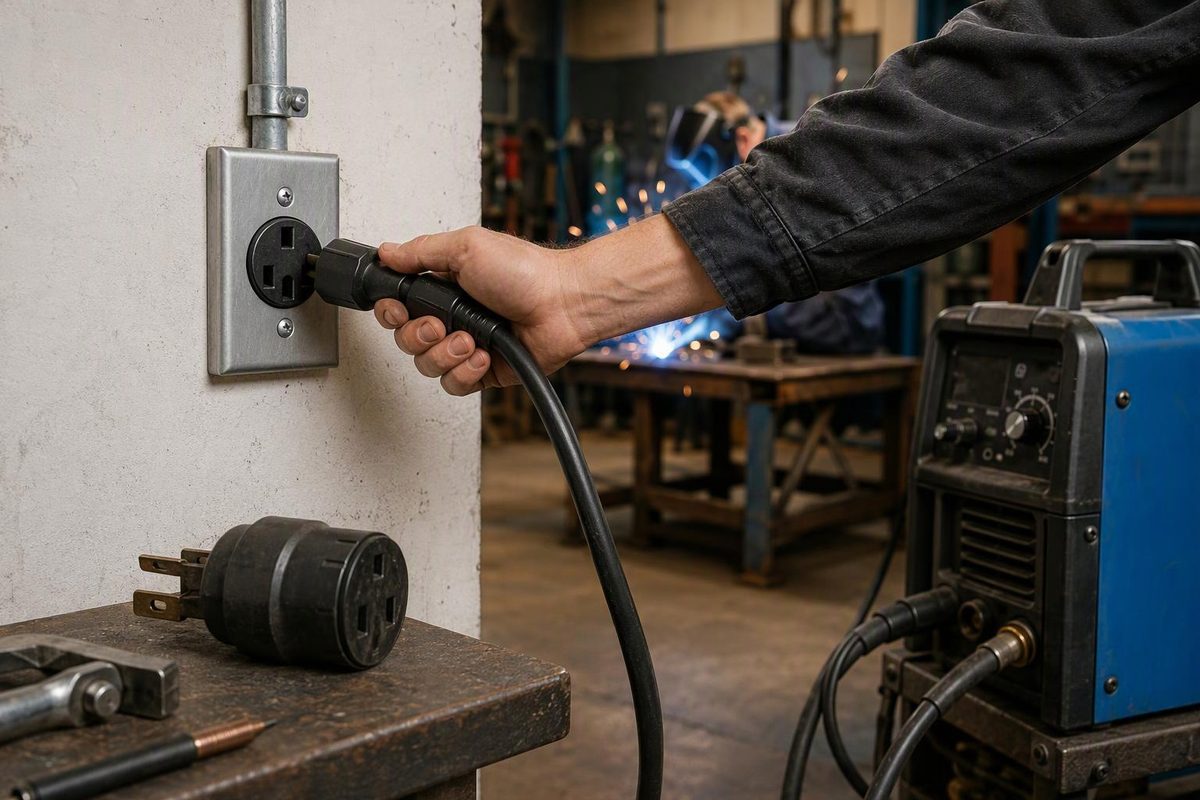
A NEMA 6-50R is a common 240V welder receptacle, but it is not the right answer for every machine—and its 50A rating does not automatically mean you need a 50A breaker. Match the outlet to the welder’s input specifications, factory plug and electrical-service instructions. Miller explicitly warns against sizing branch-circuit protection from the plug rating in its Millermatic 211 PRO manual.
This guide covers U.S. single-phase installations. Use it to identify what you need and brief an electrician, not as instructions for working inside a panel.
Start with input power, not welding amperage
“220V welder outlet” is commonly used shorthand for a 240V supply. A welder may instead be labeled 230V or list several acceptable input voltages. Do not assume compatibility from that shorthand: check the nameplate and the manual’s permitted voltage range, phase and frequency—especially if your shop supply is 208V.
Record these details before buying a receptacle:
- Exact model and serial number: use the matching manual.
- Input voltage, phase and frequency: these describe the supply the machine needs.
- Input current: look for input amperes,
I1maxand, where listed,I1eff. - Recommended circuit protection: include the specified fuse or breaker characteristics.
- Factory plug designation: identify its NEMA marking rather than guessing from the number of blades.
Welding-output amperage is not branch-circuit amperage. For example, the April 2026 Millermatic 211 PRO manual, Sections 3–4, lists 180A welding output at 40% duty cycle on 240V, while its electrical-service table lists 28.9A maximum supply current and 14.6A effective supply current. Those are different ratings serving different purposes.
Which outlet matches the welder?
In NEMA designations, P means plug; R means receptacle. Miller’s manual pairs its 6-50P plug with a 6-50R receptacle.
| Receptacle | Connections and rating | Practical consequence |
|---|---|---|
| NEMA 6-50R | Two hot conductors and equipment ground; 50A, 250V | No neutral. Physically matches a 6-50P plug; the circuit still needs verification. |
| NEMA 14-50R | Two hot conductors, neutral and equipment ground; 50A, 125/250V | Different configuration; a 6-50P does not plug directly into it. |
| NEMA 10-30R | Older non-grounding three-wire configuration; 30A, 125/250V | Not equivalent to a grounded three-wire 6-50R. |
These configurations are documented in Leviton’s specifications for the 6-50R, 14-50R and 10-30R.
Three openings do not necessarily mean two hots and a safety ground. Identify the configuration before considering an existing dryer or shop outlet.
What breaker and wire size do you need?
There is no responsible universal “220V welder = this breaker and this wire gauge” rule.
Arc-welder circuit sizing can account for duty cycle because the machine does not necessarily draw its welding-load current continuously. Miller’s electrical-service guide references NEC Articles 630.11 and 630.12 and explains that certain individual welder circuits can have conductor or receptacle ratings below the circuit-protection rating. That is a specific welder-circuit provision, not permission to oversize a breaker on ordinary wiring. See Section 4-3 of the manual.
For that same 211 PRO, Miller lists maximum recommended fuse ratings of 35A time-delay or 40A normal-operating, despite its 50A plug. If a breaker replaces the fuse, Miller specifies comparable time-current characteristics. Do not transfer those values to another welder.
Have the electrician coordinate:
- The machine’s service table and the locally adopted electrical code.
- Conductor material, insulation, wiring method, temperature and circuit length.
- Voltage drop and receptacle terminal acceptance.
- Panel capacity, circuit protection and equipment grounding.
Terminal compatibility matters: the Leviton 5374 receptacle, for example, accepts #4–#8 AWG conductors. A calculated minimum conductor size is not automatically compatible with every receptacle.
Can you use a dryer outlet or adapter?
Only consider an adapter after an electrician has verified the existing circuit’s voltage, current capacity, grounding and compatibility with the welder’s instructions. An adapter changes the connection; it does not upgrade the circuit.
A grounded four-wire outlet and an older non-grounding dryer outlet are different situations. A non-grounding 10-30R does not provide the equipment-ground connection a 6-50P-equipped welder needs. Do not improvise a neutral-to-ground connection or remove the welder’s grounding pin to make a plug fit. Lincoln warns that adapters which eliminate the grounding connection remove its safety benefit in its grounding and arc-welding safety guidance.
The welding work clamp is also not a substitute for the supply equipment ground. It completes the welding-output circuit; the equipment-grounding connection serves a separate protective function.
For a longer reach, use the machine’s cord requirements and our welder extension-cord selection guide, not an adapter chain.
Check protection requirements before installation
Do not assume a 240V welder outlet is exempt from GFCI protection. The 2020 NEC expanded dwelling-unit requirements to include 125–250V receptacles in garages and other specified locations when supplied by single-phase branch circuits rated 150V or less to ground, as summarized by IAEI. Your jurisdiction’s adopted edition and amendments determine the installation requirements.
Give the electrician the nameplate photo, serial-matched manual, plug designation, proposed outlet location and circuit-run length. Ask for a circuit suitable for that machine’s intended output and duty cycle. If an existing outlet is loose, discolored or damaged, or its circuit trips repeatedly, stop using it until the circuit and equipment have been checked—do not treat a larger breaker as the fix.