
Choose Welding Respirators by Hazard, Fit and Protection Factor
Compare half-mask welding respirators and PAPRs, understand P100 filter limits, and check fit, ventilation and workplace respiratory-protection requirements.
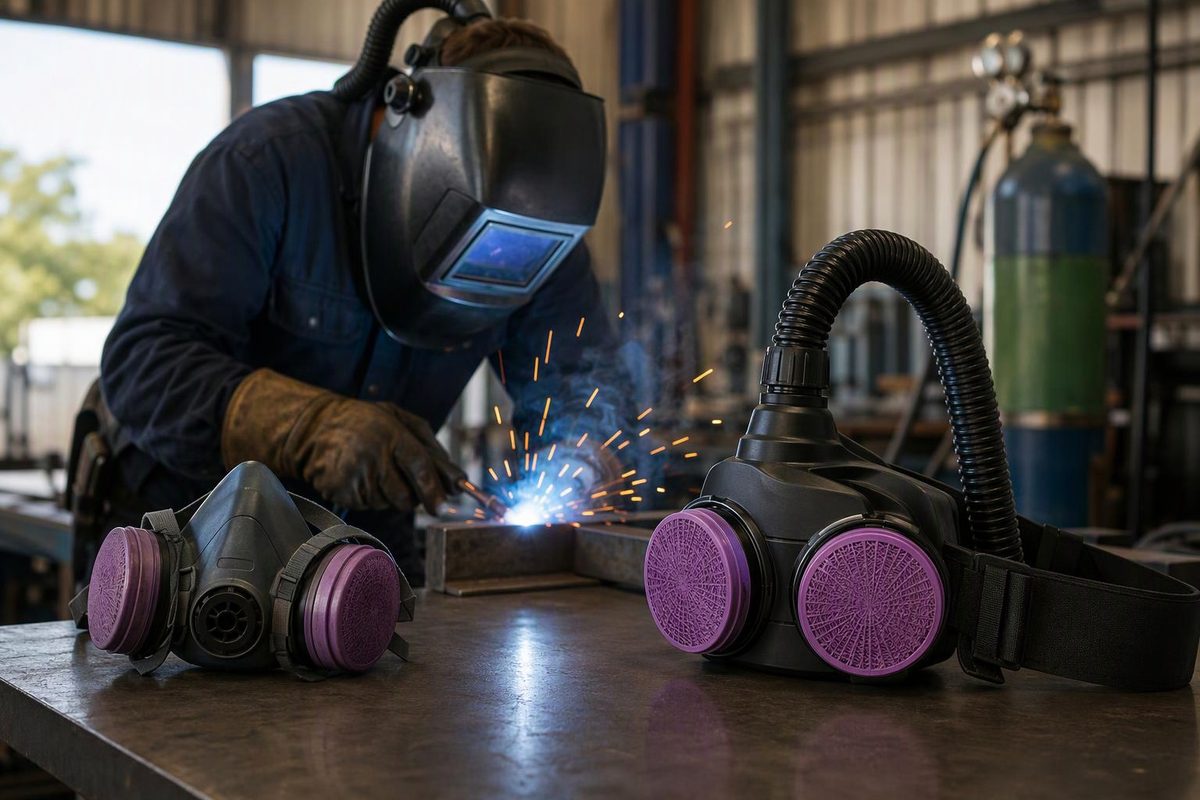
A welding respirator must match the contaminants, their concentrations and the wearer—not just fit underneath a helmet. A reusable half mask with P100 filters can be suitable for particulate welding fume when the exposure assessment supports its protection level. A powered air-purifying respirator (PAPR) may offer a higher protection factor and a loose-fitting helmet option, but it still filters surrounding air; it does not supply oxygen.
The workplace requirements below use U.S. OSHA rules. Respirator selection starts with an exposure assessment, not a product ranking.
Identify the hazard before choosing a filter
Welding fume and welding gases are different problems. A particulate filter captures airborne particles, including metal fume. It does not, by itself, provide protection against gases or vapors. OSHA requires respirators appropriate to each contaminant’s chemical state and physical form, with gas/vapor cartridges selected for the specific hazard or an appropriate atmosphere-supplying respirator. OSHA respiratory-protection standard
Before buying, identify:
- Base metal and filler: Stainless welding can generate hexavalent chromium; other materials and consumables introduce different metal hazards.
- Coatings and residues: Paint, coatings and solvent residue can introduce additional toxic exposures. Their removal also needs appropriate controls.
- Process and workload: Process, arc-on time, work position and nearby welding affect exposure.
- Work area: Air movement, extraction and enclosure change what reaches the breathing zone. Outdoor welding does not guarantee adequate ventilation.
OSHA’s welding-fume fact sheet identifies exposure factors and warns that shielding gases such as argon and helium can displace oxygen, particularly in confined or enclosed spaces.
Have the employer’s respiratory-program administrator or an industrial hygienist evaluate the task using material information and representative exposure data. OSHA requires identification of the hazards and a reasonable estimate of employee exposure; where exposure cannot be identified or reasonably estimated, the atmosphere must be treated as immediately dangerous to life or health (IDLH). OSHA selection requirements
Control the plume before relying on a respirator
Local exhaust removes contamination near the source rather than waiting for it to reach your face. Position the extraction hood or nozzle close to the plume source and arrange airflow to draw contaminants away from your breathing zone and other workers. Keep your head out of the plume where the joint and working position allow. OSHA welding-fume controls
Respirators supplement these controls when they cannot reduce exposure sufficiently, while controls are being installed, or when otherwise required. They are not a reason to ignore failed extraction. OSHA places feasible engineering controls ahead of respiratory protection. OSHA 1910.134
Half mask versus welding PAPR
The important comparison is the assigned protection factor (APF) of the complete respirator—not the filter’s efficiency percentage. APF describes the workplace protection a respirator is expected to provide within an effective respiratory-protection program.
| Choice | Practical consideration | U.S. OSHA APF |
|---|---|---|
| Nonpowered, tight-fitting half mask | Compact option if it fits beneath the helmet without disturbing its face seal; requires fit testing for required use | 10 |
| Loose-fitting PAPR facepiece | Blower delivers filtered ambient air; requires battery, airflow and filter management | 25 |
| PAPR helmet or hood | Protection depends on the exact assembly and supporting manufacturer evidence | 25, or 1,000 with qualifying evidence |
OSHA assigns helmet/hood PAPRs an APF of 25 unless the employer has manufacturer-provided testing evidence supporting protection at 1,000 or greater. Do not assume every powered welding helmet has the higher rating. OSHA APF table and notes
The program administrator uses the APF and the contaminant’s exposure limit to determine the maximum use concentration, subject to any lower IDLH or cartridge-performance limit. A higher APF does not make an unsuitable filter acceptable. OSHA maximum use concentration requirements
Choose a half mask when its APF and filters meet the assessed hazards and it passes the wearer’s fit test with compatible PPE. Consider a PAPR when a suitable configuration provides the required protection or improves the practicality of sustained wear. Check the complete system’s NIOSH approval, head covering, filters and operating instructions. Miller’s respiratory guidance distinguishes compact half masks, blower-fed PAPRs and supplied-air systems; OSHA requires NIOSH-certified respirators used within their certification conditions.
Loose-fitting helmets and hoods generally do not require fit testing; tight-fitting PAPRs do. “Powered” alone does not make a tight facepiece beard-compatible: OSHA prohibits facial hair between the face and sealing surface or interfering with valve function. For a loose-fitting system, follow the manufacturer’s limits on facial hair and the head covering’s fit. OSHA fit and seal requirements; Miller respiratory guidance
What P100 does—and does not—mean
P100 is a particulate-filter designation, not an all-hazards welding rating. For example, Miller’s LPR-100 Gen. II specification lists P100 filtration at 99.97% for oil-based and non-oil-based particles and aerosols, while the complete half-mask respirator has an APF of 10. That distinction matters: 99.97% filter efficiency does not mean 99.97% reduction in the wearer’s exposure. Face-seal leakage and the complete respirator’s performance also matter. Miller LPR-100 specification
Likewise, “nuisance organic vapor relief” is not permission to work above vapor exposure limits. Miller limits those optional filters to organic-vapor concentrations not exceeding OSHA’s permissible exposure limits or other applicable government occupational limits, whichever is lower. For air-purifying gas/vapor protection, OSHA requires appropriate equipment with a NIOSH-certified end-of-service-life indicator for the contaminant or a data-based cartridge-change schedule—not simply waiting for an odor. Miller filter limits; OSHA cartridge requirements
Check fit and condition before striking an arc
For required workplace use, OSHA requires a written respiratory-protection program, medical evaluation before fit testing or required use, training and maintenance. Tight-fitting respirators need fit testing before initial use, when the facepiece changes, and at least annually; physical changes affecting fit also trigger retesting. A user seal check each time you put it on does not replace the fit test. OSHA program and fit requirements
Before use:
- Inspect the facepiece, straps, valves, filters and connections; include the breathing tube on powered systems.
- Keep facial hair clear of a tight-fitting seal and valve function.
- Check that glasses and the lowered welding helmet do not interfere with the seal. Helmet shade and arc detection remain separate checks; see auto-darkening helmet selection and checks.
- For a PAPR, follow its prescribed airflow check, battery check and alarm procedures.
- Follow the manufacturer’s cleaning, filter-replacement and storage instructions. Use only approved components for that respirator.
OSHA specifies pre-use inspections, seal protection and approved repair parts; Miller’s respiratory-system brochure describes battery and restricted-airflow alarms on its PAPR systems. OSHA use and maintenance requirements
If breathing resistance changes, the facepiece leaks or gas/vapor breakthrough occurs, leave the exposure area before adjusting or replacing equipment. Defective equipment must be repaired or replaced before returning. OSHA continuing-effectiveness requirements
Voluntary workplace use of a reusable half mask or PAPR still requires applicable written-program provisions for medical ability, cleaning, storage and maintenance, plus OSHA Appendix D information. The exception from those written-program provisions applies when an employee’s only respirator use is voluntary use of filtering facepieces—not reusable half masks. OSHA voluntary-use requirements
When neither a half mask nor a PAPR is suitable
Do not use an air-purifying welding respirator to address oxygen deficiency or an IDLH atmosphere. OSHA defines oxygen deficiency as below 19.5% oxygen and specifies particular atmosphere-supplying configurations for IDLH entry, along with standby and rescue provisions. An ordinary supplied-air welding helmet is not automatically suitable either. OSHA IDLH requirements
For tank, vessel or other confined-space work, stop the ordinary equipment-selection process and obtain the applicable entry assessment and controls. Supplied air requires a verified breathing-air system meeting applicable quality requirements—not an improvised connection to shop compressed air. OSHA welding-space guidance; OSHA breathing-air requirements