
The Safety Program a Handheld Laser Welder Requires
Class 4 handheld laser welding calls for an LSO, controlled area, rated eyewear, training, written procedures, and a site-specific hazard assessment.
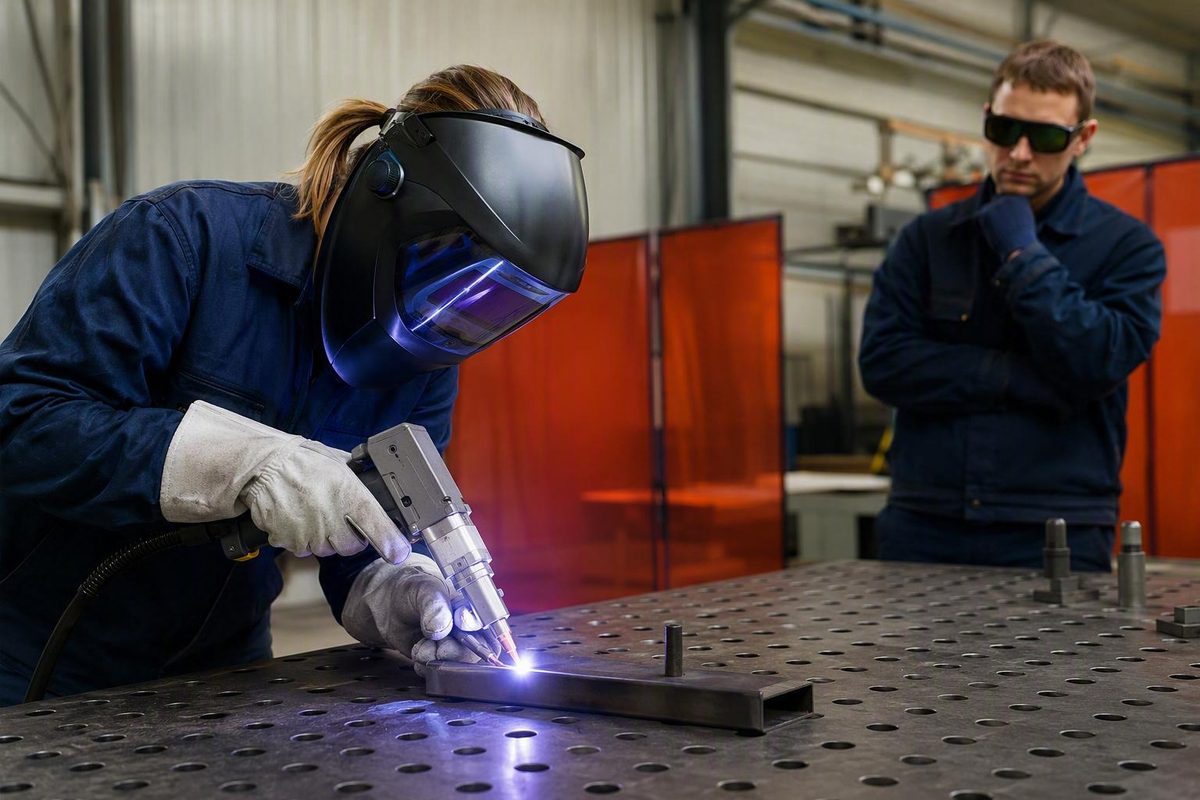
Yes. If a handheld laser welder exposes Class 3B or Class 4 radiation—as a typical Class 4 handheld fiber laser welder does—appoint a qualified Laser Safety Officer before operation. Even one machine in a small shop needs an LSO-led program with a controlled area, laser-rated containment, wavelength-specific eyewear, written procedures, training, and documented hazard assessments.
The American Welding Society (AWS) characterizes handheld laser welding equipment as high-power Class 4 laser equipment. Its guidance says an organization operating Class 3B or Class 4 lasers must appoint a qualified LSO; a sole operator must appoint one or be trained to serve in that capacity. AWS also calls for a documented safety program and controlled area at every point of use. Read the AWS handheld laser welding guidance.
A fully enclosed installation evaluated as Class 1 during normal operation can change the answer. A curtain, contact nozzle, perimeter switch, or interlock does not establish Class 1 status by itself. The classification must apply to the complete installed system and its actual operating conditions. Maintenance and service that expose a higher-class beam require a separate assessment.
Set the machine condition and mark each safeguard; the result identifies unresolved commissioning work.
Choose the installed condition, then mark each program element Ready, Missing, or Unsure. “Ready” means it is documented and verified for this machine and location.
Default review: every item below is unresolved until the shop verifies it. JavaScript only adds counting and filtering.
| Area | Evidence Required Before Use | Status |
|---|---|---|
| LSO | Critical: A qualified LSO is appointed in writing with responsibility, resources, and stop-work authority. | |
| Machine Data | Critical: Label and machine-specific documents establish class, wavelength, output, modes, accessories, and service restrictions. | |
| Beam Assessment | Critical: Direct, reflected, diffuse, and scattered paths have been assessed for the actual parts, fixtures, settings, and faults. | |
| Non-Beam Hazards | Electrical, fire, hot metal, fumes, gases, coatings, residue, and unexpected startup are covered by a written assessment. | |
| Controlled Area | Critical: The boundary is defined for every expected handpiece angle and prevents hazardous radiation from reaching occupied space. | |
| Containment | Critical: Enclosures, barriers, windows, beam stops, entrances, and penetrations are rated and approved for this laser. | |
| Access Control | Keys, doors, interlocks, warning indicators, signs, visitors, contractors, and foreseeable entry are controlled. | |
| Laser Eyewear | Critical: Wavelength coverage and required optical density come from machine data and the hazard assessment—not lens color or shade number. | |
| Other PPE | Suitable helmet protection, flame-resistant clothing, heat-resistant gloves, footwear, and task-specific PPE are specified. | |
| Procedures | Critical: Written steps cover inspection, setup, startup, test firing, welding, pauses, shutdown, faults, movement, and emergencies. | |
| Training | Critical: Operators and affected personnel receive machine-, task-, and role-specific laser safety instruction. | |
| Authorization | Approved operators, modes, locations, access conditions, and triggers for authorization review are documented. | |
| Ventilation | Source capture or other controls are approved for the base metal, coatings, filler, residue, and operating conditions. | |
| Service Work | Cleaning, troubleshooting, panel opening, interlock bypass, maintenance, and outside service have separate authorization and controls. | |
| Inspections | Pre-use and periodic checks cover barriers, gaps, reflective objects, interlocks, warnings, PPE, ventilation, and corrective action. | |
| Incident Plan | Suspected exposure, injury, fire, malfunction, isolation, reporting, investigation, medical response, and restart approval are addressed. |
- First action: appoint a qualified LSO and stop commissioning until machine data and containment are verified.
Sources: AWS handheld laser welding safety guidance; ANSI Z136.1 program elements summarized by LIA; OSHA laser-hazard and PPE materials. No universal eyewear optical-density value is supplied because it must be calculated or specified for the machine and exposure.
ANSI Expectations And OSHA Duties Are Not Identical
ANSI Z136.1 is the main consensus framework for industrial laser-safety programs. The Laser Institute of America (LIA) describes it as the foundation for programs involving Class 3B and Class 4 systems, including industrial laser welding. It covers classification, LSO duties, protective housings, procedures, PPE, signs, labels, training, beam hazards, and non-beam hazards. See LIA’s ANSI Z136.1 summary.
ANSI standards are voluntary consensus standards, not federal OSHA regulations merely because ANSI published them. OSHA’s laser materials do not state a universal federal rule requiring every employer with a handheld laser welder to use the exact title “Laser Safety Officer.”
OSHA nevertheless recognizes laser radiation as an eye and skin hazard. Its materials identify 29 CFR 1910.132 for PPE and 29 CFR 1910.133 for eye and face protection, list ANSI laser standards as guidance, and explain that OSHA-approved State Plans may impose different or more stringent requirements. Review OSHA’s laser standards page.
That distinction does not make LSO oversight optional for an ordinary open Class 4 operation. It means the standards-based requirement and the route to legal enforcement are separate questions. Federal OSHA requirements, a State Plan, state laser-control rules, fire and building requirements, manufacturer instructions, insurer conditions, contracts, and facility policies may all apply.
For an accessible Class 4 handheld welder, the defensible operating decision is to appoint an LSO and implement the controls expected by ANSI Z136.1 and AWS guidance. Confirm legal requirements with the applicable regulator or authority having jurisdiction and a qualified laser-safety professional.
Handheld Operation Creates Accessible Beam And Reflection Hazards
A handheld laser welder concentrates light energy into a small spot while the operator moves the processing head around the work. Unlike a permanently enclosed automated cell, the beam direction, workpiece angle, fixture geometry, and surrounding surfaces can change between welds. An industry overview describes how handheld laser welding fits into fabrication shops.
The direct beam is only one exposure path. The beam can strike a workpiece, clamp, table, tool, backing surface, curved part, or polished surface and reflect or scatter in an unintended direction. Open seams, holes, fixture gaps, and spaces beneath barriers can create additional paths.
Helpers, supervisors, maintenance employees, contractors, cleaners, visitors, and workers beyond the immediate station may be exposed if radiation escapes the controlled area. OSHA describes laser light as intense and highly directional and says the eye is almost always more vulnerable than the skin. OSHA summarizes laser hazards and biological effects.
Laser radiation may be visible or invisible. Visible process light does not define the hazard boundary, so reaction time and ordinary welding experience are not controls.
The assessment must also cover electrical energy, fire, hot metal, airborne contaminants, shielding gases, and unexpected startup. Coatings, filler, base metal, and surface residue affect ventilation needs. Setup, troubleshooting, cleaning, maintenance, and service can present different hazards from production welding.
Verify The Complete Installation Before Deciding Its Class
Start with the certification label and machine-specific manual. Record the laser class, wavelength or wavelength range, maximum output, operating modes, required eyewear, safety accessories, interlocks, key control, emission indicator, emergency controls, and maintenance restrictions.
Do not copy those values from a reseller’s generic page or another model in the same product family. Resolve conflicts among the physical label, manual, technical file, and sales literature with the manufacturer.
Next, assess accessible radiation in the installed configuration. Follow the intended beam through the workpiece, then examine reflections from smooth, curved, angled, and irregular surfaces. Check barriers, penetrations, entrances, windows, aisles, mezzanines, occupied workstations, and spaces above and below the station.
LIA’s risk-based guidance says an LSO is likely needed when Class 3B or Class 4 lasers are used, beam paths are open or accessible, or engineering controls do not eliminate potential exposure. A genuinely enclosed Class 1 product may have different routine-use requirements. See LIA’s guidance on when an LSO is needed.
Use these outcomes:
| Installed Condition | Operating Decision |
|---|---|
| Accessible Class 3B or Class 4 radiation | Appoint a qualified LSO before operation |
| Complete installation evaluated as Class 1 | Routine requirements may differ; assign safety responsibility |
| Enclosed production but hazardous service access | Assess service separately under higher-class controls |
| Class, wavelength, or containment uncertain | Stop commissioning and obtain machine-specific evidence |
Class 1 status must cover the assembled configuration, not just the source or handpiece. Confirm which panels, barriers, windows, doors, cable routes, and interlocks are part of that classification. Determine whether changing any of them invalidates it.
The LSO Needs Competence And Stop-Work Authority
Laser Safety Officer is an assigned function, not necessarily a new full-time job. The owner, a manager, an EHS professional, an engineer, a welding supervisor, a trained operator, or an external consultant may fill the role if that person is competent for the installation and has real authority.
Professional LSO certification is not established by the cited evidence as universally mandatory. Designation, training, course completion, and professional certification are different. A course certificate alone does not prove that someone can analyze a particular machine, define its controlled area, specify optical protection, or approve commissioning.
The LSO must be able to understand classifications, wavelengths, biological effects, direct and reflected radiation, engineering controls, procedures, PPE, and the machine’s actual workflow. The person also needs to recognize when barrier calculations, optical-density selection, exposure boundaries, or service hazards require outside expertise.
Document the appointment. Identify the equipment and locations covered, responsibilities, reporting line, relevant training, technical support, and authority to restrict access or stop work. If an internal coordinator and outside consultant divide the duties, state who approves each control and who is available during operation.
Management retains responsibility after appointing an LSO. The role cannot function without time, resources, access to decision-makers, and authority to halt production.
The LSO Must Build And Administer The Program
The first task is a site-specific assessment of direct, reflected, diffuse, and scattered radiation. It must account for intended work, foreseeable mispositioning, dropped or shifted parts, openings in the workpiece, fixture changes, barrier gaps, faults, and maintenance conditions.
The LSO then defines the laser-controlled area. AWS calls for a controlled area at every Class 3B or Class 4 point of use, restricted access, and specified protection for people inside it. The boundary must contain hazardous radiation throughout the expected range of handpiece and workpiece positions.
Depending on the assessment, approved controls can include protective housings, light-tight enclosures, laser-rated barriers, controlled entrances, interlocks, beam stops, warning systems, signs, key control, emission indicators, and fixtures that limit orientation. A conventional arc-welding curtain must not be assumed to provide laser containment.
Written procedures need to cover pre-use inspection, area setup, key custody, workholding, startup, test firing, normal welding, pauses, shutdown, movement to another location, alarms, interlock trips, cleaning, maintenance, outside service, emergencies, and suspected exposure. Procedures should name stop conditions rather than leaving operators to improvise after a barrier moves or warning system fails.
Training must be specific to the machine and task. Operators need to demonstrate that they can inspect safeguards, establish the area, select the prescribed PPE, recognize abnormal conditions, shut the unit down, and report an incident. Supervisors, observers, maintenance staff, cleaners, contractors, and nearby workers need instruction proportionate to their potential exposure.
Program records should include the LSO appointment, laser inventory, equipment documents, hazard assessments, controlled-area approval, procedure revisions, training, operator authorization, PPE specifications, inspections, service work, incidents, corrective actions, and reassessments after changes.
Containment Comes Before Laser Eyewear
An LSO designation letter cannot replace physical controls. For accessible Class 4 work, establish containment that keeps hazardous radiation from reaching unprotected people. That may require a light-tight room or enclosure, laser-rated rigid panels, controlled entrances, interlocks, warning lights, beam stops, and a documented inspection before use.
Handheld operation requires scrutiny of polished and curved parts, fixture faces, cutouts, tabletops, walls, ceilings, doors, windows, and routes toward occupied areas. Moving the welder to another bay changes the assessment; portable equipment does not make the controlled area portable without review.
Laser eyewear must match the actual wavelength or wavelength range and the optical density required by the hazard assessment. “Laser glasses,” lens color, tint, and an arc-welding shade number are not adequate specifications. The draft evidence provides no universal optical-density value because selection depends on the machine and exposure calculation.
Inspect lenses and frames, control storage, and prohibit unauthorized substitutions. Operators may also require a suitable laser-welding helmet. Standard arc helmets and general-purpose safety glasses are not automatically laser protection.
Laser PPE does not replace ordinary welding PPE. AWS guidance also identifies heat-resistant gloves and flame-resistant clothing. Ventilation, fire protection, electrical inspection, gas handling, hot-part controls, and protection against unexpected startup remain necessary.
Commissioning Stops When Critical Information Is Missing
Do not operate when the laser class, wavelength, required optical protection, or containment performance is unresolved. The same stop applies when barriers have gaps, access is uncontrolled, an interlock or warning system fails, PPE is damaged, ventilation is unavailable, or an unexpected reflection appears.
Reassess the installation after changes to software or settings, material, coating, fixture, part geometry, enclosure, room, staffing, procedure, or service state. Opening a panel or bypassing an interlock can expose a hazard that was inaccessible during normal production.
A one-person shop does not remove the need for this work. AWS says a sole operator using a Class 3B or Class 4 laser must appoint a qualified LSO or be trained to serve in that capacity. That operator must still control access by visitors and contractors, address fire and fume hazards, document procedures, and obtain qualified assistance for decisions beyond their competence.
For the typical accessible Class 4 handheld fiber laser welder, appoint the LSO before commissioning—not after the first weld—and give that person authority over containment, access, procedures, training, PPE, inspections, and restart approval.