
Spend Less Without Buying the Wrong Welder
A $200 machine is not necessarily a $200 setup. Process choice changes spending on gas, consumables and cleanup; a worksheet captures missing gear.
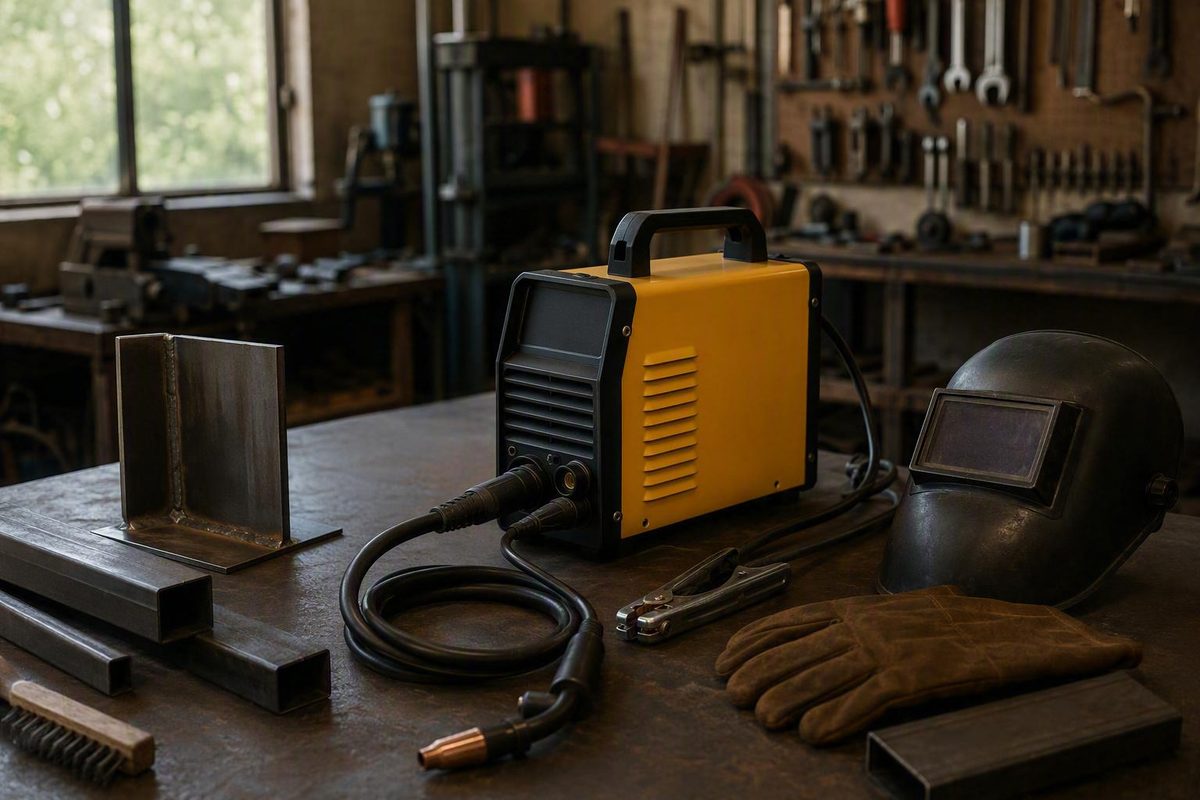
An affordable welding machine is not simply the cheapest box on a retailer’s page. It is the least expensive complete, safe setup that can perform the work you actually intend to do.
A low advertised price can become expensive when the machine lacks the required output, cannot run the appropriate process, is incompatible with the available power, reaches its thermal limit during normal work, or needs accessories that were not included. The better strategy is to define the job first, verify the manufacturer’s specifications and package contents, calculate the complete setup cost, and only then compare current prices.
Product names and prices below are observations from supplied retailer listings, not results from hands-on comparative testing. The listings were not supplied with documented retrieval dates, so all prices, stock labels, shipping offers, rebates, and package details must be rechecked before publication or purchase.
Start With the Job, Not the Sale Price
True affordability includes more than the power source. Your initial budget may also need to cover:
- An appropriate welding helmet
- Welding gloves and fire-resistant clothing
- Wire, electrodes, filler metal, or other consumables
- Contact tips, nozzles, liners, or torch parts
- A shielding-gas cylinder arrangement, regulator or flowmeter, hoses, and gas
- A grinder and other preparation tools
- Clamps and material-handling equipment
- A chipping hammer and wire brush for slag-producing processes
- Ventilation or other fume controls appropriate to the work
- Any electrical work required for the selected machine
- Shipping, service, replacement parts, and possible repairs
This is why a $200 machine is not necessarily a $200 welding setup. A gas-capable MIG welder may still require a cylinder arrangement, regulator or flowmeter, gas, wire, tips, and protective equipment. Stick and self-shielded flux-core avoid an external shielding-gas system, but they bring different consumables, operating characteristics, and cleanup requirements.
There is no single welding process suitable for every application. Material, thickness, work location, input power, finish requirements, and workload all influence the decision. Miller’s first-welder guide likewise recommends selecting the process before the machine and considering material, thickness, available power, amperage, and duty cycle rather than looking for one universal solution. Review Miller’s process-selection guidance.
Use this five-question screen before comparing products:
-
What metal will be welded? Mild steel is a common starting point, but stainless steel and aluminum can change the required process, consumables, gas, controls, and accessories.
-
What are the thinnest and thickest pieces? Thin sheet calls for controllable low-end output.
-
Will the work happen outdoors or in wind? Wind can disturb an external shielding-gas envelope. Self-shielded flux-core and stick are generally better suited to exposed work.
-
Is suitable 120V or 240V power available? A nearby receptacle is not enough by itself. Match the exact machine’s input requirements to an appropriate circuit and follow its manual.
-
How long must the machine weld before cooling? A few tack welds during a weekend project impose different demands from repeated fabrication or maintenance welds.
Also separate beginner friendliness from lowest setup cost. MIG is commonly presented as easier to learn because the machine feeds wire continuously. Stick and self-shielded flux-core can avoid the cost and portability burden of an external gas supply. The easiest process for a beginner and the least expensive process for a particular job may therefore be different.
The objective is not to minimize the checkout price. It is to avoid paying twice—first for an unsuitable machine and then for the machine that should have been purchased originally.
MIG, Flux-Core, Stick, or TIG: Which Process Fits a Tight Budget?
Process selection determines much of the real cost. It affects the machine, accessories, consumables, preparation, cleanup, portability, and learning time.
| Process | Initial equipment considerations | Learning and operation | Outdoor suitability | Cleanup | Typical budget-conscious fit |
|---|---|---|---|---|---|
| Gas-shielded MIG | Machine, gun, wire, tips, nozzles, gas-cylinder arrangement, regulator or flowmeter, and hose | Generally easier for beginners; continuous wire feed supports productive welding | Wind can disrupt the external gas shield | Generally no slag and less post-weld cleanup | Clean indoor fabrication, sheet metal, and garage projects |
| Self-shielded flux-core | Compatible wire-feed machine, flux-cored wire, and matching feed consumables | Accessible to beginners, although settings and technique still matter | Well suited to outdoor or windy work | Slag, spatter, fumes, and additional cleanup | Portable repairs and budgets that cannot support gas equipment |
| Stick | Constant-current machine, leads, holder, work clamp, and electrodes | Requires arc striking, arc-length control, and electrode changes | Well suited to exposed work | Slag must be removed | Maintenance, repair, and thicker or imperfect steel |
| TIG | Suitable power source, torch, shielding gas, tungsten, filler metal, and any required controls | Precise but comparatively slow and harder to master | Wind can disturb the shielding gas | No slag, but preparation and technique are demanding | Precision work where control and finish justify the added cost |
Gas-shielded MIG
MIG uses a continuously fed consumable wire. Once voltage and wire-feed speed are reasonably set, the operator can focus on gun angle, travel speed, arc position, and puddle control instead of repeatedly striking an electrode.
That makes MIG a common beginner choice. It is productive, generally clean, and useful for thinner, clean metal. It is often a sensible first process for indoor garage fabrication, sheet work, brackets, carts, and similar mild-steel projects.
The tradeoff is the gas system. Depending on the package, you may need a compatible cylinder arrangement, shielding gas, a regulator or flowmeter, and a hose. Local purchase, lease, exchange, and refill arrangements can materially affect both initial and continuing cost.
Self-shielded flux-core
Self-shielded flux-core also uses continuously fed wire, but flux in the wire protects the weld without a separate shielding-gas supply. It is consequently attractive for portable repairs, outdoor work, and buyers who want to avoid an external gas system.
That lower equipment burden does not make it universally better. Self-shielded flux-core generally creates slag and more cleanup than gas-shielded MIG. The selected wire must also be compatible with the machine and configured according to the machine and consumable instructions.
For an occasional outdoor repair user, those drawbacks may be an acceptable trade for portability. For clean indoor sheet-metal work where appearance and reduced cleanup matter, gas-shielded MIG may justify its higher setup cost.
Stick
Stick welding uses replaceable flux-coated electrodes and requires no external shielding-gas cylinder. The resulting setup can be portable and practical outdoors or on repair surfaces that are not perfectly clean.
The operator must strike and maintain the arc, account for the shortening electrode, replace consumed rods, and remove slag. Those requirements can make stick harder for a beginner than MIG, particularly on thin material. TWI characterizes MIG as easier for beginners and cleaner on thin metal, while describing stick equipment as generally less expensive and more portable because it does not require an external gas supply. See TWI’s MIG-and-stick comparison.
Stick can be an economical option for maintenance, repair, and work in exposed locations. It should not automatically be called the cheapest choice for every buyer. Electrode selection, input-power requirements, learning time, cleanup, and project suitability still affect total cost.
TIG
TIG offers precise control of heat and filler metal, making it useful where appearance, control, or material requirements justify the process. It is also comparatively slow and demanding to learn.
A practical TIG setup may require a torch, shielding-gas equipment, tungsten electrodes, filler rods, and controls or accessories specified for the machine. The exact requirements depend on the power source, arc-start method, current type, and intended material.
Confirm how the arc starts, what current and controls are available, what the package contains, and whether the manufacturer documents compatibility with the intended material.
No process is always cheapest. Stick may minimize the equipment burden for one outdoor repair user; self-shielded flux-core may suit another; and MIG may save enough time and cleanup to be more economical for clean indoor fabrication.
Match the Machine to Material, Thickness, and Work Location
Do not choose an affordable welding machine from peak amperage alone. Start with a representative project and work backward to the necessary process, output range, input voltage, consumable, and duty cycle.
Project-based selector
| Intended work | Priorities | Processes to investigate first |
|---|---|---|
| Clean indoor sheet metal | Stable arc, controllable low-end output, suitable consumable size, reliable feeding, limited cleanup | Gas-shielded MIG; TIG where precision justifies the cost |
| General garage fabrication | Versatility across common mild-steel thicknesses, accessible consumables, reasonable portability | MIG or a wire-feed machine supporting MIG and flux-core |
| Outdoor repairs | No dependence on an exposed external gas shield, useful portability, practical leads | Self-shielded flux-core or stick |
| Rusty or imperfect repair steel | Appropriate preparation, suitable consumables, and greater tolerance of imperfect surfaces | Stick or flux-core |
| Thicker steel | Documented capacity at the available input voltage, suitable joint preparation, multiple-pass capability, and adequate duty cycle | Stick, suitable flux-core, or a properly rated MIG setup |
For thin, clean indoor work, maximum amperage is often less important than low-end control. A machine may advertise a large peak number yet still be unsuitable if it cannot provide stable, controllable output on the intended sheet thickness.
For outdoor or windy work, investigate self-shielded flux-core or stick first. Neither depends on a separately supplied external gas envelope around the arc. Gas-shielded MIG may still be practical where the work area can be protected appropriately, but it should not be selected for exposed work without considering the shielding requirement.
Stick and flux-core are generally described as more forgiving than gas-shielded MIG on imperfect repair surfaces. “More forgiving” does not mean preparation can be ignored. Follow the relevant machine, consumable, material, and coating instructions before welding.
Treat 1/4-inch steel as a verification case
Questions about whether an inexpensive welder can handle 1/4-inch steel are common, but a generic amperage rule cannot answer them reliably.
Before buying, verify:
- The manufacturer’s rated material capacity
- Whether that rating applies on 120V or 240V input
- The process used for the rating
- The required wire or electrode type and diameter
- The joint type and fit-up
- Any specified bevel, root opening, or other preparation
- Whether the rating assumes one pass or multiple passes
- The duty cycle at the necessary output
- Any operating limitations in the manual
- Whether the available electrical supply meets the documented input requirements
Peak amperage alone does not establish practical thickness capacity, fusion, weld quality, or suitability for repeated work.
A Garage Journal discussion about a sub-$250 machine for 1/4-inch steel illustrates the questions budget buyers ask. Contributors suggested used MIG, flux-core, and DC stick equipment, but they disagreed about brands and included unsupported amperage rules. It is therefore anecdotal evidence of buyer concerns, not a performance test or capacity specification. Read the forum discussion.
If 1/4-inch steel is a central requirement, reject any candidate that lacks clear manufacturer documentation for the intended process and operating conditions.
Aluminum requires explicit compatibility
Do not assume every machine called a MIG welder can weld aluminum. Aluminum MIG may require suitable wire, compatible settings and output, the appropriate shielding gas, and a feeding arrangement designed to handle the wire. Depending on the machine, that may include a spool gun or another documented feed system.
Look for manufacturer confirmation covering the exact machine, gun or feeder, wire size, gas, settings, and accessories. Labels such as “multiprocess,” “three-in-one,” or “MIG capable” do not establish aluminum compatibility by themselves.
Understand 120V, 240V, Amperage, and Duty Cycle Before Buying
Input voltage and welding amperage describe different things:
- Input voltage describes the electrical supply delivered to the machine.
- Welding amperage describes output current used at the arc.
The specifications are related through the machine’s design and power limits, but they are not interchangeable. A 120V label does not reveal the machine’s exact welding capacity, and an advertised peak output does not reveal which circuit or input voltage is required to produce it.
When 120V makes sense
A 120V machine can be convenient for light, intermittent garage work when an appropriate supply is available. It may suit tack welding, small repairs, and fabrication within the manufacturer’s documented range.
Do not turn that convenience into a universal thickness promise. Capacity depends on the exact model, process, input circuit, consumable, joint preparation, number of passes, and duty cycle. Two machines using the same nominal input voltage do not necessarily have equivalent capability.
When 240V or dual voltage helps
Dual voltage may also benefit a buyer who works in multiple locations.
That feature provides little immediate value if a suitable 240V supply is unavailable. Do not assume an existing receptacle is appropriate merely because an adapter can connect the plug. Use the machine manual’s input requirements and obtain qualified assistance for electrical work where necessary.
Retail listings show that dual-voltage equipment is available across several processes and price levels, but the feature alone does not prove better arc quality, capacity, or value.
Read duty cycle in context
Duty cycle is the number of minutes within a ten-minute period that a machine can operate at a stated output before cooling. A 20% duty cycle at the specified setting represents two minutes within that test period; the percentage must be read with its amperage, process, and other stated conditions. Miller explains the ten-minute duty-cycle basis in its buyer guidance.
Compare machines using:
- The process you intend to run
- The expected welding output
- The applicable input voltage
- The duty-cycle rating at those conditions
- The workload you realistically expect
A hobby user making short welds with time for measuring and repositioning may place less continuous demand on a machine than someone laying repeated beads. Paying for a higher duty cycle is useful only when the expected workload needs it.
Before ordering, consult the exact manual for input-current requirements, plug and circuit information, and any restrictions or recommendations involving supply cables or extension arrangements.
What Different Price Levels Actually Buy
The available evidence does not document consistent package contents, output ranges, duty cycles, warranties, or material capacities across every price band. This section therefore presents advertised machine-price examples, not a claim about the capability buyers always receive at each level.
The supplied listings did not include documented retrieval dates. Treat every figure and stock label below as an undated example that must be rechecked directly.
Under $150
One manufacturer-retailer collection displayed a used MIG130 at $95.99 and a new MIG130 at $109.99. All five product listings supplied from that collection were marked sold out. These figures show how low an advertised price can appear; they do not establish that a suitable machine was available for purchase. View the supplied low-price listing examples.
At this level, determine whether the listing is for a complete power source, which process it supports, what input it requires, and what accessories are included. Do not infer material capacity, durability, serviceability, warranty quality, or arc performance from the discount or sale price.
Under $250
The supplied retailer evidence does not establish a suitable in-stock choice below $250. One beginner category displayed an ESAB HandyArc at $229, but the listing was marked out of stock. See the supplied beginner-category listing.
At this budget, buyers may investigate used equipment, particularly used MIG or DC stick machines. That is a possibility to compare, not proof that a used established-brand machine will outperform a new budget model.
This band also exposes the difference between machine price and setup price. A gas-capable MIG power source may exceed the budget after adding gas equipment and PPE. A used machine may need a gun, leads, work clamp, feed parts, or repairs.
$250 to $500
One supplied retailer category displayed a Razorweld ViperMIG 105 at $295. A separate category displayed an ESAB Rogue EM125 at $410.94 and identified it as in stock in the supplied evidence. Check the retailer category containing the $295 example.
Those observations do not establish current availability or comparable package contents. Before treating either figure as meaningful, compare the documented output range, process support, input requirements, duty cycle, included equipment, warranty terms, service arrangements, and consumable availability.
$500 to $1,000
The supplied beginner-category listing displayed these examples:
- Hobart Handler 125 at $545.10
- Hobart Stickmate 160 DC at $580.40
- Lincoln Sprinter 180Si at $979
The listings show that this band can contain MIG, stick, and stick/TIG machines, including dual-voltage examples. They do not establish which machine has better arc performance, durability, material capacity, warranty service, or total value. The retailer’s “beginner” label is a sales classification rather than an independent test result. Review the retailer’s displayed beginner-machine examples.
Above $1,000
Retailer listings show that multiprocess and higher-priced professional equipment can extend well above $1,000. A higher price is not automatically justified for a beginner.
A multiprocess machine may be economical if you genuinely need several processes and would otherwise purchase separate power sources. It can also be unnecessary overhead. If nearly all planned work is indoor mild-steel MIG welding, paying for unused TIG or stick functions may divert money from PPE, gas equipment, preparation tools, or a better-suited single-process machine.
Compare by documented project fit per total dollar, not by the number of processes printed on the front panel.
Financing can change when payments are due, but the advertised base price remains part of the cost comparison. Buyers should also review the financing provider’s terms for any interest or fees rather than treating a monthly payment as the total setup price.
Calculate the Complete Setup Cost
Use a process-specific shopping list and a fillable worksheet instead of estimating from the machine price alone.
Core safety equipment
Every setup should account for:
- An appropriate welding helmet
- Welding gloves
- Fire-resistant clothing
- Eye and face protection appropriate to preparation and cleanup tasks
- Footwear and other task-specific protection
- Ventilation or fume controls suitable for the process, consumable, material, and work area
- A work area prepared for the heat, sparks, electrical equipment, and other hazards involved
Beginner safety guidance in the supplied evidence identifies a welding helmet, gloves, fire-resistant clothing, and ventilation among the basic provisions for home welding. Always follow the machine manual, consumable instructions, and applicable site requirements.
Preparation and handling tools
Depending on the work, budget for:
- An angle grinder or other preparation tools
- Grinding, flap, or cutting discs
- Suitable wire brushes
- Clamps and fixtures
- Measuring and layout tools
- A suitable work surface
- Material-support equipment
- A chipping hammer for slag-producing processes
Preparation tools are part of the working setup when a joint must be cleaned, fitted, or prepared. Their absence can make an otherwise capable machine impractical for the intended project.
Gas-shielded MIG checklist
Confirm whether the package includes or requires:
- MIG gun and liner
- Work lead and clamp
- Compatible solid wire
- Required feed components
- Contact tips
- Nozzles and other gun consumables
- A compatible cylinder arrangement
- The specified shielding gas
- Regulator or flowmeter
- Gas hose and fittings
- Any spool adapters or related components
Investigate local cylinder purchase, lease, exchange, and refill arrangements before choosing the machine.
Self-shielded flux-core checklist
Account for:
- Compatible self-shielded wire
- Configuration specified for that wire
- Required feed components
- Contact tips matching the wire
- Replacement gun consumables
- Chipping hammer
- Wire brush and cleanup tools
- Fume controls appropriate to the task
Self-shielded operation does not require an external gas cylinder, but the machine and consumable must still be compatible.
Stick checklist
Confirm that you have:
- Electrodes suitable for the base metal and power source
- Electrode holder and lead
- Work lead and clamp
- Compatible connectors
- Chipping hammer
- Wire brush
- Storage appropriate to the selected consumables
- Enough usable lead length for the work area
A low-priced stick power source may no longer be inexpensive if essential leads, connectors, or a holder must be purchased separately.
TIG checklist
Depending on the machine and intended material, the setup may require:
- TIG torch
- Work lead and clamp
- Shielding-gas cylinder
- Regulator or flowmeter and hose
- Tungsten electrodes
- Torch consumables
- Suitable filler rods
- Any specified foot or hand control
- Accessories required for the intended current type or material
The ability to produce a TIG arc does not mean the package includes everything needed for the intended TIG work.
Fillable total-cost worksheet
Use one worksheet for every candidate so that packages can be compared on equal terms.
| Cost item | Included with machine? | Quantity or term | Price |
|---|---|---|---|
| Welding machine | Yes / No | 1 | $_____ |
| Gun, torch, or electrode holder | Yes / No | _____ | $_____ |
| Work lead and clamp | Yes / No | _____ | $_____ |
| Required gas equipment | Yes / No / N/A | _____ | $_____ |
| Initial gas fill or exchange | Yes / No / N/A | _____ | $_____ |
| Wire, electrodes, tungsten, or filler | Yes / No | _____ | $_____ |
| Tips, nozzles, cups, or other consumables | Yes / No | _____ | $_____ |
| Helmet | Yes / No | 1 | $_____ |
| Gloves and fire-resistant clothing | Yes / No | _____ | $_____ |
| Preparation and cleanup tools | Yes / No | _____ | $_____ |
| Clamps and material handling | Yes / No | _____ | $_____ |
| Electrical work or approved connection equipment | Yes / No | _____ | $_____ |
| Shipping and taxes | — | — | $_____ |
| Immediate used-machine maintenance | Yes / No / N/A | _____ | $_____ |
| Repair allowance | — | — | $_____ |
| Initial practice material | — | _____ | $_____ |
| Initial setup total | $_____ |
Then estimate recurring costs separately:
| Recurring item | Expected frequency | Cost per purchase | Estimated annual cost |
|---|---|---|---|
| Wire, electrodes, filler, or tungsten | _____ | $_____ | $_____ |
| Shielding gas | _____ | $_____ | $_____ |
| Gun or torch consumables | _____ | $_____ | $_____ |
| Grinding and cleanup supplies | _____ | $_____ | $_____ |
| Maintenance or service | _____ | $_____ | $_____ |
| Estimated recurring total | $_____ |
The comparison formula is:
Complete initial setup cost = machine + missing accessories + PPE + consumables + gas equipment + preparation tools + electrical work + delivery + immediate maintenance or repair allowance
Confirm package contents line by line. Retail category pages do not consistently establish whether every machine includes a gun, torch, regulator, holder, leads, work clamp, consumables, or input adapter.
New Budget Machine or Used Name-Brand Welder?
Used equipment is worth investigating when the budget is very low, but it is not automatically the better purchase.
A used established-brand machine might offer specifications or features that are unaffordable new at the same initial price. That possibility must be verified through an equal-budget comparison. The used machine may also have worn leads, missing accessories, damaged controls, obsolete parts, no transferable warranty, or an uncertain repair history.
A new budget machine may be easier to obtain and may include warranty coverage. That does not prove it is more durable, easier to service, or a better long-term value. The supplied evidence does not support a universal reliability conclusion in either direction.
Used-welder inspection checklist
Before agreeing to buy, check:
- Input cord and plug: Look for visible damage, heat discoloration, or improvised connections.
- Case and frame: Check for impact damage, corrosion, missing fasteners, or careless modifications.
- Leads and connectors: Inspect insulation, strain reliefs, lugs, sockets, and connector fit.
- Gun, torch, or holder: Look for wear, loose parts, damaged cable, or missing consumables.
- Work clamp: Check the jaws, spring action, cable attachment, and general condition.
- Wire-feed mechanism: On wire machines, inspect the spool area, rolls, tension mechanism, guides, and feed operation.
- Controls and display: Confirm that switches, knobs, selectors, and displays operate consistently.
- Cooling system: Check the fan or other documented cooling components during an appropriate operational test.
- Model and serial information: Make sure labels are readable so manuals and parts can be identified.
- Signs of overheating or improper repair: Treat burnt odors, scorching, or improvised wiring as reasons for further inspection or rejection.
Whenever practical, arrange for the machine to be powered from an appropriate supply and test-welded safely by someone competent to evaluate it.
Ask what is missing. A low used price may exclude the gun, torch, holder, leads, clamp, regulator, feed parts, adapters, manual, or consumables. Confirm that compatible replacement parts, documentation, and practical service options remain available.
Also ask about:
- Repair history
- Compatible consumables
- Remaining or transferable warranty
- Seller identity and proof of ownership
- Model and serial information
- Local or mail-in service options
Do not treat a seller’s condition statement as independent proof. The supplied $95.99 MIG130 listing, for example, described the unit as effectively unused, but that statement came from the seller and was not independently verified.
Make an equal-budget comparison:
Used machine price + missing accessories + immediate maintenance + reasonable repair allowance = adjusted used cost
Compare that figure with the complete cost of a suitable new package. A used machine is not meaningfully cheaper if missing parts and probable repairs erase the initial price advantage.
Final Buying Checklist and Non-Negotiable Safety Requirements
Before placing an order, verify:
- [ ] The process matches the intended work
- [ ] The manufacturer documents compatibility with the base material
- [ ] The documented thickness range covers the planned joints
- [ ] Low-end output is appropriate for the thinnest material
- [ ] Output is adequate for the thickest planned joint
- [ ] The input voltage matches an appropriate available supply
- [ ] The machine’s connection and circuit requirements are understood
- [ ] Duty cycle is acceptable at the intended output and process
- [ ] Portability matches the work location
- [ ] Outdoor or windy conditions have been considered
- [ ] Required wire, electrodes, filler, gas, and accessories are obtainable
- [ ] The gun, torch, holder, leads, and work clamp are included or budgeted
- [ ] Replacement consumables and parts are available
- [ ] Warranty and service arrangements are acceptable
- [ ] Shipping, taxes, and return costs are included
- [ ] Current price and stock have been verified
- [ ] Package contents have been confirmed line by line
- [ ] The complete setup cost fits the budget
- [ ] Appropriate PPE, preparation, ventilation, and work-area precautions are ready
Confirm that the listing is for a complete welding machine.
Before paying, verify current stock, final price, shipping terms, return conditions, rebate requirements, package contents, and warranty directly with the seller. Labels such as “best,” “cheap,” “beginner-friendly,” and “heavy-duty” are promotional classifications, not independent performance results.
Before striking an arc, follow the equipment manual, consumable instructions, applicable procedure, and site-specific requirements. Welder Facts’ safety notice likewise states that its general articles assume proper PPE and ventilation and that equipment manuals and site rules take priority. Review the Welder Facts safety notice.
The final decision rule is simple:
Buy the least expensive machine that meets documented project requirements and leaves enough money for safe operation—not merely the lowest-priced box.
Frequently Asked Questions
What type of welding machine is usually most affordable for a beginner?
There is no universal cheapest choice.
A basic stick or self-shielded flux-core setup can avoid the cost of an external shielding-gas system. MIG is commonly easier for beginners because it feeds wire continuously, but gas-shielded MIG may cost more after adding the cylinder arrangement, regulator or flowmeter, gas, and hose.
For clean indoor sheet work, MIG’s easier learning curve and reduced cleanup may justify the added setup cost. For outdoor repairs, self-shielded flux-core or stick may be more economical. Compare complete setups for the projects you actually intend to complete.
Can an affordable 120V welder handle 1/4-inch steel?
Possibly, but input voltage or peak amperage alone cannot answer the question.
Check the manufacturer’s documented rating for the exact model, process, consumable, input conditions, joint configuration, and number of passes. Verify the duty cycle at the required output as well.
If 1/4-inch steel is a central requirement rather than an occasional edge case, compare documented 240V and dual-voltage options alongside 120V machines. Do not rely on a universal amperage rule, forum anecdote, or unsupported seller claim.
Is flux-core cheaper than gas-shielded MIG?
Self-shielded flux-core can have a lower initial equipment burden because it does not require an external gas cylinder, regulator, gas, and hose arrangement. It is also suited to outdoor or windy work.
The total comparison still depends on wire, cleanup, replacement consumables, preparation, and the type of project. Gas-shielded MIG may be more economical for clean indoor work when reduced slag and cleanup are valuable. Flux-core is therefore not automatically cheaper in every application.
Should I buy a multiprocess welder if my budget is limited?
Only if you have a credible need for several processes.
A multiprocess machine may reduce the need to buy separate power sources when projects genuinely require MIG, TIG, stick, or flux-core capability. If nearly all your work will use one process, the additional functions may be unnecessary overhead.
Also confirm what each advertised capability includes. A machine may support a process while still requiring an optional torch, control, gas system, or other accessory.
Can a low-cost MIG machine weld aluminum?
Only if the manufacturer documents the required compatibility.
Aluminum MIG may require suitable wire, the specified shielding gas, compatible output and settings, and an appropriate wire-feeding arrangement such as a documented spool-gun system.
Do not assume that “MIG,” “multiprocess,” or a high peak-amperage number establishes aluminum capability. Confirm the supported material, wire sizes, gas, gun or feeder arrangement, and required accessories before buying.