
Flux Core vs Stick Welding: Choose by Weld Length, Access and Setup
Compare flux-core and stick welding for outdoor repairs, longer welds, thin steel, equipment costs and weld quality—and choose what fits your job.
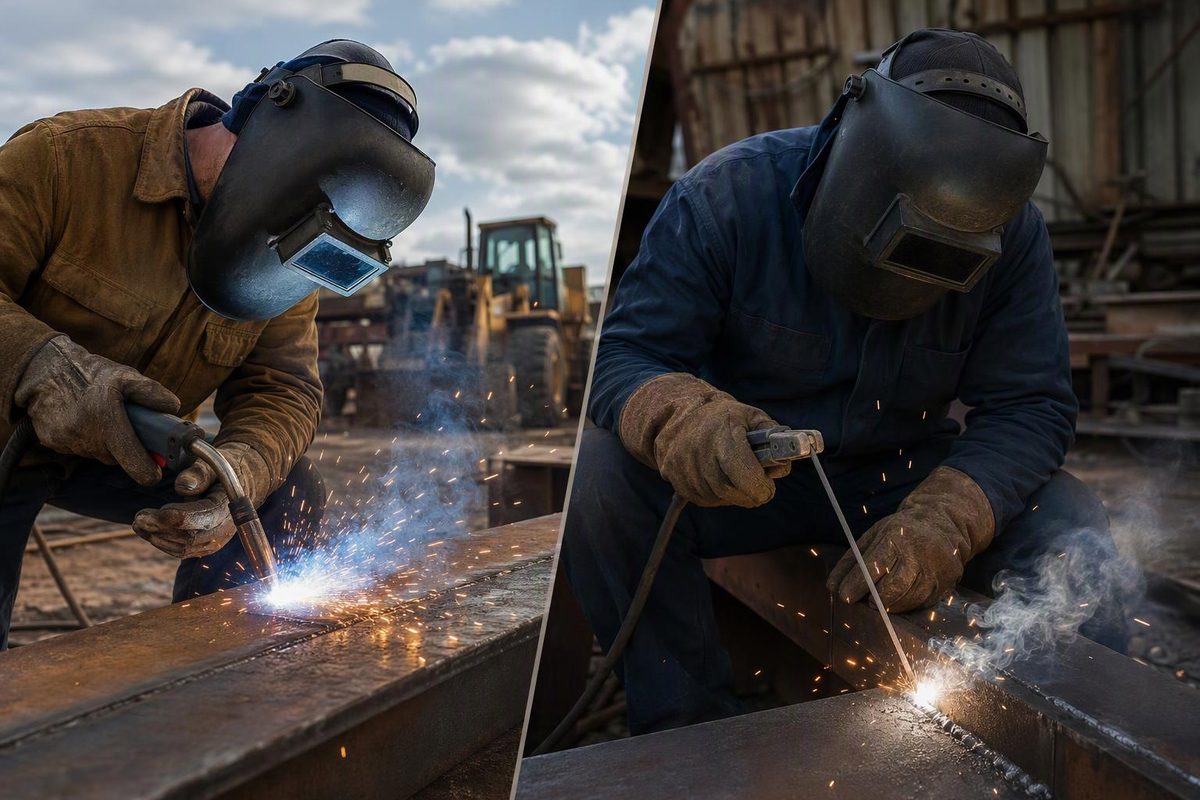
Choose self-shielded flux-core for longer steel welds where continuous wire feeding saves time. Choose stick for scattered repairs where a simple electrode-holder-and-leads setup matters more than deposition speed. Both suit outdoor work; wind alone does not decide between them. Miller likewise recommends stick for quick outdoor repairs and self-shielded flux-core for larger jobs in its welder-selection guide.
The important qualifier is self-shielded. Flux-cored arc welding includes FCAW-S, which needs no external shielding gas, and FCAW-G, which does. Gas-shielded flux-core is a productive shop option, but outdoors its gas coverage needs protection from wind. Lincoln explains this distinction in its flux-cored process overview.
The comparison below concerns ordinary carbon-steel fabrication and repair—not an assumption that the same consumable suits stainless steel, aluminum or unknown repair material.
The practical comparison
| Job consideration | Self-shielded flux-core | Stick welding |
|---|---|---|
| Long seams or repeated joints | Continuous wire feed reduces electrode-change stops | Frequent rod changes interrupt welding |
| Short, scattered repairs | Useful, but the feeder and gun must reach each joint | A straightforward setup for moving between repairs |
| Outdoor work | No external gas cylinder required | No external gas cylinder required |
| Learning the hand movement | Maintain a consistent gun-to-work distance | Maintain arc length while the rod becomes shorter |
| Cleanup | Slag removal between passes and final cleanup | Slag removal between passes and final cleanup |
| Process selection | Wire, feeder compatibility and machine capacity matter | Electrode, supported current type and machine capacity matter |
The continuous-feed advantage is real: Bernard identifies higher deposition rates and fewer starts and stops as reasons contractors switch from stick to self-shielded flux-core. It also describes the different gun and electrode-holder ergonomics. That advantage becomes more valuable as weld length increases; it matters less when fitting and positioning occupy most of the job.
Why flux-core can be easier—and faster
Both processes use flux to help protect the weld and produce a slag cover. With stick, flux surrounds the consumable rod. With flux-core, it is inside a tubular wire. Self-shielded wire uses its flux system and arc-generated gases rather than an external gas supply, as Lincoln explains in its shielding comparison.
The handling difference is more important than that resemblance. A stick welder must strike the arc, maintain its length and advance the electrode as it burns away. With flux-core, the feeder supplies wire while the operator controls gun position and travel. That removes the need to compensate by hand for a shortening rod, allowing the operator to maintain a consistent contact-tip-to-work distance.
It is not automatic quality control. Wire feeding, polarity and contact-tip-to-work distance still have to match the consumable. Slag can become trapped if technique or interpass cleaning is poor. Use the wire’s instructions rather than copying a stick-welding arc length or a solid-wire MIG setup. Our flux-core setup and troubleshooting guide covers those checks separately.
Continuous feeding also does not guarantee continuous production. A machine’s duty cycle, the gun’s capacity and the available input power can limit how much welding you complete before cooling is needed. Compare equipment at the output you actually need, not just the maximum amperage printed on the case. Miller’s selection guide explains duty-cycle limits.
Where stick still makes sense
For occasional repairs, fewer feeding components can be a practical advantage. Stick needs an electrode holder rather than a gun, contact tip, liner and drive-roll system. Changing the electrode also lets you change consumable type without unloading a wire spool—provided the electrode suits the material, machine and procedure.
Access deserves a physical check, not a blanket verdict. A rod may reach a joint where a particular gun neck or hand guard cannot fit. Conversely, a suitable flux-core gun can provide good visibility and access. Bernard’s gun-selection guidance shows how neck length, bends and guard size affect maneuverability. Check whether you can maintain the required angle and distance throughout the joint.
For cost, compare the complete setup and workload. Include leads, gun or holder, feeding parts, consumables and storage requirements. Then consider time spent changing rods, maintaining feeding equipment and cleaning welds. Stick can be the economical choice for intermittent work; flux-core’s productivity becomes more relevant on repeated, longer welds. There is no useful universal cost-per-weld winner without a specific joint and equipment comparison.
Thickness and strength: choose the consumable, not the slogan
Do not assume that every flux-core wire can weld heavy plate, or that stick always penetrates deeper. The usable range depends on the particular consumable, diameter, parameters, joint preparation and machine.
For example, Lincoln’s NR-211-MP datasheet specifies a 5/16-inch maximum plate thickness for wire diameters .045 inch and smaller, and a different limit for larger diameters. Adding passes does not erase that product limit. Other flux-core wires serve heavy structural applications, but they are not interchangeable with a small general-purpose spool.
For very thin sheet, do not force a choice between these two processes. Consider solid-wire MIG or TIG if burn-through control and finishing are the priorities. If using flux-core, verify that the wire and machine support the actual sheet thickness; do not borrow a general process minimum as a product rating.
Neither process is inherently the stronger choice for your finished joint. Lincoln cautions in the same datasheet that standardized consumable test results are not expected results for every weldment: procedure, plate chemistry, temperature and design affect the outcome. For load-bearing or code-governed work, select an accepted consumable and welding procedure, meet applicable qualification requirements and use the required inspection—not bead appearance as proof of strength.
Before committing to a machine
Write down your most common material, thickness, weld position and typical seam length. Then check:
- Power and compatibility: Does the machine support the process, required polarity and consumable size? A standard self-shielded flux-core setup uses a wire feeder and constant-voltage source, as described in Lincoln’s process overview. Do not assume a stick-only machine accepts a gun just because it has sufficient amperage.
- Access and workload: Can the holder or gun reach the joint, and does the duty cycle suit the amount of welding?
- Preparation and cleanup: Remove contamination and plan interpass slag removal. Neither process makes dirty metal good preparation.
- Fume control: No gas cylinder does not mean no hazardous gases. OSHA warns that outdoor welding does not guarantee adequate ventilation. Keep fumes out of the breathing zone and use appropriate ventilation, PPE and any required respiratory protection.
Let the actual joints—and the consumable’s limits—settle the decision.