
Best Welding Mask: Three Helmets Matched to the Job
Compare the Lincoln VIKING 3350, Miller Digital Infinity and VIKING 1740 by welding process, arc detection, viewing area, fit and shade requirements.
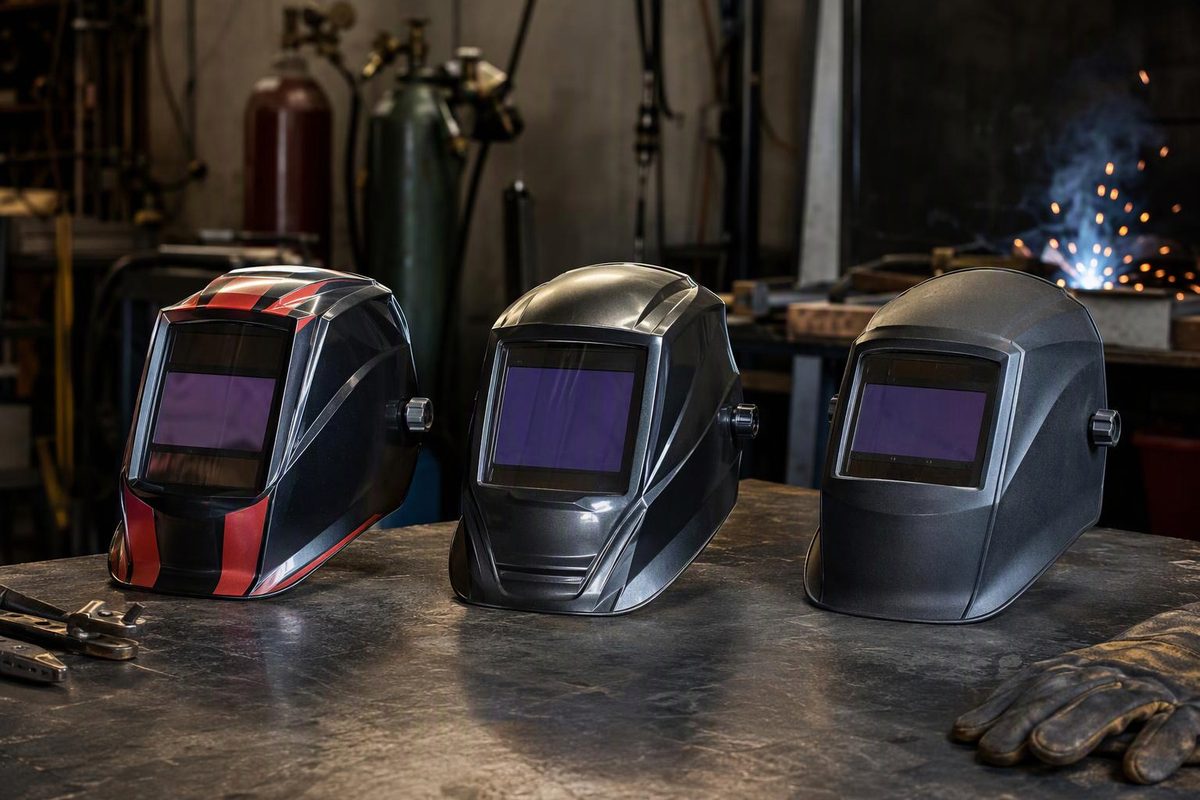
The Lincoln Electric VIKING 3350, K3034-4, is our general-purpose pick among these three helmets. It combines a large viewing area, four arc sensors, a published AC/DC TIG rating down to 2 A and analog controls. Investigate the Miller Digital Infinity instead when sunlight interference or obstructed optical sensors is the problem you need to solve. The VIKING 1740 is the simpler, lower-cost candidate for ordinary shop work.
These are recommendations based on manufacturer specifications, not a hands-on test ranking. “Welding mask” here means an arc-welding helmet, not a respirator or laser-welding protector.
The shortlist
Specifications below refer to the exact models shown, checked October 9, 2026. Viewing area means the usable filter window—not the cartridge’s outside dimensions.
| Helmet | Best fit in this shortlist | Relevant specifications | Main trade-off |
|---|---|---|---|
| Lincoln VIKING 3350, K3034-4 | General fabrication and low-current TIG | 12.5 in² window; shades 5–13; four optical sensors; AC/DC TIG ≥2 A; external grind button | Optical sensors still need a usable view of the arc |
| Miller Digital Infinity ClearLight 4x, 296786 | Outdoor work or jobs that obstruct optical sensing | 13.4 in² window; weld/X-Mode shades 8–13; cut shades 5–8; four optical sensors plus electromagnetic X-Mode | More controls; X-Mode is a distinct mode you must select |
| Lincoln VIKING 1740, K3282-4 | Cost-conscious MIG, stick and straightforward TIG work | 6.3 in² window; shades 9–13; two sensors; AC/DC TIG ≥5 A; replaceable AAA batteries | Shorter viewing window, fewer sensors and no cutting mode |
General-purpose pick: Lincoln VIKING 3350
The standard fourth-generation 3350 is worth considering when you move between MIG, stick and TIG and want a tall viewing window without adding app-based controls. Lincoln lists a 3.74 × 3.34-inch view, sensitivity and delay adjustment, X6 headgear, and replacement cover lenses, headgear and filter cartridges. Its published 2 A AC/DC TIG rating makes it a stronger candidate than the 1740 for very low-current work. See Lincoln’s specifications and 3350 product sheet.
The buying limit is fit. A large window does not help if the helmet slips as you lean forward, interferes with required PPE, or cannot reach the viewing angle your joint requires. Try it with your safety glasses and any required respiratory or head protection. For pipe or restricted-access work, check the shell in the actual working position before buying.
Do not confuse the standard 3350 with the 3350 ADV. The K3034-5 has digital controls, auto-shade technology, Bluetooth connectivity and support for modular LED illumination, but its viewing area is 11.8 in² rather than 12.5 in². Choose it because you need those features—not because every “3350” listing describes the same helmet. Lincoln documents the ADV separately.
Detection-focused pick: Miller Digital Infinity
The Digital Infinity’s useful distinction is X-Mode, not merely its larger window. Ordinary optical sensing depends on detecting light from the arc. Miller says X-Mode senses the weld electromagnetically, reducing sunlight interference and continuing to detect the arc when optical sensors are blocked. That addresses a specific problem encountered around fixtures, obstructions and outdoor lighting. Miller’s specification sheet also lists a shade-2.5 light state, half-shade adjustments, two memory settings and a TIG rating of “5 amps and below.”
This is the candidate to investigate when a helmet darkens in sunlight before you weld, or loses optical detection as your position changes. It is not permission to ignore setup: select the correct mode and follow the manual’s operating checks and limits.
Lower-cost pick: Lincoln VIKING 1740
The 1740 retains adjustable shade, sensitivity and delay, plus replaceable batteries and a documented replacement-parts list. Lincoln specifies the same 1/1/1/1 optical classification advertised for its standard 3350, but with a smaller 3.78 × 1.67-inch window and only two arc sensors. The K3282-4 product page lists these specifications and a lower MSRP than the 3350; compare current dealer quotes rather than treating MSRP as your checkout price.
For bench work with an unobstructed arc, the smaller window may be an acceptable saving. For low-current TIG below its published 5 A threshold, or work that repeatedly hides sensors, choose a better-matched model rather than trying to compensate with sensitivity alone.
Shade and detection are separate buying checks
A helmet’s TIG amp rating describes its stated arc-detection capability. Its shade setting determines how dark the filter becomes. A helmet can have sufficient shade range yet be poorly matched to the low-current arc you need it to detect.
Verify documented eye-and-face protection compliance for the exact model, too. AWS recommends helmets and eyewear meeting ANSI Z87.1; neither a large window nor a low-current rating substitutes for that protection. AWS eye-and-face guidance
For U.S. general-industry work, OSHA’s shade table lists these examples:
- MIG/FCAW at 60–160 A: minimum protective shade 10.
- TIG below 50 A: minimum protective shade 8.
- Stick at 60–160 A, with a 3/32–5/32-inch electrode: minimum protective shade 8.
Those are minimums, not universal comfort settings. The AWS lens-shade selector suggests darker comfort shades for many applications—including shade 14 for some higher-current work. A helmet topping out at shade 13 will not cover every preferred or required setting. Start dark, lighten only enough to see adequately, and never go below the applicable minimum. Follow workplace requirements and the equipment manual; do not use a manual setting below the applicable protective minimum.
Before spending more, check the helmet you already own
If the filter fails to darken or flickers during welding, stop the arc immediately before troubleshooting. If the view has deteriorated or the filter behaves inconsistently, work through this sequence:
- Inspect the shell, filter and cover lenses. Replace damaged parts; clean according to the manufacturer’s instructions.
- Confirm welding mode and shade. Do not strike an arc in grind mode.
- Check batteries, sensor cleanliness and obstruction. Then review sensitivity, delay and operating-temperature limits in the manual.
- Use the manufacturer’s prescribed function check. If darkening remains unreliable, keep the helmet out of service until corrected.
AWS identifies blocked sensors, dead batteries, improper sensitivity and very cold temperatures as causes of failed switching. It also recommends safety glasses with top and side protection underneath the helmet. AWS eye-and-face guidance explains both points. Our auto-darkening helmet guide covers the controls and checks in more detail.
Finally, none of these three helmets provides respiratory protection. If fume exposure is the buying problem, assess ventilation and any required respirator separately: OSHA says respiratory protection may be required when work practices and ventilation do not reduce exposure to safe levels. See the distinction between welding helmets and fume protection before choosing an integrated system.