
Choosing the Right Electrode Without Cracking the Casting
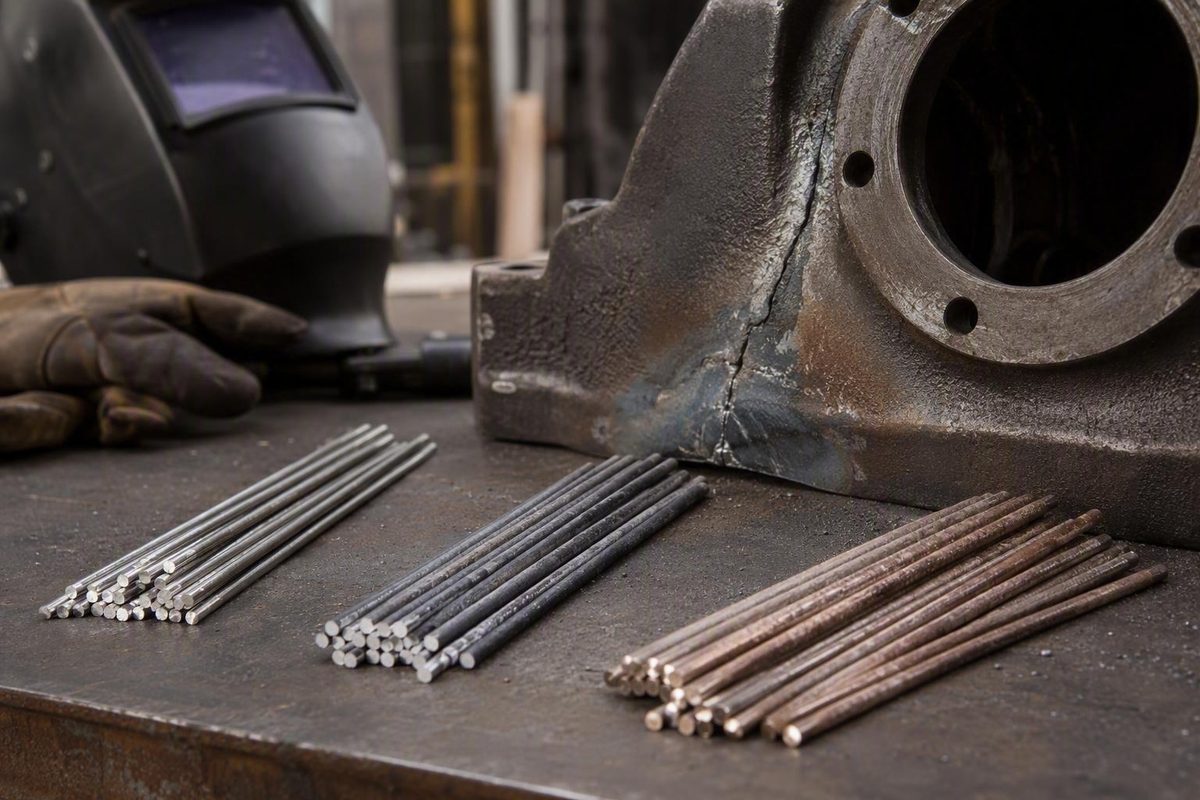
ENi-CI fits jobs needing a machinable deposit; ENiFe-CI suits heavy or multipass work, while ESt fits jobs accepting a hard weld finished by grinding.
By Cole Brandt, CWI-certified welder · Updated August 14, 2026
The short answer: choose the rod by the repair, not the label
There is no universally best cast iron welding rod. The right electrode depends on the iron grade, the component’s function, whether the repair must be machined, section thickness, restraint, the number of passes, and the planned heating and cooling method.
As a practical starting point:
- Evaluate ENi-CI, commonly sold as Nickel 99, when deposit machinability is the leading requirement. It is often selected for gray-iron repairs that will be drilled, tapped, bored, milled, or faced, especially where a single pass will have substantial base-metal admixture.
- Evaluate ENiFe-CI, commonly sold as Nickel 55, for many thick castings, multipass repairs, and cast-iron-to-steel joints. It is generally less expensive than Nickel 99 and is a common candidate when deposit volume, strength, ductility, or heavy-section use matters. High dilution can still make its deposit difficult to machine.
- Consider ESt, a steel-deposit electrode, only when a hard, non-machinable weld is acceptable. It is the lower-cost option among these three families and is normally finished by grinding.
That is a selection framework, not a universal ranking. Lincoln Electric, which manufactures the branded electrodes in its comparison, positions ENi-CI for highly machinable work, ENiFe-CI for many heavy or multipass repairs, and ESt for economical non-machined filling. Its guidance is product-specific rather than independent comparative testing. See Lincoln Electric’s cast-iron electrode comparison.
Use this decision sequence before buying:
- Identify the iron grade. Determine whether the casting is gray, ductile or nodular, malleable, white, or an alloyed grade.
- Assess the service risk. Ask what would happen if the repair cracked, leaked, distorted, or separated.
- Define the finishing requirement. Decide whether the weld or adjacent area must be drilled, tapped, bored, milled, or only ground.
- Evaluate the geometry. Consider section thickness, thickness transitions, restraint, accessibility, and the probable number of passes.
- Choose a heat-control strategy. Determine whether the casting can be heated uniformly or whether a deliberately cool, intermittent method is more practical.
- Verify the exact electrode. Read the current manufacturer datasheet for classification, diameter-specific current range, polarity, positions, storage requirements, application limits, and thermal guidance.
Do not identify a casting as ordinary gray iron solely from its color or fracture appearance. A suspected white-iron casting, severely heat-damaged component, unidentified alloy, or safety-critical part should be referred for material identification and procedure development rather than treated as a routine repair.
Why cast iron cracks even when the electrode seems right
Cast iron commonly contains approximately 2–4% carbon—about ten times the carbon content of most steels. Welding can cause carbon to migrate into the weld metal or heat-affected zone, increasing hardness and brittleness and contributing to post-weld cracking. TWI explains the relationship among carbon content, migration, hardness, and cracking.
Carbon is only part of the problem. Cast iron generally has less capacity than ordinary steel to deform as welding stresses develop. The weld deposit and adjacent base metal then contract during cooling.
Several mechanisms may act together:
- Carbon entering the weld or heat-affected zone can produce hard, brittle microstructures.
- The deposited metal shrinks as it solidifies and cools.
- The surrounding casting restrains that shrinkage.
- Localized heating creates steep temperature gradients.
- Oil, paint, moisture, graphite, or other contamination can contribute to porosity and irregular fusion.
- Existing cracks, prior overheating, and uneven wall thickness can concentrate stress.
A nickel-rich deposit is generally more accommodating than a hard steel deposit, but it cannot correct a mistaken alloy identification, an oil-soaked joint, excessive admixture, uncontrolled heat input, or rapid cooling.
It is also important to distinguish deposit machinability from heat-affected-zone machinability.
Nor does a smooth-looking bead prove that the repair is sound. Cracking may occur beside or beneath the deposit, and porosity may remain below the surface.
Know the casting before selecting an electrode
“Cast iron” describes a family of materials rather than one uniform alloy. Gray, ductile, malleable, and white irons differ in carbon form, microstructure, mechanical behavior, and response to welding.
Gray cast iron is the most common type and the material assumed by much general repair guidance. Its carbon is present largely as graphite flakes. It can be fusion welded, but its high carbon content, limited ductility, and potential for hard heat-affected zones demand careful cleaning and thermal control.
Ductile or nodular iron contains graphite in nodular rather than flake form. It can be weldable to varying degrees, but welding may alter the local microstructure and properties created during manufacture. An electrode advertised for “cast iron” is not automatically suitable for every ductile-iron grade or service condition.
Welding can change those properties near the joint, so the grade, loading, and service requirements must be evaluated before a filler or process is selected.
White cast iron retains much of its carbon in hard, brittle carbides. It is generally considered unsuitable for fusion welding because the material has little capacity to accommodate welding stress and is already prone to brittle behavior.
The strongest identification methods are documentary or analytical:
- Original material specifications
- Manufacturer records and equipment manuals
- Engineering drawings and bills of material
- Casting marks traceable to reliable documentation
- Chemical analysis
- Metallographic examination
Fracture appearance may provide clues, but it is not conclusive. Ductile iron can appear pale or white at a fracture, so color alone does not establish that a component is white iron. When visual identification is uncertain and the answer affects weldability, chemical or metallographic analysis is more defensible. This cast-iron overview discusses the different iron types and the limits of fracture appearance.
The escalation rule is simple: do not select a rod solely from appearance when alloy identity affects safety, serviceability, or the economic value of the component. If no specification is available, compare the cost of positive identification with the cost and consequences of a failed repair.
Nickel 99 vs. Nickel 55 vs. steel: the practical comparison
Nickel 99 and Nickel 55 are market names, not substitutes for checking the classification on the package and current datasheet. In Lincoln Electric’s branded range, Tech-Rod 99 is classified ENi-CI and is nominally 99% nickel; Tech-Rod 55 is ENiFe-CI and nominally 55% nickel; Ferroweld is an ESt steel-deposit electrode. Lincoln also states that high admixture can leave Tech-Rod 99 machinable but can make Tech-Rod 55 hard and difficult to machine. These figures and comparisons are manufacturer-specific product guidance.
| Classification | Nominal deposit type | Machinability | Relative cost | Typical repair fit | Principal limitation | Finishing method |
|---|---|---|---|---|---|---|
| ENi-CI / Nickel 99 | High-nickel; branded examples may be nominally 99% nickel | Generally the best of these three; may remain machinable with substantial admixture | Highest | Many gray-iron repairs requiring drilling, tapping, boring, or milling; often single-pass or high-admixture work | Cost; suitability depends partly on casting chemistry; does not prevent HAZ hardening | Conventional machining where the deposit and adjacent material permit |
| ENiFe-CI / Nickel 55 | Nickel-iron; branded examples may be nominally 55% nickel | Usually machinable, but high admixture can make it hard | Middle | Thick sections, heavy castings, multipass work, and some cast-iron-to-steel joints | Machinability is more sensitive to admixture than with Nickel 99 | Machining if hardness permits; grinding where necessary |
| ESt | Steel deposit | Normally hard and non-machinable | Lowest | Minor filling and non-machined repairs where economy matters | Hard deposit and poor suitability where cutting or tapping is required | Grinding |
ENi-CI or Nickel 99 is the usual premium candidate when post-weld machining drives the decision. Its soft deposit is useful where drilling, tapping, boring, or milling must cross the deposited metal. Its ability to remain machinable with substantial base-metal admixture is especially relevant to single-pass repairs. The tradeoffs are higher price and continued sensitivity to casting composition and heat-affected-zone hardness.
ENiFe-CI or Nickel 55 is commonly considered for thick sections and multipass repairs. It is generally less expensive than Nickel 99, and manufacturer guidance describes nickel-iron deposits as a stronger, more ductile option for many heavy repairs. Those advantages are application-specific, however; they do not establish that Nickel 55 is universally superior.
Nickel 55 is also a common candidate for joining cast iron to steel. Electrode selection alone does not qualify such a joint. Restraint, geometry, dilution from both materials, loading, thermal behavior, and the required properties of the assembly still need to be addressed by the repair procedure.
ESt provides an economical steel deposit. Its central disadvantage is hardness: the weld is ordinarily non-machinable, so grinding is the normal finishing method. A steel deposit may rust more like cast iron, which can matter in restoration work, but appearance and corrosion behavior are secondary to mechanical suitability and procedure control.
The practical conclusion is not that one row wins. Choose by the repair: ENi-CI when deposit machinability dominates, ENiFe-CI when heavy or multipass work favors nickel-iron properties and relative economy, and ESt when a hard, ground finish is acceptable.
Match the electrode to machining, thickness, and service conditions
Once the alloy and service risk are understood, turn the comparison into a repair-specific choice.
For a machinable gray-iron repair: Start by evaluating ENi-CI or Nickel 99. It is the usual first candidate when the finished area must be drilled, tapped, bored, milled, or faced. Tell the machinist where the fusion line and heat-affected zone will be; a machinable deposit does not guarantee machinable base metal beside it.
For a heavy casting or multipass repair: Start by evaluating ENiFe-CI or Nickel 55. Its relative economy matters when substantial deposit volume is required, while its common use on thick sections may make it more suitable than filling an entire large repair with Nickel 99.
Some manufacturer procedures may use a high-nickel root followed by nickel-iron fill passes. Such a sequence should come from documented product guidance or a component-specific repair procedure, not from the assumption that two individually suitable electrodes can be combined in any order.
For cast iron joined to steel: ENiFe-CI is a commonly supported candidate. The joint procedure must still address restraint, dilution, geometry, service loading, and the properties required from the completed assembly.
For minor, non-machined filling: ESt may be considered when cost matters, the deposit will be ground, and a hard weld is acceptable. Its lower purchase price becomes a false economy if the repair later needs to be drilled, tapped, bored, or milled.
Details that can change the choice include:
- Single-pass versus multipass work: A high-admixture single pass favors a deposit that remains machinable after mixing with the base metal.
- Casting chemistry: Phosphorus and other constituents can affect cracking behavior and electrode suitability.
- Restraint: A short crack in a rigid, complex housing may be more difficult than a longer defect in a free, simple section.
- Thickness transitions: Thin-to-thick geometry creates uneven heating and cooling.
- Required finishing: Grinding, machining, sealing, and cosmetic blending impose different demands.
- Service conditions: Cyclic loading, vibration, thermal cycling, pressure, and leakage sensitivity increase the consequences of hidden defects.
Proprietary electrodes are marketed for ductile or nodular iron, malleable iron, manifolds, and burnt or heat-affected castings. These labels identify products to investigate; they do not prove that the damaged component is safely repairable. Seller application descriptions and bonding-strength figures are commercial claims unless common test standards, specimens, dilution levels, heat treatments, and failure criteria are supplied. Muggy Weld’s catalog illustrates these specialized product categories and vendor claims.
Do not rank products by an advertised strength number when the test conditions are unknown or different. A larger figure does not establish that an electrode is better for the casting in front of you.
Preparation comes before rod selection
Electrode selection should follow an assessment of the casting, not precede it. Use this pre-weld checklist before opening a package of rods:
- [ ] Is the iron grade positively identified?
- [ ] What does the component do?
- [ ] Is it structural, rotating, pressure-containing, watertight, or safety-critical?
- [ ] What are the wall thickness and thickness transitions?
- [ ] How restrained is the damaged area?
- [ ] Can both sides of the crack or break be accessed?
- [ ] Will the repair require one pass or multiple passes?
- [ ] Must the repaired area be machined?
- [ ] Is there evidence of prior overheating, burning, fire exposure, or thermal fatigue?
- [ ] Has the part been exposed to oil, coolant, exhaust condensate, water, or chemicals?
- [ ] Can the whole casting be heated and cooled uniformly?
- [ ] How will the completed repair be inspected?
Cleanliness means more than exposing bright metal. Remove paint, grease, oil, rust, casting skin, loose or residual graphite, trapped moisture, and other foreign material near the joint. Industry guidance identifies alloy identification, thorough cleaning, heat control, and suitable technique as the basic prerequisites for cast-iron welding. See the foundry guidance on preparation and critical-part escalation.
There is no evidence-supported universal decontamination method for every casting. The material, geometry, absorbed substance, and allowable heating method must be assessed for the specific part.
Inspect the existing damage and joint configuration before choosing the filler. Determine whether the visible crack is the complete defect, whether it branches, and whether heat or repeated loading has weakened the surrounding material.
After identifying the electrode family, obtain the current manufacturer datasheet and verify:
- AWS classification
- Electrode diameter
- Approved current range
- Recommended polarity
- Permitted welding positions
- Storage and reconditioning instructions
- Application limits
- Preheat, interpass, and cooling guidance
- Alloy-specific restrictions
Welding exposes people and property to current, fumes, hot metal, fire, and ultraviolet radiation. Use suitable PPE and ventilation or fume control, follow the welding-machine and electrode manufacturers’ instructions, remove or control combustibles, and comply with site-specific rules. These controls override any general technique described here.
Refer the job for professional procedure development and suitable inspection when it involves structural or rotating machinery, automotive safety, pressure retention, watertight service, severe heat damage, an unidentified alloy, a large or highly restrained casting, or consequences that cannot be controlled through visual inspection alone.
Choose one heat-control strategy: uniformly hot or deliberately cool
Cast iron does not have one universal preheat temperature. General guidance describes two distinct approaches:
- Heat the casting uniformly, weld with controlled heat input, and cool it gradually.
- Keep the bulk casting deliberately cool by using small, intermittent deposits with cooling intervals.
Do not casually mix these approaches.
With the hot method, heat as much of the casting as practical slowly and uniformly. The purpose is not merely to make the joint hot; it is to reduce the temperature difference between the weld zone and the surrounding mass. Control welding heat, observe the procedure’s temperature limits, and cool the entire casting gradually.
Published temperatures vary by source. TWI describes typical minimum preheats of approximately 100–400°C, depending on the iron type and allowable heat-affected-zone hardness; these are typical ranges rather than universal settings. See TWI’s source-specific preheat and slow-cooling guidance.
Lincoln Electric’s general gray-iron guidance gives approximately 500–1200°F, warns against exceeding approximately 1400°F, and describes warming the casting to about 100°F as helpful in its no-full-preheat method while otherwise keeping the part relatively cool. Those values apply to Lincoln’s general gray-iron guidance, not every iron grade, geometry, procedure, or temperature-measurement location. Read Lincoln’s two-path gray-iron guidance.
With the cool method, use small intermittent deposits and allow cooling between them so that the bulk casting remains relatively cool. This can be practical where a large or complex component cannot be heated uniformly. It is still a controlled thermal procedure—not permission to weld continuously without monitoring the casting.
“Cool enough to touch” is descriptive manufacturer wording, not a qualified acceptance test and not an invitation to touch metal near a welding operation. A component-specific procedure should define how temperature is measured, where it is measured, and what limits apply.
Nickel electrodes can support low-heat repair methods because their deposits are generally more accommodating than hard steel weld metal. They do not make thermal management optional. Even a premium ENi-CI electrode can leave the surrounding casting cracked if arc input, sequence, restraint, or cooling is uncontrolled.
Deposit short beads, manage stress, and cool the casting gradually
After the electrode family and heat strategy have been selected, technique determines how much localized hardening and shrinkage stress the repair creates.
Use the lowest current that provides acceptable operation within the electrode manufacturer’s approved range.
Lincoln’s general gray-iron guidance uses weld segments of approximately one inch where needed. In its cool method, it also calls for cooling between deposits, filling craters, peening the deposit, and avoiding accelerated cooling with water or compressed air. These are source-specific gray-iron recommendations, not universal instructions for every casting. See Lincoln’s bead, crater, peening, and cooling recommendations.
Under a cool intermittent procedure:
- Deposit only the segment specified by the repair plan.
- Fill the crater rather than leaving a deep termination.
- Follow the planned sequence instead of welding continuously from one end.
- Allow the required cooling interval before making the next deposit.
- Monitor the casting temperature, not only the visible bead.
The exact bead length and sequence must match the electrode diameter, casting mass, wall thickness, access, joint geometry, and restraint. A generic sequencing diagram is not a substitute for a procedure developed for the part.
Peening may help counter weld-metal shrinkage when the deposited metal is sufficiently ductile and still deformable. The objective is modest plastic deformation of the deposit, not impact loading of the casting.
Do not peen indiscriminately. A hard ESt deposit should not automatically receive the same treatment as a more ductile nickel deposit.
Cooling remains part of the procedure after the arc stops. For a hot repair, technical guidance describes gradual-cooling methods such as:
- Insulating blankets
- Burial in clean, dry sand
- Controlled continued heating that diminishes gradually
The appropriate method depends on casting size, temperature, contamination, combustibility, and available controls. Do not quench the repair or accelerate cooling with water or compressed air.
After cooling, inspect for defects relevant to the component:
- Cracks beside the fusion line
- Delayed cracking
- Porosity or surface-connected voids
- Hard zones that interfere with machining
- Distortion or loss of alignment
- Leakage where fluid retention matters
Inspection methods and acceptance criteria must come from the component’s service requirements.
How to buy intelligently—and when not to weld
Shop by documented classification before shopping by nickname. “Nickel 99” and “Nickel 55” are useful market labels, but the package and current manufacturer datasheet should confirm what the electrode actually is.
Use these buying references:
- ENi-CI: high-nickel or “Nickel 99” family
- ENiFe-CI: nickel-iron or “Nickel 55” family
- ESt: steel-deposit cast-iron electrode
Before ordering, verify:
- Manufacturer
- Exact product designation
- AWS classification
- Diameter
- Package weight and electrode quantity
- Approved current range
- Polarity
- Storage requirements
- Welding positions
- Intended base materials
- Machinability limitations
- Preheat and cooling instructions
- Restrictions concerning multipass work or admixture
A product title does not prove classification, composition, mechanical properties, or compliance with a particular procedure. Marketplace wording may abbreviate, misspell, or combine terms. Even a listing titled “Nickel 99” should be checked against manufacturer documentation before it is treated as ENi-CI.
Retail catalogs illustrate the variety: one category may contain nickel-free ESt, generic Nickel 55 and Nickel 99 products, documented ENiFe-CI and ENi-CI electrodes, and proprietary repair rods. Catalog listings establish market availability and labels—not comparative technical suitability. Canada Welding Supply’s category illustrates this range.
Price comparisons are meaningful only after normalizing:
- Currency
- Date
- Electrode diameter
- Package weight
- Number of electrodes
- Shipping and minimum-order costs
- Storage life and expected wastage
A low displayed price for a small package is not necessarily cheaper per unit of deposited metal. Conversely, a large premium package may be poor value for one small repair if the remaining electrodes cannot be stored correctly.
Treat price, stock status, customer ratings, bonding-strength figures, and specialized-use descriptions as volatile seller or manufacturer claims. They may help locate candidate products, but they do not prove weldability or suitability for a particular casting.
Before committing to fusion welding, reconsider the repair if any of the following apply:
- The part is likely white iron.
- The alloy remains unidentified.
- The casting has severe fire or heat damage.
- Cracking is extensive, branching, or recurrent.
- The component retains pressure.
- A small leak would create serious consequences.
- The part experiences high cyclic loading or vibration.
- Failure could affect steering, braking, lifting, guarding, or rotating equipment.
- The casting is highly restrained or difficult to heat uniformly.
- The completed joint cannot be inspected adequately.
Possible alternatives include brazing, studding, metal stitching, service-appropriate sealing methods, specialist repair, or replacement. Each alternative has its own temperature, strength, sealing, design, and inspection limitations. Naming an option does not establish that it is suitable for the component.
The decision sequence remains straightforward: identify the casting and its service risk, establish whether machining is required, evaluate thickness and restraint, select a deliberate heat-control strategy, and then choose among ENi-CI, ENiFe-CI, and ESt using the electrode manufacturer’s current instructions.
Electrode price is only one part of repair economics. Material analysis, preparation, heating equipment, machining, inspection, downtime, and the consequences of failure may cost much more than the rods. A premium cast iron welding rod cannot overcome the wrong alloy assumption or an uncontrolled heating and cooling cycle. Critical or uncertain repairs belong with a qualified specialist.
What is the best cast iron welding rod for a machinable repair?
ENi-CI, commonly called Nickel 99, is the usual starting point when deposit machinability is the primary requirement. Its soft, high-nickel deposit is commonly selected for repairs that will be drilled, tapped, bored, or milled, and branded products in this family may remain machinable despite substantial base-metal admixture.
That does not guarantee a soft heat-affected zone. Confirm the iron grade, machining location, likely admixture, and heat-control procedure before selecting the electrode.
What is the difference between Nickel 55 and Nickel 99 electrodes?
Nickel 99 generally refers to the ENi-CI high-nickel family. It favors deposit machinability and is relatively expensive, making it a common candidate for single-pass or high-admixture repairs that must be machined.
Nickel 55 generally refers to the ENiFe-CI nickel-iron family. It is less expensive and commonly considered for thick sections, multipass repairs, and some cast-iron-to-steel joints. Its deposit is usually machinable, but excessive admixture can make it hard and difficult to cut.
Can cast iron be welded without full preheating?
Sometimes. A deliberately cool method can use short, intermittent deposits with controlled cooling intervals, particularly when heating the entire casting uniformly is impractical.
That does not mean heat control is unnecessary. Cool intermittent welding and uniform preheating are distinct procedural paths. Do not switch casually between them, and do not assume that a nickel electrode makes every casting suitable for no-preheat welding.
Can white cast iron be welded with a nickel rod?
White cast iron is generally considered unsuitable for fusion welding because of its hard, brittle, carbide-rich structure. A nickel electrode does not convert the underlying casting into a ductile material or eliminate fusion-line and heat-affected-zone cracking.
If white iron is suspected, verify the material rather than relying on fracture color. Specialist evaluation, a suitable non-fusion repair method, or replacement is normally more defensible than routine nickel-electrode welding.
Can I use an inexpensive steel electrode on cast iron?
An ESt steel electrode may be considered for limited, non-machined filling where a hard deposit is acceptable and the repair will be finished by grinding. It is generally the lowest-cost of the three electrode families discussed here.
Its disadvantages are poor machinability and a less accommodating deposit. Do not choose ESt solely because it is inexpensive if the repair must later be drilled, tapped, bored, or milled, or if restraint and service risk call for a more ductile deposit.