
Welding Rod Numbers: How to Read E6010, E6011, E6013 and E7018
Decode welding rod numbers for tensile strength, position, coating and current, plus H4R suffixes and why TIG rod codes work differently.
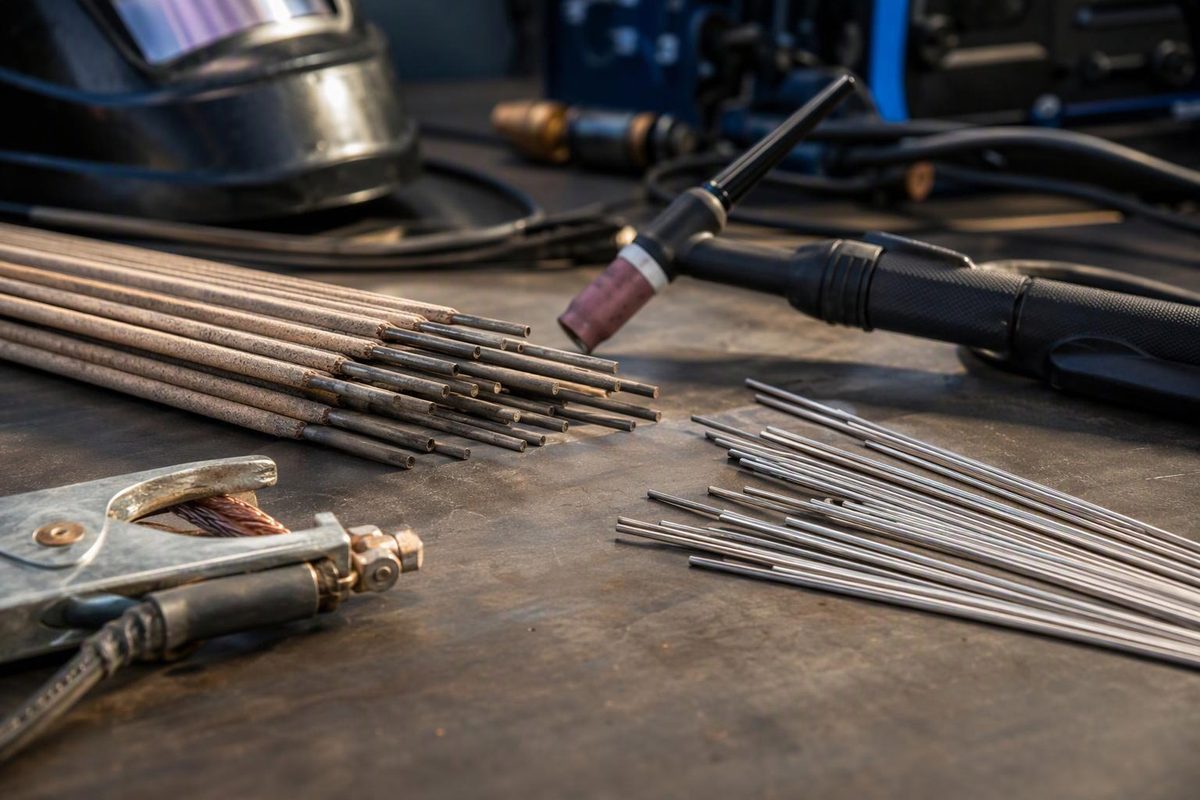
Numbers such as E6010, E6011, E6013 and E7018 are filler-metal classifications, not amperage settings or rod diameters. On common carbon-steel stick electrodes, the letters and digits identify the electrode, minimum tensile strength of the deposited weld metal, permitted welding positions, and a covering/current family.
For example:
E7018 = electrode + 70 ksi minimum tensile strength + all-position + low-hydrogen, iron-powder covering/current classification.
That reading is useful, but it does not establish that the rod matches the base metal, joint, machine, welding procedure or service conditions.
How to decode a four-digit stick electrode number
The familiar system applies to carbon-steel covered electrodes classified under AWS A5.1. The current edition, AWS A5.1/A5.1M:2025, covers chemical composition, mechanical properties, weld-metal soundness, usability, moisture testing, sizes and marking—not merely the four characters printed on a rod (AWS specification description).
| Part | Meaning in E7018 | Practical interpretation |
|---|---|---|
| E | Electrode | The consumable conducts welding current and melts into the weld |
| 70 | 70 ksi | Deposited weld metal has a specified minimum tensile strength of 70,000 psi under classification test conditions |
| 1 | All positions | Permitted for flat, horizontal, vertical and overhead welding |
| 8 | Covering/current designator | Low-hydrogen, iron-powder family; commonly used with AC or DCEP, subject to the exact product data |
For five-digit strength classifications, the first three digits carry the strength value. Thus, E10018 indicates 100 ksi rather than 10 ksi. Lincoln Electric’s classification guide confirms the 60 ksi reading for E6010 and 100 ksi for E10018 (Lincoln Electric).
The stated strength belongs to weld metal deposited and tested under the applicable specification. It does not mean every joint made with E7018 will withstand 70,000 psi. Joint design, base metal, dilution, discontinuities, heat input and procedure control still govern the finished weld.
The position digit
For common carbon-steel SMAW classifications:
- 1 means all positions.
- 2 limits the electrode to flat and horizontal applications; the exact permitted groove and fillet positions come from the applicable classification table.
- Less-common position designators should also be checked against that table rather than inferred.
This explains a major difference between E7018 and E7024. E7018 is all-position, while E7024 is used for high-speed flat or horizontal fillet welds. Its high iron-powder content increases deposition rate but also creates a more fluid pool, limiting out-of-position use (Miller).
“All-position” does not authorize every progression or technique. A welding procedure may still specify vertical-up or vertical-down progression, bead placement, heat input and electrode diameter.
The last digit is not an amperage number
The final digit belongs to a standardized usability designation involving the flux covering and suitable current characteristics. It does not mean 0, 1, 3 or 8 amps, and it should not be used by itself to set a machine.
| Classification | Covering/arc family | Classification current compatibility | Common behavior |
|---|---|---|---|
| E6010 | High-cellulose sodium | DCEP | Forceful, digging arc and deep penetration |
| E6011 | High-cellulose potassium | AC, DCEP or DCEN | Digging arc, with AC capability |
| E6013 | High-titania potassium | AC, DCEP or DCEN | Softer arc, moderate penetration and easily removed slag |
| E7018 | Low-hydrogen, iron powder | AC, DCEP or DCEN | Smooth arc, medium penetration and controlled-hydrogen capability when properly handled |
These are classification-level possibilities, not a substitute for the instructions on the package. Use the current and polarity stated on the exact manufacturer datasheet or container. Products sharing a classification can differ in arc starting and handling, and some carry additional designators. Miller likewise recommends considering base metal, strength, joint, position, power source and service requirements when selecting an electrode (Miller electrode-selection guide).
For individual setup and application limits, see E6011 rod selection, E6013 uses and amperage and E7018 setup and storage.
What suffixes such as “-1 H4R” mean
A package may show a longer designation such as E7018-1 H4R:
- -1 indicates supplemental requirements for improved toughness and ductility.
- H4 means the product meets a diffusible-hydrogen limit of no more than 4 mL per 100 g of deposited weld metal under the classification test.
- R indicates compliance with an absorbed-moisture test for a moisture-resistant low-hydrogen covering.
H4R does not make an electrode immune to moisture. Low-hydrogen electrodes still have to be received, exposed, stored and, where permitted, reconditioned according to the manufacturer’s instructions and governing procedure. The optional suffixes and their test meanings are summarized by Hobart Brothers, while Lincoln cautions that even H4 products may no longer meet their specification after improper exposure (Lincoln Electric).
Low-alloy classifications may also include chemistry suffixes. In E8018-B2 H4R, for example, B2 identifies a specified weld-metal composition group; it is not another position or current code (Lincoln Electric). This is why decoding should begin with the applicable filler-metal specification rather than a supposedly universal chart.
TIG rod and MIG wire numbers use different systems
Do not force the E60XX/E70XX stick-electrode shortcut onto every filler metal. Under the separate AWS A5.18 system, a classification such as ER70S-6 is read differently:
- ER identifies a product usable as an electrode or rod.
- 70 identifies its tensile-strength class.
- S means solid.
- 6 distinguishes a chemical-composition classification; it is not a welding-position digit.
AWS A5.18 classifies solid carbon-steel electrodes and rods using their chemical composition and the deposited weld metal’s mechanical properties (AWS A5.18/A5.18M:2023). Hobart’s classification guide also emphasizes that stick electrodes, solid wires and flux-cored wires do not share one nomenclature (Hobart Brothers). Stainless and aluminum filler classifications use still other alloy-based systems, so their digits cannot be decoded as SMAW position and covering numbers. For GTAW selection, match the filler alloy before choosing a convenient diameter; see TIG welding rod selection.
Read the package in this order
- Identify the process and full classification. Do not rely on a partial ink stamp or rod color.
- Match the filler to the known base metal and the governing WPS, repair instruction or engineering requirement.
- Check welding position and progression.
- Confirm that the machine supplies the specified current type and polarity.
- Treat diameter separately. “1/8 in E7018” means a 1/8-inch-diameter E7018; diameter is not encoded in “7018.”
- Use the manufacturer’s amperage range for that diameter, then make any permitted adjustment on representative material while watching arc stability, puddle control, fusion and bead profile.
- Follow handling requirements, especially for low-hydrogen electrodes.
The classification narrows the choice; it does not approve the application or certify the finished weld. For code work, the WPS and project requirements control even when another rod appears to run well.