
Where E6013 Works—and Where It Does Not
See where E6013 excels, where it falls short, and how rod diameter, polarity, amperage, joint condition and technique shape the result.
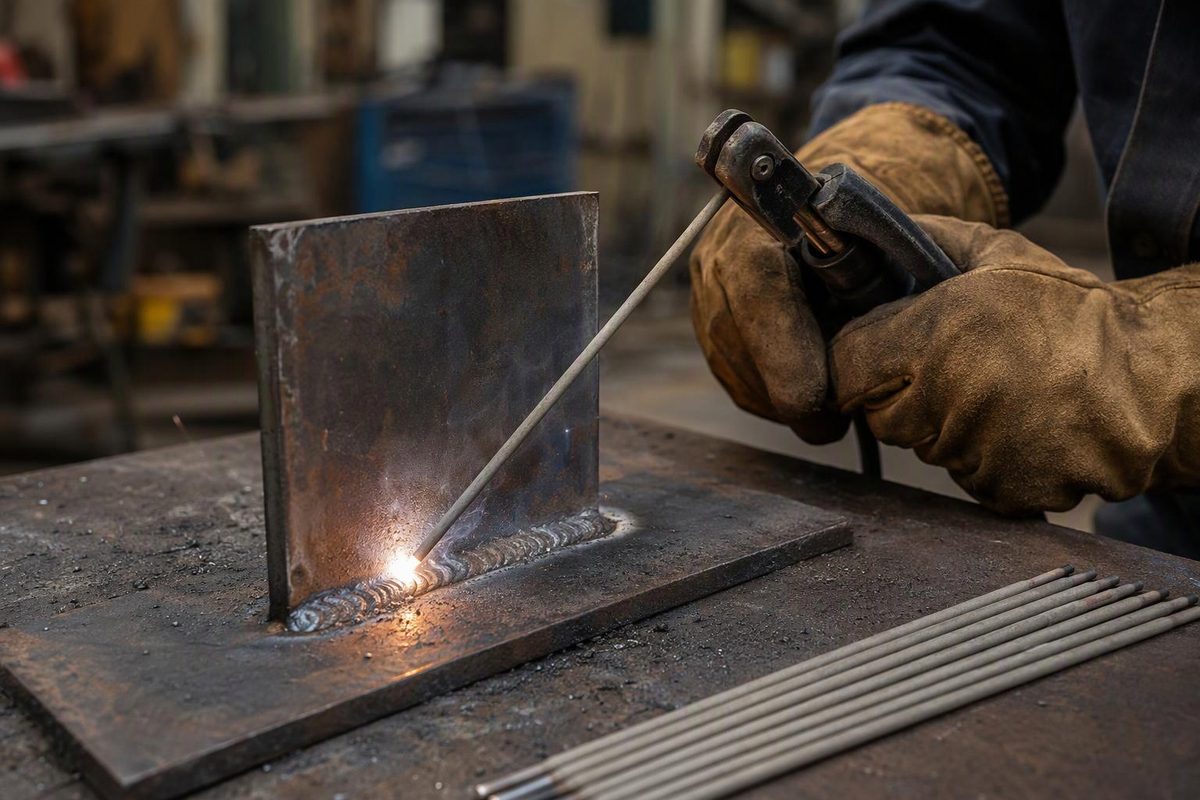
E6013 is best used on clean mild-steel sheet, light fabrication, short welds and noncritical repairs. Its soft arc, moderate penetration, light spatter and removable slag favor bead control and cleanup, not the digging action needed for contaminated steel or open roots. It is not the default rod for rusty steel, code-governed structural work or applications requiring low-hydrogen electrodes (Lincoln Electric; Hobart Brothers).
Choose the job, rod diameter and current type to check E6013 suitability and the Fleetweld 37 example amperage range.
E6013 Job And Amperage Check
The amperage shown is for Lincoln Electric Fleetweld 37, not every E6013 product.
Clean mild-steel sheet is a common E6013 application.
For a 3/32 in (2.4 mm) Fleetweld 37 rod on AC: 75–115 A.
Fleetweld 37 Example Ranges
| Diameter | AC | DC, Either Polarity |
|---|---|---|
| 5/64 in | 50–80 A | 45–75 A |
| 3/32 in | 75–115 A | 70–105 A |
| 1/8 in | 110–140 A | 100–135 A |
| 5/32 in | 160–200 A | 145–180 A |
Limits behind the recommendation
E6013 has moderate penetration. Use the exact electrode label, drawing, WPS and governing code where they apply. An attractive bead does not establish root fusion or weld acceptance.
Source: Lincoln Electric Fleetweld 37 product data; application limits summarized from Lincoln Electric and Hobart Brothers guidance cited in the article.
Common E6013 Welding Rod Uses
E6013 is commonly suited to:
- Mild-steel sheet and light-gauge components
- Short or intermittent welds
- Light brackets, frames and general shop fabrication
- Noncritical maintenance and repair
- Certain machinery and agricultural-equipment repairs
- Practice on clean plate where a manageable arc is useful
- Small AC welders, when the specific electrode is approved for the machine’s output
Lincoln Electric lists sheet metal, maintenance and repair, irregular short welds and small low-open-circuit-voltage AC welders among the applications for Fleetweld 37 E6013. Hobart Brothers similarly identifies thinner material, light general fabrication and certain machine parts as suitable applications (Lincoln Electric; Hobart Brothers).
E6013 can produce a smooth-looking bead, but its moderate penetration makes fit-up, surface preparation, arc length and travel speed important. A neat face does not prove root fusion or make a weld acceptable. Inspect the joint against its drawing, procedure and applicable acceptance criteria; see appearance versus weld acceptance.
The E6013 Classification Does Not Rate the Finished Joint
The AWS classification breaks down this way:
- E: Covered electrode for shielded metal arc welding, or SMAW
- 60: 60 ksi minimum tensile strength for deposited weld metal under the classification test
- 1: Suitable for all welding positions
- 3: Identifies coating and current characteristics
That 60 ksi figure does not state the load capacity of a finished joint. Joint design, base metal, weld size, discontinuities, procedure and loading all affect performance.
Lincoln Electric’s current Fleetweld 37 listing gives E6013 classification minimums of 60 ksi tensile strength, 48 ksi yield strength and 17% elongation (Lincoln Electric). Those values apply to the classification test and listed product data, not every weld made with an E6013 electrode.
Polarity Depends on the Exact E6013 Product
E6013 electrodes are available for AC, direct-current electrode positive and direct-current electrode negative operation. The package or datasheet for the exact product controls. Classification alone is not a substitute for the manufacturer’s instructions.
The following are Fleetweld 37 example ranges, not universal settings for every E6013 (Lincoln Electric):
| Rod Diameter | AC | DC, Either Polarity |
|---|---|---|
| 5/64 in (2.0 mm) | 50–80 A | 45–75 A |
| 3/32 in (2.4 mm) | 75–115 A | 70–105 A |
| 1/8 in (3.2 mm) | 110–140 A | 100–135 A |
| 5/32 in (4.0 mm) | 160–200 A | 145–180 A |
On thin material, begin toward the lower part of the product’s range and adjust on representative scrap. Rod diameter, joint type, welding position, travel speed and the machine’s actual output can shift the useful setting.
These ranges also show why rod diameter matters. A 5/32-inch electrode is not a practical substitute for a smaller rod merely because the machine can strike it. Its listed amperage range introduces substantially more heat than the smaller sizes, which can make a thin joint difficult to control.
Keep a short arc. Excessive arc length increases spatter and makes the puddle harder to control. On sheet, use the smallest practical electrode, maintain consistent fit-up and distribute short welds to reduce heat buildup and distortion.
For vertical-down welding, verify that the specific electrode permits it. Fleetweld 37 does, but an all-position classification does not make every progression suitable for every joint or welding procedure.
Rust, Open Roots and Critical Work Call for Another Electrode
Choose the electrode according to the base metal and job requirements rather than bead appearance.
Rust, paint or scale: E6011 has a more forceful, penetrating arc and tolerates imperfect surfaces better. Remove coatings whenever practical instead of treating any electrode as a substitute for preparation.
Open roots or deeper penetration: E6010 or E6011 is often more suitable when the approved procedure calls for one. E6013’s smoother, less-forceful arc is not the same as the digging arc normally selected for this work.
Critical structural or low-hydrogen work: Use the electrode required by the drawing, welding procedure specification and governing code. That may be E7018, but it should never be selected by assumption. Hobart notes that E6013 has no specified Charpy V-notch impact requirement and is not recommended for many critical applications (Hobart Brothers).
Other base metals: Ordinary E6013 is a mild-steel electrode, not a general-purpose filler for stainless steel, cast iron or aluminum. Match the electrode to the identified base metal and required procedure.
Diagnose a Poor E6013 Bead in a Fixed Order
Start with the electrode label rather than changing amperage at random. Verify the classification, diameter, permitted polarity and manufacturer’s amperage range. Two rods carrying the same general classification can have product-specific operating instructions.
Next, clean the joint and inspect the complete current path. Remove rust, mill scale, paint, oil and moisture. Confirm that the work connection and the rest of the welding-current path are sound. A poor connection can make the arc behave inconsistently and send you chasing settings that are not the underlying problem.
Check fit-up before welding more test beads. A changing gap on sheet can alternate between poor fusion and burn-through even when amperage remains unchanged.
Shorten an excessive arc. Too much distance between the rod and work can produce spatter, wandering and poor shielding. E6013 generally rewards a steady, short arc rather than a long arc used to watch the puddle from a distance.
Adjust one variable at a time. Sticking or a tall, narrow bead can indicate low current, fast travel or both. Undercut, an uncontrollable puddle or burn-through can indicate excessive current, slow travel, poor fit-up or an oversized rod. Changing current, travel speed and arc length simultaneously makes the actual cause difficult to identify.
Keep the arc at the leading edge of the puddle, control the slag and clean each pass completely before depositing another. A smooth E6013 bead can still trap slag if technique allows slag to run ahead of the arc or if residue remains between passes.
Finally, check electrode condition. Moisture exposure can cause a noisy arc, high spatter, tight slag or undercut. Store rods dry and follow the manufacturer’s product-specific reconditioning limits rather than baking them by guesswork. Lincoln specifies controlled storage and redrying conditions for its E6013 products and warns that excessive time or temperature can damage electrodes (Lincoln Electric).
Welding Fume Still Requires Active Control
Stick welding produces hazardous fume even though it uses no external shielding-gas cylinder. Remove coatings that could create toxic exposure, keep the plume out of the breathing zone and use effective ventilation or local exhaust.
Outdoor or open work does not by itself guarantee adequate ventilation, according to OSHA. Use the required helmet, eye protection, gloves and protective clothing, and follow the electrode safety data sheet, equipment manual and site rules.