
Clean Painted Metal Without Stripping the Finish
A gentle cleaning sequence for painted shop frames, guards and cabinets, plus grease removal, coating-damage checks and welding-area solvent safety.
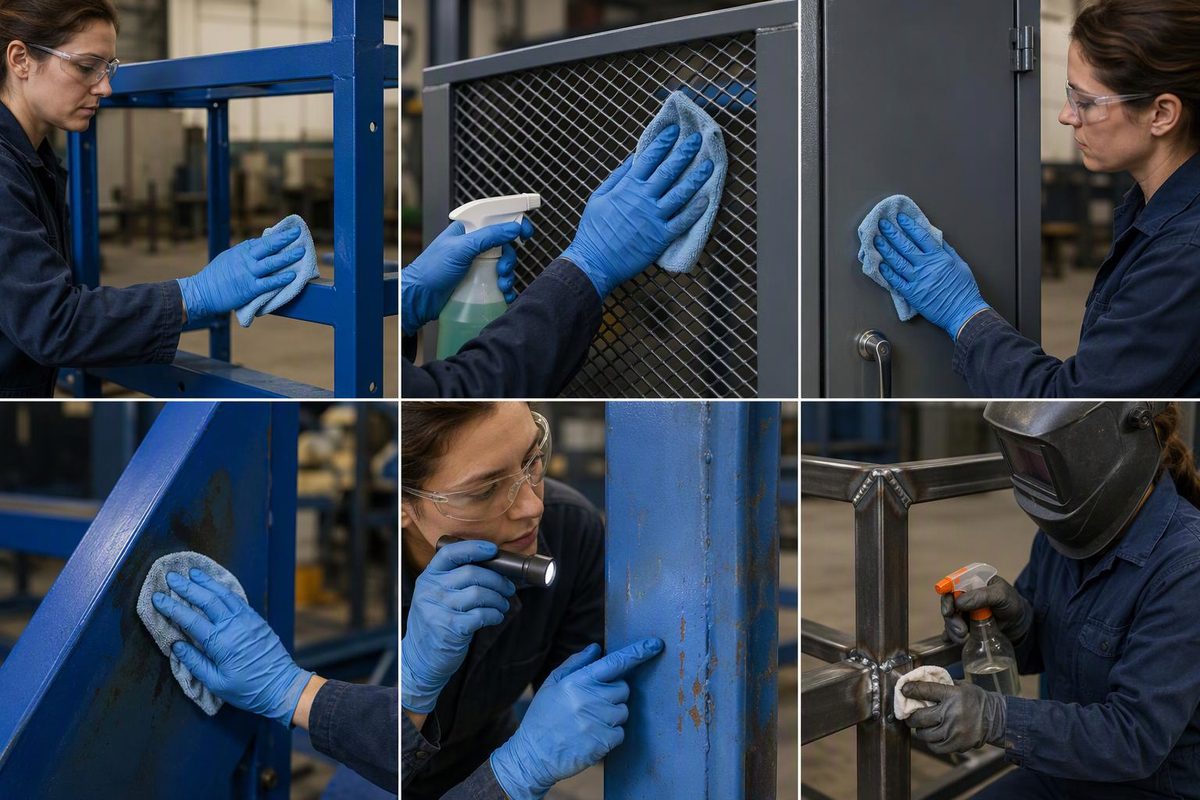
To clean painted metal while keeping the finish intact, start with a dilute solution of mild detergent, a soft cloth or soft-bristled brush, and clean water. Remove loose dirt first, wash gently, rinse away the detergent and dry. This approach is recommended for both coated industrial steelwork and powder-coated metal in Dulux’s paints and coatings care guide.
For painted frames, guards, cabinets and other shop fabrications, the first decision is whether you are removing contamination or dealing with a failing coating. Stronger cleaner will not fix peeling paint or corrosion beneath it.
Check the finish before cleaning
Look for a coating specification, product label or manufacturer’s care instructions. A cleaner approved for one powder coating is not automatically suitable for another paint system. For recently painted parts, follow the coating’s curing and washing instructions rather than assuming that dry-to-touch means ready to scrub.
Inspect edges, weld seams, fasteners and joints for chips, blistering, flaking or rust staining. Dulux identifies these locations as important inspection points on coated steelwork and treats coating damage and corrosion separately from routine cleaning. Its care guide also calls for prompt attention to rust staining.
If you are cleaning a machine enclosure rather than a detached fabrication, follow the equipment manual. Use a damp cloth where appropriate; do not treat vents, switches or electrical compartments as washable panels.
A gentle cleaning sequence
Gather a bucket, mild detergent, clean water, a soft lint-free cloth or non-abrasive sponge, and a soft-bristled brush for corners or textured surfaces. Let hot parts cool and follow any surface-temperature and water-temperature limits in the manufacturer’s care instructions.
- Remove loose deposits. Lift off dust and debris gently with a damp cloth or soft brush. Avoid dragging gritty deposits across the paint.
- Mix a mild cleaning solution. A pH-neutral liquid detergent is a suitable starting point for many powder-coated surfaces. Follow its dilution instructions and any limits in the coating’s care sheet; there is no single mixing ratio for every cleaner and finish.
- Test a hidden spot. Wash, rinse and let the test area dry. Check for a change in colour, gloss or texture before cleaning the visible surface. Stop if the coating softens, lifts or becomes tacky.
- Wash gently in small sections. Use light pressure, working into corners with the soft brush rather than a scraper. On very coarse industrial finishes, a brush may work better than a cloth that can snag and leave fibres.
- Rinse and dry. Remove all detergent with clean water, then dry smooth surfaces with a soft lint-free cloth. On installed equipment, wipe away residue with a clean damp cloth instead of flooding the assembly.
Dulux recommends gentle washing and thorough rinsing for its industrial and powder-coated finishes. Cabinet manufacturer JW Metal Cabinets likewise recommends mild soap, soft cleaning tools, a hidden-area test for new cleaners and drying to prevent water spots in its powder-coating care instructions, which also specify temperature limits.
Grease and stubborn marks: escalate by compatibility
If mild detergent leaves grease, adhesive residue or another stubborn mark, check the finish manufacturer’s approved spot-cleaning products before reaching for a solvent.
Some coatings permit limited solvent cleaning. For example, Dulux’s powder-coating guidance allows recommended solvents such as isopropyl alcohol or methylated spirits on affected areas, followed by rinsing. That is product-specific permission, not a universal rule for painted metal. Follow the approved cleaner’s contact time and precautions, and test first. Source: Dulux care guide.
Avoid wire brushes, steel wool, scouring pads and abrasive cleaners when the aim is to preserve paint. Do not default to bleach, strong acids, alkaline degreasers or unknown solvent blends; JW Metal Cabinets explicitly warns against these on its powder-coated finishes.
If a mark persists while the finish begins changing, stop. Blistering, flaking and corrosion require assessment and a compatible coating repair—not harder scrubbing.
Keep cleaning separate from welding preparation
Washing a painted fabrication does not make it ready to weld or provide bare-metal electrical contact. If the next operation is welding, treat joint preparation separately; see work-clamp contact guidance.
Keep solvent cleaning separate from active welding. Under U.S. OSHA’s general-industry welding requirements, vapours from chlorinated-hydrocarbon cleaning operations must not reach the welding atmosphere. Cleaning products’ toxicity and flammability precautions must also be followed. Do not use a cleaner of unknown composition beside an active arc. OSHA 1910.252(c)(11).