
Inside the Sensors, Electronics and Liquid-Crystal Filter
See how arc sensors, control electronics, liquid crystals and polarizers change a welding helmet’s shade—and why UV/IR protection is separate.
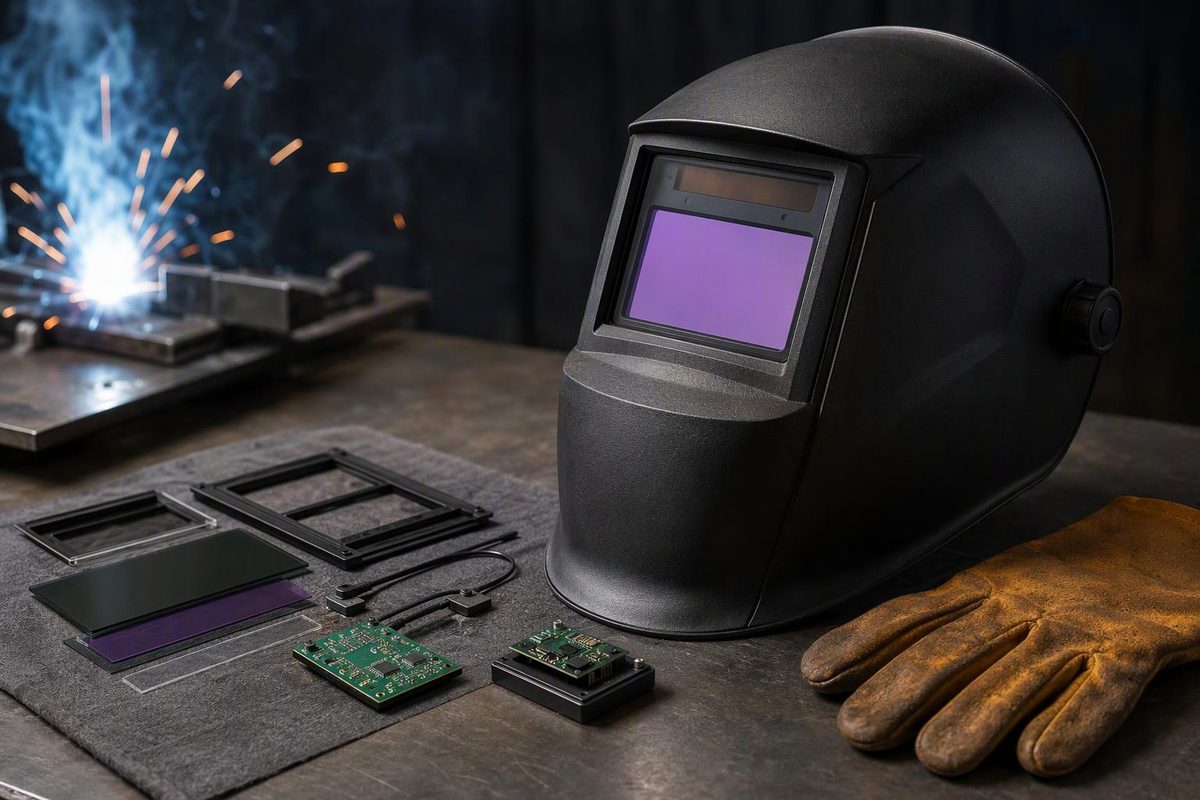
An auto-darkening welding helmet uses an electrically controlled optical shutter. In a typical light-triggered design, sensors detect the arc, electronics change the voltage driving liquid-crystal cells, and those cells work with polarizing filters to reduce the visible light reaching your eyes. The lens stays in place; its light transmission changes. GVS-RPB’s ADF explanation describes the layered filter construction.
The key distinction is that the liquid crystals control visible darkness, while a separate UV/IR filter provides ultraviolet and infrared protection.
What Actually Makes the Lens Dark?
The viewing cartridge is called an auto-darkening filter, or ADF. Its optical stack includes a UV/IR filter, polarizing filters and liquid-crystal cells. The cells sit between polarizing layers; they are not simply a sheet of glass that becomes tinted. GVS-RPB
To understand the shutter, picture light as a wave with an orientation of vibration—its polarization. A polarizer passes one orientation more readily than others. Two polarizers oriented at right angles can strongly block light, but a liquid-crystal cell between them can change the light’s polarization and therefore how much passes through the second filter.
Applying an electric field changes the alignment of the liquid-crystal molecules, changing their effect on the light. The combination of liquid crystals and polarizers becomes an adjustable light attenuator: one electrical state transmits more light, another transmits less. Meadowlark Optics explains this operating principle.
That is the physical darkening mechanism. It is not a mechanical shutter sliding across the window. Actual ADFs use layered arrangements, so “power on means dark” is not a universal rule: the resulting shade depends on the optical arrangement and electrical drive.
From Arc Light to a Dark Welding View
The switching sequence has three parts:
- Detection: Optical sensors receive light from the welding arc.
- Control: The sensor circuit produces an electrical signal. Control electronics respond by changing the drive to the liquid-crystal filter.
- Attenuation: The liquid crystals change how light passes through the polarizing stack, producing the dark welding state.
A published welding-filter patent application documents one implementation: a photoelectric diode feeds a sensing circuit, a threshold determines when it triggers, and the control circuit drives the liquid-crystal viewing module. The exact circuit varies by helmet, but this explains why the sensors and the darkening window perform different jobs.
It also explains why switching speed alone cannot guarantee reliable operation. If an arm, torch or joint blocks the sensors’ view, the electronics may not receive the trigger they need. Lincoln’s 2015 VIKING 3350 manual identifies blocked sensors as a reason the filter may fail to darken when the arc is struck.
The electronics need power. A solar panel is part of the power supply, not the liquid-crystal shutter itself. “Solar-powered” does not necessarily mean battery-free: that Lincoln manual documents a cartridge using both solar power and a replaceable battery. Check your exact model’s manual for its power arrangement.
Why It Lightens Again—and What Stays Protective
After the arc stops, the control system returns the ADF to its light viewing state. An adjustable delay can hold it dark while the hot puddle still glows. Delay controls dark-to-light return, not how quickly the lens darkens at arc initiation. Sensitivity affects triggering; shade determines the dark viewing level. These functions are documented in the Lincoln manual.
UV/IR protection does not wait for that switching sequence. Lincoln states that its filters provide UV/IR protection in both light and dark states. That is not permission to weld through a failed ADF: the required dark shade still matters, and a damaged cartridge must not be used.
For shade selection, pre-use checks and troubleshooting, use our auto-darkening helmet selection and settings guide. If the filter fails to darken or flickers during welding, stop the arc before investigating.