
MIG vs. Flux-Core Welding: Choose by Shielding, Job and Setup
Compare solid-wire MIG, self-shielded flux-core and gas-shielded flux-core by cleanup, wind tolerance, material thickness and equipment setup.
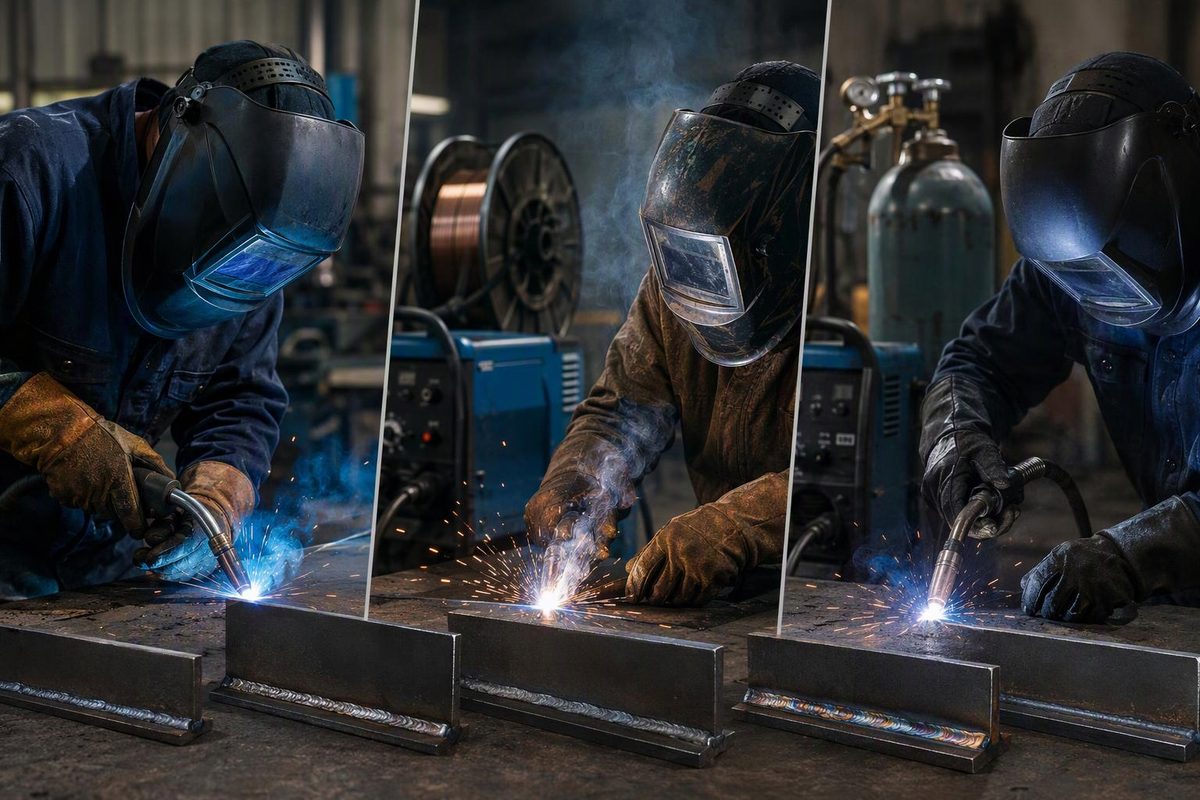
The main difference is the wire and how the molten weld is shielded from air. Solid-wire MIG uses externally supplied shielding gas. Flux-core welding uses tubular wire containing flux: self-shielded wire works without a gas cylinder, while gas-shielded flux-core still needs one.
For clean, thin steel indoors, solid-wire MIG is usually the more practical choice. For outdoor steel repairs where shielding gas would be difficult to protect from wind, self-shielded flux-core is often better suited. Gas-shielded flux-core is a separate option for heavier fabrication—not another name for gasless welding. Miller’s process comparison explains these distinctions.
MIG vs. flux-core at a glance
Here, MIG means the common shop usage: solid-wire gas metal arc welding, or GMAW. Flux-core means flux-cored arc welding, or FCAW. Both continuously feed an electrode through a gun; that wire carries welding current and melts into the joint. The job-selection advice below focuses on mild steel.
| Feature | Solid-wire MIG/GMAW | Self-shielded flux-core/FCAW-S | Gas-shielded flux-core/FCAW-G |
|---|---|---|---|
| Wire construction | Solid metal wire | Tubular wire containing flux | Tubular wire containing flux |
| External shielding gas | Required | Not required | Required |
| Slag covering | No flux slag layer | Yes; remove after welding and between passes | Yes; remove after welding and between passes |
| Wind exposure | Gas coverage needs protection | Better suited to outdoor work | Gas coverage needs protection |
| Typical reason to choose it | Thin material and less cleanup | Portability and outdoor steel work | Deposition rate and heavier fabrication, including suitable out-of-position work |
| Polarity | Normally DCEP: gun positive | Often DCEN: gun negative; check the wire | Follow the wire’s specified polarity |
The shielding and application differences come from Miller’s comparison. Its MIG guide identifies DCEP as the normal MIG arrangement; Hobart’s technical explanation in The Welder stresses that FCAW polarity depends on wire formulation.
What the shielding changes in practice
MIG gas flows through the nozzle around the arc and weld pool, protecting molten metal from the surrounding atmosphere. Wind can displace that coverage and cause porosity. This also affects gas-shielded flux-core: having flux inside the wire does not make its required external gas optional. Miller explains the shielding risks for both gas-dependent processes.
Self-shielded wire generates its shielding through reactions of the flux in the arc. It removes the cylinder, regulator and gas hose from the setup, making field work simpler. That is why a machine advertised as a “gasless MIG welder” is usually running FCAW-S rather than solid-wire MIG. See the gasless welding setup guide for the equipment checks.
Flux-cored wires also form slag. The slag protects the cooling weld, and suitable fast-freezing slag systems help support the pool during vertical-up or overhead welding. Miller describes this pool-support mechanism. The tradeoff is cleaning between passes: slag left in the joint can become trapped in the next deposit. Hobart’s flux-core explanation covers slag removal and techniques to avoid inclusions.
Which process fits your job?
Thin sheet and clean indoor fabrication: usually MIG
Solid-wire MIG avoids slag removal and, with a suitable short-circuit setup, can reduce burn-through risk on thin material. It is a sensible starting choice for light sheet-metal fabrication and automotive bodywork. Miller recommends solid wire for thinner applications.
That is a process choice, not a universal setting. Sheet thickness, joint gap, wire diameter, machine output and travel speed still determine whether you burn through or achieve fusion. Do not treat example parameters as settings for every sheet-metal joint.
Outdoor steel repairs: usually self-shielded flux-core
Choose FCAW-S when portability and wind exposure are the main problems. Verify the particular wire’s material, thickness and position limits before starting.
“Flux-core penetrates better” does not mean a small welder can weld any thickness. For example, Lincoln’s NR-211-MP product information specifies a maximum plate thickness of 5/16 inch (7.9 mm) for .045-inch and smaller diameters. That consumable limit is not a promise that every machine using that wire can make the required joint.
Heavy fabrication: consider gas-shielded flux-core
FCAW-G can offer high deposition rates and good pool support for suitable out-of-position work. It deserves consideration when filling larger joints, provided the machine, wire, shielding gas and welding procedure match the application. Miller identifies thicker metal and out-of-position welding as common reasons to choose it.
Neither process excuses poor preparation. Flux-cored wire can tolerate some surface contamination better than solid wire, but clean the joint rather than relying on flux to deal with rust, oil or paint. Miller recommends cleaning before welding with either wire type.
Strength and cost: neither has an automatic advantage
Neither process is inherently stronger. Joint design, fusion, filler properties and the welding procedure matter more than the process label. A smooth MIG bead does not prove root fusion; an aggressive flux-core arc does not prove a sound weld. Lincoln explicitly warns that consumable test results are not guaranteed results in an actual weldment and calls for appropriate qualification or testing in its NR-211-MP datasheet.
For cost, compare the whole job—not just the spool. MIG needs gas equipment and refills. FCAW-S avoids those costs but adds slag-cleaning time, while part of the wire becomes slag rather than deposited weld metal. FCAW-G still needs gas, yet higher deposition rates can reduce production time. Hobart’s comparison explains why wire price alone is misleading.
Switching processes: check setup before changing settings
A wire-feed machine may support both MIG and flux-core, but do not assume that accepting the spool makes it compatible. Use this sequence:
- Read the machine manual and wire data. Confirm supported process, diameter, output range, welding position and any single-pass or thickness restrictions.
- Check polarity. Solid-wire MIG normally uses gun positive. NR-211-MP specifies gun negative. Other flux-cored wires may differ; “all flux-core is negative” is not a safe rule.
- Match the feed components. Verify drive-roll groove, contact-tip size and liner compatibility. Adjust roll pressure and spool tension according to the manual rather than tightening until the wire deforms.
- Match shielding and technique. Supply the specified gas for MIG or FCAW-G. For flux-core, use the wire’s recommended contact-tip-to-work distance and generally a drag technique to keep slag behind the arc.
- Start with the correct chart, then weld a representative coupon. Match material, thickness, joint and position. Do not carry MIG voltage and wire-speed settings unchanged into FCAW.
These checks draw on Miller’s setup guidance and Hobart’s wire-specific equipment and technique guidance. The wire’s specified polarity and distance take priority over generic process advice. For symptom-by-symptom checks after conversion, use the flux-core setup and troubleshooting guide.
If the new setup spits, stubs or develops porosity, first recheck wire identity, polarity, feeding and shielding—not just voltage. A weld that merely looks better is not evidence that a critical joint meets its acceptance requirements.
Gasless does not mean fumeless. Both processes require appropriate eye, skin and fire protection. OSHA lists FCAW as generally higher-fume-producing than GMAW and warns that outdoor welding does not guarantee adequate ventilation. Keep your breathing zone out of the plume and use appropriate exposure controls; see OSHA’s welding-fume guidance.