
Does Flux Core Welding Wire Go Bad? Check Storage, Not Just Age
Old flux-cored wire may still be usable. Learn how shelf life, moisture, rust and packaging affect whether to test, replace or recondition a spool.
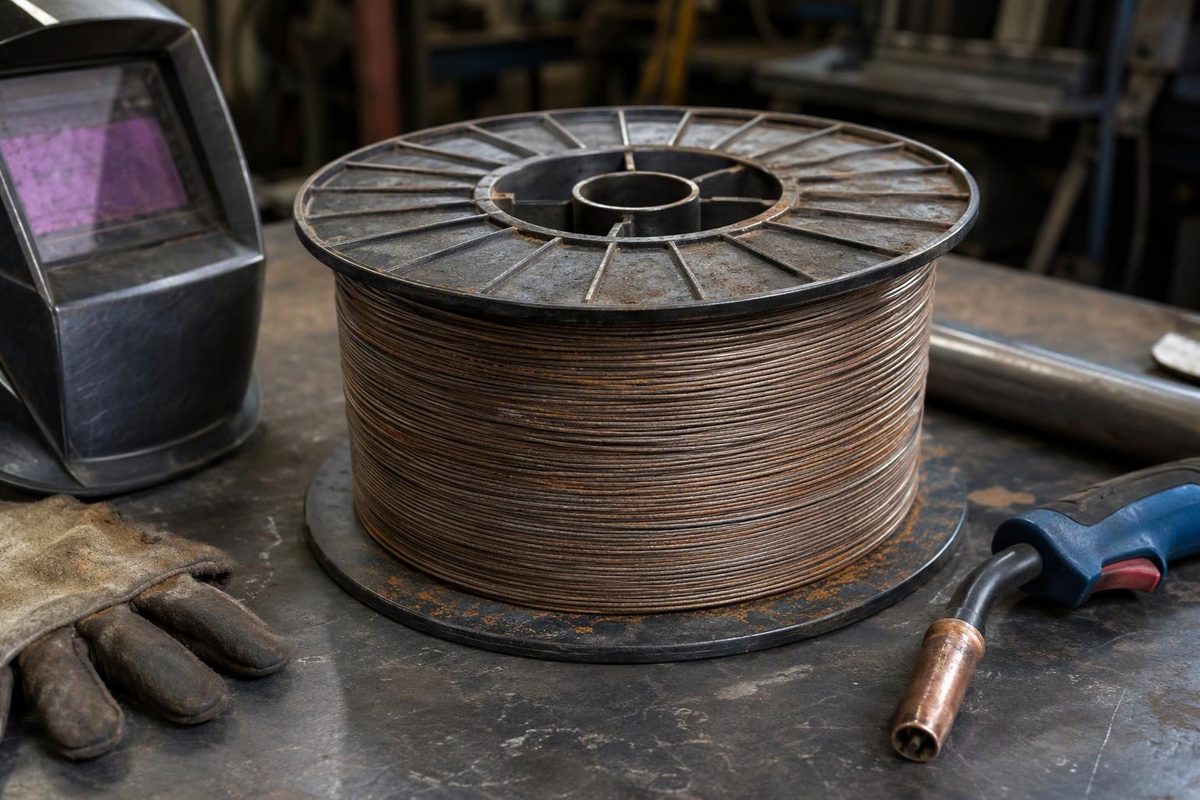
Yes—flux-cored welding wire can deteriorate, but age alone does not tell you whether a spool is usable. Moisture exposure, corrosion, contamination and damaged packaging matter. A properly stored, sealed spool is a different proposition from one left uncovered in a damp garage.
Do not assume wire lasts indefinitely, either. Manufacturers publish shelf-life and handling limits. Check the exact product and packaging before deciding to use an old spool.
How long does flux-cored wire last?
There is no single expiration period for all flux-cored wire. For example:
- Lincoln Electric Europe’s storage instructions specify a three-year shelf life for the consumables covered by that document, extendable to five years for vacuum-packed consumables, provided storage and handling requirements are met. The document includes both Innershield and Outershield cored wires. It also notes that individual products might last longer; the published limit accounts for possible changes in standards or formulas, not just physical deterioration. Source: Lincoln Electric
- ESAB’s September 2018 North American guidance lists five years for Dual Shield and Coreshield cored wires in vacuum bags, but one year in other packages. These figures assume unopened storage protected from water; nonhermetic packages also require steady conditions of 50–90°F (10–32°C) and no more than 50% relative humidity. These are dated, product-specific figures—not a universal rule for another brand or today’s product label. Source: ESAB
Unopened shelf life is not the same as allowable exposure after opening. ESAB’s same guidance recommends using its carbon-steel and low-alloy Dual Shield, Coreweld and Coreshield wires within one week after opening for best results, with storage measures specified when that is not possible. A cardboard box containing a plastic bag is not necessarily a hermetically sealed package.
If the spool is past its published limit, ask the manufacturer about the product and lot rather than treating a good-looking bead as an extension of its shelf life.
What actually goes bad?
The steel sheath can corrode, and the core ingredients can absorb moisture. Susceptibility varies with wire construction and formulation. Lincoln’s instructions require protection from damp conditions and temperature/humidity extremes that can cause condensation; they call for discarding rusty or seriously water-contaminated cored wire. Source: Lincoln Electric
Moisture can produce porosity and surface gas trails, often called worm tracks. It can also increase diffusible hydrogen in deposited weld metal—a concern for hydrogen-assisted cracking in susceptible joints. A 2023 study of four gas-shielded, high-strength-steel cored wires found that storage exposure changed surface condition and increased deposited-metal hydrogen for several of the tested wires. That study supports the deterioration mechanism; it does not establish a lifespan for every small self-shielded spool. Sources: ESAB, Wolski and colleagues
A clean exterior therefore does not prove that the core is dry, and an acceptable-looking bead does not establish weld soundness.
Should you use the old spool?
Use this sequence before loading it:
- Identify it. Confirm the product name, classification, diameter and lot/date information. If the label is missing, appearance alone cannot establish the wire’s suitability, polarity or shielding requirements.
- Check its history and packaging. Was it sealed and stored dry, or left on the feeder through damp weather? A broken vacuum seal removes the protection that sealed-storage guidance assumes.
- Inspect the wire. Rust, serious water exposure or significant contamination is a reason to reject it—not simply adjust the welder around it. Lesser moisture exposure still needs evaluation under the product’s handling instructions.
- Separate practice from consequential work. For noncritical practice, a clean, identified spool within its manufacturer’s limits can be evaluated on clean scrap after verifying setup. For structural, pressure-containing or other safety-critical work, replace wire with unknown storage history with documented consumable and follow the welding procedure’s handling requirements.
If the old wire feeds poorly or produces porosity, worm tracks or an erratic arc, stop and investigate. Those symptoms are not unique to aged wire. Check the setup using the flux-core troubleshooting sequence; where practical, compare against fresh wire of the same product and diameter. That comparison helps isolate a consumable problem, but it does not qualify the finished weld.
Can you dry it out?
Do not apply an E7018 stick-electrode baking schedule to flux-cored wire. Reconditioning is product- and package-specific. Lincoln’s cited instructions permit conditioning certain wires on metal spools, while ESAB’s cited guidance provides separate schedules for certain coils and wire baskets and says plastic-spooled wire cannot be reconditioned. Lincoln explicitly calls for discarding rusty or seriously water-contaminated wire rather than trying to restore it. Sources: Lincoln Electric, ESAB
Only recondition wire when the manufacturer authorizes it for that exact product and package. Otherwise, replace the suspect spool.
To preserve the next spool, keep unopened packaging intact, store it in a dry environment within the product’s temperature/humidity limits, and return opened wire to its original packaging, sealed as well as possible, when not in use. Avoid condensation—not just direct rain—and retain the label and opening date.