
Choose the Wire That Fits the Metal, Machine, and Working Conditions
E71T-11 fits versatile outdoor repair; E71T-GS is a narrower single-pass option, while critical work needs a qualified wire and procedure.
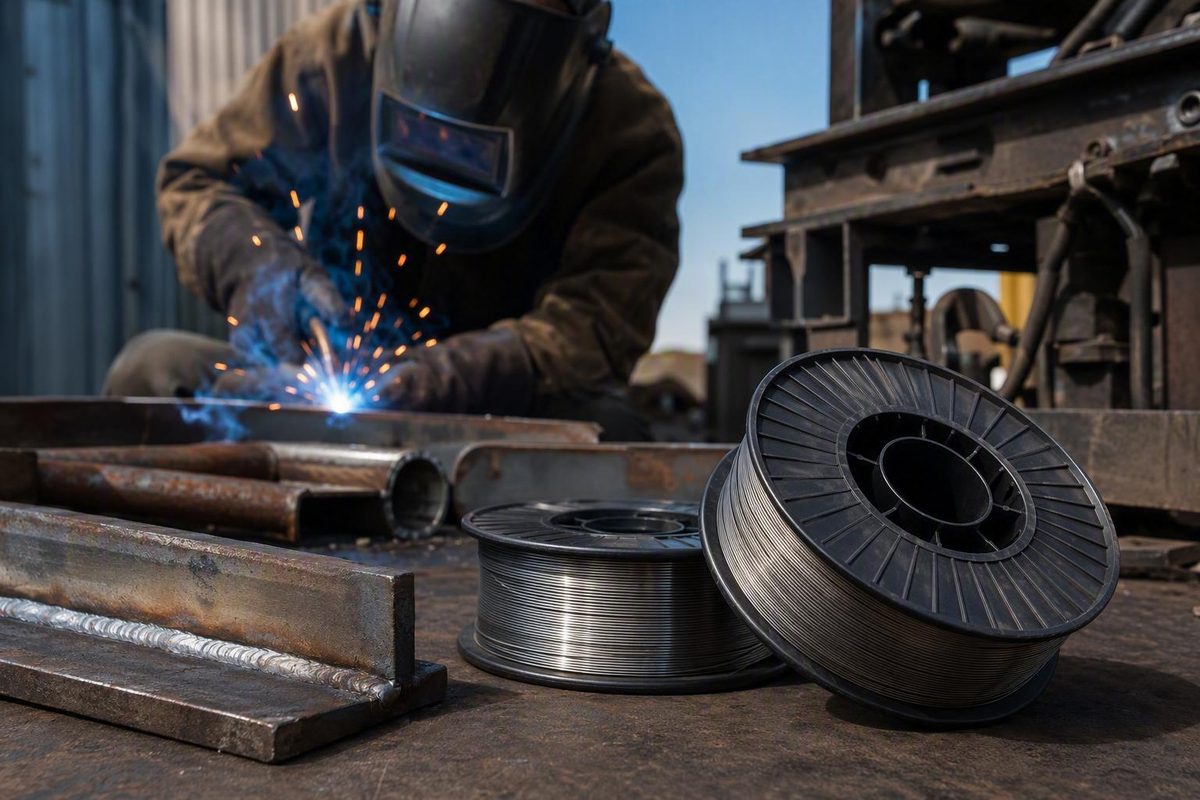
Best flux core welding wire: choices by job and welder
The short answer: the best wire depends on the job
There is no single best flux core welding wire. The defensible choice is the wire whose shielding method, classification, diameter, polarity, operating range, mechanical properties, and pass limitations fit the work and the welding machine.
Start with the application rather than the brand:
| Use case | Practical starting category | Why it belongs on the shortlist | What must be verified |
|---|---|---|---|
| Outdoor, noncritical mild-steel repair requiring multiple passes | Self-shielded E71T-11 | No external shielding gas; commonly associated with repair and general fabrication; classification guidance permits single- or multipass welding | Exact product, diameter, polarity, position, material limits, machine output, and operating range |
| Thin mild or galvanized steel requiring one pass | Self-shielded E71T-GS | Commonly marketed for thin-gauge, single-pass work | Material, thickness, position, polarity, mechanical properties, and the product’s single-pass restrictions |
| Controlled shop welding on thicker carbon steel | Application-matched FCAW-G wire | Worth investigating where shielding gas can be protected and productivity or positional capability matters | Required gas, base-metal match, position, mechanical properties, parameters, and procedure |
| Structural, seismic, low-temperature, or impact-sensitive welding | Procedure-specified T-8, T-8-J, or another qualified classification | More relevant than general-purpose T-11 when documented toughness or structural requirements apply | Governing code, qualified procedure, complete classification, current approvals, equipment, and lot documentation |
| High-deposition flat or horizontal welding | Application-matched T-4, T-6, or T-7 | Specialized self-shielded categories with different polarity and toughness provisions | Position, polarity, toughness requirements, operating range, cracking controls, and machine capacity |
| Stainless or low-alloy steel | Matching stainless or low-alloy filler classification | Mild-steel wire is not a substitute for alloy-matched filler metal | Base-metal specification, filler classification, shielding method, procedure, strength, and corrosion requirements |
For ordinary outdoor mild-steel repair, a machine-compatible E71T-11 self-shielded wire is often the most versatile category to investigate when multiple passes may be needed. It is not automatic approval for a load-bearing trailer component, structural member, lifting device, pressure component, or another safety-critical joint. Hobart’s classification guidance associates T-11 with general repair and single- or multipass work but notes that AWS A5.20 imposes no impact-toughness requirement on that classification. Exact products and diameters can have additional limits. See Hobart’s FCAW-S classification overview.
For thin material requiring only one pass, E71T-GS may be suitable. The designation does not provide enough information to choose a spool without its documentation. For example, PGN describes its E71T-GS wire as self-shielded and intended for single-pass welding of thin mild and galvanized steel, with that product’s guidance limited to flat and horizontal positions. The same vendor presents its E71T-11 product as an all-position, single- or multipass option. Those are product-specific vendor statements, not proof that every GS or T-11 wire has identical operating limits. Review the vendor’s E71T-GS and E71T-11 comparison.
In a protected fabrication shop, gas-shielded flux-cored wire may be the better category to investigate for thicker work, higher deposition, or vertical-up and overhead welding. It is not automatically better than self-shielded wire: it adds gas equipment, requires the exact gas specified for the electrode, and needs protection from drafts.
A T-8, T-8-J, or another specified classification may be relevant, but a family name alone does not approve a product, diameter, or joint.
This mild-steel shortlist also does not extend to stainless or low-alloy steel. Those materials require filler classifications matched to the base metal and service conditions.
No named manufacturer is crowned the overall winner here. The available evidence includes manufacturer guidance, retailer listings, and uncontrolled forum reports, but no independent head-to-head test using identical machines, joints, steel, settings, storage conditions, operators, and inspection methods. This is therefore a classification-led selection guide, not a current product ranking.
Self-shielded or gas-shielded flux core?
Flux-cored wire is a continuously fed tubular electrode containing flux ingredients. It falls into two broad process categories:
- FCAW-S: self-shielded flux-cored arc welding
- FCAW-G: gas-shielded flux-cored arc welding
Both use tubular wire and produce slag, but their shielding requirements and suitable working environments differ.
When FCAW-S makes sense
Self-shielded wire generates the shielding needed by the process and does not require an external gas cylinder. It is generally the first category to investigate for field repairs, farm work, construction sites, and other locations where transporting gas is inconvenient or maintaining an external shielding envelope is difficult.
That outdoor advantage is conditional. Wind, access, joint preparation, and operator control still matter, and every electrode has its own limits. The key distinction is that FCAW-S does not depend on externally supplied shielding gas around the weld pool.
Self-shielded does not mean universally interchangeable. FCAW-S wires differ in:
- Required polarity
- Permitted welding positions
- Single- or multipass capability
- Mechanical and impact properties
- Electrode extension
- Diameter-specific operating ranges
- Power-source and feeder requirements
- Permitted base materials and applications
Choose the exact product only after checking those requirements.
When FCAW-G makes sense
Gas-shielded flux-cored wire requires external shielding gas. The permitted gas must come from the exact product documentation rather than a generic recommendation; different electrodes may specify carbon dioxide or a particular argon/carbon-dioxide mixture.
FCAW-G is worth investigating in controlled conditions when welding thicker material or when an application-specific electrode offers the required deposition rate or positional capability. Some gas-shielded wires are designed for vertical-up or overhead welding, but those characteristics should not be attributed to every FCAW-G product.
Draft protection matters because wind can displace external shielding gas and contribute to porosity. Miller’s process comparison identifies self-shielded wire as the outdoor-oriented option and gas-shielded flux core as a category to consider for thicker or out-of-position work. See Miller’s FCAW process comparison.
The statement that “flux core is good outdoors” is therefore incomplete. The outdoor advantage primarily applies to self-shielded flux core.
FCAW-S versus FCAW-G checklist
| Decision point | FCAW-S | FCAW-G |
|---|---|---|
| External gas equipment | Not required | Cylinder, regulator or flowmeter, hose, and compatible gun system required |
| Wind sensitivity | Does not rely on an external gas envelope | External shielding can be displaced, so protected conditions matter |
| Likely environment | Field, farm, outdoor repair, mobile work, or a shop avoiding gas equipment | Controlled fabrication shop or sheltered jobsite |
| Cleanup | Produces slag; spatter and slag behavior depend on the wire and settings | Produces slag; release and cleanup vary by product |
| Welding position | Determined by classification, diameter, and product instructions | Determined by classification and slag system |
| Productivity priority | Continuous wire feeding without external-gas logistics | Often investigated for application-specific deposition or positional performance |
| Main compatibility risk | Wrong polarity, inadequate output, incorrect extension, or feeder mismatch | Wrong gas, drafts, incorrect polarity, inadequate output, or feeder mismatch |
| Best reason to investigate | Portability and independence from external shielding gas | Controlled shielding combined with application-specific properties |
Choose the shielding method first. Compare classifications and brands only within the correct process.
Best wire category by use case
A useful recommendation identifies both a starting category and the conditions that could disqualify it.
| Use case | Environment | Typical pass requirement | Likely position | Category to investigate | Mandatory verification |
|---|---|---|---|---|---|
| Home, farm, and ordinary noncritical mild-steel repair | Often outdoors or in an open shop | Single or multiple | Flat, horizontal, or out of position as documented | FCAW-S E71T-11 | Machine support, diameter, polarity, position, material limits, and joint requirements |
| Load-bearing or road-going trailer component | Shop or field | Procedure dependent | Procedure dependent | Design- and procedure-specified filler | Design requirements, qualified procedure, inspection, base metal, and current product documentation |
| Thin-gauge repair | Indoor or outdoor | Single pass | Product dependent | FCAW-S E71T-GS | Material, thickness, position, polarity, properties, and single-pass restriction |
| Windy industrial field work | Outdoor | Varies | Often out of position | Current application-matched FCAW-S product | Data sheet, machine mode, output, extension, positions, material range, approvals, and procedure |
| General all-position multipass fabrication | Shop or field | Multiple | All position only if documented | E71T-11 for ordinary work or another application-specific class | Diameter-specific positions, operating range, toughness needs, and procedure |
| Structural or impact-sensitive work | Shop or field | Commonly multiple | As required by the procedure | Qualified T-8, T-8-J, or another specified classification | Code, WPS, approvals, toughness, base-metal group, equipment, and consumable controls |
| High-deposition production | Controlled or application-specific | Single or multiple | Generally flat or horizontal for T-4, T-6, and T-7 | Specialized T-4, T-6, or T-7 | Position, polarity, toughness, cracking controls, procedure, and capacity |
| Thicker steel fabrication | Protected shop | Often multiple | Product dependent | Suitable FCAW-G classification | Base metal, gas, properties, positions, parameters, and WPS |
Home, farm, and general repair
For ordinary, non-code mild-steel repair where multiple passes may be necessary, E71T-11 is a logical self-shielded classification to shortlist. It is commonly associated with home, farm, maintenance, and general-fabrication work.
A T-11 label does not guarantee that every spool will run properly in every compact feeder. Product diameter, machine output, polarity, feeder design, duty cycle, and the manufacturer’s operating window still control.
Treat load-bearing trailer parts separately from routine brackets, gates, carts, and noncritical repairs. If failure could cause injury or loss of control, selection must be based on the applicable design, procedure, documentation, and inspection requirements—not on T-11’s general-purpose reputation.
Thin-gauge single-pass repair
E71T-GS may be appropriate when:
- The exact product supports the base metal
- The joint can be completed in one pass
- The product permits the intended position
- The machine supports the required diameter and polarity
- The documented material range includes the work
Do not use overlapping or repeated beads to turn a single-pass GS product into a multipass electrode. The S is a consumable restriction, not merely advice to finish quickly.
A vendor’s statement that its wire can be used on galvanized material also does not remove the need for suitable preparation, PPE, ventilation, and the controls required by the coating, workplace, and product safety information.
Windy industrial field work
Hobart 21-B and Lincoln NR-211 or NR-212 appeared in a 2011 forum discussion about self-shielded field welding. Participants also mentioned NR-232 and NR-233 for more specialized work, but they disagreed about performance and equipment requirements. These names are historical research leads only; the discussion does not verify current classifications, availability, approvals, parameters, or machine compatibility. Read the dated WeldingWeb discussion in context.
Do not buy one of these products from the forum name alone. For the precise trade name, diameter, and package:
- Find the manufacturer’s current product page.
- Download the current technical data sheet.
- Record its publication or revision date.
- Confirm the complete classification and supplemental designators.
- Compare polarity and required power-source mode with the welder manual.
- Compare the operating range with the machine’s rated output and duty cycle.
- Confirm electrode extension, positions, pass limits, material range, and feeder requirements.
- Check current approvals against the governing WPS, code, and contract.
- Resolve any conflict in favor of the governing procedure and current manufacturer documentation.
If no current manufacturer sheet can be found, the forum mention is not enough to support a purchase for industrial or critical work.
Structural and impact-sensitive work
T-11 should not be treated as the default for structural, seismic, low-temperature, or impact-critical welding. Hobart’s manufacturer guidance says AWS A5.20 does not impose an impact-toughness requirement on T-11 and describes T-8 as an all-position, single- or multipass family with low-temperature impact provisions. The same guidance reports different test temperatures for the base T-8 and J designations, but the governing specification and current product documentation must be checked before those values are used for design or procedure decisions. See Hobart’s classification summary and its stated limitations.
High-deposition flat and horizontal work
Manufacturer classification guidance describes T-4, T-6, and T-7 as specialized self-shielded categories generally used for flat or horizontal high-deposition work. In that guidance:
- T-4 uses DCEP and has no AWS A5.20 impact-toughness requirement.
- T-6 uses DCEP, permits single- or multipass welding, and includes stated impact provisions.
- T-7 uses DCEN, permits single- or multipass welding, and has no AWS A5.20 impact-toughness requirement.
These are classification-level summaries from a consumable manufacturer, not substitutes for the current AWS specification or the exact product sheet. They are sufficient to show why the categories are not interchangeable, but not to approve a product for a project.
Controlled fabrication on thicker steel
For protected shop work, investigate an FCAW-G wire matched to:
- Carbon, low-alloy, or stainless base metal
- Required strength and toughness
- Permitted shielding gas
- Welding position
- Joint design
- Deposition objective
- Power-source and feeder capacity
- Applicable WPS and code
Do not choose FCAW-G solely because of a high-deposition claim. If the shop cannot supply the specified gas, protect the shielding envelope, or maintain the documented operating range, the product is not a practical match.
Decode the label before comparing brands
AWS classifications communicate capabilities and restrictions that are more useful than marketplace popularity. They do not communicate every product-specific approval, diameter restriction, or operating characteristic.
Worked example: E71T-1C-H8
In the example designation E71T-1C-H8:
- E means electrode.
- 70 indicates a 70,000 psi as-welded tensile-strength class.
- 1 indicates all-position use.
- T identifies a tubular electrode.
- C indicates carbon-dioxide shielding in that designation.
- H8 indicates a maximum diffusible-hydrogen level of 8 milliliters per 100 grams of deposited weld metal.
This breakdown comes from a manufacturer’s classification guide rather than the governing AWS specification, so it should be used as an introduction to label reading, not as the sole authority for procedure or purchasing decisions. See the NS Arc classification example.
The worked example also does not mean every classification follows one simple pattern. Read the complete designation under the applicable specification and confirm it against the product documentation.
What E71T-11 tells you
Manufacturer guidance associates E71T-11 with:
- Self-shielded operation
- All-position capability at the classification level
- Single- or multipass welding
- DCEN polarity
- General repair and fabrication
- No AWS A5.20 impact-toughness requirement
The exact product sheet controls diameter-specific positions, parameters, material limits, electrode extension, packaging, storage instructions, and approvals. Two E71T-11 products are not necessarily interchangeable.
What E71T-GS tells you
E71T-GS is commonly sold as self-shielded wire for single-pass work, often on thin steel.
The suffixes have distinct implications:
- G means the designation does not communicate all essential properties or usability characteristics through one fully defined class, so the manufacturer’s documentation becomes especially important.
- S denotes a single-pass restriction.
A G or GS marking does not prove that the wire is poor quality. It means buyers have less classification-level information on which to base assumptions. A forum discussion distinguishes the G designation from the S restriction but should be treated as explanatory commentary rather than an AWS authority. See the archived E71T-11 versus E71T-GS discussion.
What T-8 and T-8-J tell you
Manufacturer classification guidance presents T-8 as an all-position, self-shielded category supporting single- or multipass welding with low-temperature impact provisions. It presents the J designator as indicating testing at a lower temperature than the base classification.
That information identifies a family worth investigating when toughness matters. It does not approve a product for a bridge, seismic connection, low-temperature structure, or another code-controlled application. Confirm the applicable specification, complete designation, current product data sheet, governing code, and qualified procedure.
Classification versus product performance
A classification may communicate some combination of:
- Strength class
- Position
- Shielding method or gas
- Pass capability
- Toughness provisions
- Hydrogen designator
- Chemical or usability requirements
It may not establish:
- How the wire feeds in a particular machine
- Whether the machine can reach its operating window
- How slag behaves in a particular joint
- Whether the spool package fits
- Whether a specific diameter permits every classification-level position
- Whether a project currently approves the trade name
- Whether storage or package damage has affected the wire
Classification comes before brand, but the exact product sheet comes before purchase.
Choose .030, .035, or .045 inch by machine and material
There is no universal rule making .030-, .035-, or .045-inch wire the best choice for a stated plate thickness. Usable diameter depends on the exact consumable, approved operating range, machine output, joint design, welding position, travel technique, pass sequence, and duty cycle.
In broad terms:
- Smaller diameters may be easier to operate on thinner material or lower-output machines.
- Larger diameters may support greater deposition or thicker work when the machine and feeder can run them correctly.
- Position can influence diameter selection independently of thickness.
- Duty cycle can disqualify an otherwise workable diameter during sustained welding.
Consumer-facing wire commonly includes .030-, .035-, and .045-inch sizes, while industrial catalogs include additional diameters. A manufacturer selection guide identifies .030 through .045 inch as common sizes but makes equipment and material compatibility the deciding factors. See D&H Sécheron’s diameter overview.
A spool is not compatible merely because it fits on the spindle. Confirm:
- Supported wire diameter
- Machine output range
- Duty cycle at the intended output
- Power-source mode
- Required polarity
- Spool diameter and weight
- Suitable drive-roll type and groove
- Correct contact-tip size
- Gun, liner, and feed-path compatibility
- Required shielding method or gas
- Diameter-specific operating range
A favorable forum report about .030-inch wire in one small welder is not a rule for another model.
Industrial catalogs illustrate the market’s range rather than a quality hierarchy. One specialist retailer lists diameters beyond the three common consumer sizes and packages ranging from small spools to bulk formats, but inventory and price do not establish suitability or performance. See the retailer’s FCAW-G catalog.
Pre-purchase machine worksheet
| Item | Your requirement |
|---|---|
| Welder make and model | |
| Input power available | |
| Power-source mode | |
| Rated output range | |
| Duty cycle at intended output | |
| Supported FCAW process | |
| Supported wire diameters | |
| Maximum spool diameter and weight | |
| Contact-tip size | |
| Drive-roll type and groove | |
| Gun and liner compatibility | |
| Available polarity | |
| Base-metal specification | |
| Material thickness | |
| Joint type and preparation | |
| Welding position | |
| Single- or multipass requirement | |
| Required shielding method or gas | |
| Required mechanical or impact properties | |
| Governing WPS, code, or manufacturer instructions |
If a compatibility field is unknown, stop before ordering. Compare the welder manual with the current wire data sheet or ask a qualified distributor to confirm the match.
Polarity and power-source compatibility can disqualify a wire
Polarity is a mandatory purchasing check, not a setup detail to discover after opening the spool.
Manufacturer classification guidance lists:
- T-4: DCEP
- T-6: DCEP
- T-7: DCEN
- T-8: DCEN
- T-11: DCEN
These are category-level summaries. The instructions for the exact product and diameter control.
A machine marketed as “flux core capable” is not necessarily capable of running every self-shielded electrode. Follow the machine’s polarity diagram rather than inferring polarity from the gun connection.
Power-source mode matters
Industrial field wires may require a particular power-source mode, feeder arrangement, output range, and electrode extension that a compact machine cannot provide. Historical forum discussions contain claims about particular NR-series wires running on constant-current or constant-voltage equipment, but those comments are dated, equipment-specific anecdotes—not current operating instructions.
Use this verification sequence for the exact trade name and diameter:
- Record the full product name, classification, diameter, and package SKU.
- Locate the manufacturer’s current technical data sheet.
- Record the sheet’s revision or publication date.
- Confirm required polarity and power-source mode.
- Compare voltage or current and wire-feed ranges with the machine’s rated capabilities.
- Confirm electrode extension, welding positions, and pass restrictions.
- Verify feeder, gun, drive-roll, contact-tip, and duty-cycle compatibility.
- Compare the result with the applicable WPS or project requirements.
- Ask the manufacturer or qualified distributor to resolve any conflict.
Do not substitute settings from solid wire, another FCAW-S classification, or a different diameter.
Bad operation does not automatically mean bad wire
If a wire produces an unstable arc, excessive spatter, poor bead shape, or inconsistent feeding, investigate the complete setup before condemning the spool:
- Is polarity correct?
- Is the machine in the permitted mode?
- Are settings within the documented range?
- Is wire feed stable?
- Is the contact tip the right size and in serviceable condition?
- Is drive-roll pressure sufficient without deforming the wire?
- Is electrode extension within the manufacturer’s instructions?
- Is the return circuit secure?
- Is the work prepared as required?
- Is the machine reaching an output or duty-cycle limit?
- Is the wire dry and undamaged?
What the named recommendations really prove
Named recommendations are useful only when the evidence behind them is identified.
Evidence labels used here
- Manufacturer guidance: Useful for classification summaries, operating instructions, approvals, and product limitations. It may contain promotional claims.
- Retailer listing: Useful for identifying products, classifications, diameters, and package formats. Inventory and price do not prove performance.
- Forum anecdote: Useful for discovering products and possible setup issues. It does not control variables or establish superiority.
- Independent comparative test: A documented comparison using consistent materials, machines, settings, procedures, operators, and inspection. No such test is available in the supplied evidence.
Because current manufacturer data sheets were not available for the named products, none of the following should be treated as a current product shortlist or compatibility recommendation.
INETUB BA71TGS
A small number of contributors in a 2022 forum thread favored INE INETUB BA71TGS. One participant reported personal use of .030- and .035-inch wire and preferred its feeding, smoke, and bead appearance to other wires that person had tried. Another reported substantial crew use.
Those are uncontrolled personal impressions. The machines, material, joints, settings, preparation, technique, storage, and acceptance methods were not standardized. The reports support only the statement that some forum users liked the product.
PGN E71T-11
In the same discussion, one contributor described PGN E71T-11 as inexpensive, level-wound, and smooth-feeding in that person’s machine. That does not prove superior value, universal feedability, equivalent performance to another product, or suitability for critical work.
The thread also contains speculation about private-label manufacturing. That speculation is not evidence and should not influence a purchase. Read the forum reports as anecdotal market context only.
Hobart 21-B and Lincoln NR-series wires
Hobart 21-B and Lincoln NR-211, NR-212, NR-232, and NR-233 appeared in the older field-welding discussion. Participants reported differing experiences, particularly with NR-211, and repeatedly raised equipment mode and output as concerns.
The disagreement is more informative than any individual endorsement. It shows why operator preference cannot replace current compatibility documentation. It also shows why a recommendation made for industrial field equipment should not be transferred to a compact hobby feeder.
Lincoln gas-shielded product families
Retailer catalogs contain multiple Lincoln gas-shielded families and classifications covering carbon steel, low-alloy steel, and stainless steel. Catalog breadth establishes only that the market contains many application-specific choices. It does not establish arc quality, toughness, deposition efficiency, approval status, or suitability for a particular WPS.
How to compare exact products
After determining the correct process and classification, compare products in this order:
- Base-metal compatibility
- Complete classification
- Shielding method and exact gas
- Polarity and power-source mode
- Welding positions
- Single- or multipass capability
- Mechanical and impact properties
- Current approvals
- Diameter-specific operating range
- Electrode extension
- Machine and feeder compatibility
- Spool size and packaging
- Technical support and availability
- Lot control and documentation, if required
- Price after accounting for waste, cleanup, and rework
Brand belongs near the end of the decision, not at the beginning.
How to judge wire quality, value, storage, and safety
Classification establishes important capabilities and restrictions, but practical usability still matters. Evaluate it through repeatable trials on representative joints, not one bead made under uncertain conditions.
Practical usability indicators
Look for:
- Consistent feeding without surging
- Orderly spool winding
- Stable operation within the approved range
- Repeatable starts
- Manageable spatter
- Consistent smoke and fume behavior
- Predictable slag release
- Uniform bead profile
- Reliable toe tie-in
- Repeatable results between passes and spools
These observations become meaningful only when the machine, polarity, diameter, joint, steel preparation, extension, settings, travel technique, and operator remain as consistent as practical.
Appearance alone does not establish weld quality. Where a procedure or code requires inspection or testing, use the specified method and acceptance criteria.
Judge value beyond spool price
Consider:
- Wire lost to tangles, damage, or corrosion
- Time spent stabilizing the feed system
- Grinding and spatter cleanup
- Slag-removal time
- Rework
- Production interruptions
- Replacement-spool availability
- Documentation and technical support
- Whether the package can be consumed before storage becomes a problem
A higher purchase price may be economical if a properly matched wire runs consistently in the intended operation. An expensive industrial electrode offers no advantage if the machine cannot operate it correctly.
Inspect and store the spool correctly
Before installation, check that:
- The package is sealed and undamaged
- The wire is dry and free of visible corrosion
- The winding is orderly
- The spool is not cracked
- Wire has not slipped beneath adjacent wraps
- The hub and package fit the machine
- The label matches the order
- Classification, diameter, lot, and package weight are legible
Store wire dry and follow the manufacturer’s handling instructions. Projects with formal consumable controls must follow their required storage, issue, traceability, and disposition procedures.
Clean the steel
Some flux-cored wires may tolerate limited mill scale or contamination better than solid wire because their flux systems contain deoxidizing ingredients and produce slag. That tolerance does not replace cleaning; Miller’s comparison still recommends preparing the workpiece. See Miller’s discussion of contamination tolerance and cleaning.
Remove oil, paint, moisture, heavy rust, loose scale, and coatings as required by the material, product documentation, and procedure.
Safety is part of wire selection
Provide the ventilation or fume extraction required for the consumable and base material, inspect welding leads and connections, protect nearby people from the arc, and follow applicable hot-work controls.
Treat the equipment manual, consumable safety data, employer requirements, site rules, permits, governing procedure, and qualified safety guidance as controlling documents. The publisher’s general safety notice likewise assumes appropriate PPE and ventilation and states that equipment manuals and site rules override general article advice. Read the publication’s safety notice.
Final buying checklist
At a distributor counter or product page, confirm:
- [ ] The wire matches the base metal
- [ ] FCAW-S or FCAW-G suits the environment
- [ ] The complete classification fits the service
- [ ] The exact diameter supports the required position
- [ ] Pass capability matches the joint
- [ ] Required mechanical and impact properties are documented
- [ ] The welder supports the selected diameter
- [ ] The machine can reach the operating range
- [ ] Power-source mode is compatible
- [ ] Polarity is correct
- [ ] The specified shielding gas is available and can be protected
- [ ] Spool size fits the machine
- [ ] Contact tip, drive roll, gun, and liner are compatible
- [ ] Electrode extension is documented
- [ ] Duty cycle is adequate
- [ ] Current approvals satisfy the WPS, code, and contract
- [ ] The data-sheet revision is current
- [ ] Packaging and winding are intact
- [ ] Storage history is acceptable
- [ ] Safety data and manufacturer instructions are available
- [ ] Price has been considered alongside waste, cleanup, and rework
Frequently asked questions
Is E71T-11 better than E71T-GS?
E71T-11 is generally the more versatile starting category when mild-steel work requires documented multipass capability or broader positional use. E71T-GS is commonly intended for single-pass work, often on thinner material, and the exact manufacturer documentation is especially important because the designation does not communicate all product properties.
That does not make E71T-GS inherently poor. It makes it narrower and more product dependent. Choose it only when one pass is sufficient and the exact wire supports the material, position, polarity, and machine.
Is .030- or .035-inch flux-core wire better for a small welder?
Neither is universally better. A .030-inch product may suit thinner work or lower-output operation, while a .035-inch product may offer greater deposition when the machine can run it within the approved range.
Check the welder manual for supported diameter, output, duty cycle, polarity, spool size, contact tip, and drive roll. Then compare those limits with the data sheet for the exact wire and diameter.
Can self-shielded flux-core wire be used with shielding gas?
Use self-shielded wire as the manufacturer specifies—normally without external shielding gas. Adding gas does not reclassify an FCAW-S electrode as FCAW-G and is not a substitute for choosing a gas-shielded product designed for the required gas.
If external gas is wanted, select an FCAW-G wire whose current documentation specifies that gas.
What flux-core wire should be used for structural or impact-critical welding?
Use the classification and exact product required by the governing code, contract, and qualified welding procedure. T-8, T-8-J, or another toughness-qualified family may be more relevant than general-purpose T-11, but the family name alone is not approval.
Verify the applicable specification, complete classification, impact properties, diameter, positions, parameters, power-source requirements, lot documentation, and current project approvals. Do not select a named structural wire for a compact machine or critical joint based on an old forum recommendation.
Can flux-core wire weld rusty or mill-scaled steel without cleaning?
Some flux-cored wires tolerate limited mill scale or contamination better than solid wire, but cleaning remains the recommended preparation.
Remove oil, paint, moisture, heavy rust, loose scale, and coatings as required. Prepare the joint for the needed access and fusion, and follow coating-specific safety controls rather than relying on the flux to consume contamination.
Final buying decision
Buy in stages:
- Choose FCAW-S or FCAW-G for the working environment.
- Match the classification to the base metal and service requirements.
- Confirm the required position and pass capability.
- Select only a diameter the machine and feeder can run.
- Verify polarity, power-source mode, gas, parameters, duty cycle, and electrode extension on the current data sheet.
- Compare current approvals and documentation with the governing WPS, code, and contract.
- Compare brands only after every technical requirement is satisfied.
For ordinary outdoor mild-steel repair, a compatible E71T-11 wire is often the most versatile category to investigate. E71T-GS is a narrower single-pass option. Structural or impact-sensitive work requires a specifically qualified wire and procedure. Brand comes last, after documented application fit.