
Choose Welding Safety Equipment by Hazard, Not by Kit
Match welding safety equipment to arc radiation, spatter, fumes, noise and fire hazards—with practical checks for PPE, ventilation and the work area.
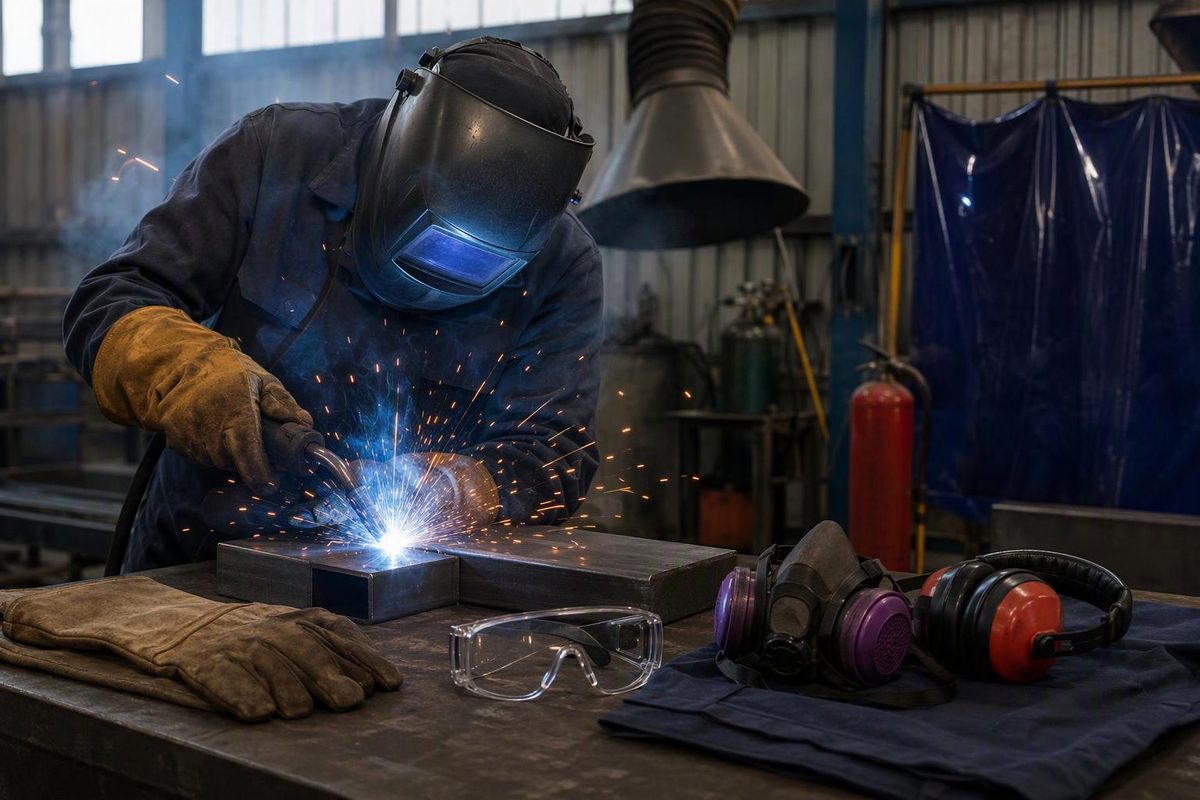
For MIG, TIG, stick and flux-core welding, start with a suitable welding helmet, safety glasses with side protection, welding gloves, protective clothing and boots. Add hearing and respiratory protection according to the hazards. The work area also needs fume control, protection for nearby people and fire precautions.
A complete PPE kit does not make an unsafe welding location safe. Choose equipment for the process, current, material, coatings, welding position and surrounding work—not just the word “welding” on the package. Follow equipment instructions and applicable workplace rules; the U.S. OSHA requirements identified below are not universal legal requirements.
Match the equipment to the exposure
| Equipment | What to check before buying or using it |
|---|---|
| Welding helmet and filter | Suitable for the process and current; enough face, neck and ear coverage; identifiable protection markings; replacement lenses available |
| Safety glasses or goggles | Protection appropriate to flying debris, including side protection; fit beneath the helmet without being displaced |
| Welding gloves | Heat and spatter protection, wrist coverage and enough dexterity to control the torch or electrode holder; dry and undamaged |
| Protective clothing | Resistance to sparks, heat and flame; long sleeves; coverage at the neck, wrists and waist; no openings that collect spatter |
| Protective boots | High tops, secure fastening and protection appropriate to the shop’s foot hazards; trouser legs outside the boot tops |
| Hearing protection | Suitable for the assessed noise exposure and compatible with the helmet and other PPE |
| Respirator, when required | Selected for the contaminants and exposure level—not simply because it fits under a helmet |
CCOHS’s welding PPE guidance covers these protection categories and emphasizes that helpers and nearby personnel may also need protection.
Protect against both arc radiation and flying particles
A welding filter controls radiation from the arc. Safety glasses with side shields protect against debris when the helmet is raised and provide protection beneath it. Wear both; CCOHS specifically advises safety glasses or goggles even when other eye and face protection is used. Gas-welding goggles and sunglasses are not substitutes for an arc-welding helmet. Source: CCOHS
Select shade by the process and operating current, using the applicable chart and helmet instructions. For example, the U.S. OSHA table lists shade 10 as the minimum for GMAW and FCAW at 160–250 A. That is a minimum, not necessarily the most comfortable working shade. OSHA advises starting darker and moving lighter only until the weld zone is visible, without dropping below the minimum. Source: OSHA 1910.133
For an auto-darkening helmet, verify the stated process/current capability and perform the manufacturer’s pre-use checks. Replace damaged lenses and scratched or hazy cover plates. Our auto-darkening helmet guide explains selection, settings and checks.
Protect others with suitable welding screens or curtains. Arrange the enclosure so it does not seriously restrict ventilation; an arc barrier should not become a fume trap. Source: OSHA 1910.252
Close the gaps in clothing and gloves
Spatter can enter cuffs, pockets and boot tops. UV can reach exposed skin at the collar or between garments. Button the collar and cuffs, cover pockets, avoid trouser cuffs, and make sure the jacket overlaps the trousers when reaching. Keep clothing free of oil and grease, and repair tears or holes.
Avoid ordinary melt-prone synthetic clothing. Choose garments intended for welding exposure, and follow their care instructions; some laundering products can damage flame-retardant properties. Use a flame-resistant cap or hood beneath the helmet to protect the scalp and exposed head areas. Leather aprons, sleeves or boot protectors can add coverage where sparks land. Source: CCOHS clothing guidance
Choose gloves that protect against the expected heat and spatter while allowing reliable control of the work. Wet welding gloves are not acceptable protection when changing a stick electrode. Keep hands and clothing dry, and avoid working on wet surfaces. Source: CCOHS electrical safety
For garment selection beyond the label, see FR clothing for welding.
Control fumes before choosing a respirator
Identify the base metal, filler and coatings first. Welding-fume exposure depends on those materials, the process, work position, airflow and ventilation controls. Stainless steel and hazardous coatings can change the required controls substantially.
Use suitable ventilation, including local exhaust where needed. Position the extraction hood or nozzle close to the plume source so it draws contaminants away from the breathing zone, and keep exhaust discharge away from other workers. Outdoor welding does not guarantee adequate ventilation. Source: OSHA welding-fume fact sheet
If engineering controls and work practices are insufficient, respiratory protection must be selected from the exposure assessment. In U.S. workplaces, required respirator use involves a written program, medical evaluation, training and maintenance; tight-fitting respirators also require fit testing. OSHA requires NIOSH-certified respirators used within their certification conditions. Source: OSHA 1910.134
A particulate filter alone does not protect against gases or vapors. A powered air-purifying respirator—PAPR—filters ambient air; it does not supply oxygen. Neither a half-mask air-purifying respirator nor a PAPR makes an oxygen-deficient space safe. Confined-space work needs a separate assessment and entry/rescue arrangements, not a larger PPE shopping list. Sources: OSHA respiratory protection and confined-space welding precautions
Check the area and welding circuit before striking an arc
- Fire: Remove or protect combustibles, including those exposed through openings or on the opposite side of heated metal. Keep suitable extinguishing equipment ready. U.S. general-industry OSHA rules require fire watches where more than a minor fire might develop, including specified combustible-material and concealed-space hazards. Required watches continue for at least 30 minutes after welding; the applicable permit or site rules may require longer. A blanket does not remove the need to inspect concealed spark paths. Source: OSHA 1910.252
- Electrical equipment: Check connections, holder insulation and cables. Replace cables with damaged insulation or exposed conductors, and discontinue use of defective equipment until its safety is assured. The work-return connection and machine safety grounding are separate checks. Source: OSHA 1910.254
- Gas cylinders: Use suitable restraints and cylinder-handling equipment. Keep cylinders protected against falling and physical damage; do not secure them to structures where they could become part of the welding circuit. Source: CCOHS cylinder guidance
Resolve missing protection, failed extraction, damaged equipment or uncontrolled fire hazards before welding. For handheld laser welding, use a separate laser safety assessment and controls; this arc-welding checklist is not a laser-protection specification.