
Choose a Welding Mask by Hazard, Process and Shade
Choose a welding mask by hazard, process, shade and fit. Distinguish welding helmets, clear face shields and respiratory protection.
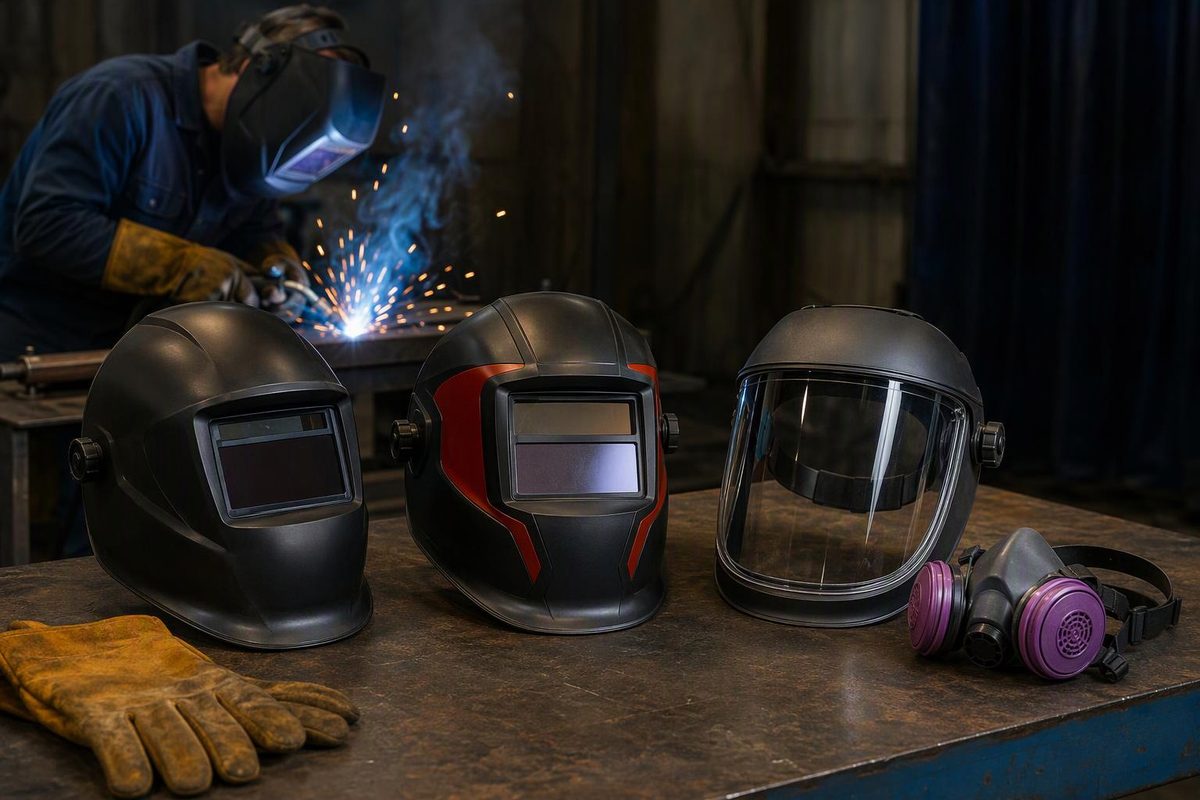
For MIG, TIG, stick or flux-core welding, a welding mask usually means a welding helmet: an opaque shell with a suitable filter that protects the eyes and face from arc radiation and spatter. It is not automatically respiratory protection. If you mean a mask for welding fumes, that is a separate selection based on the airborne hazards and exposure controls. CCOHS welding PPE guidance
Choose protection by hazard first, then check process suitability, filter shade, coverage and fit. A large viewing window cannot compensate for the wrong filter or unreliable darkening.
Helmet, clear face shield or respirator?
These protect against different hazards:
| Equipment | Its role | Important limit |
|---|---|---|
| Welding helmet with a suitable filter | Eye and face protection during arc welding | An ordinary helmet does not filter breathing air |
| Clear grinding face shield | Face protection against task-specific flying debris | A clear shield is not a welding filter |
| Safety glasses with side shields or suitable goggles | Eye protection beneath the helmet, including when it is lifted | Clear lenses alone do not provide the required arc-welding shade |
| Welding respirator or integrated respiratory helmet | Respiratory protection selected for the assessed exposure | Suitability depends on the complete system and its approval, not its appearance |
CCOHS calls for full-face protection during arc welding and advises wearing goggles or safety glasses with side shields even when a welding helmet is also used. It specifically warns against using gas-welding goggles for arc welding or substituting sunglasses for proper welding lenses. CCOHS welding PPE guidance
Choose the helmet type and verify its suitability
A passive helmet uses a filter that stays dark. Its simplicity can suit work at a consistent process and current, provided the installed shade is appropriate. Check the actual lens: a common shade 10 is not a universal answer for every welding operation.
An auto-darkening helmet provides a lighter viewing state for setup, then darkens when it detects the arc. A variable-shade model can serve different processes, but only within its specified range. For optically triggered filters, sensor coverage matters when an obstruction blocks the view of the arc. Miller helmet-selection guidance
For low-current TIG ratings, sensor coverage and electronic controls, use our auto-darkening helmet selection and checks.
Before buying, look for an identifiable manufacturer, a model-specific manual, documented eye-and-face protection compliance, and available replacement cover lenses. For U.S. general-industry workplaces, OSHA’s eye-protection rule identifies accepted ANSI standards and allows alternatives the employer demonstrates are at least as effective. A listing that merely says “welding mask” does not establish suitability. OSHA 1910.133
Select shade by process and current
Higher shade numbers mean darker filters. Minimum protective shades and suggested comfort shades are not the same. These examples use OSHA’s U.S. general-industry minimums, alongside suggested shades from Miller’s Ultra HDV manual:
| Example operation | Minimum protective shade | Suggested shade |
|---|---|---|
| Stick, 1/8-inch electrode at 120 A | 8 | 10 |
| MIG or flux-core at 120 A | 10 | 11 |
| TIG at 120 A | 8 | 12 |
The manual’s table references ANSI Z49.1:2021. These are examples, not a complete selection chart or universal settings for every jurisdiction. Start dark, then lighten only enough to see the weld zone without going below the applicable minimum. Follow the helmet manual and workplace requirements. OSHA shade table · Miller Ultra HDV manual, section 1-4
If the view is poor, inspect the cover lenses and improve task lighting before reducing shade. Replace scratched, hazy or damaged lenses as directed. CCOHS lens-care guidance
Check fit, coverage and condition
Try the helmet with your safety glasses and any required respiratory or head protection. Adjust it so it stays in position and gives you a usable view without sacrificing coverage. Check position-specific limits: the Ultra HDV manual, for example, says that helmet is not rated for overhead welding and requires additional precautions for direct overhead work.
Before striking an arc, inspect the shell, filter, retainers and cover lenses. On an auto-darkening helmet, perform the manufacturer’s prescribed operation check and confirm welding mode and the correct shade. Do not weld in grind mode. Stop immediately if the filter fails to darken or flickers unexpectedly; correct the problem before resuming. Miller Ultra HDV manual
Treat fume protection as a separate decision
An ordinary welding helmet is not a fume-control system. OSHA recommends work practices and ventilation, including local exhaust near the plume; respiratory protection may be required when those measures do not reduce exposure to safe levels. Welding outdoors does not guarantee adequate ventilation. OSHA welding-fume guidance
If respiratory protection is required, select it through the workplace hazard assessment and respiratory-protection program—not simply by whether it fits beneath the helmet. Under OSHA’s rule, the respirator must be NIOSH-certified and used within its certification conditions. A particulate filter is not protection against gases and vapors, and an air-purifying respirator, including a PAPR, does not supply oxygen. Oxygen-deficient work requires a different respiratory-protection assessment and atmosphere-supplying equipment. OSHA 1910.134
For the clearance and fit-testing distinctions between common welding respirators and PAPR configurations, see respirator medical-evaluation requirements for welders.