
Nomex Honeycomb Is a Bonded Core, Not a Weldable Metal
Learn what Nomex honeycomb is, how sandwich panels carry loads, which specifications matter, and why welding heat threatens the core and its bonds.
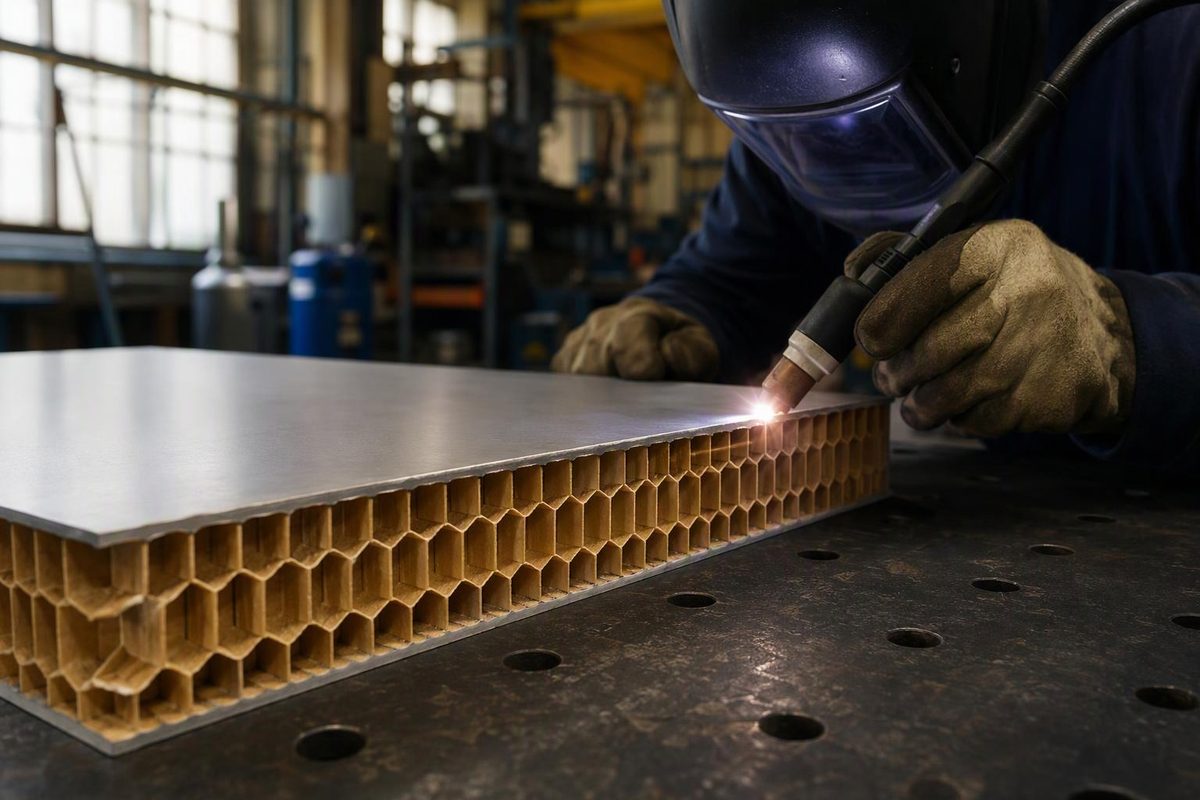
Nomex honeycomb is a lightweight, nonmetallic core used in bonded sandwich panels—not a material you MIG, TIG or stick weld. For a fabrication shop, the important distinction is between the panel’s facing material and what sits behind it. A metal skin does not make the complete panel a weldable metal assembly.
What it is and how it works
Nomex honeycomb uses aramid-fiber paper formed into a cellular structure and reinforced with resin. Hexcel’s HRH-10, for example, consists of Nomex paper with a phenolic resin coating. Its manufacturing process bonds sheets at their nodes, expands the block into a honeycomb configuration, then applies and cures the resin before cutting slices to thickness. Hexcel’s honeycomb guide and HRH-10 datasheet describe this construction.
The core normally sits between two bonded facing skins. Think of an I-beam: the skins act like its flanges, carrying tension and compression from bending. The core holds them apart, supports them and carries shear. The adhesive transfers loads between the components so they work together. That separation produces a stiff panel without the weight of a solid section. The core, skins and bonds are one structural system; core strength alone is not the panel’s load rating. Hexcel’s sandwich-design guide explains the load path and failure modes.
HRH-10 applications include aircraft interior panels, radomes, fairings and helicopter blades, as well as some high-performance boats. Its low density, toughness, fire resistance and electrical-insulating properties help explain those uses. They do not establish suitability for an unrelated shop fixture or repair. HRH-10 product data
Read the specification—not just “Nomex”
Before ordering replacement core or fabricating a panel, check:
- Material grade and resin system. “Aramid honeycomb” is not a complete specification.
- Cell size and configuration. Standard hexagonal, overexpanded and flexible configurations have different forming behavior and directional properties.
- Density and thickness. Density is the mass per unit volume of the cellular core, including its voids; thickness sets the skin spacing and influences panel behavior.
- Ribbon direction. Identify the L and W axes on the drawing and preserve the specified orientation.
- Facing, adhesive and attachment details. These determine whether loads can enter and travel through the panel.
For example, Hexcel’s metric designation HRH-10-3.2-48 means HRH-10 core, a nominal 3.2 mm cell size and 48 kg/m³ density—not 48 mm thickness. Its datasheet lists different L- and W-direction shear properties. Rotating a replacement piece is therefore not automatically harmless. Published typical values are test results, not design allowables for your finished assembly. HRH-10 designation and mechanical properties
Why welding is the wrong joining method
There is no arc-welding setting or filler metal that joins this paper-and-resin core as though it were aluminum. Nomex honeycomb panels are assembled through bonding. Any proposed weld on an attached metal component needs a separate assessment of the metal joint, panel protection and applicable hot-work restrictions.
Fire resistance is not permission to apply welding heat. Hexcel recommends HRH-10 for service up to 350°F, about 177°C, but that is a core-product recommendation—not a hot-work limit or a guarantee for the adhesive and skins. The complete panel needs its own temperature limits. Hexcel’s HRH-10 material guidance
Before welding a nearby frame or bracket:
- Identify the full panel construction. Do not infer the core from its exterior finish.
- Check the fabrication or repair procedure. Where permitted, completing metal hot work before installing bonded panels avoids exposing them during welding.
- Assess conducted heat as well as sparks. Shielding the visible face does not stop heat traveling through attached metal.
- Stop if the construction or protection method is unknown. Lower amperage and short tacks are not proof that hidden bonds remain sound.
For U.S. general-industry work, OSHA specifically prohibits welding on walls or partitions of combustible sandwich-type panel construction. Its hot-work rules also address ignition on the opposite side of metal surfaces from conducted or radiated heat. OSHA 1910.252
Cutting, bonding and repair checks
Use the specified cutting, cleaning and bonding process rather than treating the core like sheet metal. Honeycomb bonding requires adhesive that forms fillets at the cell edges without draining away from the skin-to-core joint. Local pressure also matters: concentrated loads can crush the core. Hexcel’s bonding and design guidance
Capture dust at the cutting zone and keep ignition sources away. Hexcel’s aramid-honeycomb safety sheet warns that machining dust can irritate eyes, skin and the respiratory tract, and may present a fire or explosion hazard when sufficient airborne dust and an ignition source are present. Use extraction and collection equipment suitable for that dust hazard, eye and skin protection, and exposure-based respiratory controls. Store core clean and dry. Hexcel safety sheet
A clean-looking skin does not establish an intact core or bond. For U.S. aircraft work, use the applicable maintenance or structural-repair data and specified inspection—not an improvised welded patch. FAA AC 43-214A explains that major repairs require FAA-approved data and describes qualification, inspection and recordkeeping procedures for composite and bonded repairs. It is guidance for an acceptable means of compliance, not a standalone repair authorization. FAA AC 43-214A