
The Real Risks and Fatality Data Behind Underwater Welding
Underwater welding layers hot-work hazards onto commercial diving. See the fatality data limits, principal dangers and required safety controls.
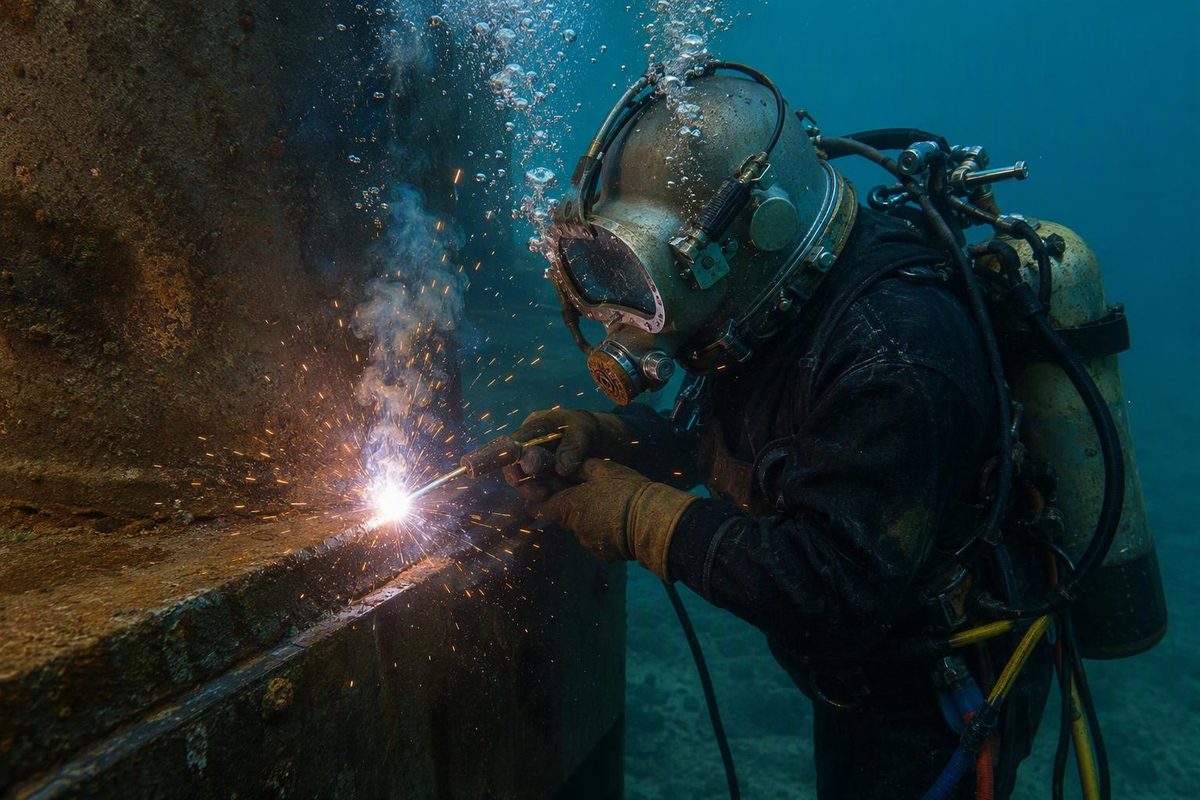
Underwater welding is a high-hazard commercial-diving task. A worker can face drowning, loss of breathing gas, entrapment, differential pressure, decompression sickness, hypothermia, electric shock, fire or explosion, and ordinary construction hazards during the same operation.
That does not validate the often-repeated claim that “15% of underwater welders die on the job.” The principal U.S. datasets track commercial divers, not underwater welding as a separate occupation or task. The defensible verdict is that underwater welding is demonstrably dangerous, but no reliable current death rate specific to underwater welders is available from those datasets.
Check the three control groups; any “No” or “Unknown” result means the job is not ready to proceed.
Underwater Welding Stop-Work Screen
This is a pre-dive control check, not a substitute for the approved dive plan or applicable rules.
Sources: OSHA 29 CFR Part 1910 Subpart T, OSHA Delta-P Hazard Alert and CDC/NIOSH commercial-diving guidance. This screen does not calculate a fatality probability because no reliable welder-only rate is available.
The Available Numbers Cover Commercial Divers
NIOSH reports 460 nonfatal occupational injuries and illnesses involving days away from work and 39 fatal occupational injuries among commercial divers from 2011 through 2017. Those figures cover all commercial-diving work, not only welding. NIOSH also identifies drowning, respiratory and circulatory complications, hypothermia, limited visibility, physical workload and construction-type work as hazards (CDC/NIOSH).
An older NIOSH record helps explain why commercial diving is frequently described as exceptionally dangerous. For 1989–1997, it reported 49 deaths among an estimated 3,000 full-time commercial divers—about 180 deaths per 100,000 employed divers per year and roughly 40 times the rate for all workers at that time.
That record is now more than 25 years old, concerns commercial divers rather than underwater welders, and relies partly on unpublished OSHA data. It cannot be converted into a modern “career fatality percentage.” In a related 1989–1994 occupational-diving dataset, drowning was the cause listed most often (NIOSH archive).
The occupational category itself is broad. BLS defines commercial divers as workers who inspect, repair, remove or install underwater equipment and structures and who may use torches and welding equipment (BLS). Neither the NIOSH totals nor BLS employment figures isolate hours spent welding underwater.
A welder-only fatality rate would require dependable counts of underwater welders, their exposure hours and deaths attributable to that work over a defined period. The cited U.S. datasets do not provide those three pieces, so they cannot support a current percentage or career odds.
Drowning Can Begin With a Single Equipment Failure
A failed gas supply, damaged umbilical, helmet problem, entanglement or incapacitating injury can become a drowning emergency. In surface-supplied diving, the umbilical can carry breathing gas, communications, power or heat, along with a safety line. Managing it is part of the life-support system, not simple housekeeping.
U.S. commercial-diving rules require training or experience for the assigned task and diving mode, knowledge of emergency procedures, CPR and first-aid training, and a qualified person in charge at the dive site (OSHA 1910.410). OSHA also requires pre-dive assessment of breathing-gas supplies, reserves, thermal protection, equipment, team assignments, decompression and emergency procedures (29 CFR Part 1910 Subpart T).
Standby-diver and reserve-gas requirements vary with the diving mode, depth and whether the dive exceeds no-decompression limits. This remains team-based commercial work—not a job for a lone welder with recreational scuba equipment. Recreational certification by itself does not qualify someone for commercial underwater welding.
Differential Pressure Can Pin a Diver in Place
“Delta P” is a pressure difference that moves water toward an intake, drain, pipe, valve or other opening. The resulting force can trap a diver so firmly that neither the diver nor a rescuer can overcome it.
OSHA reported that five of six Delta-P fatalities from June 2019 through July 2021 occurred at power-generation facilities. Its alert calls for measures including current facility drawings, lockout/tagout, verification of zero energy, guards or screens where appropriate, umbilical management and a plan for every dive (OSHA Delta-P alert). Near hydraulic infrastructure, this hazard can dominate the risk before an arc is struck.
Electrical Safety Depends on Tender-Controlled Power
Wet welding establishes an electrical arc while the diver and work are immersed. Damaged insulation, poor connections, incorrect electrode handling or an uncontrolled circuit can expose the diver to current. Even a nonfatal shock can trigger involuntary movement, loss of breathing control or another underwater emergency.
OSHA requires a current-interrupt switch tended by a dive-team member in voice communication with the diver. The switch must remain open except while the diver is welding or burning. The rules also require the welding-machine frame to be grounded, cables and holders to be properly insulated and rated for the required current, and insulated gloves for the diver (29 CFR 1910.422).
These controls depend on a deliberate diver-to-tender switching protocol. Insulated gloves alone do not control the circuit.
Underwater Hot Work Can Still Cause Fire or Explosion
Submersion does not make a closed pipe, tank or compartment safe for hot work. Welding or burning can ignite flammable vapor trapped in the space.
OSHA requires a closed compartment, structure or pipe that contains—or may develop—flammable vapor to be vented, flooded or purged with a gas mixture that will not support combustion before welding or burning begins. The internal atmosphere and connected systems must be addressed, not judged safe merely because the exterior is underwater.
Depth and Time Add Pressure-Related Illnesses
Depth and bottom time affect how much inert gas the body absorbs. If pressure is reduced too quickly during ascent, bubbles can form in tissues and cause decompression sickness. Severe cases can involve neurological or respiratory symptoms and shock.
Pressure changes can also injure the ears, sinuses or lungs, while breathing-gas composition introduces hazards including nitrogen narcosis and oxygen or carbon-dioxide toxicity (OSHA health-effects guidance).
These hazards exist whether or not a weld is being made. Welding adds workload and can complicate an emergency or delay the planned ascent. OSHA requires appropriate decompression tables at the dive location and a depth-time profile for each diver. For specified dives deeper than 100 feet of seawater, outside no-decompression limits or using mixed gas, the rules also require an on-site recompression chamber.
Cold, Current and Poor Visibility Compound the Risk
Cold water can impair dexterity and cause hypothermia. Current raises exertion and makes positioning harder. Low or zero visibility complicates joint preparation, electrode control, rigging and hazard recognition.
The diver may also be working around sharp steel, suspended loads, powered equipment, contaminated water or unstable structures. OSHA describes commercial diving as combining underwater physiological hazards with activities such as cutting, welding, material handling and power-tool work (OSHA commercial-diving overview).
These conditions interact. A current that increases exertion can also complicate umbilical management. Poor visibility can conceal an opening or snag point. Cold-reduced dexterity can make electrode handling and emergency action more difficult.
Dry Welding Changes the Process, Not the Diving Risk
In wet welding, the diver and joint are exposed directly to the water. In dry hyperbaric welding, a pressurized habitat excludes water from the weld area while remaining near the surrounding water pressure. The dry environment changes arc behavior and weld-process control, but it does not remove diving, pressure, habitat or fire hazards.
AWS D3.6M:2017 covers underwater welding in both wet and dry environments. It defines Class A welds as comparable to above-water welding, Class B for less-critical applications and Class O for work governed by another designated code or specification (AWS D3.6M:2017).
A continuous-looking bead on a video feed is not proof of acceptance. The specified weld class, applicable design rules, approved procedure, welder qualification and required inspection determine whether the work is acceptable—just as appearance alone cannot establish weld quality.
A Controlled Job Starts Before the Diver Enters the Water
The practical dividing line is not courage; it is control of the entire diving and welding system. Before work starts, a credible operation should have:
- a commercial dive team trained and assigned for the task and diving mode;
- a designated person in charge, working communications and emergency procedures;
- a standby diver and primary or reserve breathing-gas arrangements as required by the mode and dive plan;
- a site-specific assessment covering Delta P, current, visibility, entrapment, thermal exposure, rigging and nearby operations;
- isolation of intakes, discharges and mechanical or hydraulic energy, with zero energy verified;
- an attended welding-current disconnect and an unambiguous diver-to-tender switching protocol;
- depth-time tracking, appropriate decompression tables and any required recompression capability; and
- the specified welding procedure, qualification and inspection plan for the required weld class.
Underwater welding is best understood as commercial diving with an additional hot-work operation, not ordinary welding performed in unusual PPE. Planning, competent crew members and engineered controls can reduce the risk substantially, but they do not turn the environment into a fabrication shop.