
Core Material in Sandwich Panels: What Welders Need to Check
Learn what sandwich-panel core material does, how foam, balsa and honeycomb differ, and what to verify before welding or attaching a bracket.
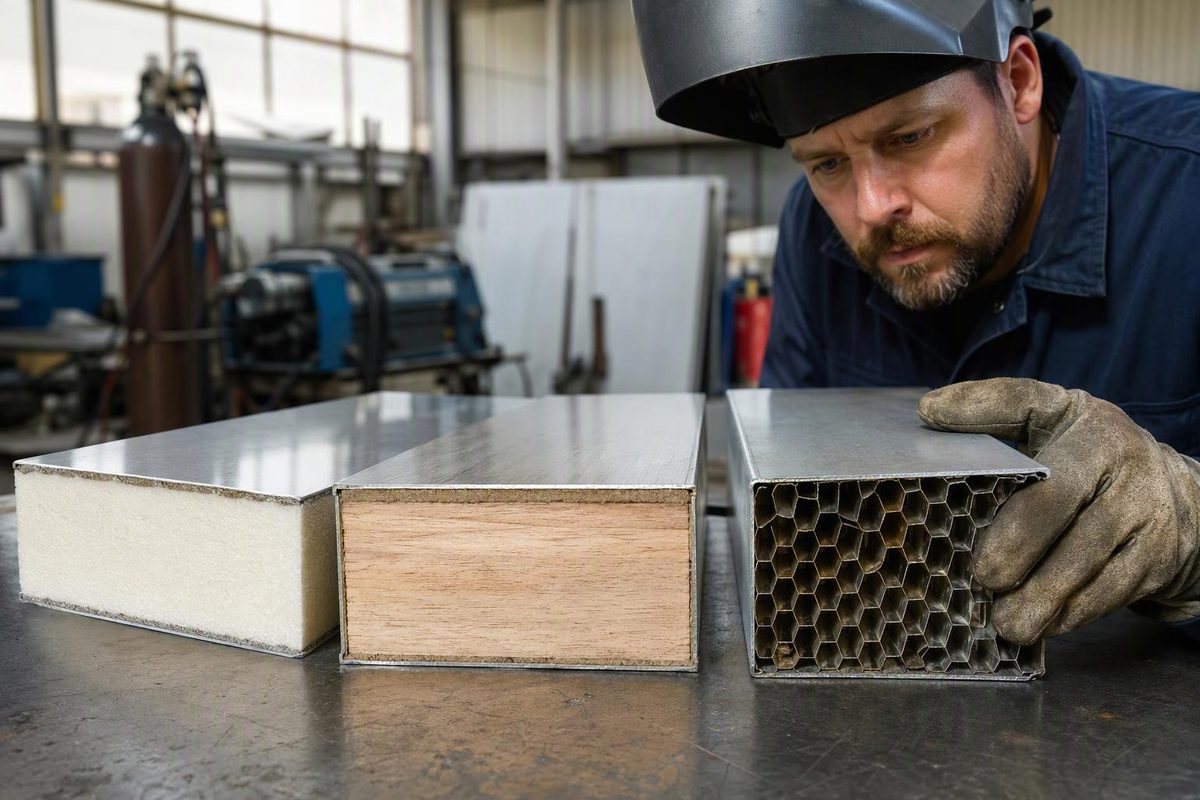
In structural sandwich construction, core material is the middle layer of a panel, separating and supporting its two outer skins. It may be foam, balsa wood or honeycomb. For a welder attaching a bracket or repairing a metal-faced panel, the important point is that the visible metal is only one part of the assembly: its weldability does not establish whether the complete panel can tolerate welding.
This article covers structural panel cores—not the contents of flux-cored welding wire. For that process, see the flux-core welding definition.
What the core actually does
A structural sandwich panel works much like an I-beam. Under bending, the skins carry tension and compression; the core keeps them apart and carries shear. Increasing that separation can raise bending stiffness without the weight penalty of making the entire panel solid. The core also supports the thin skins against buckling.
The bond matters just as much. In an adhesively bonded panel, the adhesive transfers forces between the skins and core so they act together. A weak core or failed bond can therefore reduce stiffness even when the outer sheet remains intact. Diab’s core-and-sandwich guide explains these separate functions.
That distinction changes the repair task: restoring a metal surface is not necessarily restoring the panel’s load-carrying structure.
Common core materials—and the checks they require
| Core material | Construction | What to verify before fabrication or repair |
|---|---|---|
| Structural foam | Lightweight cellular polymer; examples include PVC and PET | Exact grade, density, shear and compression properties, resin compatibility and temperature limits |
| End-grain balsa | Wood arranged with its grain through the panel thickness | Specified grade and density, condition, moisture protection and edge sealing |
| Aramid honeycomb | Resin-coated or impregnated aramid paper or fabric formed into cells; Nomex-based products are one example | Product designation, cell size, density, orientation and resin/bond system |
| Aluminum honeycomb | Thin aluminum foil formed into cells | Alloy, foil thickness, cell size, density, orientation, coatings and bond system |
Diab describes foam and end-grain balsa cores, including balsa’s susceptibility to moisture uptake and rot if improperly installed or maintained. Hexcel’s honeycomb guide details aluminum and aramid constructions, adhesive manufacturing methods and directional shear properties.
Do not substitute cores solely because their thickness or density matches. Those measurements do not establish equivalent mechanical properties, heat tolerance or bonding compatibility. For the nonmetallic honeycomb option, see Nomex honeycomb properties and welding limits.
Why a metal skin is not permission to weld
There are two separate questions: will hot work be safe, and will the panel remain structurally suitable afterward?
Fire restrictions can settle the first question immediately. In U.S. general industry, OSHA 1910.252(a)(2)(xi) says welding must not be attempted on walls or partitions of combustible sandwich-type panel construction. It also prohibits welding on a metal partition, wall, ceiling or roof having a combustible covering. These are specific restrictions—not conditions that a welding blanket or fire watch automatically overrides. OSHA’s welding requirements also address ignition by heat conducted through metal.
For structural suitability, a core’s service or processing temperature is not a welding qualification. Diab notes that temperature performance depends on load, exposure time, pressure and other process conditions. A published temperature value cannot, by itself, demonstrate that the core and bond beneath a weld will remain acceptable. Diab’s temperature guidance makes those dependencies explicit.
Even an aluminum-core panel may contain adhesive joints. “All metal” should never be inferred from the face sheet alone.
A practical sequence before attaching or repairing
- Identify the complete panel. Obtain its drawing or manufacturer specification: skin materials and thicknesses, core designation, bond system, coatings and intended loads. An unidentified core is a reason to pause—not choose lower amperage.
- Check hot-work restrictions. Establish whether combustible material is present within or behind the assembly, and have the responsible person authorize any permitted hot work. Apply the rules for the workplace and jurisdiction.
- Use the specified attachment or repair detail. Ask whether the connection requires an insert, reinforced region, edge member or panel replacement. Do not assume a fastener arrangement intended for solid sheet transfers safely to sandwich construction. CEL Components’ fastening guidance shows why the core, skins and thickness govern connection selection.
- Define acceptance before starting. For load-carrying work, obtain the required repair procedure and inspection criteria. A sound-looking bead cannot demonstrate the condition of the hidden core or bond.
There is no useful universal MIG or TIG setting for an unknown sandwich panel. First establish an approved joint detail and a heat-tolerant assembly; only then select the welding process and parameters.