
What to Do When a Welding Arc Exposes Your Eyes
Arc eye may not hurt until hours after exposure. An electrical arc-flash fault is separate and requires its own assessment.
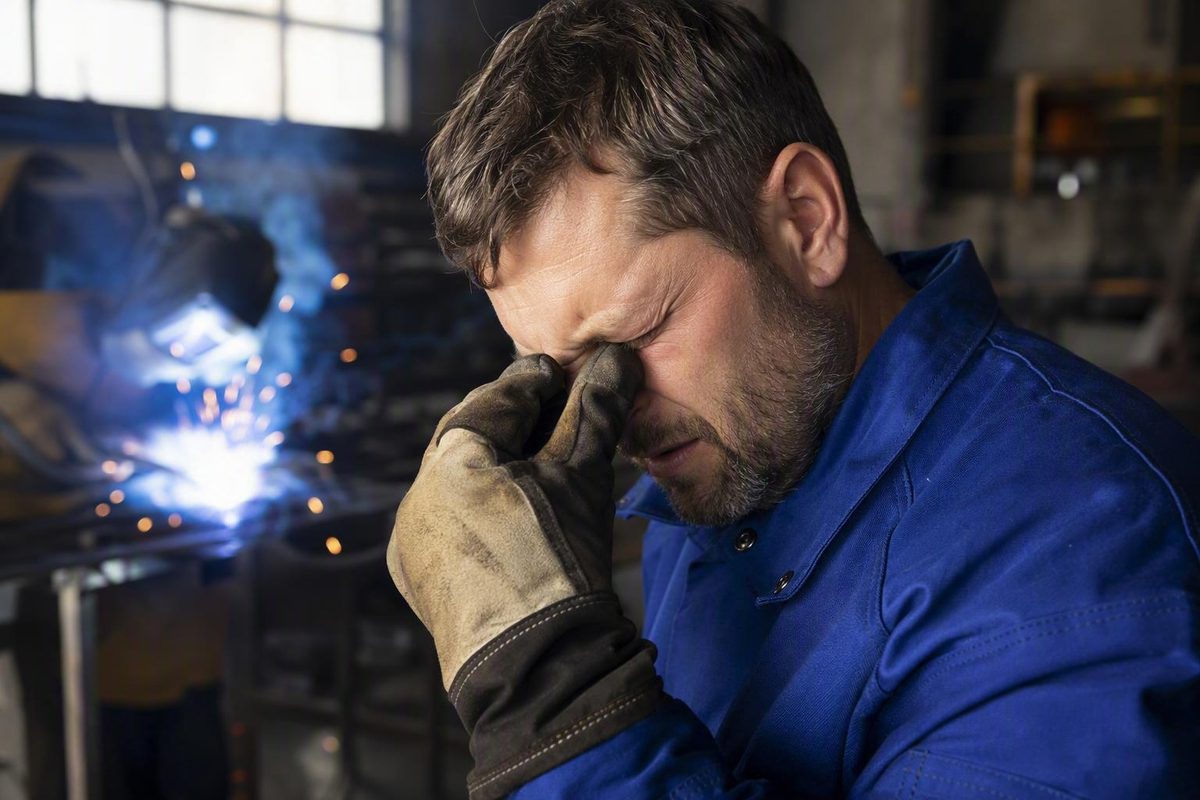
An accidental view of a welding arc may seem harmless at first. A person looks away, finishes the task, and feels normal—only to develop painful, watery, light-sensitive eyes later that day or overnight.
In welding conversations, “arc flash” often refers to arc eye, welder’s flash, or photokeratitis: an acute injury caused principally by ultraviolet radiation from the arc. It affects exposed eye surfaces, including the cornea and conjunctiva. This is not the same hazard as an electrical arc-flash fault involving energized electrical equipment. The Canadian Centre for Occupational Health and Safety describes welding arc eye and the broader effects of welding radiation.
If your eyes may have been exposed, stop the exposure and avoid rubbing them. This article can explain reasonable precautions, but it cannot determine whether the problem is photokeratitis, a particle, an abrasion, a chemical injury, infection, or another eye condition. It also cannot establish how urgently a particular injury needs care.
First, Which Kind of Arc Flash Do You Mean?
The phrase welding arc flash is potentially confusing because “arc flash” is used for two different hazards.
In welding shops, workers may use arc flash, arc eye, welder’s flash, and photokeratitis to describe an acute radiation injury involving the cornea—the clear front surface of the eye—and the conjunctiva covering the white of the eye and the inner eyelids. Ultraviolet radiation from the welding arc is the principal cause.
An electrical arc-flash fault is a separate electrical hazard. This article does not define electrical-fault exposure, select electrical protective equipment, or provide incident-energy calculations, boundaries, categories, or fault-response procedures. A welding helmet and ordinary welding clothing should not be treated as evidence that a separate electrical hazard has been assessed or controlled.
Electrical shock is another distinct concern and can occur without an electrical arc-flash event. Contact with an electrically energized component while also touching a welder case, workpiece, or grounded metal can create a dangerous current path. Equipment condition, insulation, grounding, dry gloves, dry working surfaces, and body position all matter. A NIOSH arc-welding electrical-safety toolbox talk advises inspecting welders and leads, grounding the welder case, insulating the body from the work, using dry insulating surfaces, and avoiding bare-skin or wet-clothing contact with electrodes and holder metal.
This article focuses primarily on welding-radiation exposure: how exposure occurs, what arc eye may feel like, why symptoms can be delayed, what limited precautions are supported after a suspected exposure, and how to protect welders and nearby people. Electrical shock, damaged conductors, hot material, fire, fumes, sparks, slag, and flying particles are addressed later as separate hazards.
What a Welding Arc Emits and How Exposure Happens
A welding arc is more than an intense point of visible light. It produces radiation across a broad spectrum that includes:
-
Ultraviolet radiation, principally responsible for arc eye and capable of burning uncovered skin
-
Infrared radiation, which creates additional eye and heat-related hazards through mechanisms different from photokeratitis
These forms of radiation should not be treated as interchangeable. Arc eye primarily concerns ultraviolet injury to the exposed surface of the eye, but not every painful or visually disturbed eye after welding is photokeratitis.
A person does not need to stare directly into the weld pool to be exposed. Radiation may reach the eyes:
- From the side of a poorly positioned helmet
- Through a gap in a screen or curtain
- From another active welding station
- Across an open doorway or aisle
- From behind the welder
- After reflecting from nearby surfaces
Direct and reflected radiation can affect both eyes and skin, while bright visible welding light can temporarily impair vision. Exposure risk depends on radiation intensity, duration, distance, viewing angle, reflections, welding conditions, and the protection in use—not on one factor alone. CCOHS explains these radiation types, exposure variables, and direct or reflected pathways in its occupational-health guidance on welding radiation.
Radiation protection therefore extends beyond the person holding the electrode or torch. Depending on the layout, suitable controls may be needed for:
- Helpers positioning or handling work
- Fitters working beside the welder
- Inspectors checking fit-up or weld progression
- Supervisors entering an active area
- Grinders at adjacent stations
- Workers beside or behind the welder
- People passing an open bay or doorway
- Visitors who do not know an arc is about to be struck
Turning the head away is not a dependable control. Screens, barriers, access controls, communication, and suitable personal protection need to be established before welding begins.
There is no universal safe viewing distance or exposure duration for every process, current, layout, reflection, and person. Distance may reduce exposure under some conditions, but it does not replace a suitable welding filter or physical screening. A brief accidental exposure does not guarantee injury, but it also cannot be declared harmless solely because it was short.
The practical question is not simply how far away someone stood. It is whether direct or reflected radiation could reach that person without suitable protection.
Arc Eye Symptoms and the Delayed-Onset Timeline
Commonly reported symptoms of arc eye include:
- Eye pain or burning
- Excessive tearing
- Redness
- A gritty, sandy, or foreign-body sensation
- Light sensitivity
- Blurred vision
- Dry-feeling or irritated eyes
- Swollen eyelids
The number, severity, or distribution of symptoms is not enough to diagnose photokeratitis without an examination.
One of the most misleading features of arc eye is delayed discomfort. Injury may occur during a short, intense exposure even though the eyes do not immediately hurt. Several secondary sources describe symptoms appearing or intensifying over approximately 6 to 12 hours; an MSC overview of welder’s flash gives that typical onset range. Timing and severity nevertheless vary.
A possible sequence is:
- At the time of exposure: The person sees an unshielded or reflected arc, experiences glare, or realizes that a helmet was raised. There may be no immediate pain.
- During the following hours: Tearing, redness, dryness, or mild irritation may begin.
- Later that day or overnight: Pain, grittiness, swollen eyelids, blurred vision, or marked light sensitivity may become more noticeable.
- After symptoms begin: The course depends on the exposure and on whether the condition is uncomplicated photokeratitis or a different injury.
Feeling normal immediately after an accidental flash therefore does not prove that no injury occurred. Stop further unprotected exposure and pay attention to developing symptoms rather than repeatedly testing the eyes against bright light.
At the same time, not every glance at an arc causes arc eye, and not every painful eye after welding has been injured by ultraviolet radiation. Welding and associated work can expose the eyes to other hazards, including:
- Metal particles or slag
- Grinding debris or dust
- Corneal abrasions
- Chemical splashes or vapors
- Smoke and other irritants
- Infection
- Impact from flying material
- Hot particles or surfaces
Redness, tearing, blurred vision, and light sensitivity also occur with multiple eye conditions. A symptom list can identify reasons for concern, but it cannot establish the cause.
What to Do After Suspected Welding-Arc Eye Exposure
The available evidence supports only a limited set of general precautions. This section is not a complete eye-injury triage protocol and cannot determine the appropriate care for an individual case.
1. Stop the exposure. Move away from the active arc and any direct or reflected radiation path. Do not remain unprotected while another person finishes the weld. Before work resumes, correct the failed screen, positioning, access control, or personal-protection problem.
2. Do not rub the eyes.
3. Rest the eyes and reduce uncomfortable light exposure. Closed-eye rest, a darker environment, sunglasses, or a cool compress may make discomfort more tolerable. These are temporary comfort measures, not a diagnosis or treatment for every possible welding-related eye injury.
4. Obtain professional advice when an injury is suspected. Professional assessment is particularly important when symptoms persist, worsen, or otherwise cause concern. An eye professional can examine the eye surface and consider causes that cannot be ruled out from a workplace symptom checklist. A commercial prevention guide also recommends evaluation after suspected arc-eye injury and advises against rubbing, but its guidance should not replace clinical judgment or workplace requirements (YesWelder).
Delayed pain does not establish that the condition is “just flash burn,” while immediate pain does not rule photokeratitis in or out.
Because the supplied evidence does not provide authoritative clinical instructions for medication use, contact-lens handling, chemical exposure, embedded material, or emergency triage, this article does not prescribe actions in those areas. Do not use its silence on a particular symptom or exposure as reassurance that professional assessment is unnecessary.
The workplace response should also address the failed control:
- Record when and where the exposure occurred.
- Determine whether the path was direct, reflected, lateral, or from behind.
- Check whether the helmet was raised, displaced, damaged, or unsuitable for the work.
- Examine screens and curtains for gaps or poor positioning.
- Determine whether another welding station created the exposure.
- Review signs, barriers, access restrictions, and communication.
- Correct the problem before another arc is struck.
Relieving discomfort does not make the original setup safe. The exposure pathway still needs to be identified and controlled.
How Long Arc Eye May Last—and Why There Is No Guaranteed Recovery Time
Many uncomplicated cases of welding-related photokeratitis improve over a few days, but no single recovery deadline applies to every exposure.
The supplied secondary sources also disagree. MSC says symptoms generally resolve within about one to two days (MSC Industrial Supply), while a trade-publication article reports an estimate of approximately three to five days for a healthy person and notes that recovery varies (Construction Equipment). Neither estimate should be converted into a promise.
A recovery prediction is particularly unreliable when the condition has not been professionally identified. A person who assumes they have arc eye may instead have:
- A retained particle
- A corneal abrasion
- Infection or significant inflammation
- A chemical or thermal injury
- Another cause of visual disturbance
Symptoms that remain concerning warrant professional assessment rather than repeated self-diagnosis. Improvement in pain also does not establish that the workplace controls were adequate; the incident should still be reviewed before welding resumes under the same conditions.
Acute recovery should also be distinguished from questions about repeated or prolonged exposure. A single suspected episode of photokeratitis and years of inadequately controlled welding radiation are different exposure patterns. Long-term ultraviolet and infrared exposure has been associated with chronic effects involving the eyes, while prolonged ultraviolet exposure can also affect the skin.
Those associations do not mean that one brief accidental glance inevitably causes cataracts, cancer, permanent blindness, or another chronic disease. Avoid both extremes: do not dismiss an acute exposure solely because it was brief, and do not present every brief flash as proof of permanent damage.
Choosing and Using Eye and Face Protection
Protection begins with a welding helmet that fits properly and contains a filter suitable for the work. Filter selection depends on the welding process, amperage, equipment instructions, applicable workplace requirements, and site rules. There is no single shade number for every operation.
Do not treat a generic online shade chart as a substitute for current requirements or the equipment manufacturer’s instructions. Processes, current ranges, tasks, equipment, and workplace rules differ.
Welding filters fall into two broad categories:
- Passive filters maintain a fixed shade. The helmet and filter must be positioned before the arc is struck.
- Auto-darkening filters detect the arc and change to the selected dark state automatically.
Either type may be protective when it is properly selected, fitted, maintained, and used. Passive helmets are not inherently obsolete, and an auto-darkening label does not by itself prove that a complete helmet is suitable or functioning correctly.
Auto-darkening equipment adds components and settings that require attention. Checks should follow the manufacturer’s procedure and may include power status, sensors, shade selection, sensitivity, delay settings, and darkening operation.
A practical pre-use inspection should address:
- Fit: The helmet remains in the intended position and provides suitable face and side coverage.
- Shell condition: The shell has no cracks, holes, severe distortion, or unauthorized modifications.
- Viewing components: Cover lenses and viewing surfaces are clean, correctly installed, and not damaged in a way that interferes with vision or protection.
- Filter suitability: The filter matches the process, current, task, and applicable requirements.
- Retention: The filter and cover components are secure.
- Auto-darkening operation: Power, sensors, settings, and darkening function have been checked as directed by the manufacturer.
- Work position: The helmet can be placed correctly before arc initiation and kept in position during the weld.
Ohio State University’s arc-welding safety guidance calls for a properly fitted welding helmet with an appropriate filter plate, inspection of welding equipment, protective clothing in good condition, and compliance with manufacturer recommendations.
A trade-publication review specifically reports a recommendation for safety glasses beneath the helmet because reflected radiation may enter around it (Construction Equipment).
Safety glasses do not replace the welding filter. Clear or lightly tinted lenses do not make it safe to watch an active arc with the helmet raised. The helmet, shaded filter, and underlying impact protection perform different functions.
PPE is only one layer. A correctly equipped welder can still expose an unprotected helper through an open curtain or be exposed from behind by another station.
Protecting Skin, Helpers, and Everyone Around the Weld
Direct or reflected ultraviolet radiation can cause a sunburn-like injury to uncovered skin. The neck, ears, forearms, wrists, and gaps between garments are easy to overlook.
Protective clothing should cover exposed skin and also be suitable for welding heat, sparks, molten material, and spatter. Depending on the work and site requirements, a clothing system may include:
- Dry welding gloves in serviceable condition
- Long sleeves
- Trousers that provide suitable coverage over footwear
- Appropriate welding footwear
- A fastened welding jacket, shirt, apron, or comparable garment
- Neck, shoulder, or overhead protection when the position requires it
Open cuffs, rolled sleeves, damaged gloves, frayed fabric, and exposed collars can create gaps.
Welding radiation may burn exposed skin through either direct or reflected paths, and long-term ultraviolet exposure is associated with additional skin risks. These effects depend on the pattern and extent of exposure; one brief exposure should not be presented as inevitably causing chronic disease.
Area controls should protect people who are not performing the weld. Depending on the workplace, those controls may include:
- Welding screens or curtains placed across plausible radiation paths
- Warning signs at entrances to active areas
- Barriers or access restrictions
- Advance communication with nearby crews
- Coordination between adjacent welding stations
- Controlled pedestrian routes
- Review of reflective surfaces and screen gaps
A screen must fit the geometry of the job. A curtain that protects a person directly in front of the weld may leave a side aisle, doorway, elevated platform, or worker behind the welder exposed. Gaps above, below, or between screens also matter.
Helpers and observers may need protection even if they are not holding the torch or looking directly at the arc. A fitter can be exposed from the side. An inspector may lift eye protection moments before welding resumes. A supervisor or passerby may enter from behind a screen without knowing that the arc is active.
Do not begin welding when an unprotected person can be exposed under the conditions present. Pause, communicate, restore the barrier or access control, and confirm that suitable protection is in use. Distance alone is inadequate because exposure also depends on intensity, duration, angle, reflections, and the protection provided.
A Pre-Weld Stop-Work Checklist for Hazards Beyond Arc Eye
“Arc flash” should not become a catch-all term for every welding danger. Before striking the arc, consider radiation, electrical shock, hot metal and particles, fire, and fumes separately. Stop and correct missing or defective controls before work proceeds.
Radiation
Stop work when:
- The helmet is damaged, badly fitted, or equipped with an unsuitable filter.
- A passive filter cannot be positioned before arc initiation.
- Auto-darkening equipment has not been checked according to its instructions.
- Required eye or face protection is missing.
- Skin is exposed through open cuffs, damaged gloves, short sleeves, or other gaps.
- Screens or curtains are absent, damaged, poorly positioned, or leave significant exposure paths.
- An unprotected helper, inspector, passerby, or adjacent worker can be exposed directly or by reflection.
- Required warning, access, or communication controls are missing.
Check side and rear exposure as well as the welder’s forward view. Another welding station may expose the welder when their own arc is off or their helmet is raised.
Electrical shock
Inspect the welder, leads, cable insulation, connectors, electrode holder, controls, and surrounding conditions before use. NIOSH identifies frayed leads, damaged insulation, improper repairs, wet conditions, contact with grounded metal, and inadequate body insulation as serious electrical-shock concerns in its arc-welding electrical-safety guidance.
Stop work for conditions such as:
- Frayed welding leads
- Exposed conductors
- Cut, burned, cracked, or deteriorated insulation
- Loose or overheating connections
- Defective electrode-holder jaws or insulation
- Improvised or visibly inadequate cable repairs
- Damage to the welder enclosure or controls
- Questionable grounding
- Inaccessible required disconnect arrangements
- Wet gloves or damp clothing
- Standing water or a wet work position
- Lack of a suitable dry insulating surface where one is needed
Moisture increases concern because it can make unintended current paths easier to establish. Resting the body, arms, or legs on the workpiece or grounded metal may also create a path, particularly when skin is exposed or clothing is wet.
Use dry gloves and suitable dry insulating surfaces. Confirm that the machine and installation are properly grounded and that the required disconnect is accessible. Disconnect power before repair.
If work is planned near energized electrical equipment, do not assume that ordinary welding controls have addressed the separate electrical hazards. Those conditions require an assessment outside the scope of this article.
Hot metal and particles
Stop work if protection is inadequate for sparks, slag, spatter, grinding debris, or hot material.
Check that:
- Required impact-rated eye protection is available.
- Additional face protection is available for associated chipping or grinding.
- Gloves and clothing are dry and serviceable.
- Clothing and footwear do not create obvious traps for hot particles.
- Screens protect nearby people from flying material as well as radiation.
- Hot workpieces can be handled, marked, isolated, or allowed to cool safely.
- Nearby workers know that recently welded material may remain hot.
Conversely, clear safety glasses do not replace a correctly selected welding filter while the arc is active.
Fire
Remove or protect combustible material before welding.
Stop work if:
- Combustible dust, liquids, gases, insulation, packaging, or debris have not been controlled.
- Openings allow sparks or molten material to enter concealed spaces.
- Containers or process equipment have not been made safe for the planned work.
- Required fire-response equipment is unavailable or inaccessible.
- Applicable site fire-control procedures have not been completed.
- Nearby workers have not been informed about the operation.
Ohio State’s safety module directs workers to inspect the welder, remove potential fire hazards, keep an extinguisher ready, provide a power disconnect, ground the equipment, and disconnect power before repairs (Ohioline).
Follow workplace requirements for monitoring the area after welding.
Fumes
Ventilation is separate from radiation protection.
Stop and reassess when:
- Required ventilation is unavailable or not operating.
- Work is moved into a confined or poorly ventilated space.
- Coatings, residues, base metals, or consumables present uncertain fume hazards.
- Exhaust positioning draws fumes through the welder’s breathing zone.
- Required respiratory protection, monitoring, permits, or qualified supervision is absent.
- Exhaust may expose nearby workers.
There is no useful universal airflow figure for every welding operation.
Before work proceeds, read the machine and consumable instructions, follow current workplace rules, and involve qualified safety, electrical, fire-prevention, ventilation, or industrial-hygiene personnel when conditions fall outside routine work.
Can one quick glance at a welding arc cause arc eye?
It can. A short, intense ultraviolet exposure may injure the exposed surface of the eye, and discomfort may not begin immediately. Not every brief glance guarantees injury, however, and severity cannot be determined solely from the estimated viewing time.
Stop further exposure and pay attention to delayed pain, tearing, redness, grittiness, light sensitivity, or blurred vision. Because those symptoms overlap with particles, abrasions, and other eye problems, seek professional advice when an injury is suspected or symptoms cause concern.
Can reflected welding light cause welder’s flash?
Yes. Directly staring into the weld pool is not required. Welding radiation can reflect from surrounding surfaces or reach someone through the side, rear, or gaps in an inadequately screened area.
Helpers, inspectors, supervisors, nearby workers, and passersby may therefore need protection. Curtains and barriers should be positioned around actual exposure paths rather than only the welder’s forward line of sight.
Why can arc-eye symptoms appear hours after welding?
Photokeratitis can affect the cornea and conjunctiva before pain and inflammation become obvious. A person may feel normal immediately after exposure and later develop pain, tearing, redness, grittiness, blurred vision, or light sensitivity.
Delayed onset is consistent with arc eye, but it does not prove the diagnosis. Particles, abrasions, chemical injuries, infection, and other conditions can cause overlapping symptoms.
Should safety glasses be worn under a welding helmet?
Wear the eye protection required for the work and workplace.
They do not replace the welding helmet or its correctly selected filter. Clear safety glasses do not make it safe to view an active welding arc with the helmet raised.
Is an auto-darkening helmet safer than a passive helmet?
Not categorically. Passive and auto-darkening filters may both be protective when correctly selected, fitted, maintained, and used.
A passive helmet requires the appropriate fixed filter to be positioned before the arc is struck. Auto-darkening equipment must have suitable settings and be checked according to the manufacturer’s instructions, including its power, controls, sensors, and darkening operation. Choose according to task suitability, verified condition, equipment instructions, and workplace requirements—not a blanket claim that one category is always safer.
The central distinction is straightforward: welding arc eye is a radiation injury that may not hurt until hours after exposure, while an electrical arc-flash fault is a different hazard requiring a separate assessment. After suspected eye exposure, stop the exposure, avoid rubbing irritated eyes, and obtain professional advice when injury is suspected or symptoms remain concerning. Before welding resumes, correct the failed control and restore layered protection for the welder’s eyes and skin, helpers, observers, and bystanders.