
Choose a Welding Shirt by Exposure, Not Just the FR Label
Choose fire resistant welding shirts by fabric, coverage, documented limits and care instructions—and recognize when a shirt needs added protection.
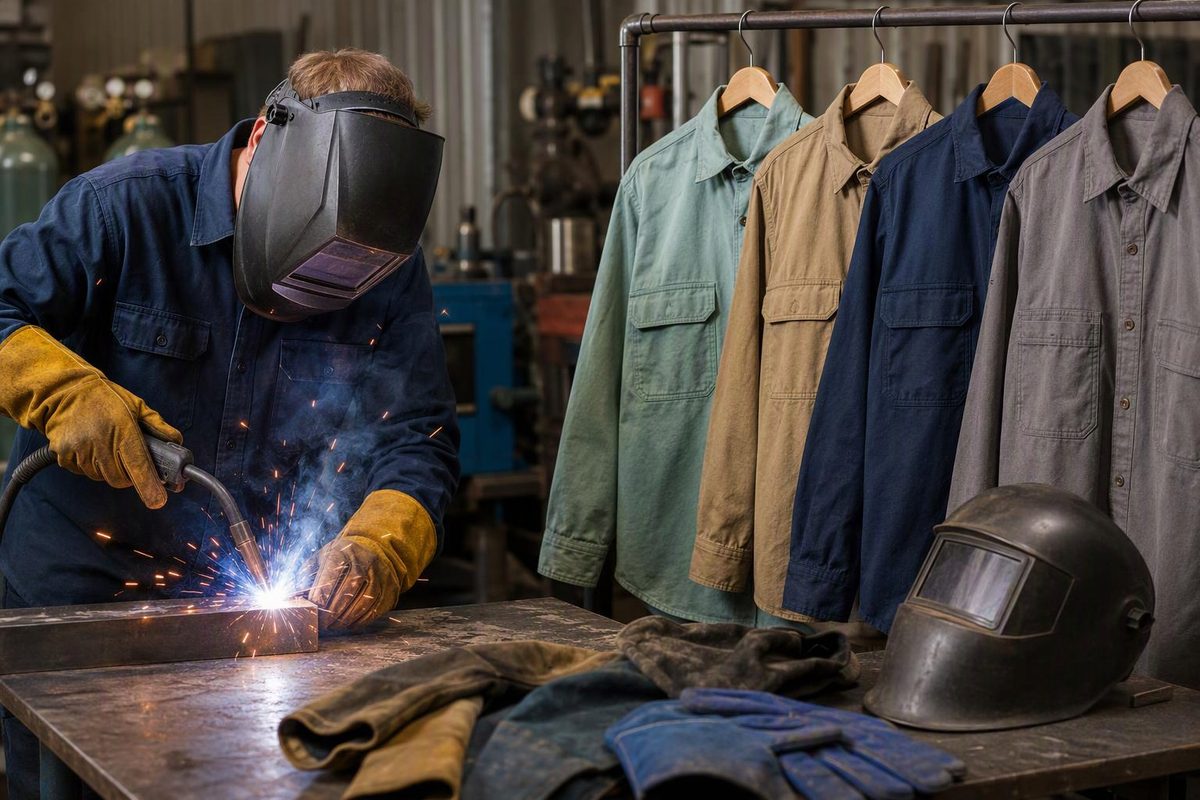
Fire resistant welding shirts are usually sold as flame-resistant (FR) shirts. The useful question is whether the exact shirt’s fabric, construction and documented limits match your welding exposure—not simply whether the listing says “FR.”
FR does not mean fireproof. Flame-resistant clothing provides temporary protection against serious burns; it is not permission to remain in a fire. Flame resistance may come from the material itself or from a treatment. CCOHS explains these limits and material types.
What to verify before buying
Look for an exact model number and manufacturer documentation, not only a marketplace title that says “welding shirt.” Verify:
- Material: Is it identified as FR-treated or inherently flame-resistant? “100% cotton” alone does not establish an FR treatment or tested performance.
- Intended use: Does the manufacturer limit it to light welding, or describe it as a layer beneath other protection?
- Construction: Does it have long sleeves, a closable collar, secure cuffs and covered pockets?
- Care and service limits: Are laundering instructions and any tested wash-count limits available?
Ordinary synthetic clothing is a poor substitute: materials such as polyester and nylon can melt and cause severe burns. Underlayers matter too. CCOHS recommends fire-resistant fabrics or non-melting natural fibres against the skin; do not assume an FR outer shirt makes a polyester undershirt suitable. CCOHS clothing guidance
Read standards for what they actually measure
ASTM D6413/D6413M is a vertical flame test for textiles. It measures afterflame time, afterglow time and char length under a specified laboratory exposure. A D6413 claim is not, by itself, a molten-spatter protection rating or proof that the garment suits every welding job. ASTM’s published scope and significance explain those test limits.
NFPA 2112 addresses flame-resistant clothing for short-duration thermal exposures from fire, including flash-fire exposure. That is a different selection question from how much welding spatter a shirt can tolerate. NFPA’s standard description
A documented example—not a best-shirt ranking
Black Stallion’s FS7-KHK illustrates why the specification sheet matters. Its manufacturer listing identifies 7 oz. FR-treated cotton, flapped chest pockets, front and adjustable wrist snaps, and protection tested through 50 home washings. Crucially, its specification sheet recommends it for light welding applications only.
Those are manufacturer claims, not an independent wear test. “Tested through 50 home washings” is not a guarantee that a damaged or contaminated shirt remains usable until wash 50, nor proof of protection beyond that testing. Follow the garment’s care label and service instructions.
When does a shirt need added protection?
Check where sparks, spatter and hot slag can land, including whether they can collect against your chest, forearms or lap. A shirt documented for light welding should not automatically become the outer layer for overhead welding or heavy spatter exposure.
The American Welding Society recommends heavier protective materials over lighter ones and leather aprons, capes, sleeves or leggings as needed for the application. Shirts and jackets must also cover exposed skin to protect against arc radiation and burns. AWS PPE guidance
For U.S. general-industry workplaces, OSHA’s welding standard requires protective clothing appropriate to the size, nature and location of the work—not one shirt weight for every operation. Follow your employer’s hazard assessment and site requirements.
Use our FR clothing selection guide to assess the complete outfit, or the welding jacket buying guide when a shirt needs more substantial outer protection.
Check fit in your working position
Try the shirt on with the layers and gloves you will actually wear. Reach forward and raise your arms: the hem should still overlap your trousers, and your wrists and neck should remain covered.
Keep cuffs closed and sleeves unrolled. Close pocket flaps; open pockets and rolled cuffs can catch hot particles. Choose room for movement without a tight fit—CCOHS notes that an air layer between fabric and skin adds thermal insulation. Welding clothing and coverage guidance; FR fit guidance
Keep protection in service
Inspect before use and after cleaning. Remove damaged or contaminated shirts from service until they can be cleaned or repaired according to the manufacturer’s instructions. Oil and grease can undermine protection; holes leave skin exposed. Repairs need appropriate FR patches and thread, not an improvised ordinary-fabric patch. Follow the care label, including restrictions on bleach and fabric softeners. CCOHS inspection, repair and cleaning guidance
Keep clothing dry and change wet garments to reduce electrical-shock risk. AWS clothing care guidance