
Leather Welding Gloves Should Match the Arc, Heat and Handwork
Choose leather welding gloves for TIG, MIG, stick or cutting by heat exposure, dexterity, cuff coverage, fit, construction and documented ratings.
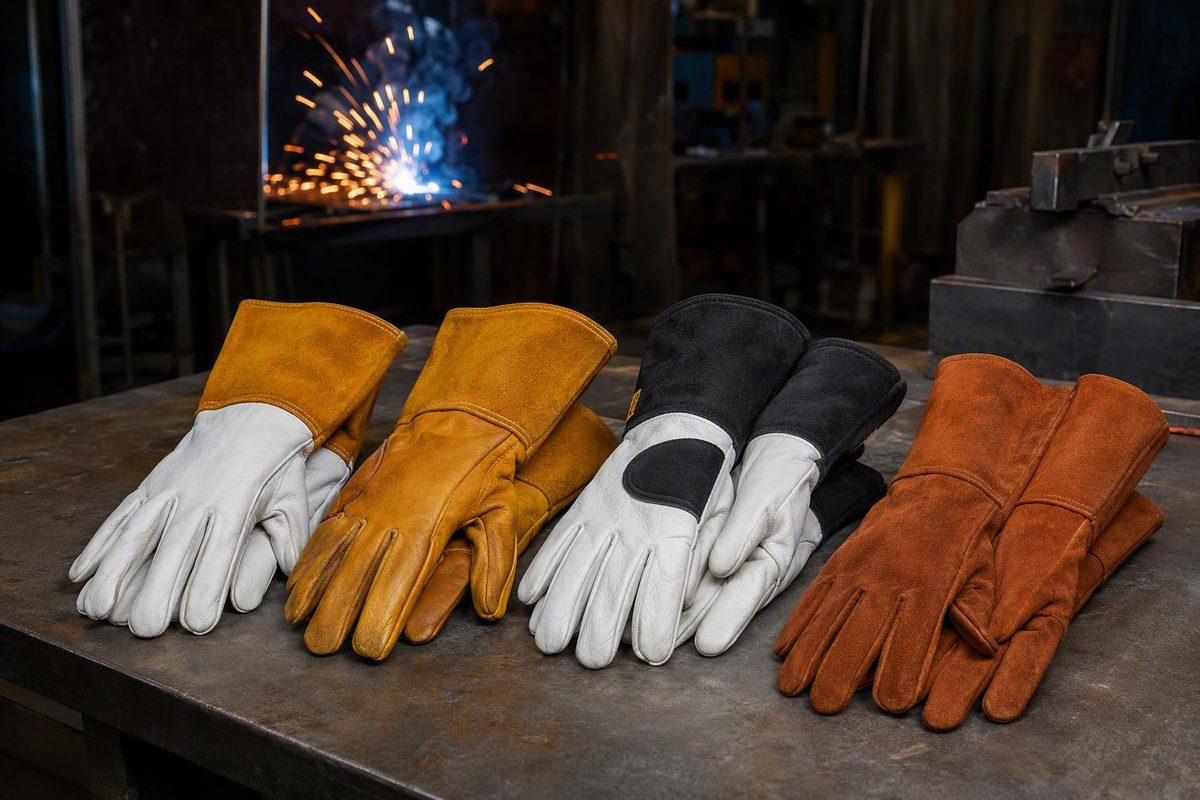
Leather welding gloves are not interchangeable. A thin, close-fitting pair can make TIG filler control easier but may be a poor choice for sustained stick welding, heavy flux-core work or handling hot parts. A heavily insulated glove reverses that tradeoff: more thermal protection, less finger feel.
The useful question is therefore not “Which leather is best?” It is “Which complete glove matches this process, position, heat exposure and handling task?” OSHA requires workplace hand protection to be selected from its performance relative to the task, conditions, duration and identified hazards—not from material name alone (29 CFR 1910.138).
Start with the welding process
| Work | Practical starting point | What to verify |
|---|---|---|
| TIG | Supple, close-fitting leather; light or no full lining | Finger control, flame-resistant seams, sufficient cuff and actual heat rating |
| MIG | Medium-weight leather with reinforced palm and moderate lining | Spatter resistance, back-of-hand coverage and gun-hand mobility |
| Stick or flux-core | Heavier leather, longer cuff and more insulation | Thermal performance, seam protection and ability to release the electrode holder safely |
| Cutting, gouging or high-spatter work | Heavy gauntlet glove selected for the assessed exposure | Heat, sparks, molten-metal splash, abrasion and cuff-to-sleeve overlap |
These are starting points, not process certifications. Amperage alone does not determine glove choice. Arc time, hand distance from the puddle, welding position, preheat, reflected heat, spatter and whether the same worker handles material all change the exposure.
Commercial designs illustrate the tradeoff. One current TIG glove uses unlined goatskin for a low-bulk fit, then adds a padded palm, split-leather reinforcement and flame-resistant stitching; its maker separately lists puncture, abrasion and conductive-heat levels (Miller). A heavy MIG/stick design instead combines grain and split leather with a double-layer insulated palm and back plus foam and cotton-fleece lining (Miller). Those are examples of construction choices—not proof that every goatskin glove is a TIG glove or every cowhide glove is suitable for heavy welding.
Read the glove, not just the leather label
Check the exact model’s datasheet or declaration for:
- Thermal performance: Look for documented contact-heat, flame and molten-metal results where relevant. “Leather” by itself is not a heat rating.
- Mechanical protection: Grinding, plate handling and sharp edges add abrasion, cut and puncture hazards that a dexterous welding glove may not address adequately.
- Lining: More insulation generally increases bulk. Decide whether sustained heat or precise rod and torch control is the limiting need.
- Palm construction: Grain leather tends to give a smoother contact surface; split leather is commonly used where abrasion and heat exposure justify a rougher, heavier layer. Reinforced wear zones can matter more than the animal species printed on the package.
- Seams: Inspect thread, welted seams and exposed stitch lines. A strong leather shell is little help after a hot particle opens or burns through a seam.
- Cuff: A gauntlet should overlap the protective sleeve through the full working range. Overhead and vertical welding deserve particular attention because sparks can travel toward the wrist and forearm. OSHA’s hot-work guidance gives gauntlet gloves as an example of PPE following a hazard assessment (OSHA).
Where EN markings are used, EN 12477 addresses welding gloves and draws on EN 388 mechanical tests and EN 407 thermal tests (Ejendals). In the United States, do not treat a generic “OSHA compliant” sales claim as a substitute for performance data: OSHA’s rule places selection on the evaluated task and hazards.
Fit is a safety feature
Try the gloves while making the same grip used at work. Fingers should reach the ends without excess empty leather folding around the controls. The palm should not bunch around a TIG torch, MIG trigger or electrode holder. At the same time, the glove must not be so tight that closing the hand strains seams or compresses insulation.
Run three checks before committing to a size:
- Grip and release the torch or holder without repositioning the glove.
- Feed a sample TIG rod or operate the gun trigger without fingertip collapse.
- Flex the wrist and raise the arm to confirm that the cuff still overlaps the jacket or welding arm guard.
Fit the actual product rather than relying on a universal small-to-XL assumption. Patterns, finger length and liner thickness differ. A narrower or broader pattern can improve control without changing the nominal size.
Inspect before every use
Replace the glove when it has a hole, split seam, burned-through area, badly thinned palm or damaged lining. Retire a glove that has become oil-soaked or otherwise contaminated, and follow the manufacturer’s care instructions rather than improvising a wash that may alter the leather or liner.
Keep welding gloves dry and separate from general grinding or material-handling gloves when those jobs wear through the fingertips quickly. Do not pick up recently welded metal merely because the glove feels thick; use handling tools and the shop’s hot-material marking procedure. OSHA specifically requires completed hot metal to be marked or otherwise identified to warn other workers (29 CFR 1910.252).
For a shop covering multiple processes, two task-specific pairs usually make more sense than forcing one compromise glove to do everything: a dexterity-focused TIG pair and a more insulated MIG/stick or hot-work pair. The final selection still follows the workplace hazard assessment, equipment instructions and site PPE rules.