
How to Decide Whether Chaps Fit the Hazards of Your Welding Job
See why OSHA does not mandate them for every job, then compare coverage, fit, closures, materials and documentation before buying.
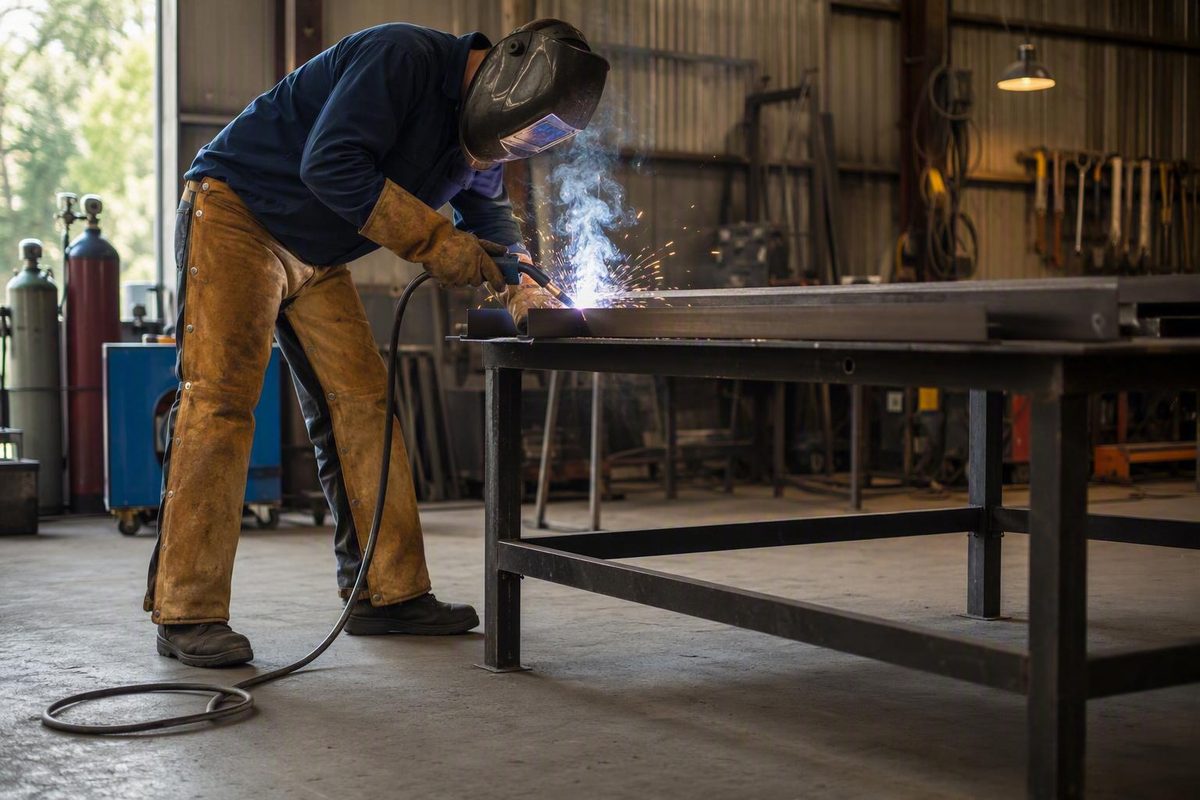
Welding chaps can be useful lower-body PPE, but the product name does not define the protection. Start with the job’s expected sparks, slag, heat, flame exposure, posture, and environment. Then evaluate whether the exact garment covers the exposure zones identified by the employer’s hazard assessment, subject to workplace rules and the manufacturer’s instructions.
The short answer: choose coverage for the hazard, not the product name
Some hang from the waist with split leg panels; others may be described as waist aprons or split-leg aprons. Do not assume that every product called “chaps” begins at the knee, reaches the ankle, protects the inner legs, or wraps around the wearer in the same way.
Chaps are also only one part of a welding PPE system.
OSHA requires suitable PPE for workers exposed to welding, cutting, and brazing hazards, but it does not prescribe welding chaps for every operation. Appropriate protective clothing varies with the “size, nature, and location” of the work, so selection depends on the employer’s assessment of the particular job (OSHA’s welding requirements).
Before choosing a garment, ask:
- Where will sparks and slag travel during the actual task?
- Which parts of the legs or waist could be exposed?
- Is radiant heat or short-duration flame exposure reasonably expected?
- Will the welder stand, crouch, kneel, climb, or work seated?
- How will the garment overlap the jacket, apron, work pants, and boots?
- Can it remain properly positioned through the expected range of movement?
Use those questions as a fit-check framework—not as a substitute for the employer’s hazard assessment, site requirements, or manufacturer limitations. Product drawings, dimensions, labels, and instructions are more useful than a category heading alone.
Chaps, aprons, leggings, and pants: a coverage decision table
| Garment label | Documented design | Coverage question to verify | Primary limitation |
|---|---|---|---|
| Split-leg chaps | Waist-supported garment with separate split leg panels | Do its dimensions and adjustment cover the assessed thigh, knee, inner-leg, and ankle exposure? | Length and panel width may leave gaps for a particular wearer or posture |
| Waist apron/chaps | Split-leg cowhide garment marketed under both names | Where does the waist section end, and how far do the leg panels extend or wrap? | The overlapping category name does not establish coverage |
| Split-leg bib apron | Bib or torso section extending into separate leg panels | Does it cover the necessary torso-to-leg exposure without opening during movement? | Front coverage does not establish side or rear coverage |
| Supported leather leggings | Lower-leg garment held in shape by an insert or side bar | Where does it start, and does it overlap the pants and footwear? | It does not inherently address upper-leg or waist exposure |
| Full leather or welding pants | Trouser-style lower-body garment | Is the material and complete construction documented for the assessed exposure? | Additional worn coverage may increase bulk and thermal burden |
Manufacturer catalogs illustrate why the labels need close reading. Black Stallion lists model 40WS as 40-inch split-cowhide split-leg chaps. The same catalog lists model 75CL as split-cowhide leggings with plastic insert support and model 92CL as split-cowhide leggings with metal side-bar support. It also lists split-leg bib aprons as another distinct construction (Black Stallion’s apron and chap catalog).
Tillman uses overlapping terminology: models 5330 and 5330A are cowhide split-leg “waist apron/chaps,” while models 3840, 4436, and 4440 are split-leg aprons and model 5350 is cowhide pants (Tillman’s leather pants and chaps catalog).
A simple way to build a shortlist is to begin with the exposed body region:
- If the assessment identifies lower-leg exposure, evaluate whether documented leggings provide the necessary starting point, length, and overlap.
- If exposure runs from the front torso or waist into the legs, evaluate split-leg bib aprons or waist-supported split-leg garments.
- If sparks or heat can reach around, between, or beyond chap panels, evaluate whether a more continuous garment is needed.
- If more coverage is considered, account for mobility, fit, and thermal burden rather than assuming that the largest garment is automatically the correct one.
These are screening questions, not universal prescriptions. Final selection still depends on the job assessment, garment documentation, and fit on the intended wearer.
What OSHA actually says about welding chaps
OSHA’s welding rules do not name chaps as mandatory clothing for every welding job. The governing principle is that employees exposed to welding, cutting, or brazing hazards must receive suitable PPE, with the clothing configuration determined by the work and its hazards.
An OSHA interpretation addressing flame-resistant clothing explains that workers exposed to flash-fire or short-duration thermal hazards may need clothing suitable for those hazards. It also says that if engineering or administrative controls eliminate the exposure, PPE designed for that particular thermal hazard may not be required. The letter interprets existing requirements for particular circumstances; it does not create additional employer obligations (OSHA’s interpretation on FR clothing for welders).
Consequently, buying an item marketed as “welding chaps” does not by itself establish compliance. Neither do general sales terms such as heavy duty, flame-resistant, or welding protection. Selection depends on the assessed exposure, the garment’s documented capabilities and limitations, its condition and fit, and its use within the employer’s complete protection program.
Protective clothing must also be distinguished from fire prevention. Welding rules separately address moving combustible hazards, using guards where hazards cannot be removed, keeping extinguishing equipment ready, and assigning a fire watch under specified conditions. Those controls protect the work area and cannot be replaced by clothing worn by the welder.
Do not describe a pair of chaps as “OSHA approved,” “OSHA certified,” or compliant merely because it appears in a welding-PPE catalog. The supplied product listings do not establish such status, and workplace compliance cannot be determined from a category name.
Material choices: what is documented and what remains a seller claim
Split cowhide is the recurring documented material among the expressly identified chap products reviewed here. Black Stallion 40WS is listed as split cowhide; Industrial Source lists a side-split cowhide product; MCR Safety describes model 38600MW as heavy side-split leather; and Tillman identifies models 5330 and 5330A as cowhide waist apron/chaps.
That catalog pattern does not prove suitability for a particular welding process or hazard. “Cowhide” or “leather” alone does not establish thickness, grade, heat-transfer performance, seam strength, or the behavior of the complete garment.
One welding-gear vendor characterizes leather chaps as durable and resistant to heat and sparks but potentially heavy and stiff. The same vendor describes FR-treated cotton as lighter and more breathable and says the treatment may wear over time. Those are vendor descriptions without supplied comparative test data; they do not demonstrate equivalent protection or establish which material fits a particular job.
A statement that a material resists heat or sparks is not evidence of indefinite flame protection, and base-material claims do not establish the performance of panels, seams, straps, buckles, or closures.
Before choosing leather, FR-treated cotton, or another construction, request:
- The precise material specification, including leather type or fabric weight
- The manufacturer’s intended-use statement for the exact model
- Applicable standards and test methods
- Available test records for the complete garment
- Information about seams, thread, reinforcement, straps, and closures
- Care, storage, inspection, and retirement instructions
- Limitations involving heat, flame, sparks, slag, or molten material
- Restrictions involving contamination, wear, punctures, or other damage
Terms such as heavy leather, flame-resistant, and Kevlar-stitched identify selected attributes. None proves whole-garment performance against the hazards of a specific job.
The pre-purchase checklist: coverage, fit, closures, and documentation
Begin with actual dimensions. Generic small, medium, and large labels do not show where the garment will sit or which areas its panels will cover.
- Measure the wearer and garment. Check the documented waist range, overall length, panel width, and the points where each panel begins and ends. A 40-inch length is a product specification, not a universal fit recommendation.
- Test every expected working position. Evaluate coverage while standing, crouching, kneeling, climbing, and seated. Treat this as a practical fit check against the areas identified by the hazard assessment.
- Check garment interfaces. Inspect overlap with work clothing and footwear. Look for exposed areas at the waist, between split panels, along the inner legs, around the knees, above the ankles, and at the boot tops.
- Verify adjustment limits. Use manufacturer documentation rather than assuming a waist strap or leg adjustment will accommodate the wearer.
- Examine the closure system. Determine how closures operate with gloves and adjacent PPE. Do not assume that straps will remain secure or allow safe removal without model-specific documentation.
- Check for interference. Look for loose panels, pockets, straps, or hardware that could interfere with movement, climbing, tools, leads, or other equipment. No product should be presumed snag-safe from its appearance.
- Inspect construction. Review stitching, seams, reinforcement, panel joins, hardware, labels, and damaged areas. A reinforced-thread claim is not a substitute for complete-garment information.
- Read the intended-use statement. Confirm what the manufacturer says the exact model is designed to do and note any stated limitations.
- Review care instructions. Follow instructions for the specific garment. Cleaning or conditioning practices suitable for one material may not be appropriate for another.
- Request performance documentation. Look for identified standards, test methods, results, and confirmation that the documented construction matches the model being purchased.
For example, Industrial Source lists one side-split cowhide welding-chap product at 24 by 40 inches. Its category page does not show fastening details, performance ratings, or fit guidance for that item, demonstrating why a published length and width are only the beginning of the evaluation (Industrial Source’s welding aprons and chaps listings).
The employer’s hazard assessment, site rules, equipment requirements, and garment instructions should override generic buying advice.
Representative products without a false “best chaps” ranking
The following examples show the constructions represented in the reviewed manufacturer and retailer listings. This is not a ranking of safety, quality, value, durability, or performance.
| Product | Source type | Listed construction | Published dimensions or limitation |
|---|---|---|---|
| Black Stallion 40WS | Manufacturer catalog | Split-cowhide split-leg chaps | 40-inch length; task suitability not established |
| Industrial Source listing | Retailer category | Side-split cowhide leather welding chaps | 24 × 40 inches; fastening and fit details not shown |
| MCR Safety 38600MW | Manufacturer store | Heavy side-split leather welding chaps | Dimensions and protection rating not shown |
| Tillman 5330 / 5330A | Manufacturer catalog | Cowhide split-leg waist apron/chaps | Dimensions and closure details not shown |
MCR Safety’s listing markets model 38600MW for protection from heat, sparks, slag, and cuts. Those statements are seller claims: the cited listing does not show test results, an applicable standard, or a protection rating substantiating them (MCR Safety 38600MW listing).
Retail categories can also overstate the apparent selection. One page headed as an eight-item welding-chaps category contained only two chap listings—Black Stallion 40WS and Tillman 5330—while the other six products were utility-pant variants. The retailer also advertised Kevlar stitching without showing standards or complete-garment test results on the category page (Welder Supply’s chaps category).
A defensible “best welding chaps” verdict is not possible from these listings. They do not provide comparable information across sizing, leather thickness, garment weight, closures, certifications, testing, care limits, or warranties. Prices, discounts, stock status, purchase counts, and category rankings are sales data, not evidence of protective performance.
Use chaps as part of the system—and account for heat stress
After selecting lower-body coverage, check the rest of the protection plan. Chaps do not replace helmets or hand shields, appropriate eye protection for helpers, gloves, suitable footwear, ventilation, respiratory protection where required, or other PPE identified by the hazard assessment.
Clothing also does not replace fire controls. Movable combustible hazards must be taken to a safe location when the workpiece cannot readily be moved. Where hazards cannot all be removed, guards must be used to confine heat, sparks, and slag, and suitable extinguishing equipment must be ready for immediate use. When OSHA requires a fire watch under the specified higher-risk conditions, the watcher must remain for at least 30 minutes after welding or cutting is completed to detect and extinguish possible smoldering fires (29 CFR 1910.252).
Coverage and heat burden must be considered together. Less coverage can leave an assessed hazard unaddressed, while additional protective clothing may contribute to heat stress. OSHA’s interpretation recommends considering lightweight, breathable clothing where appropriate, providing cold liquids and electrolyte-replenishing drinks, and using work-rest cycles when heat stress is a concern (OSHA’s FR-clothing interpretation).
Use this five-step sequence:
- Assess the hazard. Identify expected sparks, slag, heat, flame exposure, posture, environment, and task duration.
- Map the exposed areas. Determine what requires protection during every expected movement and working position.
- Compare actual coverage. Evaluate panel shape, dimensions, overlap, and possible openings rather than relying on the garment name.
- Verify documentation and fit. Check materials, intended use, standards, test records, seams, closures, care limits, and fit on the intended wearer.
- Apply the complete plan. Follow site rules and integrate the garment with required PPE, ventilation, respiratory protection, heat controls, and fire-prevention measures.
The useful question is not whether welding chaps are good in general. It is whether a documented garment addresses the exposure zones identified for the job without leaving gaps the employer’s assessment considers unacceptable—and whether another garment configuration is needed.
Are leather welding chaps fireproof?
No. Leather welding chaps should not be treated as fireproof. A seller may describe leather as resistant to heat and sparks, but resistance language does not establish indefinite flame protection or complete-garment performance.
Check the manufacturer’s intended use, applicable test documentation, limitations, seams, closures, care instructions, and the conditions addressed by the employer’s hazard assessment.
Does a flame-resistant or Kevlar-stitched label prove that welding chaps are suitable for my job?
No. Flame-resistant should be tied to an identified garment, exposure, standard, and test method rather than treated as a universal guarantee. Kevlar stitching describes one construction detail; it does not prove the performance of the leather or fabric, panels, straps, closures, or complete garment.
Suitability still depends on the assessed hazard, actual coverage, fit, condition, manufacturer limitations, and integration with the rest of the PPE and fire-control plan.