
Choose Eye Protection by the Job, Not the Product Label
Arc welding generally calls for a rated helmet or equivalent broad face protection. Shade, UV/IR filtration, impact and coverage remain separate checks.
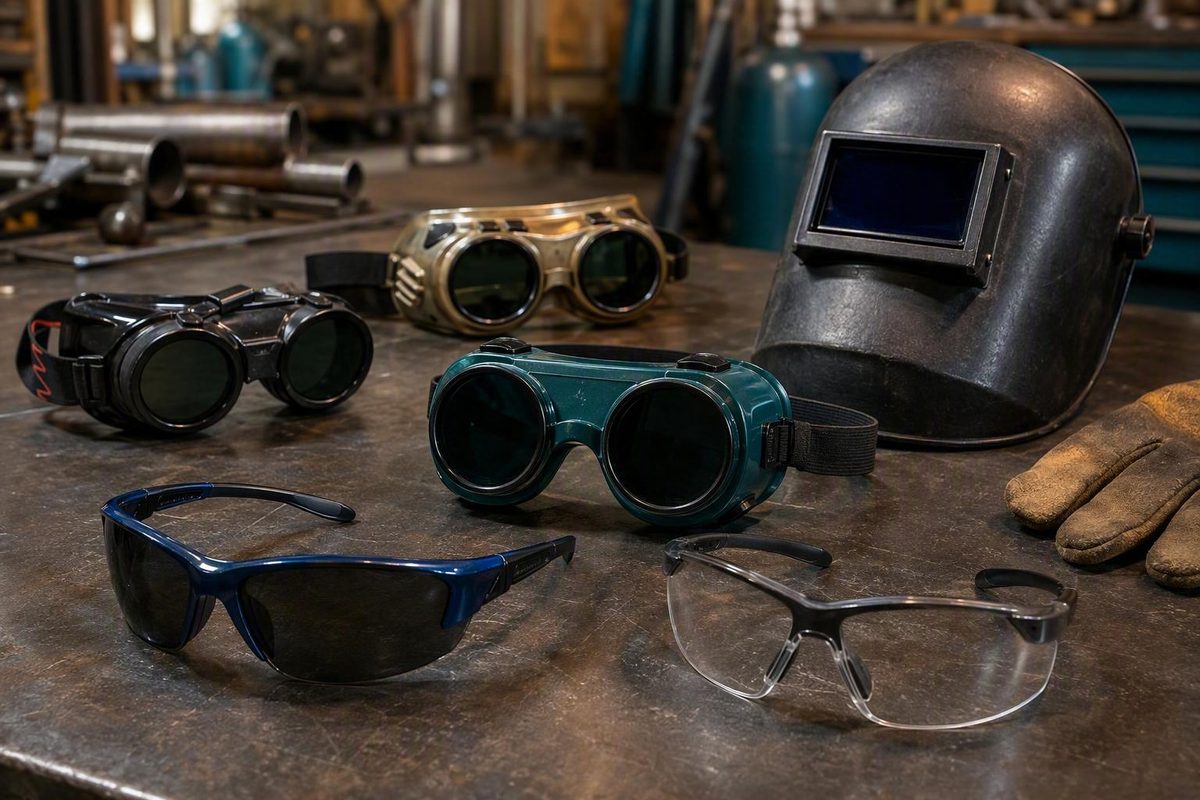
“Welding goggles” is a broad retail label, not a complete safety specification. It may describe fixed-shade cup goggles for brazing, filtered safety glasses for cutting, clip-on filters, compact auto-darkening systems, or a category page filled with replacement parts.
Choose protection by answering four separate questions:
- Is the filter shade correct for the process and operating range?
- Is ultraviolet and infrared filtration documented for the exact filter?
- Does the equipment provide the impact protection required for the hazard?
- Does it cover enough of the eyes, face, neck, and exposed skin?
A familiar product name—or even a familiar shade number—cannot answer all four.
This guide provides general selection and comparison principles from the supplied evidence. It cannot establish the legal minimum for every workplace or jurisdiction because the evidence does not include the full text of current OSHA provisions, ANSI/ISEA Z87.1, AWS Z49.1, CSA Z94.3, or applicable EN standards. Verify controlling requirements through the official source, the equipment manufacturer, and your employer before use.
Start Here: Are Goggles Appropriate for Your Task?
Begin with the process, not the product:
- MIG, TIG, stick, FCAW, plasma arc welding, or another arc process: Use a properly rated welding helmet or equivalent broad face-protection system suited to the operation. Goggles primarily protect the eyes and generally leave more facial skin exposed.
- Gas welding or oxy-fuel cutting: Properly rated goggles may be suitable for selected operations when their filter shade, documented radiation filtration, impact protection, and physical coverage match the exposure.
- Torch brazing or soldering: Lower-shade filtered eyewear may be appropriate, but the required shade varies by operation. A product marketed for brazing is not automatically suitable for cutting or gas welding.
- Grinding: Select protection for flying fragments and the visibility required to control the tool. A welding shade does not, by itself, establish adequate impact protection.
- Molten-metal observation: Use a filter documented for that application. Lens color or a general “welding” description is insufficient.
The central difference between goggles and a helmet is coverage. Goggles concentrate protection around the eyes. A helmet covers the eyes and more of the face, although neck, side, and top coverage still depend on its design. A 2025 commercial overview similarly describes goggles as eye-focused protection and recommends helmets for arc welding and work involving intense radiation, heat, sparks, or spatter; because it is vendor-authored, its broad task recommendations should still be checked against the controlling rules for the job (ArcCaptain goggles-versus-helmet overview).
That distinction matters because an optically appropriate filter can still be part of a physically inadequate protector. Shade selection concerns light transmission. It does not independently establish protection against fragments, side entry, hot spatter, or exposure of the surrounding skin.
Use this four-part decision test before buying:
| Question | What to verify |
|---|---|
| Correct shade? | Exact process, amperage, electrode size where relevant, and operating conditions |
| Documented UV/IR filtration? | Model-specific markings and documentation for the exact filter |
| Adequate impact protection? | Applicable impact designation and suitability for the expected fragments |
| Enough coverage? | Eyes, sides, face, and exposed skin relative to sparks, spatter, heat, and radiation |
Escalate to the broader protection required by the equipment instructions and workplace rules when the operation produces an intense arc, substantial sparks, hot spatter, flying fragments, or an exposure you cannot confidently characterize. Compactness and convenience do not justify leaving predictable hazards uncovered.
Equipment instructions, current governing requirements, and workplace procedures take priority over a generalized online guide. Welder Facts likewise states that its articles are informational and that equipment manuals and site rules override them (Welder Facts safety notice).
What Welding Lens Shade Numbers Mean
A filter’s shade number indicates how much visible light it transmits. Higher shade numbers are darker and permit less visible light to pass. The correct shade depends on the process and operating conditions—especially amperage—not simply on a preference for a darker view.
Shade is only one property of protective equipment. By itself, it does not tell you:
- whether UV and IR filtration is documented;
- whether the lens and frame have the necessary impact designation;
- how the filter performs optically;
- whether radiation or debris can enter around the sides;
- whether the face and surrounding skin are covered; or
- whether the assembled protector is suitable for the intended process.
“Darker is always safer” is therefore a poor buying rule. A filter must control the exposure while still allowing the operator to see the joint, workpiece, torch or electrode, and surrounding hazards. Excessive darkness can impair positioning and situational awareness.
Some secondary charts distinguish a minimum protective shade from a suggested darker shade intended for viewing comfort. Do not treat the two columns as interchangeable or assume that a secondary chart establishes the controlling legal minimum. WeldingMart’s retailer-authored chart, for example, lists separate minimum and suggested values and advises starting darker, then moving lighter only within the applicable guidance until the weld pool is visible (WeldingMart shade guide).
A bounded selection method is:
- Identify the applicable table for the exact process and operating range.
- Start at the darker end of that guidance when adequate visibility permits.
- Move lighter only within the permitted range until the work is clearly visible.
- Never move outside the current requirements merely for convenience.
- Recheck the selection whenever the process, amperage, electrode, fuel-gas operation, or working conditions change.
The American Welding Society’s educational guide also says shade selection should be based on process and amperage, with any move to a lighter filter kept within the recommended guidance. It specifically rejects ordinary blue safety glasses as a substitute for qualified arc-welding filters (AWS welding lens guide).
Ordinary smoke, amber, blue, or other tinted safety glasses should not be treated as welding filters unless the exact product is documented and marked for the intended exposure. Color alone does not prove shade, radiation filtration, impact performance, or process suitability.
Shade Guide by Process and Amperage
The table below is general starting guidance, not a complete regulatory or process table. It summarizes the November 2025 AWS educational article. Verify the exact process, amperage, electrode size, equipment instructions, workplace procedure, and requirements for your jurisdiction before selecting a filter (AWS welding lens shade chart).
| Process | Operating range | General starting shade range |
|---|---|---|
| Oxy-fuel cutting or torch brazing | Operation-dependent | 4–6 |
| TIG | Below 50 A | 8–10 |
| TIG | 50–150 A | 10–12 |
| TIG | Above 150 A | 12–14 |
| MIG and FCAW | Below 60 A | 7–10 |
| MIG and FCAW | 60–160 A | 10–12 |
| Stick | 60–160 A | 10–12 |
| Stick | Above 160 A | 12–14 |
| Plasma cutting | Variable amperage | 9–14 |
The plasma-cutting entry is intentionally broad. Because the cited article labels amperage only as “variable,” Shade 9–14 is not precise enough to serve as a standalone selection instruction. Use the current controlling table and the plasma-cutter manufacturer’s instructions.
Oxy-fuel cutting, brazing, and soldering
The AWS article groups oxy-fuel cutting and torch brazing within a broad Shade 4–6 range. WeldingMart’s secondary chart is more granular: it suggests Shade 3 or 4 for torch brazing, Shades 4, 5, and 6 for light, medium, and heavy oxy-fuel cutting respectively, and Shade 2 for torch soldering. These values come from a retailer-authored summary and must be checked against the current controlling source for the exact operation.
Do not average differing charts into a new universal rule. Differences may reflect distinct definitions, table structures, assumptions, operating ranges, or distinctions between minimum and suggested shades.
This context explains why Shade 5 welding goggles appear frequently in catalogs. Shade 5 is widely marketed for selected brazing, oxy-acetylene, and oxy-fuel-cutting work; it is not a universal arc-welding shade. Forney’s category, for example, contains six Shade 5 models described as brazing, oxy-acetylene, barricade, or lift-front goggles (Forney Shade 5 goggle listings).
MIG, TIG, stick, and FCAW
Arc processes generally require both an appropriate filter and broad face protection. The shade values in the table should not be interpreted as permission to perform arc welding in goggles alone.
Secondary charts may give different minimum or suggested values for particular amperage bands. Do not choose the lowest number found online. Determine which current requirement governs the work, then follow any more specific equipment instruction, employer procedure, standard, or jurisdictional rule.
Why the exact operating range matters
“MIG” or “TIG” is not enough information. Low-amperage bench work and higher-amperage production work can fall into different shade ranges. Electrode size and other process conditions may also affect the applicable guidance.
Treat the shade table as the beginning of the selection process. You must still verify documented radiation filtration, impact performance, fit, and physical coverage.
Fixed-Shade vs. Auto-Darkening Welding Goggles
Fixed-shade and auto-darkening products solve different usability problems. Neither design is suitable for every process merely because it is sold as welding eyewear.
Fixed-shade goggles
Fixed-shade goggles remain at one darkness. They can be practical when the process and operating range remain consistent because the operator does not need to select among several dark states.
Common forms include:
- Cup goggles, with separate eyecups;
- Barricade goggles, with a wider one-piece body;
- Wraparound designs, intended to extend lateral coverage;
- Lift-front goggles, with a filtered front that lifts away from a clear lens; and
- Flip-up designs, using a similar filtered-to-clear transition.
These terms describe construction, not proven protection. You cannot conclude that a barricade design is safer than cup goggles—or that wraparound glasses outperform either—without comparable product-level testing, markings, and coverage information.
Forney’s six-product category consists entirely of Shade 5 goggles. KwikSafety similarly markets its KS1101 flip-up Shade 5 model for oxy-fuel welding, oxygen cutting, brazing, soldering, and light-to-medium gas welding. Those are seller-defined applications, not permission to use Shade 5 for unrelated processes.
Auto-darkening goggles
Convenience does not establish suitability. Before relying on an auto-darkening product, obtain and review:
- selectable dark-shade range;
- light-state shade;
- switching speed;
- optical class;
- viewing area;
- number and position of sensors;
- sensitivity settings;
- delay settings;
- power source and battery requirements;
- approved replacement covers and components;
- model-specific compliance markings and documentation; and
- compatibility with the included or separately required face protection.
YesWelder illustrates why this specification audit matters. The seller lists its LYG-R100A at Shades 5, 7, 9, 11, and 13, describes it for MIG, TIG, stick, gas welding, and cutting, gives a weight of 7.8 ounces, and says a face shield is included. The supplied page does not disclose cited certification, switching speed, optical class, viewing area, power source, sensor configuration, or warranty specifications, so the product’s suitability for a specific arc-welding operation cannot be independently established from that page alone (YesWelder LYG-R100A product page).
Confined spaces: access versus coverage
A compact goggle system may fit where a conventional helmet shell interferes with access. Treat that as an ergonomic characteristic, not proof that the complete system controls the exposure.
Before using compact equipment in a restricted position, ask:
- Is skin around the eyes, cheeks, forehead, ears, or neck exposed?
- Can hot spatter reach behind or around the face guard?
- Does the protector restrict peripheral or exit visibility?
- Can the workpiece, torch, hand, or surrounding structure block the sensors?
- Does a respirator displace the goggles or face guard?
- Can protection remain in place while the user enters and leaves the position?
A smaller protector can improve access while reducing coverage. Evaluate both sides of that tradeoff.
How to Verify Standards and Product Claims
Read the markings on the exact frame, lens, filter, and assembled protector. Do not rely on a retail-category heading, search-result title, package color, or unexplained standards logo.
A clear impact-rated lens, for example, is not automatically a welding filter. Conversely, a dark welding filter does not by itself establish the impact performance of the complete assembly.
Wording such as “OSHA certified” should not be accepted as model-specific evidence. Ask which standard and edition were used, which model and variant were evaluated, who performed the evaluation, and which markings should appear on the product.
At minimum, confirm:
- manufacturer or traceable identification;
- exact model and variant;
- fixed shade or variable shade range;
- applicable standard and edition;
- impact designation where required;
- markings on the frame and filter, as applicable;
- model-specific instructions;
- stated applications and limitations; and
- access to supporting documentation.
This guide cannot provide a universal decoder for frame, lens, impact, and filter markings because the full authoritative standards and jurisdiction-specific rules are not included in the evidence. Use the current official marking guide for the applicable standard. If the markings cannot be connected to model-specific documentation, treat the product as unverified rather than guessing what an abbreviation means.
When a seller claims ANSI, CE, EN, or CSA compliance without reproducing supporting evidence, request the applicable declaration, test report, certificate, or other model-specific documentation. Confirm that the document covers the exact variant being purchased rather than a similar-looking product family.
KwikSafety, for example, says its KS1101 was third-party tested for ANSI Z87.1 compliance and claims CE EN175 F certification. The supplied product page neither identifies the laboratory nor reproduces the test results, so these remain seller-reported claims rather than independently verified findings (KwikSafety KS1101 listing).
Apply the same evidence standard to claims about:
- UV or IR protection;
- anti-fog performance;
- scratch resistance;
- durability;
- optical clarity;
- comfort;
- reduced fatigue; and
- confined-space suitability.
Marketing language may identify features worth investigating, but it is not equivalent to comparative testing or model-specific technical evidence.
For product comparisons, label evidence consistently:
- Documented in supplied technical evidence — supported by model-specific technical documentation or test evidence.
- Seller-reported — stated by a manufacturer or retailer but not independently substantiated in the available material.
- Not disclosed — absent from the available documentation.
“Not disclosed” does not prove that a feature is absent. It means the available evidence cannot verify it.
Fit, Coverage, Visibility, and Prescription Glasses
A protector that shifts, obstructs vision, or conflicts with other PPE may not provide the intended coverage in use. Evaluate fit with the complete system you will wear for the job.
Fit checklist
Check that:
- the strap adjusts securely and remains stable when you bend or turn;
- the frame supplies the side coverage required for the task;
- the protector does not create concentrated pressure points;
- the nose bridge, eyecups, and seals sit consistently;
- peripheral vision remains usable;
- the filter provides a clear view of the work and surrounding hazards;
- lifting or flipping the front does not dislodge the goggles;
- required safety glasses fit without forcing the goggles out of position; and
- respirators, hearing protection, hard hats, hoods, helmets, and face shields do not disrupt fit or coverage.
Padding, flexible frames, ventilation, and anti-fog treatments may improve usability. They do not compensate for an incorrect shade, undocumented radiation filtration, inadequate impact protection, or insufficient skin coverage.
Fogging and visibility
Fogging can obscure the joint and surrounding work area.
Do not assume that a product will resist fogging merely because “anti-fog” appears in its title. Treat that wording as seller-reported unless product-level evidence supports it. Use only the cleaning and anti-fog methods specified for the exact lens and coating.
Flip-up and lift-front designs
A flip-up or lift-front design lets the operator move between filtered and clear viewing without removing the entire frame. This can simplify layout, inspection, and transitions between work steps.
The mechanism does not establish process suitability. The filtered position still requires the correct shade and documented filtration. If work continues with the filter raised, verify that the remaining clear protector has the impact performance and coverage required for that activity. Check the product instructions for inspection of hinges, latches, and moving parts.
Wearing goggles with prescription glasses
- Over-glasses goggles: Built with internal space for some prescription frames.
- Clip-on filters: Attached to compatible host eyewear, with shade, stability, side coverage, and impact performance verified as a complete arrangement.
- Corrective-lens systems: Prescription inserts or other manufacturer-approved corrective options within a compatible protector.
Test the protector with the actual prescription frames. “Fits over glasses” does not guarantee clearance for every frame width, temple style, or lens depth, nor does it prove that the goggles will remain stable.
KwikSafety says medium-sized eyeglasses fit beneath the KS1101, while a retailer listing describes Lincoln Electric Cover2 eyewear as an over-glasses design. These are seller-attributed fit statements rather than universal guarantees; the same retailer collection also illustrates how prescription-compatible products may be mixed with IR goggles, clear glasses, tinted glasses, and clip-ons (mixed welding-eyewear collection).
A larger viewing area may improve awareness, but it may also affect the protector’s size or weight. Compare the documented dimensions, viewing area, weight, and fit rather than assuming that the largest window will be the most comfortable.
What the Market Actually Includes—and How to Compare Prices Fairly
Retailers frequently group unlike products under “welding goggles.” Separate them into meaningful classes before comparing specifications or prices:
- Fixed-shade goggles
- Welding safety glasses
- Clip-on filters
- Auto-darkening goggle or mask systems
- Helmets or weld caps
- Replacement parts and accessories
These classes do not solve the same problem. A replacement lens is not a complete protector. Clear safety glasses are not equivalent to filtered goggles. A clip-on depends on compatible host eyewear. A compact auto-darkening mask should not be priced against a bare fixed-shade lens as though the packages were interchangeable.
Retail categories may also contain headgear, magnifiers, anti-fog film, face guards, clear covers, batteries, frames, and service parts. Before comparing prices, determine whether the listing includes a complete usable system.
Market snapshots, not rankings
The supplied Forney snapshot lists six fixed Shade 5 products, including brazing, oxy-acetylene, barricade, and lift-front goggles. Displayed prices run from $12.99 to $24.99. The source-capture date was not disclosed, so these figures must be rechecked before publication or purchase. The category also lacks enough technical information to compare safety performance (Forney welding-goggle category).
The supplied KwikSafety snapshot displayed the KS1101 at $13.96, with a 4.7-star rating based on 34 reviews. Again, the capture date was not disclosed. Price, availability, ratings, and review counts are volatile, and none verifies suitability for a particular exposure (KwikSafety KS1101 product page).
A mixed retailer collection demonstrates why the cheapest search result may be misleading: its first-page listings include IR3 and IR5 goggles, clear and tinted safety glasses, clip-ons, and over-glasses eyewear. Products from different classes should not be treated as direct alternatives.
At the premium and accessory-heavy end, the supplied Weldfabulous category filter spans $14 to $362 and includes complete goggles, auto-darkening helmet products, weld caps, face guards, service parts, replacement lenses, magnifiers, and other accessories. The capture date was not disclosed. That $348 spread does not show that comparable goggles differ in price by that amount; it shows that the category contains unlike products (Weldfabulous mixed goggle category).
A fair comparison template
Use a table like this without turning it into an unsupported ranking:
| Product/model | Product class | Fixed or variable shade | Stated application | Eye and face coverage | Seller-reported standards | Prescription compatibility | Included guards | Disclosed technical specifications | Replacement support | Price and check date | Missing data |
|---|---|---|---|---|---|---|---|---|---|---|---|
| Model A | Fixed goggle | Fixed | Seller-stated tasks | Describe actual coverage | List exact claim | Yes/no/unclear | List | Record documented items | Available/unclear | Recheck and date | List omissions |
| Model B | Auto-darkening mask | Variable | Seller-stated tasks | Describe actual coverage | List exact claim | Yes/no/unclear | List | Record documented items | Available/unclear | Recheck and date | List omissions |
| Model C | Clip-on | Fixed | Seller-stated tasks | Depends on host eyewear | List exact claim | Host-dependent | None/other | Record documented items | Available/unclear | Recheck and date | List omissions |
Keep relatively stable specifications separate from volatile commercial information. Model markings, shade range, documentation, and physical coverage are more useful to a safety comparison than a temporary discount or star rating.
Sparse reviews cannot support a “best welding goggles” ranking. Forney’s 0.0 ratings correspond to zero reviews, not demonstrated poor performance. A positive customer rating likewise does not verify shade accuracy, radiation filtration, impact resistance, or face coverage.
Inspection, Cleaning, Storage, and Replacement
Available manufacturer guidance advises keeping the outer cover free of slag and spatter for consistent visibility, while vendor guidance recommends checking protectors for cracks, dirt, and other damage before use (Miller helmet-selection guidance).
Because inspection methods, approved cleaners, replacement parts, and functional tests vary by model, the exact manufacturer’s instructions should govern this section of the job.
Pre-use inspection
Before starting:
- Inspect the filter and clear covers. Look for cracks, deep scratches, pitting, embedded spatter, haze, or contamination that affects the viewing area.
- Check visibility. Confirm that the work and surrounding hazards can be seen without obstruction.
- Inspect the frame and fit. Look for damage or deformation that prevents stable placement or required coverage.
- Check the strap and attachments. Confirm that the protector remains securely positioned.
- Operate moving parts. Follow the manufacturer’s procedure for checking flip-up fronts, lift mechanisms, hinges, latches, and guards.
- Read the markings. Confirm that the model and shade markings remain legible.
- Test the complete PPE arrangement. Put on the respirator, hearing protection, hood, hard hat, helmet, or face shield that will be used and check for interference.
Remove the equipment from service when its condition prevents clear vision, stable fit, required coverage, or reliable identification. If there is uncertainty about whether damage is acceptable, follow the manufacturer’s removal and replacement criteria rather than judging solely by whether the defect lies at the center of the viewing area.
Cleaning
A dirty or spatter-covered outer cover can reduce visibility. Clean or replace it using the procedure specified for the exact model.
Do not prescribe a universal solvent, scraper, or anti-fog chemical for all welding lenses. Lens materials and coatings differ. Use only products and methods approved by the manufacturer for that filter and cover.
Storage
Follow the manufacturer’s storage requirements. At a minimum, choose a protected location where the filter and covers will not be crushed or placed in contact with loose tools, abrasives, spatter, or contaminants.
A dedicated case or protected compartment can help separate the eyewear from metal parts and abrasive debris, but it does not replace any temperature, chemical-exposure, or storage limits stated by the manufacturer.
Replacement parts
Use lenses, covers, guards, straps, batteries, frames, and other components identified as compatible with the exact model.
If the manufacturer does not confirm compatibility, treat the replacement status as unverified.
For auto-darkening equipment, perform the functional check specified by the manufacturer before use. Confirm the power or battery condition, make sure sensors are unobstructed, and verify that the selected settings match the task. The availability of a replacement part in a retailer category does not prove that it is approved for a particular model.
Finish every setup with this pre-job check:
- process and operating range identified;
- applicable shade guidance confirmed;
- exact model and markings verified;
- equipment clean and undamaged;
- all PPE compatible;
- view of the work clear; and
- current equipment instructions and site rules satisfied.
“Shade 5 welding goggles” is a product description, not a complete safety decision. Identify the process and amperage, determine whether goggles provide enough coverage, verify the exact filter and impact documentation, test the complete PPE fit, and inspect the assembly. When exposure or coverage is uncertain, use the properly rated broader protection required for the job.
Frequently Asked Questions
Can welding goggles replace a welding helmet?
Not as a universal rule. Goggles primarily protect the eyes, while a welding helmet provides broader facial coverage. MIG, TIG, stick, FCAW, and other arc processes generally call for a properly rated helmet or equivalent broad face protection. Goggles may be appropriate for selected gas-welding, cutting, brazing, or soldering operations only when shade, radiation filtration, impact performance, and coverage all match the task.
Are Shade 5 welding goggles safe for MIG, TIG, or stick welding?
Do not assume so. Shade 5 goggles are commonly marketed for selected oxy-fuel cutting, gas welding, brazing, and soldering. The AWS starting ranges place many MIG, TIG, and stick conditions at darker shades that vary with amperage, and arc processes generally require broader face protection. Select protection by the exact process and operating range, not by the Shade 5 label.
Should safety glasses be worn under a welding helmet?
Miller advises wearing safety glasses beneath a welding helmet as secondary eye protection while emphasizing that welding PPE also includes face, hand, and body protection. Follow the helmet instructions and workplace rules, and verify that the glasses have the impact marking required for the job (Miller welding-helmet guidance).
What should I check before buying auto-darkening welding goggles?
Check the dark-shade range, light state, switching speed, optical class, viewing area, sensor number and placement, sensitivity, delay, power source, replacement-part support, exact compliance markings, and included face protection. Confirm that the documentation applies to the exact model and intended process. Treat broad application claims cautiously when key technical specifications are not disclosed.
Can welding goggles fit over prescription glasses?
Some can, but fit depends on both the goggle and the prescription frame. Compare true over-glasses goggles, compatible clip-on filters, and manufacturer-approved corrective-lens systems. Test the protector with your actual frames and all other PPE, checking clearance, pressure points, stability, side coverage, and visibility. A seller’s “fits over glasses” statement is a starting point, not a universal guarantee.