
How to Choose Respiratory Protection That Works With Your Welding Helmet
Four formats span half masks, PAPRs, supplied air and full-face combinations. A PAPR filters ambient air and does not generate oxygen.
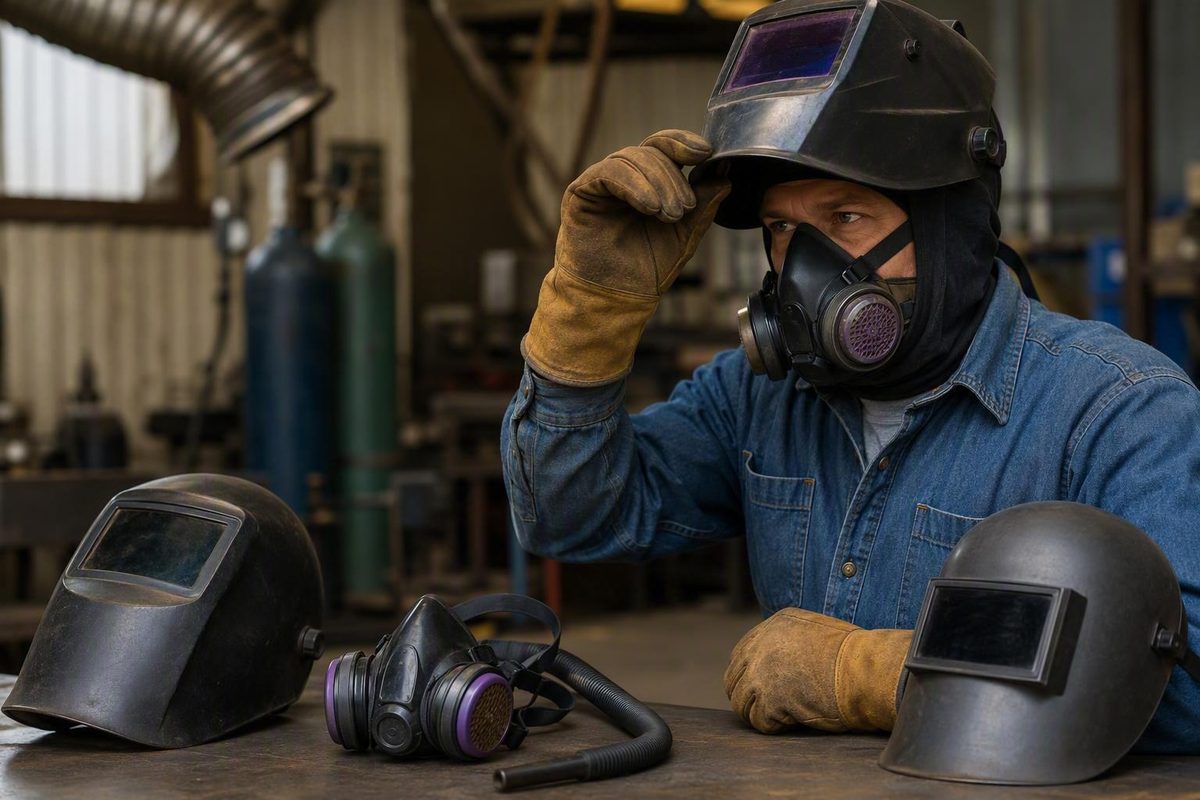
A “welding hood with respirator” is not one product category with one obvious winner. The phrase may describe a compact half mask worn beneath an existing welding helmet, a helmet integrated with a powered air-purifying respirator (PAPR), a supplied-air welding helmet, or a full-face respirator with a flip-up welding attachment.
This is therefore a system-type selection guide, not a verified model-by-model recommendation. The available evidence confirms that these formats are sold, but it does not establish complete-system approvals, Assigned Protection Factors (APFs), contaminant limits, lens specifications, or current package contents for every named product.
Start with the job, not the catalog: identify the airborne hazards and likely exposure, determine whether the atmosphere is safe to filter, and apply ventilation and other higher-level controls. Only then should you compare respirator classes, approved configurations, fit requirements, workflow, and total ownership cost.
What “welding hood with respirator” can mean
A standard welding helmet protects the eyes and face from arc radiation, sparks, and debris, but it does not by itself control what the welder inhales. Respiratory protection remains a separate function even when the helmet and respirator are sold as an integrated system. General welding-PPE guidance likewise distinguishes helmet protection from respiratory protective equipment used for residual inhalation hazards.
The search phrase commonly refers to four configurations:
-
A low-profile half mask beneath a separate welding helmet The reusable respirator seals around the nose and mouth. Approved filters or cartridges attach to the facepiece, while the existing helmet provides optical and face protection. The mask, filters, straps, eyewear, and helmet must work together without disturbing the respirator seal.
-
An integrated loose-fitting PAPR welding helmet A battery-powered blower draws surrounding workplace air through approved filters and moves the filtered air through a breathing tube into a helmet or hood. Loose-fitting designs rely on airflow and the designed headtop rather than a tight face seal. Not every PAPR, however, uses a loose-fitting facepiece.
-
A supplied-air welding helmet The helmet receives breathing air from an independent source through an airline. It does not rely on filtering the air immediately around the welder, although suitability still depends on the complete system, breathing-air source, operating conditions, and hazard assessment.
-
A full-face respirator with a welding attachment The documented example in the supplied evidence combines a full-face respirator with a flip-up welding hood. Unlike a loose-fitting PAPR helmet, the underlying respirator may depend on a tight face seal and replaceable filters or cartridges.
These are established commercial formats. The 3M respiratory welding helmet catalog lists Speedglas helmets in Adflo powered-air and Fresh-Air III supplied-air configurations. Miller lists half-mask, PAPR, and supplied-air options and distinguishes filtered ambient air from air delivered by an independent source.
That distinction is critical. A PAPR filters ambient air; it does not generate oxygen. “Powered air,” “fresh air,” and “supplied air” should not be treated as interchangeable marketing terms.
It is equally important to distinguish a complete system from a component. A listing might cover only a:
- Facepiece
- Filter or cartridge
- Blower
- Battery or charger
- Belt or backpack harness
- Breathing tube
- Airline
- Helmet shell
- Welding lens
- Grinding visor
- Adapter or air duct
A blower and helmet that appear to connect are not necessarily an approved, ready-to-use respiratory system. Before comparing prices, identify every component included in the exact package and verify the approved configuration.
The Parcil WF-100 illustrates the full-face combination format. Its seller markets it as a full-face respirator with an O-A-X cartridge and flip-up welding hood, with a separate WF-101 auto-darkening option. The listing does not establish complete-system certification, APF, welding-lens shade, cartridge service life, or contaminant-specific suitability. Its availability wording is also inconsistent. Treat the product as evidence that the format is marketed—not as proof that it is appropriate for a workplace exposure.
Choose from the hazard assessment, not the product page
A respirator should be selected for the atmosphere and task, not merely because its filters have a familiar color, a high efficiency percentage, or a shape that fits under a preferred helmet.
Build a preselection record covering:
- Welding or thermal-cutting process
- Base and filler metals
- Coatings, plating, paint, oil, cleaners, or other contamination
- Expected airborne particles
- Possible gases or vapors
- Duration and frequency of work
- Breathing-zone position relative to the plume
- Existing local exhaust, source capture, enclosure, or general ventilation
- Available exposure-monitoring results
- Applicable occupational exposure limits
- Oxygen status
- Whether the work is enclosed or in a confined space
- Other PPE that must be worn simultaneously
The process and visible smoke alone do not identify everything in the atmosphere. Changes in metal, filler, surface treatment, cleaning chemistry, or work location can change the hazard. If the contaminant or exposure concentration is unknown, workplace air monitoring may be needed. The 3M welding-equipment selection guide similarly begins with hazard identification and notes that monitoring may involve air-sampling equipment.
Respiratory PPE should not be the first or only fume-control measure. Use this sequence:
- Eliminate the hazardous task or material where feasible.
- Substitute a less hazardous process or material where feasible.
- Apply engineering controls such as local exhaust or source capture.
- Use appropriate work-practice and administrative controls.
- Use respiratory protection for remaining exposure when required.
An open door, fan, or cross-breeze should not be assumed to be an adequate stand-alone welding-fume control. Air movement may move a plume without reliably keeping it out of the breathing zone and may interact with the welding process. Ventilation should be designed for the actual shop, task, and exposure—not prescribed from a general buying guide.
Next, distinguish particles from gases and vapors. P100 and P3 are particulate-filter designations; they do not mean the filter addresses every gas, vapor, or welding byproduct. Some approved systems accept combination filters or chemical cartridges for specified contaminants, but the exact cartridge must be approved for the respirator and selected for the identified substance and concentration.
“Nuisance-odor relief” is narrower still. It is not protection against hazardous vapor concentrations, and the absence of an odor does not establish that a cartridge is effective or that the atmosphere is safe.
Finally, determine whether the atmosphere can be filtered at all. An air-purifying respirator, including a PAPR, uses surrounding air and does not supply oxygen. Possible oxygen deficiency, unknown conditions that prevent correct respirator selection, restricted escape, or confined-space work require a separate assessment of the atmosphere, entry procedure, rescue provisions, and breathing-air needs.
These points are non-negotiable:
- Do not select from filter efficiency alone.
- Do not generalize particulate filtration to gases or vapors.
- Do not use an air-purifying respirator where oxygen may be deficient.
- Do not treat respiratory PPE as a replacement for source control.
- Do not rely on a product name, star rating, odor, or nominal airflow as proof of protection.
- Do not improvise or mix components outside an approved configuration.
For workplace use, the decision belongs within the applicable respiratory-protection program. Consult exposure results, current system instructions, approval documents, site procedures, and jurisdiction-specific requirements. Equipment manuals and site rules override a general article; see the site’s informational-use and safety notice.
Half mask, PAPR, or supplied air: the practical differences
The three principal approaches solve different problems. This table is a screening tool, not a substitute for exposure assessment or approval documents.
| Comparison point | Tight-fitting half mask under a hood | Loose-fitting integrated PAPR | Supplied-air welding helmet |
|---|---|---|---|
| Air source | Surrounding air drawn through filters or cartridges by the wearer | Battery-powered blower moves filtered surrounding air into the headtop | Independent breathing-air source delivers air through an airline |
| Seal dependence | High; protection depends on a stable face seal | Relies on the approved loose-fitting headtop and airflow | Depends on the exact facepiece or headtop |
| Fit-test status | Typically subject to fit testing under workplace respiratory programs | Loose-fitting headtops generally do not require fit testing; verify local rules | Depends on the exact facepiece and governing requirements |
| Facial-hair implications | Hair or stubble must not cross the sealing surface | Some loose-fitting designs may accommodate some facial hair, subject to instructions | Depends on whether the system is tight- or loose-fitting |
| Mobility | Usually high, with no blower or airline | Mobile, but the wearer carries a blower, battery, belt, and hose | Airline routing and support equipment can restrict movement |
| Breathing effort | Wearer draws air through filters | Powered airflow can reduce breathing resistance | Air is delivered by the supply system |
| Major components | Facepiece, filters or cartridges, retainers, straps | Headtop, blower, filters, battery, charger, belt, breathing tube | Headtop, regulator, airline, fittings, approved air source |
| Maintenance burden | Cleaning, seal inspection, filter management, fit testing | Cleaning plus filter, battery, charger, tube, airflow, and blower checks | Cleaning plus airline, fittings, regulator, source, and air-quality management |
| Indicative price tier | Lower | Higher | Higher, plus supporting infrastructure |
| Critical limitations | Seal interference, facial hair, breathing resistance, limited clearance | Filters ambient air; does not supply oxygen; depends on battery and airflow | Hose management, mobility limits, and proper breathing-air infrastructure |
A half mask can be the least expensive route when the welder already owns a suitable helmet. But physical fit is not enough. Correct model and size, applicable fit testing, a user seal check as directed by the governing program and manufacturer, unobstructed sealing surfaces, approved filters or cartridges, and stable clearance throughout movement all matter.
A PAPR uses a blower rather than the wearer’s lungs to pull air through its filters. Powered airflow can reduce breathing resistance and move air across the face. A loose-fitting headtop can also reduce dependence on a tight facial seal. The tradeoff is additional equipment: blower, battery, belt, breathing tube, filters, charging, inspection, weight, and noise.
Do not assume every PAPR is loose-fitting. PAPRs can use different facepieces and modes. Fit-test obligations and APF depend on the exact approved configuration. A Canadian trade-publication interview with 3M representatives notes that loose-fitting models can accommodate some facial hair and generally avoid fit testing, while also emphasizing contaminant assessment, respiratory-program requirements, and system-specific selection.
A supplied-air system receives air from an independent source rather than filtering workplace air. That may be necessary when the assessment calls for supplied breathing air. The airline and support system then become part of the job plan, including source requirements, hose routing, connections, mobility, and escape considerations.
APF cannot be inferred from “PAPR,” “full face,” or “supplied air.” It depends on respirator class, facepiece, operating mode, and the complete approved configuration. Miller’s respiratory guidance states that tight-fitting respirators require fit testing before initial use, after changing facepieces, and at least annually, with a seal check whenever they are worn. Confirm the governing requirements for the workplace and jurisdiction rather than treating a manufacturer summary as universally applicable law.
Comfort is individual. Powered airflow may feel cooler and easier to breathe through, while the belt, hose, battery, helmet mass, and sound create other burdens. The available evidence does not independently quantify these differences across models. A realistic trial is more useful than a general comfort claim.
Fit testing, facial hair, and under-hood compatibility
There are two separate compatibility questions:
- Does the respirator physically fit beneath the helmet?
- Does it continue providing the intended protection while the helmet and other PPE are worn?
A facepiece can clear the shell yet remain unsuitable. Helmet headgear may cross the respirator straps. Safety glasses may interfere with the seal. A cartridge can touch the shell when the hood is lowered. Looking down can shift the mask, and repeatedly raising the helmet may pull on straps.
For a tight-fitting respirator, follow the governing fit-testing rule, workplace program, and manufacturer instructions. Choosing the same nominal size as another worker does not replace initial fit testing. Retesting may be necessary after changing models or sizes, and periodic testing may be required. A user seal check performed as directed whenever the respirator is donned does not replace formal fit testing.
Hair, stubble, or another object crossing a tight-fitting sealing surface can create a leak path. Any facial-hair accommodation should be limited to an appropriate loose-fitting system and the configurations allowed by its instructions. “PAPR” does not automatically mean beard-compatible because some PAPRs use tight-fitting facepieces.
Use this proposed pre-purchase protocol, validating every step against the exact system instructions and workplace procedure:
- Obtain the exact facepiece model and proposed size.
- Install only the approved filter or cartridge selected for the assessed hazard.
- Put on required eyewear, hearing protection, head protection, and other PPE.
- Don the respirator and perform the prescribed checks.
- Put on the exact welding helmet and adjust its headgear.
- Lower and raise the hood repeatedly.
- Turn fully left and right.
- Nod, look up, and look down.
- Assume representative welding positions.
- Check lens position, downward visibility, straps, cartridge clearance, and shell contact.
- Confirm that movement has not altered the seal.
- For powered- or supplied-air systems, assess tube or airline routing against the manual and job hazards.
Low-profile filters may improve shell clearance, but shape comes after hazard suitability and approval. A compact particulate filter is not preferable if the assessment requires a different cartridge or respiratory method.
Forum reports can suggest combinations worth testing, but they cannot verify compatibility for someone else. Welders report using various low-profile half masks beneath particular helmets and describe differences caused by filter profile, straps, heat, and individual fit. Those anecdotes are test prompts—not approval evidence or fitting instructions.
Do not drill a helmet, install a homemade air fitting, construct an improvised supplied-air device, or combine cross-brand parts merely because the connections appear to fit. Use only combinations identified in the current approval documentation and system instructions.
Approvals and specifications to verify before buying
A professional quote should include documentation, not just a photograph and broad claims about “fumes,” “fresh air,” or “maximum protection.”
Request or locate the following for the exact configuration:
- Complete-system approval and approval schedule
- Applicable NIOSH, ANSI, CSA, EN, or other jurisdiction-relevant markings
- APF for the exact facepiece and operating mode
- Approved facepiece or headtop
- Approved blower, battery, and charger
- Approved filter, prefilter, spark arrestor, or chemical cartridge
- Approved breathing tube, airline, regulator, and fittings
- Approved welding helmet or shield
- Contaminant and concentration limitations
- Oxygen and atmosphere limitations
- Welding-lens shade range and optical markings
- Airflow-check procedure and warning indicators
- Fit-test status
- Inspection, cleaning, storage, and change-out instructions
- Replacement-parts list
- Current user manual
A component from another brand may appear to connect yet remain outside the tested and approved system.
Real-world protection also depends on correct selection, exposure level, fit, seal, assembly, condition, and use within the approved configuration. Retail catalogs separate ordinary P100 products from nuisance-odor variants and list replacement filters independently, underscoring that these are distinct products rather than universal solutions.
Keep the categories separate:
- Particulate filter: For listed particle hazards within its limitations.
- Gas or vapor cartridge: For specified gases or vapors within approval and service-life limits.
- Combination cartridge/filter: For its listed particle and chemical hazards—not every airborne contaminant.
- Nuisance-odor relief: For the limited conditions defined by the manufacturer, not hazardous vapor concentrations.
- PAPR: A blower-assisted air-purifying system using ambient air.
- Supplied-air respirator: A system receiving breathing air from a separate source.
Do not use nominal blower airflow as a substitute for APF or contaminant limits. Star ratings and marketing phrases are not approval documents.
Optical protection must be verified separately. Respiratory integration does not establish that a welding lens has the appropriate shade or optical classification for the process and current. A package may also omit an auto-darkening filter even if its photographs show a compatible helmet family.
The featured Parcil listing leaves important questions unanswered: it does not show complete-system certification, APF, welding shade, cartridge service life, or detailed contaminant limits. Its claims should not be used to select the product for a particular exposure without additional documentation.
Obtain current documents directly before ordering. Product names may remain similar while included lenses, batteries, filters, and accessories change.
Price tiers and what the listing actually includes
The figures below are undated seller snapshots from the supplied research, not verified current prices. They are included only to illustrate broad equipment tiers. Because no reliable capture dates or complete documentation were supplied, every figure, package, and availability statement must be rechecked before publication or purchase.
| Tier | Seller snapshot | What the evidence establishes | What remains to verify |
|---|---|---|---|
| Budget half mask | $29.60–$41.90 | Cyberweld displayed selected Hobart, Lincoln, and Miller half masks in this range | Exact SKU, included filters, size, current price, approval, fit requirements |
| Powered half-mask reference | $1,479 | Cyberweld displayed an Optrel Swiss Air powered half-mask system | Exact package, helmet compatibility, current price, approved configuration |
| Full-face combination | $199.97 / $269.97 | Parcil displayed the WF-100 and WF-101 at these prices | Availability, approval, APF, lens shade, cartridge limits, package contents |
| Integrated powered-air welding kit | $1,380 | A retailer displayed an ArcOne AirPlus kit with a Vision X81VX helmet | Exact kit contents, approval, APF, current price, battery and lens data |
| Powered-air grinding-visor kit | $1,095 | The same retailer displayed an AirPlus package centered on a grinding visor | Whether it supports the intended welding task and which parts are included |
Replacement filters or cartridges are recurring purchases, and applicable fit testing adds workplace cost. The $1,479 Optrel listing also shows why “half mask” does not necessarily mean passive or inexpensive. Retailer wording about broad helmet compatibility still requires testing with the exact wearer and helmet (Cyberweld breathing-protection catalog).
Parcil displayed the WF-100 at $199.97 and the WF-101 auto-darkening option at $269.97. The product page contained inconsistent availability language, and price does not resolve the missing approval, APF, shade, service-life, and contaminant documentation (Parcil WF-100 listing).
A retailer displayed an ArcOne AirPlus kit with a Vision X81VX auto-darkening welding helmet at $1,380, while an AirPlus package with a grinding visor, battery, charger, and waist-mounted equipment was displayed at $1,095. These are different package types and should not be treated as equivalent (ArcOne package listings).
For every shortlisted listing, mark each item as included, optional, or missing:
- Helmet or clear visor
- Welding lens or auto-darkening filter
- Blower
- Battery
- Charger
- Belt, harness, or backpack
- Breathing tube
- Approved hose cover
- Main filter
- Prefilter
- Spark arrestor, if specified
- Airflow indicator
- Required adapter or air duct
- Lens covers
- Storage equipment
A low price may represent only a bare facepiece, blower, filter, breathing tube, helmet shell, or replacement part. Compare exact manufacturer part numbers rather than shortened product names.
Confirm quantities as well. A filter listing may cover one filter when the facepiece requires two, or a package may include only the installed filter. Spare batteries, lens covers, or hose protection may be operationally important without being part of the starter kit.
Total ownership cost, workflow, and maintenance
Purchase price is only one line in the comparison. A half mask may have a low initial cost but require fit testing and recurring filters or cartridges. A PAPR has batteries, chargers, tubing, filters, and blower checks. A supplied-air system can require fixed infrastructure and airline management in addition to wearer equipment.
Use a first-year worksheet rather than relying on sticker price:
| First-year cost item | Quantity or assumption | Quoted cost | Notes |
|---|---|---|---|
| Initial approved kit | Record exact part numbers | ||
| Main filters | Do not assume replacement frequency | ||
| Prefilters or spark arrestors | If specified by the system | ||
| Gas or vapor cartridges | Only if approved and hazard-appropriate | ||
| Fit testing | For applicable tight-fitting facepieces | ||
| Spare battery | Check whether included | ||
| Additional charger | Consider shift pattern | ||
| Breathing tube | Price a spare if site policy requires one | ||
| Hose cover | Verify the approved option | ||
| Belt or harness | Include sizing and replacement needs | ||
| Airline and fittings | Supplied-air systems | ||
| Lens covers | Inner and outer, as applicable | ||
| Helmet parts | Headgear, shrouds, seals, sweatbands | ||
| Cleaning supplies | Products approved in the instructions | ||
| Inspection or service | Internal or external | ||
| Training time | Initial and refresher | ||
| Downtime or spare system | Charging, repair, unavailable parts | ||
| Shipping and taxes | Use an actual supplier quote |
Do not calculate a fixed annual total without reliable use data. Filter and cartridge life, battery performance, duty cycle, environmental loading, cleaning frequency, and replacement rates vary. Follow the approved system, use conditions, respiratory program, and manufacturer instructions rather than a universal weekly or monthly schedule.
Workflow may justify an integrated system, but only if the exact package supports the task. For repeated transitions between welding and grinding, look for an approved clear visor beneath a flip-up welding filter so the respiratory headtop can remain in place. 3M identifies Speedglas configurations with flip-up welding filters and clear protective visors for non-welding work, but the exact package and approval still need verification.
A hands-on trial should assess:
- Field of view
- Welding-lens position
- View of the joint when looking down
- Helmet balance and neck load
- Belt placement while bending or sitting
- Tube or airline management
- Airflow noise and communication
- Heat and sweat
- Head movement
- Access in tight spaces
- Safety-glasses compatibility
- Hearing-protection clearance
- Hard-hat integration, if required
- Changeover between welding and grinding
The supplied evidence does not independently compare these factors across models. Comfort also varies with body size, welding position, shift length, temperature, and other PPE.
An integrated helmet does not necessarily replace safety glasses or other required PPE. Confirm the exact equipment instructions and site rules. Likewise, an optional hard hat or hearing accessory is not included unless its part number appears in the quote.
Before each use, follow the exact manual and workplace procedure. A typical routine will include:
- Inspecting the facepiece, headtop, helmet, seals, shrouds, straps, and headgear.
- Inspecting filters, cartridges, retainers, tubes, airlines, and connections.
- Confirming that the assembled parts match the approved configuration.
- Checking battery charge and warning indicators where applicable.
- Performing the prescribed seal or airflow check.
- Inspecting welding and clear lens covers.
- Confirming the correct lens setting or shade.
- Checking that air paths are unobstructed.
- Verifying tube or airline routing for the actual task.
- Cleaning and storing the equipment as instructed after use.
Do not substitute improvised repairs, cleaning methods, solvents, or replacement parts for procedures and components authorized by the system manufacturer.
A hazard-first shortlist process
There is no defensible universal “best welding hood with respirator.” Use a documented sequence.
1. Assess and control the hazard. Identify the process, metals, coatings, contamination, duration, position, and ventilation. Apply elimination, substitution, source capture, and work-practice controls before relying on respiratory PPE.
2. Determine oxygen status and atmosphere classification. Do not proceed with an air-purifying respirator if oxygen deficiency or another atmosphere beyond its limitations is possible. Confined-space work requires a separate entry and respiratory assessment.
3. Separate particles from gases and vapors. Do not translate “welding fumes” into an automatic P100 or P3 choice. Identify what the approved filter or cartridge addresses and whether its limitations fit the assessed exposure.
4. Establish the required protection. Use exposure results, applicable limits, the respiratory-protection program, and the exact configuration’s documented APF. Do not derive protection from filter efficiency or nominal airflow.
5. Decide whether a tight seal can be maintained. Consider facial hair, facial geometry, eyewear, other PPE, physical activity, and helmet interference. If a tight-fitting facepiece cannot be reliably fitted and worn, stop treating it as the default low-cost option.
6. Choose the system class.
- Possible lower-cost path: Retain an existing compatible helmet and evaluate an approved low-profile half mask only when the assessment supports air-purifying respiratory protection. Demonstrate fit, seal, cartridge suitability, and under-hood compatibility.
- Possible integrated-PAPR path: Consider an approved loose-fitting PAPR when it addresses the assessed contaminant, tight-mask use is impractical, or integrated welding-and-grinding workflow has value. Verify that it is actually loose-fitting and that the headtop, blower, filter, battery, and tube are approved together.
- Possible supplied-air path: Consider supplied air when independently delivered breathing air is required. Include air quality, infrastructure, airline routing, escape, and mobility in the plan.
7. Verify complete-system approval. Match every facepiece, headtop, blower, filter, cartridge, tube, airline, regulator, and helmet to current approval documents.
8. Test compatibility. Conduct fitting and movement checks while wearing all required PPE. Include representative work positions, not only a standing trial at a sales counter.
9. Compare ownership cost and workflow. Price the complete package, consumables, fit testing, batteries, cleaning, inspection, downtime, and replacement parts. Assess grinding transitions, field of view, mobility, and access.
Stop and escalate the decision to the responsible safety professional, industrial hygienist, respiratory-program administrator, manufacturer, or another qualified person when:
- Coatings or contaminants are unknown
- Oxygen deficiency is possible
- Work is performed in a confined space
- Concentration is unknown and that prevents correct selection
- Exposure may exceed the proposed system’s capability
- The wearer cannot obtain or maintain the required fit
- Complete approval documents are unavailable
- Cartridge service-life information is missing
- The lens specification is unclear
- A seller recommends mixing components outside an approved configuration
- The job would require modifying the helmet or respiratory equipment
Copy this checklist into the request for quotation:
- Exact model and manufacturer part number
- Complete package contents
- Complete-system approval and approval schedule
- APF for the quoted configuration
- Contaminant and atmosphere limitations
- Filter, prefilter, and cartridge part numbers
- Fit-test status and facepiece type
- Welding-lens specification and shade range
- Clear grinding-visor configuration
- Battery type, charger, indicators, and documented runtime conditions
- Airflow-check method
- Supplied-air requirements, if applicable
- Replacement-parts prices and availability
- Training and service support
- Warranty terms
- Current price, verification date, and lead time
The available evidence establishes that half-mask, integrated PAPR, supplied-air, and full-face combination products exist. It does not provide an independent model-by-model comparison of respiratory performance, optical quality, battery life, comfort, durability, or support.
The right setup is the complete approved configuration that matches the assessed hazard, works with higher-level fume controls, provides the required protection, fits without interference, and can be maintained throughout the job—not the product with the strongest marketing claim or highest filter percentage.
For context on the publication’s welding coverage, authorship, and sourcing approach, see how Welder Facts describes its editorial scope.
Frequently asked questions about welding hoods and respirators
Can I wear a P100 respirator under a welding hood?
Yes, when the hazard assessment supports a P100 particulate filter and the exact respirator can be correctly fitted and worn beneath the hood. Physical clearance alone is not enough.
Use the correct facepiece size, complete applicable fit testing, perform the prescribed user seal check, and confirm that the helmet, headgear, eyewear, filters, and head movement do not disturb the seal. Low-profile filters may help with clearance, but P100 filtration should not be selected merely because it fits.
Does a welding PAPR require fit testing, and can I use one with facial hair?
It depends on the facepiece. A loose-fitting PAPR welding hood generally does not require fit testing and may accommodate some facial hair, subject to its instructions and the governing workplace rules. A PAPR with a tight-fitting facepiece may still require fit testing and an unobstructed sealing surface.
Do not assume “PAPR” automatically means loose-fitting or beard-compatible. Verify the exact headtop, operating mode, approval, and instructions.
Does a P100 or P3 filter protect against welding gases and vapors?
Not automatically. P100 and P3 are particulate-filter designations and should not be generalized to gases or vapors.
Some approved systems accept combination filters or chemical cartridges for specified contaminants. Suitability depends on the identified substance, concentration, cartridge approval, service-life controls, and complete configuration. Nuisance-odor relief is not protection against hazardous vapor concentrations.
Can I use a PAPR for welding in a confined space?
Not merely because it has powered airflow. A PAPR filters surrounding air and does not supply oxygen. Confined-space welding requires a separate assessment of oxygen concentration, contaminants, exposure, access, escape, rescue, and breathing-air needs.
If oxygen deficiency or an atmosphere beyond the PAPR’s limitations is possible, the applicable program may require supplied breathing air or breathing apparatus. Do not enter based on the product name or blower airflow alone.
Can one respirator helmet stay on for both welding and grinding?
Some approved systems are designed for that workflow. A common arrangement uses a flip-up welding filter with a clear protective visor underneath, allowing the user to switch to grinding without removing the respiratory headtop.
Confirm that the quoted package includes the clear visor, welding filter, lens protection, and respiratory components required for both tasks. Also verify eye-protection requirements, approvals, airflow checks, and whether accessories shown in photographs are included or optional.