
How to Choose the Right Stick Electrode for the Metal, Machine, and Job
On an AC-only welder, an AC-compatible E6011 may be a practical candidate when the job calls for a penetrating, fast-freezing electrode.
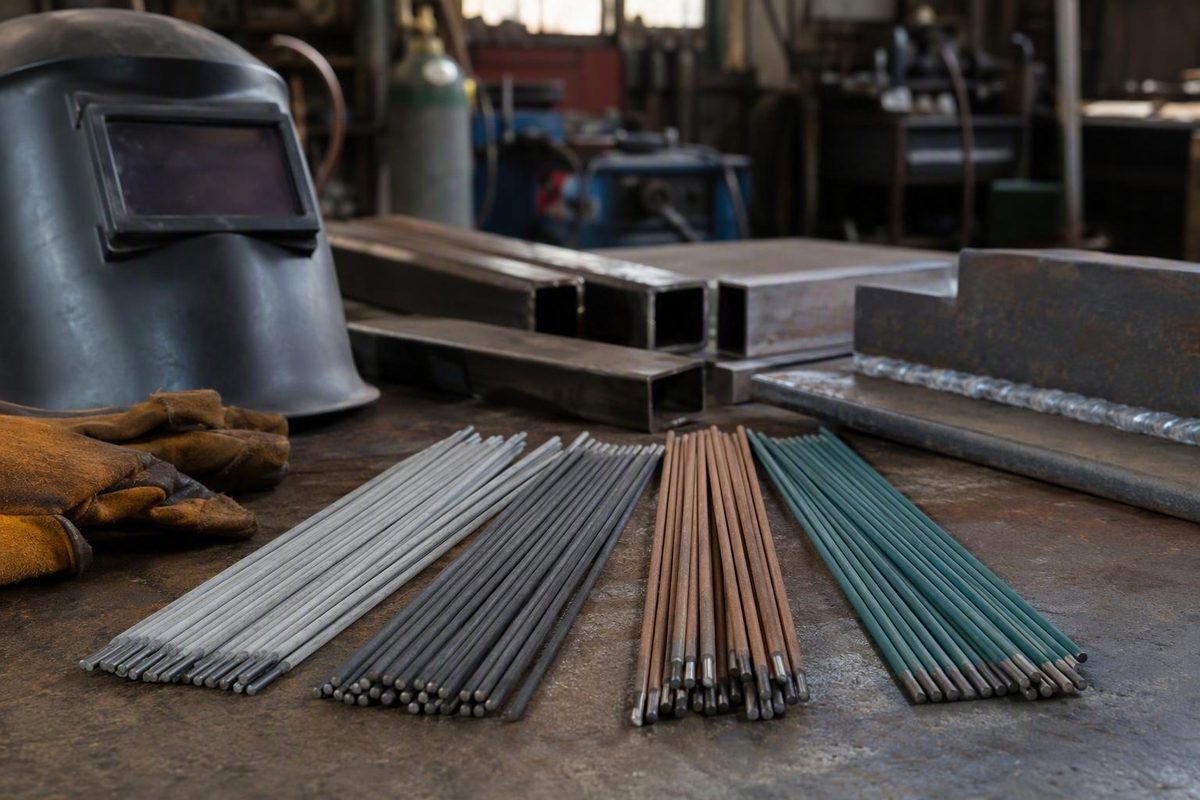
Choosing welding stick rods should begin with the work—not with a favorite classification, brand, bestseller list, or rule of thumb. Identify the base metal and service requirements first. Then confirm the welder’s output and polarity, account for welding position and joint conditions, select an appropriate electrode classification and diameter, and follow the settings and handling instructions for that exact product.
That order matters because electrodes of the same diameter can behave differently. Even products carrying the same broad classification may have different current ranges, storage instructions, suffixes, and application limits.
What a stick welding rod is—and what it is not
Stick welding is the common name for shielded metal arc welding, or SMAW. The process establishes an electric arc between the workpiece and a consumable, flux-coated metal electrode. The metal core melts and supplies filler metal. The coating supports shielding and arc stability, then leaves slag over the cooling weld. Depending on its formulation, the flux may also supply deoxidizers, alloying elements, or iron powder.
In ordinary shop language, stick rod, stick electrode, arc welding rod, and SMAW electrode generally refer to this same consumable. A conventional stick electrode is not simply a bare filler rod: its core and coating work as a system.
The classification printed on the package matters because electrode families can differ in:
- Deposited-weld-metal strength class
- Qualified welding positions
- Compatible current types and polarities
- Penetration profile
- Arc and puddle behavior
- Slag characteristics
- Deposition rate
- Storage and moisture-control requirements
Retail terminology is less reliable than it may appear. A “welding rods” category can contain conventional SMAW electrodes alongside brazing rods, gouging electrodes, aluminum repair products, solder bars, or plastic-welding rods. Forney’s catalog, for example, places several such specialty products within its broader stick-electrode assortment, even though they are not interchangeable with ordinary carbon-steel SMAW electrodes (Forney stick-electrode catalog).
Use this selection order:
- Identify the base metal.
- Establish the required service and mechanical properties.
- Check for an approved welding procedure or governing specification.
- Confirm machine output and polarity.
- Account for welding position, joint design, fit-up, and surface condition.
- Select the electrode classification.
- Select the diameter.
- Confirm the exact product’s settings and handling instructions.
- Test the setup on comparable scrap where appropriate.
How to read AWS stick-electrode numbers
Common carbon-steel designations such as E6011 and E7018 communicate several properties. They are useful screening tools, but they are not complete welding instructions.
For a common four-digit carbon-steel designation:
- E identifies an electrode.
- The first two digits identify the minimum tensile-strength class of the deposited weld metal in thousands of pounds per square inch.
- The next digit identifies the welding positions for which the electrode is classified.
- The final digit relates to coating and compatible welding current.
For example, E6011 breaks down as follows:
- E: electrode
- 60: deposited weld metal in the 60,000-psi minimum tensile-strength class
- 1: classified for flat, horizontal, vertical, and overhead welding
- 1: coating-and-current identifier for that classification
In E7018, the 70 denotes a 70,000-psi minimum tensile-strength class, the following 1 denotes all-position classification, and the final 8 identifies coating and current characteristics associated with the low-hydrogen, iron-powder family. In this classification system, a position digit of 1 denotes all positions, while 2 denotes flat and horizontal-fillet welding (Miller’s explanation of common stick-electrode classifications).
Position classification still requires context. An all-position electrode is not necessarily equally easy or productive in every position. The classification also does not override a welding procedure that limits vertical progression, amperage, electrode diameter, bead placement, or technique.
AC, DCEP, and DCEN in plain language
AC, or alternating current, repeatedly reverses direction.
DC, or direct current, maintains one direction and can be connected in two ways:
Polarity affects arc behavior and whether an electrode operates as intended. Do not reduce the final classification digit to a universal polarity shortcut. General comparison charts disagree on some details, particularly around E7018, and manufacturers offer variants such as E7018 and E7018-AC. Verify the exact package or current product data sheet before welding.
Tensile classification alone does not establish suitability. Base-metal composition, weld-metal toughness and ductility, restraint, cracking susceptibility, service temperature, loading, and governing requirements may also control electrode selection.
E6010 vs. E6011 vs. E6013 vs. E7018
The following table summarizes classification-level tendencies, not specifications for every product. Exact polarity, amperage, position limits, storage requirements, and permitted applications must be confirmed from the electrode package, product documentation, and any applicable welding procedure.
| Classification | Strength class | Commonly listed current compatibility | Qualified positions | Relative penetration | Puddle and slag behavior | Preferred surface condition | Common reasons to evaluate it |
|---|---|---|---|---|---|---|---|
| E6010 | 60,000 psi | Generally DCEP | All positions | Deep | Forceful, digging arc; fast-freezing puddle; relatively thin slag | Cleaned steel, though its arc is more tolerant of residual scale or rust than smoother-running rods | Root passes, pipe work, tack welds, repairs, and joints needing a digging arc |
| E6011 | 60,000 psi | Commonly AC or DCEP; check product | All positions | Deep | Digging, fast-freezing behavior similar to E6010 | Cleaned steel; may operate on less-than-ideal field surfaces | Maintenance or repair when AC compatibility is needed |
| E6013 | 60,000 psi | Commonly AC and one or more DC options; check product | All positions | Low to moderate | Softer, smoother arc; relatively manageable slag | Clean, relatively thin steel with sound fit-up | Light fabrication and work where smooth operation is prioritized |
| E7018 | 70,000 psi | Commonly DCEP; many products also support AC | All positions | Moderate | Smooth arc, medium penetration, substantial slag | Clean steel; controlled dry handling is important | Structural, thicker, higher-strength, restrained, or crack-sensitive carbon-steel work when specified or permitted |
These strength classes, position classifications, and broad operating characteristics are summarized in Miller’s comparison of common SMAW electrodes; manufacturer-specific instructions still control the product actually being used (Miller electrode guide).
E6010: digging arc and fast freeze
E6010 is generally a deep-penetrating, fast-freezing, all-position electrode intended for DCEP. Its forceful arc can be useful when a root or tight joint calls for a digging action and a quickly freezing puddle. Root passes, pipe welding, tack welds, and repair work are common examples, not universal approvals.
E6010 also demands careful control of arc length, electrode manipulation, and puddle behavior. Confirm that the power source is connected correctly and that its manual supports the intended electrode and diameter.
E6011: similar purpose with AC flexibility
E6011 occupies a similar practical category: deep penetration, a forceful arc, and a fast-freezing puddle. Its major equipment advantage is that appropriate E6011 products can run on AC.
For an AC-only transformer machine, E6011 may remain a candidate where a typical DCEP-only E6010 is incompatible. That does not mean every E6011 product behaves identically on AC and DCEP; the package remains the authority for current compatibility.
E6013: smoother operation on clean steel
E6013 is associated with a softer arc, less aggressive penetration, and relatively manageable slag. Those tendencies can make it useful on clean, thinner carbon steel when smooth operation is preferred over a digging arc.
The 1 in E6013 denotes all-position classification. It does not mean every E6013 product is equally easy to control in every position. Diameter, amperage, joint orientation, puddle behavior, slag, and operator technique still matter.
E7018: low hydrogen and a higher strength class
E7018 is a 70,000-psi-class low-hydrogen electrode commonly associated with structural steel, thicker sections, higher-strength work, and joints where hydrogen-cracking control matters. It offers a different tradeoff from E6010 and E6011: smooth operation and low-hydrogen characteristics rather than the most aggressive digging arc.
Those properties come with handling obligations. E7018 must be managed according to the exact product instructions and welding procedure. For critical work, those documents determine whether E7018 is appropriate, which suffix is required, what diameter may be used, and which welding variables are permitted.
In practical terms:
- E6010 and E6011 prioritize a penetrating arc and fast-freezing puddle.
- E6013 prioritizes smoother operation on clean material.
- E7018 adds low-hydrogen properties and a higher tensile-strength class but requires more disciplined handling.
None is universally best.
Secondary options worth knowing
- E6012: May be evaluated where bridging a wider root opening matters more than deep penetration.
- E7014: Offers a higher deposition rate than lighter general-purpose electrodes and may suit production-oriented carbon-steel work.
- E7024: A high-deposition option intended mainly for flat and horizontal welding, not a general out-of-position substitute.
Contamination tolerance has limits. An electrode’s ability to maintain an arc on an imperfect surface is not permission to weld over oil, moisture, paint, heavy rust, or other coatings. Clean the joint whenever practical and identify any coating before welding rather than relying on electrode choice to address it.
A job-first decision process for choosing a rod
Use this decision tree before comparing brands or package prices.
-
Identify the base-metal type and grade. Start with drawings, markings, purchase records, material certifications, or reliable equipment documentation. Appearance, magnetism, grinder sparks, and response to a file or chisel may provide clues, but they are indicators rather than definitive identification methods.
-
Match the electrode family to the metal. Match or closely match electrode composition to the known base metal and intended service. Ordinary carbon-steel stick rods should not be casually substituted for stainless steel, cast iron, aluminum, nickel alloy, or hardfacing applications. Those categories can require alloy-specific selection, preparation, and technique.
-
Determine the required properties. Ask what the weld must provide beyond nominal tensile strength. Relevant factors can include ductility, impact toughness, chemistry, corrosion behavior, fatigue loading, restraint, cracking risk, and operating temperature. Miller’s selection framework starts with base-metal properties and also considers current, fit-up, position, service conditions, and job environment (Miller electrode-selection guide).
-
Stop using a generic selector if the work is governed or critical. Structural connections, pressure-containing equipment, pipelines, boilers, and other code-regulated or consequential work may require specified electrodes and controlled variables. Follow the approved welding procedure, project requirements, applicable rules, and current product documentation.
-
Check the welder before shopping. Determine whether the machine supplies AC, DCEP, DCEN, or multiple outputs. Check its available amperage, lead connections, duty cycle, and electrode limitations.
-
Eliminate incompatible electrodes. On an AC-only machine, a typical DCEP-only E6010 should be removed from consideration. An AC-compatible E6011 may remain a candidate. Do not assume that every DC-capable machine supports every DC electrode equally well.
-
Account for welding position. Select a classification qualified for the required flat, horizontal, vertical, or overhead position. Then check the permitted progression and technique. Position qualification does not automatically authorize vertical-down welding or every manipulation.
-
Evaluate the joint and desired penetration. Consider material thickness, bevel angle, root face, root opening, fit-up, access, number of passes, and required penetration. E6010 or E6011 may be candidates when a joint calls for a digging arc. E6012 may deserve consideration where gap bridging is more important.
-
Evaluate surface condition and environment. Remove grease, paint, moisture, excessive scale, and heavy rust where practical. Prepare a clean point for the work connection. For outdoor work, also account for weather, electrode exposure, access, and site controls.
-
Verify the exact product. Read the package and data sheet for classification, suffix, polarity, amperage, position, storage, exposure control, and application restrictions. Do not presume that two products with the same base classification have identical operating instructions.
For pressure-vessel, boiler, or other specification-controlled work, manufacturer guidance specifically directs users to the applicable welding specification and procedure rather than a generic selector (Miller selection guidance).
If uncertainty remains, do not resolve it from bead appearance alone. Obtain the material information and consult the applicable procedure, filler-metal manufacturer, welding engineer, or qualified welding supervisor.
Rod diameter, amperage, and machine capacity
Commonly encountered electrode diameters include 3/32, 1/8, and 5/32 inch. Larger electrodes generally deposit more metal but also demand more current and machine capacity (Kings of Welding diameter guide).
Diameter is not determined by plate thickness alone. Consider:
- Base-metal thickness
- Joint type and bevel
- Root opening and fit-up
- Welding position
- Planned pass sequence
- Electrode classification
- Required deposition rate
- Available output and duty cycle
- Puddle control
A smaller electrode can improve control and reduce burn-through risk on thinner material or out-of-position work. It may also fit a narrow root more readily.
A larger electrode can overwhelm a thin edge, open root, or limited-output machine. Select a diameter that suits the joint and position while remaining within the machine’s operating limits.
Retailer-published illustrative starting ranges
The following figures are retailer-published starting ranges, not manufacturer-verified settings for every electrode carrying the classification.
| Electrode | 3/32 in. | 1/8 in. | 5/32 in. |
|---|---|---|---|
| E6010 | 40–85 A | 75–125 A | 110–160 A |
| E6011 | 40–90 A | 75–125 A | 110–160 A |
| E6013 | 40–90 A | 90–130 A | 120–180 A |
| E7018 | 70–100 A | 90–140 A | 110–165 A |
These illustrative ranges come from a retailer’s settings guide and are not universal specifications. Use the range printed for the exact classification, suffix, manufacturer, and diameter (ARCCAPTAIN settings table).
A rough saying assigns approximately one amp per thousandth of electrode diameter. Do not treat that as a setting. A 1/8-inch electrode is 0.125 inch in diameter, yet the table shows 1/8-inch ranges extending below and above 125 amps depending on classification.
After finding a permitted range, test on scrap comparable to the actual work in material, thickness, joint geometry, and position. Observe arc stability, puddle control, bead profile, slag behavior, and heat effects. Change one variable at a time.
| Symptom | What it may indicate | What to check before changing current |
|---|---|---|
| Rod repeatedly sticks | Current may be too low | Polarity, work connection, arc length, rod angle, electrode condition, and machine compatibility |
| Arc is difficult to start | Current may be too low | Strike area, lead connections, electrode condition, machine output, and technique |
| Arc feels weak or unstable | Insufficient current is possible | Polarity, loose or corroded connections, work-clamp placement, and electrode compatibility |
| Arc is violent | Current may be excessive | Arc length, polarity, electrode type, and selected diameter |
| Heavy spatter or overly wide bead | Excessive heat or technique may be involved | Arc length, travel speed, rod angle, polarity, and surface condition |
| Electrode becomes red hot | Current may be excessive for the rod | Package range, diameter, holder condition, and arc time |
| Warping or burn-through | Heat input or diameter may be excessive | Fit-up, travel speed, pass sequence, rod size, and current |
| Poor fusion despite high current | The problem may not be amperage | Joint preparation, angle, travel speed, slag control, and root access |
These symptoms are clues, not proof of a single cause. Before changing amperage, check polarity, work-lead contact, electrode condition, arc length, and technique. A clean, secure return path is part of that diagnosis; see this practical discussion of welding work-clamp condition and placement.
Consult the equipment manual for output, duty-cycle limits, connection requirements, cable requirements, and supported electrode sizes before increasing current.
Surface preparation, electrode storage, and handling
Electrode choice cannot compensate for avoidable contamination. Remove excessive rust, mill scale, oil, grease, paint, and moisture where practical. Cleaning provides better access to the joint and can reduce porosity risk.
E6010 and E6011 may operate on imperfect surfaces more readily than some smoother-running electrodes, but that is an operating tendency—not an acceptable preparation standard. A forceful arc does not make contamination harmless or establish the condition of the metal beneath corrosion or a coating.
Flux condition matters because the coating contributes to shielding, slag formation, and arc behavior. In some formulations it also supplies alloying elements, deoxidizers, or iron powder. Keep electrodes identifiable and protect their coatings from contamination or physical damage.
E7018 requires particular attention because it is a low-hydrogen classification. Dry handling and exposure control are part of weld-quality management, not merely ways to make the electrode easier to strike.
Do not apply a universal holding-oven temperature, atmospheric exposure limit, or reconditioning cycle to every E7018 product. Requirements vary by manufacturer, formulation, package condition, exposure history, and welding procedure. Follow the exact package and data sheet.
Likewise, do not improvise a reconditioning process for damp, unidentified, or improperly stored electrodes used on critical work. Follow the manufacturer’s documented instructions for the product and its exposure history.
Keep package labels with the rods.
- Full classification and suffixes
- Diameter
- Product family
- Lot or batch identification
- Compatible current and polarity
- Amperage range
- Storage and exposure instructions
Pre-use checklist
- [ ] Classification and suffix are readable
- [ ] Diameter is known
- [ ] Flux coating is intact
- [ ] Electrode condition and storage comply with its instructions
- [ ] Current and polarity match the package
- [ ] Joint and strike area are clean
- [ ] Work connection is sound
- [ ] Setup has been checked on comparable scrap where appropriate
How to buy stick rods without relying on hype
Shop first by technical requirements:
- Exact classification and suffix
- Diameter
- Base-metal compatibility
- Compatible current and polarity
- Welding positions
- Recommended amperage
- Package size
- Storage and exposure requirements
- Manufacturer documentation
- Package condition
Only after those points match should brand and price enter the comparison.
Retail catalogs commonly include E6010, E6011, E6013, E7014, E7018, and E7024, along with stainless, nickel-alloy, hardfacing, and pipeline electrodes. Available diameters and packages range from small quantities to bulk containers, so there is no single standard box size (WeldingMart stick-electrode assortment).
Calculate a basic unit price as follows:
Price per pound = package price ÷ net electrode weight in pounds
For example, a captured retailer listing showed a 5-pound E6013 package at $30.98. The resulting snapshot price is approximately $6.20 per pound:
$30.98 ÷ 5 lb = $6.196 per lb
That figure is only an illustration of the calculation, not a current quote or value recommendation. A meaningful comparison still requires the same classification, suffix, diameter, formulation, and package condition. Moisture-resistant packaging, specialty alloys, trial packs, and opened or damaged containers should not be judged by raw price per pound alone.
Treat prices, stock notices, ratings, review counts, delivery offers, and bestseller labels as changing snapshots. Amazon describes its bestseller rankings as sales-based and frequently updated; the category also includes products other than conventional SMAW electrodes (Amazon Arc Welding Rods ranking). Sales rank and customer sentiment do not establish code compliance, deposited-weld properties, package condition, or suitability for a particular joint.
Specialty categories require application-specific selection:
-
Stainless electrodes must be selected for the known base alloy and service requirements.
-
Nickel-alloy electrodes require alloy- and service-specific matching.
-
Aluminum electrodes are not generic replacements for carbon-steel rods.
-
Pipeline electrodes may be tied to a procedure, material grade, position, and required mechanical properties.
The available retailer and manufacturer descriptions do not support an independent “best brand” ranking. Use catalogs to locate candidates, then evaluate those candidates through classification, documentation, package condition, and procedure requirements.
Product-label checklist
Before buying, confirm:
- [ ] Full classification
- [ ] Any suffixes or hydrogen/moisture designators
- [ ] Electrode diameter
- [ ] Compatible AC or DC output
- [ ] Required DC polarity
- [ ] Recommended amperage range
- [ ] Qualified welding positions
- [ ] Base-metal and application notes
- [ ] Package seal and physical condition
- [ ] Storage and exposure directions
- [ ] Availability of current manufacturer documentation
Also perform a category check. Reject a product labeled brazing rod, carbon-arc gouging electrode, solder bar, or plastic welding rod when the job calls for a conventional SMAW electrode. Similar shape or retail placement does not make these products interchangeable.
Final setup and safety checklist
Before striking the arc, verify the complete chain:
- [ ] Base metal is known
- [ ] Service requirements are understood
- [ ] An approved welding procedure is being followed where applicable
- [ ] Electrode is qualified and permitted for the required position
- [ ] Machine provides the required current and polarity
- [ ] Available output and duty cycle support the selected diameter
- [ ] Classification suits the metal, joint, and required properties
- [ ] Diameter suits the joint, position, and pass plan
- [ ] Settings come from the exact product documentation
- [ ] Electrode is identifiable and acceptably stored
- [ ] Joint and work-connection area are clean
- [ ] Setup has been checked on comparable scrap where appropriate
Wear welding gloves, fire-resistant clothing, and a welding helmet with an appropriate shade. Basic PPE guidance is not a complete safety program; welding involves current, ultraviolet exposure, fumes, sparks, and hot metal (Arc Labs’ basic SMAW safety guidance).
Provide the ventilation and site controls required for the work. If the metal is galvanized, painted, plated, coated, stainless, or unknown, identify the material and coating before welding and follow the applicable site, product, and material instructions. This article does not provide a material-specific fume-control or respiratory-protection procedure.
Equipment manuals, site rules, approved welding procedures, applicable requirements, and manufacturer instructions override general article guidance. Welder Facts likewise states that its articles assume proper PPE and ventilation and that equipment manuals and site rules take precedence (Welder Facts terms and safety notice).
Frequently asked questions
What is the best all-purpose welding stick rod?
There is no universally best all-purpose rod.
E6011 may be practical for maintenance work and AC machines. E6013 may provide smoother operation on clean, thinner steel. E7018 may be appropriate where low-hydrogen properties and a 70,000-psi tensile-strength class are required. E6010 may suit a DCEP application needing a digging arc.
The correct choice depends on the base metal, service conditions, machine, position, joint, penetration requirements, and governing procedure. A rod that runs well on your machine can still be technically wrong for the component.
Can I use E6010 on an AC-only stick welder?
A typical E6010 requires DCEP and should not be selected for an AC-only machine. Check the exact package rather than relying solely on classification shorthand.
If the machine truly provides AC only, an AC-compatible E6011 may be a more plausible candidate when the work calls for a penetrating, fast-freezing electrode. Also check the machine manual for available amperage, supported diameters, and connection requirements.
Is E6013 or E7018 easier for a beginner?
E6013 is commonly associated with a softer arc, less aggressive penetration, and manageable slag on clean, relatively thin steel. Those characteristics may make it easier for a new operator to control in a suitable application.
E7018 can also provide a smooth arc, but puddle control, restarts, slag management, and dry-handling requirements introduce different demands.
Ease does not determine suitability. E6013 is not a substitute where a procedure requires low-hydrogen properties or specific mechanical performance. E7018 should not be chosen for a light, noncritical project merely because its classification indicates a higher tensile-strength class.
Why does my welding rod keep sticking?
Repeated sticking can be consistent with insufficient amperage, particularly when accompanied by difficult starts and a weak arc. Increase current only within the exact product’s permitted range and in modest steps.
Before changing amperage, check:
- Correct polarity
- Clean, secure work-lead contact
- Electrode condition
- Arc length
- Rod angle and striking technique
- Lead and holder connections
- Whether the machine supports the classification and diameter
A rod may also stick because the arc is too short, the return path is poor, the electrode is damaged, or the selected product does not operate well on the available power source.
Do E7018 rods need to be kept in an electrode oven?
E7018 is a low-hydrogen classification requiring controlled dry handling, but the correct storage arrangement cannot be reduced to a universal oven rule. Requirements depend on the exact product, packaging, exposure history, welding procedure, and manufacturer instructions.
An unopened package may have different handling requirements from an opened container. Once electrodes are exposed, permitted exposure and any required storage or reconditioning process can vary. Do not invent a holding temperature or heating cycle, and do not assume a household oven is suitable.
Classification narrows the options; it does not finalize the setup. The right stick electrode matches the known metal and service requirements, operates correctly on the available power source, is qualified and permitted for the position, fits the joint and machine capacity, and is handled according to its documentation.