
What Does MIG Stand for in Welding?
MIG means Metal Inert Gas. Learn how the process works, why steel welding is often technically MAG, and how gasless flux-core differs.
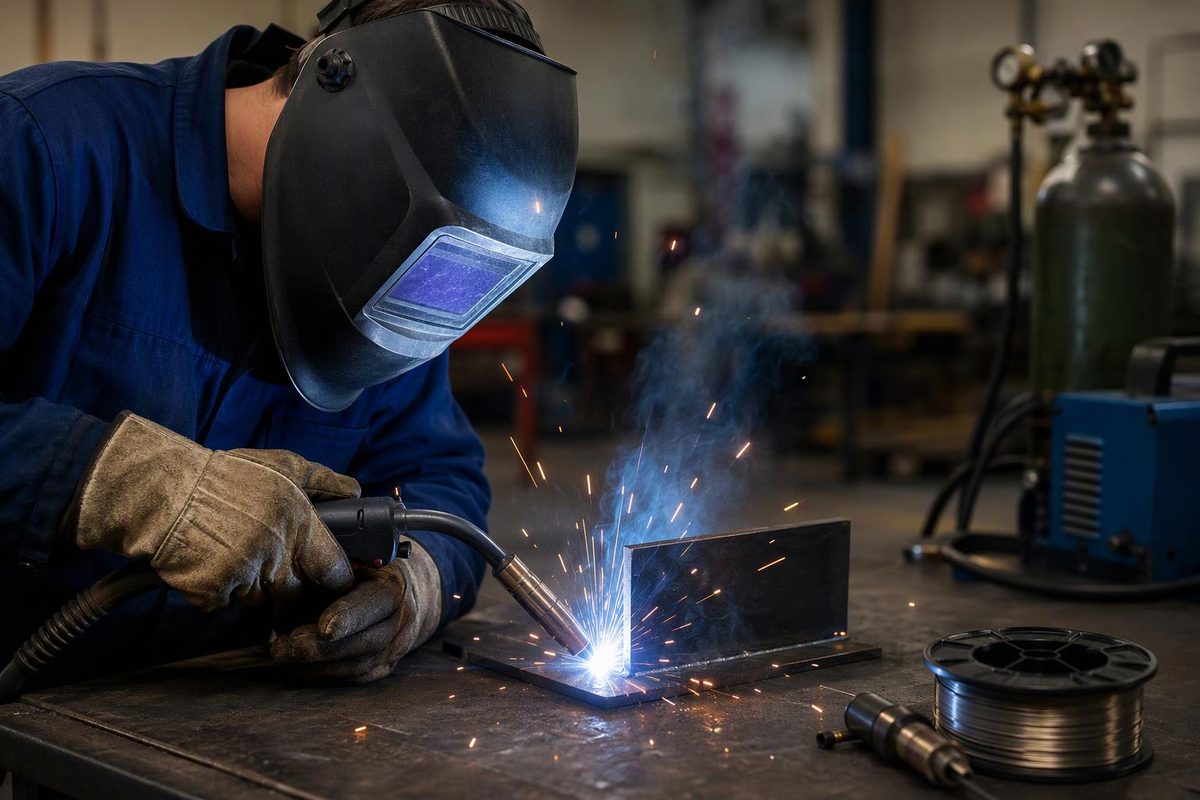
MIG stands for Metal Inert Gas. It is an arc-welding process that uses a continuously fed, consumable metal wire and an inert shielding gas to protect the arc and molten weld pool from atmospheric contamination. MIG is a variation of GMAW—Gas Metal Arc Welding. TWI explains the terminology and process.
There is one important wrinkle: much of the steel welding commonly called “MIG” uses an active gas mixture, making it technically MAG—Metal Active Gas welding.
What the name describes
- Metal: The wire is the electrode. It carries welding current and melts to supply filler metal to the joint.
- Inert: The shielding gas does not chemically react with the filler metal or weld pool. Examples include argon, helium and argon–helium mixtures.
- Gas: Shielding gas flows through the welding gun around the arc and weld pool, protecting them from the surrounding atmosphere. It is not a fuel gas; the electric arc supplies the heat.
A feeder pushes wire from a spool through the gun’s contact tip. An arc forms between the wire and workpiece, melting the wire and base metal to create the joint. Because the machine continuously feeds the wire while the operator guides the gun, manual MIG welding is often called semiautomatic welding. TWI’s process description explains this arrangement.
MIG, MAG and GMAW: what is the difference?
The distinction between MIG and MAG is the shielding gas—not whether the machine feeds wire.
| Term | Full name | Shielding-gas distinction |
|---|---|---|
| MIG | Metal Inert Gas | Inert gas, such as argon for aluminum |
| MAG | Metal Active Gas | Active gas, such as CO₂ or an argon–CO₂ mixture for steel |
| GMAW | Gas Metal Arc Welding | The broader process name covering both MIG and MAG |
An argon–CO₂ mixture is still an active shielding gas, even when argon makes up most of it. TWI distinguishes these gas categories. Equipment guides also use “MIG” more broadly: Miller’s MIG basics describe using an argon–CO₂ mix, which is technically MAG.
That naming difference matters when choosing consumables: “MIG welder” does not mean pure argon is right for every metal. Choose the gas for the material, wire and transfer mode; see our MIG shielding-gas guide.
Is “gasless MIG” actually MIG?
Usually, “gasless MIG” means self-shielded flux-cored arc welding, not MIG. Its tubular wire contains flux that generates shielding as it burns, so it does not need an external gas cylinder. Solid-wire MIG requires an external shielding-gas supply. Some flux-cored wires also require external gas, so “flux-core” alone does not mean gasless. Miller explains the wire and shielding differences.
If you want to weld without a cylinder, follow a self-shielded flux-core setup—do not simply turn off the gas while running solid MIG wire.