
Which Gas Should You Use for MIG Welding?
Choose MIG shielding gas for mild steel, stainless or aluminum, set a practical flow rate, and diagnose porosity before turning up the gas.
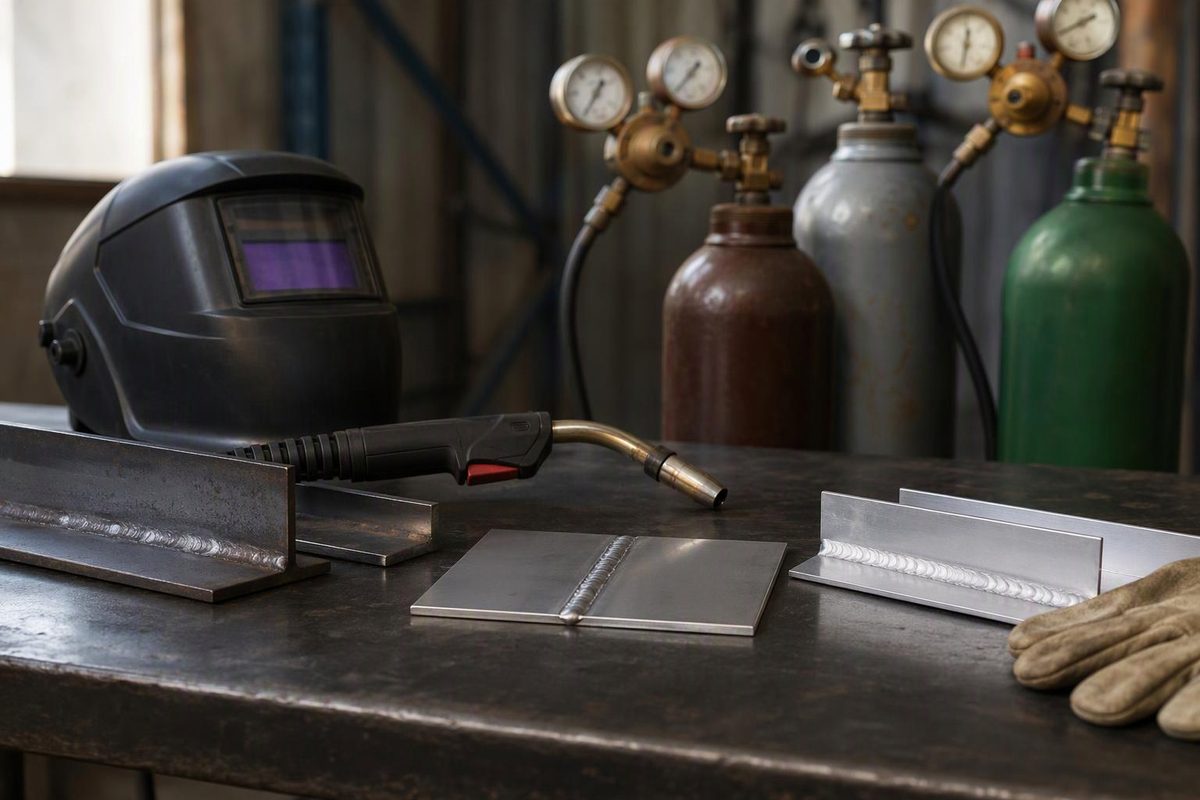
For ordinary indoor, short-circuit MIG welding of mild steel with solid wire, 75% argon/25% carbon dioxide—often called 75/25 or C25—is a practical starting choice. Aluminum normally uses 100% argon. Stainless steel needs a blend matched to the wire, transfer mode and machine; it is not simply another job for the mild-steel cylinder. Miller’s shielding-gas guide explains these distinctions.
Shielding gas keeps atmospheric contaminants away from the molten weld pool. It also changes arc stability, spatter, bead shape and transfer behavior. Choose it before tuning voltage and wire-feed speed—not as a final accessory.
Match the gas to the job
These are common options for solid-wire GMAW, usually called MIG. They are not substitutes for the wire datasheet, equipment manual or an applicable welding procedure specification (WPS).
| Material and transfer mode | Common gas choice | Main decision |
|---|---|---|
| Mild steel, short-circuit | 75% argon / 25% CO₂ | Good general-purpose arc behavior with less spatter than straight CO₂ |
| Mild steel, short-circuit where gas cost matters | 100% CO₂ | Lower gas cost, but generally more spatter and a rougher bead |
| Mild steel, spray or pulsed spray | 90% argon / 10% CO₂ | Match the blend to the machine’s program and wire recommendation |
| Aluminum | 100% argon | Common choice; argon/helium blends are alternatives for some applications |
| Stainless steel, conventional short-circuit | 90% helium / 7.5% argon / 2.5% CO₂ | Traditional helium-rich tri-mix; verify machine compatibility |
| Stainless steel, conventional spray | Argon with 1–2% oxygen | One established option; follow the wire and procedure requirements |
| Stainless steel, pulsed spray | 98% argon / 2% CO₂ | A typical option; use the blend specified for the machine’s program |
The mild-steel and aluminum choices follow Miller’s gas-selection guidance. Lincoln’s stainless guidance supports the short-circuit tri-mix and argon/oxygen spray options; Miller’s pulsed-MIG guide identifies 98/2 as a typical stainless pulsed blend.
Why 75/25 is not the answer to every steel weld
Short-circuit transfer repeatedly brings the wire into contact with the weld pool. Spray transfer sends fine molten droplets across an established arc and requires a suitable combination of gas and output.
Miller states that carbon-steel spray and pulsed transfer typically need at least 80% argon, with 90/10 common. C25 contains only 75% argon, so do not buy it expecting conventional solid-wire spray transfer simply by raising voltage. Pulse also requires a pulse-capable power source. Source: Miller.
Straight CO₂ can provide deeper penetration than C25, but that does not make it automatically better for a joint. It also increases spatter, and voltage and wire speed depend partly on the gas. After changing cylinders, use the corresponding setup chart and check a representative coupon. Source: Miller’s mild-steel setup guide.
Do not treat pure argon for aluminum or TIG as a substitute for the recommended steel blend. TWI’s GMAW guidance lists CO₂ and argon mixtures containing CO₂ or oxygen for steels.
For stainless, check percentages rather than buying by the name “tri-mix” alone. Some newer machines support low-CO₂ argon blends for short-circuit stainless, while others are designed around helium-rich gas. For aluminum, do not use CO₂-containing blends. Source: Miller. See our stainless MIG setup guide for the transfer-mode distinctions.
Set flow—not cylinder pressure
For a small indoor mild-steel setup, 20–25 CFH, approximately 9–12 L/min, can be a useful starting range where the equipment and wire instructions agree. For example, the Millermatic 211 PRO manual, section 4-16, gives this typical range and directs users to the wire manufacturer’s recommendation. It is not a universal setting for every nozzle, joint or transfer mode.
Set the flow while gas is flowing through the machine and gun. Use the machine’s purge function or its manual’s trigger procedure; prevent wire feeding as instructed and keep the gun safely directed. A cylinder-pressure reading is not the shielding flow rate.
Before switching to straight CO₂, verify regulator compatibility. The same manual specifically warns against using its argon/mixed-gas regulator with CO₂ and calls for suitable CO₂ equipment.
Too little flow leaves the pool exposed. Too much can create turbulence that draws atmospheric contaminants into the shield, causing porosity while wasting gas. Wind can strip the shield away even when the meter reads correctly. Source: Miller’s shielding-gas guide.
Porosity: check delivery before increasing flow
If holes appear, work through the gas path rather than immediately changing arc settings:
- Confirm the supply. Check the cylinder label, open valve, flowing reading and correct MIG gas port on a multiprocess machine.
- Check for leaks. Inspect hoses and fittings with a gas-compatible leak-detection product. Close the cylinder valve and correct leaks before welding; never test with a flame. Source: CCOHS cylinder-handling guidance.
- Check gun seating and consumables. A poorly seated gun can leak gas at the feeder. Spatter buildup in the nozzle can disrupt coverage.
- Check distance and drafts. Follow the procedure’s contact-tip-to-work distance and use suitable wind protection without sacrificing ventilation. A gun held too far away can lose coverage.
- Check contamination. Clean oil, rust and coatings from the joint and inspect the wire. Gas cannot compensate for dirty material.
The delivery checks follow Miller’s shielding-gas troubleshooting guidance; the cleaning guidance comes from its mild-steel MIG guide. If coverage is still uncertain, a nozzle flow checker can help distinguish the regulator reading from gas actually reaching the gun.
A cleaner-looking bead is not proof of adequate fusion or a certified weld. Critical work needs the specified procedure and inspection, not just a successful gas adjustment.
If you want to weld without a cylinder
Solid MIG wire still needs external shielding. Cylinder-free wire welding uses self-shielded flux-cored wire, a different process, as the Miller manual’s process table distinguishes. Gas-shielded flux-cored wire still needs its specified gas; Lincoln explains why its recommended blend matters. Use our MIG-without-gas setup guide to check wire type, polarity and feeder compatibility.
Secure cylinders upright and identify gas by its label, not cylinder color. Argon, helium and CO₂ can displace oxygen, especially in enclosed spaces. Wind protection must not become an unventilated enclosure; shielding gas does not remove welding fumes. Follow CCOHS cylinder precautions and OSHA’s welding-fume and gas guidance.