
How to Choose Welding Protection That Fits Your Body and the Job
A six-model shortlist tracks fit, construction and missing documentation. Only Benchmark has seller-stated ATPV 12 cal/cm² and CAT 2.
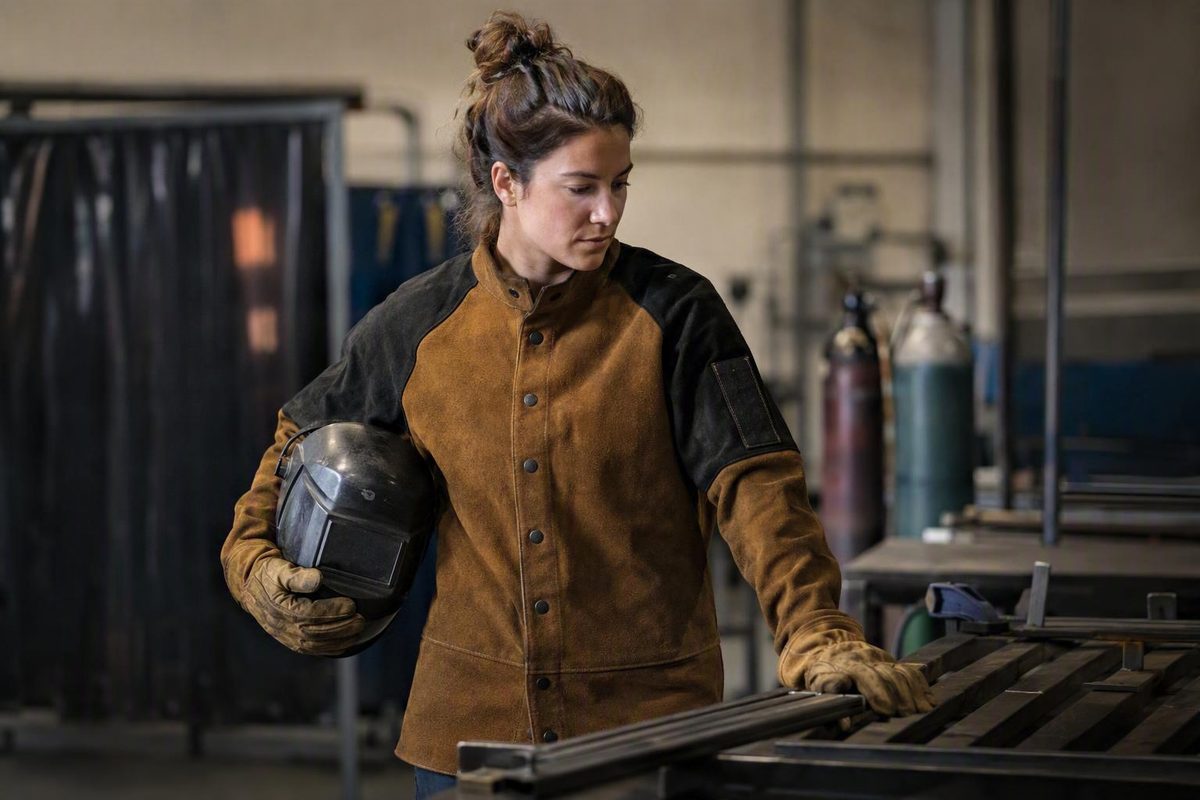
A women’s welding jacket should do more than carry a women-specific label. It should close over normal work clothing, maintain practical coverage as the wearer reaches or crouches, and come with documentation that can be checked against the intended work.
No single model is universally best or safest. Lighter flame-resistant cotton may reduce weight and heat burden in some working conditions, while leather reinforcement may be worth investigating where heat, spatter, abrasion, or puncture exposure is greater. If workplace documents call for arc-rated clothing, the jacket’s exact model, permanent label, rating, and supporting technical information need separate verification.
This article is therefore a product-documentation comparison, not a compliance determination. The buying sequence is to define the work and exposure, identify explicitly women-specific candidates, compare documented construction and ratings, measure against the current brand chart, test the fit through realistic movement, and verify the received garment before use.
What makes a welding jacket genuinely women-specific?
Placement in a retailer’s “women’s” collection does not prove that a jacket was patterned for women. Such collections may include unisex products, accessories, or ordinary garments grouped for merchandising. For a defensible comparison, count a model as explicitly women-specific only when its product name or description says so.
The clearest fit language among the supplied listings comes from Cyberweld. The retailer says AngelFire women’s jackets have trimmer waists and wider hips than standard welding jackets. That is useful evidence of women-specific positioning, but it is retailer-provided language rather than independently verified pattern data. The same page explicitly names the AngelFire JF1015-NB and JH1515-NB as women’s jackets. See Cyberweld’s AngelFire women’s apparel listing.
Lincoln Electric describes its Women’s Shadow jacket as designed specifically to fit women welders. It includes a snap-cinch waist, but that feature alone does not show how the shoulders, bust, hips, sleeves, or torso are graded.
The Miller Classic Cloth retailer listing says the jacket follows women’s sizing standards and includes adjustable waist and wrist closures. It does not provide complete finished-garment measurements. Descriptions such as “tailored,” “women’s sizing,” or “specifically fitted” cannot establish how much room a particular wearer will have at every body point.
Nominal size is therefore only an initial filter. Practical fit depends on several interacting factors:
- Shoulder mobility: The jacket should permit the arm positions required for the work.
- Bust or chest room: The front should close without obvious pulling at the zipper or snaps.
- Waist fit: Adjustment should refine the fit without causing the jacket to ride upward.
- Hip clearance: The hem should not catch on the hips when sitting, kneeling, or crouching.
- Sleeve reach: Cuffs should remain at the wrists when the elbows bend and the arms extend.
- Collar coverage: The collar should close as intended without unduly restricting head and neck movement.
- Layering room: The fit should account for the clothing and other compatible equipment normally worn underneath.
- Excess-fabric control: A larger size should not create substantial bunching at the elbows or loose areas around tools and equipment.
A jacket can feel comfortable while the wearer stands still but shift noticeably during overhead reach, forward extension, or kneeling. The opposite problem also matters: excessive room may create long sleeves, joint bunching, or loose fabric.
The unresolved evidence gap is consistent across the compared products. The supplied pages do not provide complete bust, waist, hip, shoulder, sleeve, torso, and finished-garment measurements for every model and size. Buyers whose measurements span several nominal sizes should treat the size name as a starting point and request model-specific dimensions where possible.
Start with the hazard and working conditions, not the product name
A label such as “MIG jacket,” “Stick jacket,” or “welding cloth” does not describe every working condition in which the garment might be used. Before comparing brands, document what the jacket is expected to encounter and take that information to the employer, site PPE contact, manufacturer, or qualified supplier responsible for the selection.
A practical pre-shopping checklist includes:
- Spark and spatter exposure: Note the amount, direction, frequency, and apparent intensity of hot material reaching the upper body.
- Heat: Consider process heat, nearby hot work, and hot surfaces.
- Abrasion and puncture: Record contact with rough plate, sharp edges, confined spaces, and grinding debris.
- Working position: Distinguish bench work from vertical, overhead, kneeling, or under-structure work.
- Time under the hood: Consider whether the work consists of short tacks or extended production periods.
- Job settings and duration: Record the equipment settings and duty pattern relevant to the work rather than relying on the process name alone.
- Ambient conditions: Temperature, humidity, airflow, and heat from surrounding operations affect comfort.
- Ventilation arrangement: Check whether the jacket works with the ventilation equipment and procedures used at the site.
- Layers: Include cold-weather clothing and any other garment worn beneath the jacket.
- Mobility: Note overhead reach, crawling, climbing, crouching, and work in restricted spaces.
- Adjacent work: Cutting, gouging, grinding, or another welder’s operation may change the conditions around the wearer.
- Documented properties: Ask which garment properties, labels, or ratings the workplace requires.
Miller’s manufacturer-authored apparel guide identifies the work performed, environment, desired protection, comfort, durability, breathability, and heat stress as selection considerations. It describes FR cotton as relatively lightweight and breathable but says it may not provide enough protection where heat, sparks, or spatter are intense. These are manufacturer statements rather than independent comparative test results. Review Miller’s material-selection guidance.
That evidence supports a bounded shopping path:
- Where the assessed exposure is relatively mild and garment weight or heat burden is important, investigate a documented lighter FR-cotton model.
- Where the work presents greater heat, spatter, abrasion, or puncture concerns, investigate leather or leather-reinforced construction.
- Where workplace documentation calls for arc-rated clothing, limit the shortlist to garments whose exact rating and supporting documentation can be verified.
- Where the conditions do not fit a simple category, compare the complete garment—including panel placement, seams, collar, cuffs, closures, pockets, label, care information, and stated limitations.
Material names alone do not establish the complete protection level. Two hybrid jackets may put leather in different locations. Two cotton jackets may differ in fabric weight, treatment, seams, closures, or published ratings. A seller’s process recommendation likewise cannot determine suitability for every workplace using that process.
The final choice should be checked against the employer’s instructions, site PPE requirements, equipment documentation, and the current label for the exact garment received. This article cannot resolve conflicts among those materials or interpret occupational-safety standards.
FR cotton, leather, hybrid, and cloth: understand the tradeoffs
Material categories help organize a shortlist, but none is a complete safety specification.
FR cotton is described in the supplied manufacturer guidance as relatively lightweight, breathable, washable, and inexpensive compared with leather. The same guidance says FR cotton may char and may not provide enough protection where heat, sparks, or spatter are intense. “Cotton” by itself does not establish flame resistance.
Leather is described as resistant to heat penetration, abrasion, and puncture. Its type, cut, thickness, and grade can vary, so “leather” does not describe a uniform product. Full-leather garments may also be heavier, stiffer, and less breathable than lighter fabric jackets.
Hybrid construction attempts to place leather in higher-exposure areas while retaining lighter FR fabric elsewhere. It can offer a useful combination of features, but “hybrid” does not identify a standardized panel layout or performance level. Buyers need to determine where the reinforcement is located and whether the arrangement addresses their documented working conditions.
The AngelFire models show the basic distinction. Cyberweld describes JF1015-NB as a 9-ounce FR-cotton jacket and JH1515-NB as a combination of 9-ounce FR cotton and black cowhide leather. Those are retailer-stated specifications; the captured listing does not supply a complete size chart, care instructions, certification details, or defined duty level.
Lincoln Electric’s Women’s Shadow uses a different hybrid arrangement: split-cowhide sleeves with FR cloth front and back panels. That construction should not be assumed to perform identically to the AngelFire hybrid because the available descriptions do not establish equivalent panel placement, garment construction, or test results.
The Miller Classic Cloth women’s jacket needs more cautious treatment. Its retailer page states 9-ounce, 100% cotton, but the supplied description does not identify an FR treatment, named FR standard, or arc rating. Flame resistance cannot be inferred from the page URL, the jacket’s product category, or its proximity to products described as FR.
Terms such as “breathable,” “cooling,” “heavy-duty,” “industrial,” and “comfortable” should be treated as manufacturer or seller descriptions unless accompanied by appropriate comparative evidence. A fabric may be lighter than leather without being comfortable for every wearer or every environment.
For each candidate, separate four questions:
- What base material does the cited page identify?
- Which areas receive leather or other reinforcement?
- What protective properties or ratings are documented for the complete garment?
- What important information is missing from the cited evidence?
Women-specific models compared by documented features
The table reports only what the cited manufacturer or retailer page establishes. “Not provided” means the information was not found in the supplied page; it does not prove that no separate document exists.
| Model | Women-specific evidence | Construction and weight | Sizes | Fit, collar, closure, and pockets | Stated use or hazard information | Care and ratings | Undated retail snapshot | Evidence quality and unresolved information |
|---|---|---|---|---|---|---|---|---|
| Black Stallion AngelFire JF1015-NB, navy/black | Explicit women’s product title; Cyberweld says AngelFire jackets have trimmer waists and wider hips | Retailer-described 9-ounce FR cotton | Not provided in captured listing | Not provided | No defined duty level in the cited listing | Care, named standard, certification details, and arc rating not provided | Cyberweld displayed 26.55; Canada Welding Supply displayed 36.00. Capture date and stated currency were not supplied. | Retailer-stated construction and fit language; complete measurements and technical documentation remain unresolved. Cyberweld listing |
| Black Stallion AngelFire JH1515-NB, navy/black | Explicit women’s product title; same Cyberweld fit description | Retailer-described black cowhide and 9-ounce FR cotton | Not provided in captured listing | Not provided | No independently established process or exposure level | Care, named standard, and arc rating not provided | Cyberweld displayed 52.85, Welding Outfitter 65.00, and Canada Welding Supply 72.00. Capture dates were not supplied; currency was not established consistently. | Retailer-stated construction; leather layout, measurements, care, and technical documentation remain unresolved. Welding Outfitter collection |
| Lincoln Electric Women’s Shadow | Manufacturer says it is specifically designed to fit women welders | Split-cowhide sleeves with FR cloth front and back panels; weight not stated | XS–XL | Flip-up collar, adjustable snap sleeves, snap-cinch waist, two horizontal flap pockets; main closure not detailed in supplied text | Lincoln calls it ideal for MIG or Stick welding; this is a manufacturer-stated use | Named standard, arc rating, and care instructions not provided in the cited page | Lincoln’s page showed no public amount in the supplied material; Canada Welding Supply displayed 170.00 without a supplied capture date or confirmed currency | Manufacturer-documented features; finished measurements, fabric weight, care, and ratings remain unresolved. Lincoln Electric specifications |
| Miller Classic Cloth Women’s Welding Jacket | Retailer says it follows women’s sizing standards | 9-ounce, 100% cotton | S–XL | Covered zipper, stand-up collar, adjustable waist and wrists; pockets not stated | Seller positions it for industrial welding, without defining an exposure level | FR treatment, named FR standard, arc rating, and care instructions not provided | Welding Store displayed a 57.75 sale amount; Canada Welding Supply listed the model from 44.00. No capture dates were supplied, and equivalent variants cannot be confirmed from the available evidence. | Retailer-documented specifications; FR status, finished measurements, care, and hazard limitations remain unresolved. Welding Store product page |
| Benchmark FR Women’s Flame Resistant Welding Jacket | Explicit women’s product title | Arapaho cotton-nylon blend; weight not stated | XS–3XL | Snap front, cuffs, and collar; sleeve pen pocket, inside pocket, longer sides | Seller markets it for flame and electric-arc hazards and excludes firefighting and chemical exposure | Seller states ATPV 12 cal/cm² and CAT 2; care is supplied; references to NFPA 2112 and NFPA 2113 are inconsistent | Seller displayed 89.99 regular and 69.99 for 2XL. No capture date was supplied; stock and price varied by size. | Seller-provided performance and compliance claims were not independently verified in the supplied evidence. Current label and certification records need confirmation. Benchmark FR product page |
| Up In Smoke TESTUDA women’s jacket with hood | Explicit women’s product title on a retailer collection page | Not established by supplied collection page | Not provided | Hood identified in the title; other details not supplied | Hood compatibility and job-specific suitability not established | Standards, ratings, and care not provided | Canada Welding Supply displayed 184.00 without a supplied capture date or confirmed currency | Collection-page listing only; construction, sizing, measurements, closures, compatibility, ratings, care, and limitations remain unresolved. Canada Welding Supply collection |
Black Stallion’s own catalog confirms the AngelFire model names, model numbers, and navy-and-black descriptions, but the captured category information does not resolve their sizing, rating, care, or finished-measurement gaps.
The documentation supports feature-based shortlisting, not a best-overall ranking. Lincoln supplies the most detailed feature list among the leather-reinforced candidates, while Benchmark provides the broadest listed size range and the only seller-stated arc-performance figures in this comparison. Those distinctions do not establish comparative safety, fit, durability, or suitability.
The TESTUDA listing establishes only that a women’s hooded model was offered on the captured retailer page. A hood is a design feature, not evidence of compatibility with a particular helmet, respirator, harness, or workplace procedure.
How to measure, size, and movement-test the jacket
Begin with the current size chart for the exact manufacturer and model. Do not assume that a medium from one brand matches a medium from another or that a women’s welding jacket will fit like an ordinary fashion jacket.
Measure over the work clothing normally worn beneath the jacket. If substantial cold-weather or protective layers are part of the job, include them during measurement or discuss the required allowance with the manufacturer or seller.
Using a flexible tape, record:
- Bust or chest: Measure around the fullest point with the tape level and comfortably close, not pulled tight.
- Waist: Measure at the natural waist or at the point specified by the manufacturer’s chart.
- Hips: Measure around the fullest point if the jacket hem extends over the hips.
- Shoulder span: Record the distance across the upper back between the shoulder points.
- Sleeve length: With the arm slightly bent, measure to the wrist using the method specified by the brand.
- Torso length: Measure from the base of the neck toward the natural waist or intended hem position.
- Normal layers: Record what was worn during measurement so the result can be reproduced.
Chest, sleeve, and torso measurement guidance is supported by the supplied manufacturer-authored fitting article, but its recommendations are generic and not women-specific. Hip and shoulder measurements are practical supplementary checks rather than dimensions supplied for every compared model.
When measurements fall into different nominal sizes, identify which body area affects closure and coverage most strongly, then ask the manufacturer or seller how the model is cut.
Arc-Zone recommends beginning with the wearer’s normal apparel size and considering a slight size increase when substantial layering is planned. Treat this as general retailer guidance, not a universal rule; model-specific dimensions and an actual try-on provide stronger evidence. See Arc-Zone’s women’s jacket sizing guidance.
Once the jacket arrives, try it over normal work clothing and with the compatible equipment that affects its fit:
- Close the front fully.
- Close or raise the collar as it would normally be worn.
- Adjust the cuffs in relation to the gloves.
- Set the waist adjustment without forcing the jacket upward.
- Reach both arms overhead.
- Bend both elbows fully.
- Extend both arms forward.
- Rotate the shoulders and reach across the body.
- Crouch and kneel.
- Reproduce common working positions without performing hot work.
During the test, observe whether:
- The collar remains in its intended position.
- The cuffs remain at the wrists.
- The lower torso stays covered.
- The front closure pulls apart or shows obvious strain.
- The shoulders and elbows permit the required movement.
- The hem catches on the hips and forces the jacket upward.
- Fabric bunches heavily at the elbows, shoulders, or waist.
- Loose areas interfere with tools or nearby equipment.
These are practical fitting observations, not a certification test. If workplace procedures impose additional coverage or compatibility requirements, use those criteria instead.
Material can change the result. Leather’s weight and stiffness may require different ease around the shoulders and elbows than a lighter fabric. A physical try-on, sample garment, or workable return option is therefore particularly valuable for full-leather and leather-sleeve models.
If the jacket fits at the bust but has excessively long sleeves—or fits at the shoulders but catches at the hips—do not assume the next nominal size will solve the problem. Ask whether another model uses a different cut. Before altering a protective garment, obtain guidance from its manufacturer and the workplace contact responsible for PPE approval.
FR, arc ratings, and standards: read the label before relying on the claim
The supplied pages support four separate documentation categories:
- Welding-oriented coverage: The garment is sold with features intended for welding use.
- An FR material claim: The manufacturer or seller describes the fabric as flame-resistant.
- Leather reinforcement: Leather is used in selected areas.
- A published arc-performance claim: The seller or manufacturer provides a numerical arc rating or category designation.
These categories should not be treated as interchangeable. A women-specific fit claim says nothing about arc performance. Leather reinforcement does not by itself provide a published arc rating. Likewise, an FR description on a retail page does not establish a numerical ATPV or category.
This article does not define or interpret ASTM, NFPA, UL, or other standards because the supplied evidence does not include the standards bodies’ requirements. Where such documentation matters, the appropriate question is not whether a product page uses a familiar acronym, but whether the exact garment’s current label and supporting records satisfy the requirement provided by the workplace.
Among the compared pages, Benchmark is the only model with seller-stated arc-performance figures: ATPV 12 cal/cm² and CAT 2. The same page states sizes XS through 3XL and excludes firefighting and chemical exposure. These are seller-provided claims and limitations rather than independently verified findings in the available evidence.
The Benchmark page also contains inconsistent standards language. Detailed copy refers to NFPA 2112-2023, while another portion refers to NFPA 2113. Do not try to reconcile that discrepancy from the retail copy alone. Request the current garment label, technical data, and applicable certification record for the exact variant.
The supplied Lincoln, AngelFire, and Miller pages do not provide a comparable published arc rating. That means a rating is not established by the cited evidence; it does not prove that no additional manufacturer document exists.
Before relying on a product claim, verify as applicable:
- Exact manufacturer and model number
- Selected size, color, and variant
- Permanent garment label
- Stated rating and referenced test standard
- Current technical data sheet or declaration
- Whether the documentation applies to the complete garment
- Model-specific care limits
- Stated hazard exclusions
- Manufacturer inspection guidance
- Compatibility with the gloves, helmet, respirator, harness, and other equipment used
- Acceptance under the employer’s current PPE procedure
Do not remove tags or use the garment for hot work until important documentation conflicts and return conditions have been resolved.
Price, availability, and reviews: compare retail snapshots carefully
Retail data is volatile. The supplied evidence did not include capture dates for the prices below, and some pages did not explicitly identify the currency. Consequently, the figures are reproduced only to show seller-to-seller variation; they should not be treated as current offers or normalized into a direct price ranking.
| Model | Named seller and displayed amount | Context and limitations |
|---|---|---|
| AngelFire JF1015-NB | Cyberweld: 26.55; Canada Welding Supply: 36.00 | Undated captured-page amounts. Currency was not established consistently, and current stock or pricing must be checked with each seller. |
| AngelFire JH1515-NB | Cyberweld: 52.85; Welding Outfitter: 65.00; Canada Welding Supply: 72.00 | Undated snapshots from different sellers. Market, currency, timing, discounts, and inventory age may account for the spread. |
| Lincoln Women’s Shadow | Canada Welding Supply: 170.00 | Undated collection-page snapshot. The captured text did not explicitly state the currency. |
| Miller Classic Cloth women’s jacket | Welding Store: 57.75 sale; Canada Welding Supply: from 44.00 | Different undated retail contexts. The available evidence does not establish that both figures applied to an identical size or variant. |
| Benchmark FR women’s jacket | Benchmark FR: 89.99 regular; 69.99 for 2XL | Undated seller snapshot with size-specific price and stock differences. |
| Up In Smoke TESTUDA women’s jacket with hood | Canada Welding Supply: 184.00 | Undated collection-page snapshot with limited specifications and no explicitly stated currency in the captured text. |
Canada Welding Supply marked every visible product card in the supplied collection excerpt as sold out, while its availability filter reported in-stock products. That internal conflict prevents a reliable stock conclusion from the captured page.
Cyberweld displayed 5.0 from four reviews for JF1015-NB and 4.8 from nine reviews for JH1515-NB. Those are undated retailer snapshots with small review pools, not sufficient evidence to rank comparative fit, durability, quality, or safety. The cited Benchmark and Miller pages showed no customer reviews, so the available evidence cannot support a balanced review-based comparison.
Before checkout, confirm:
- Exact model, size, color, and variant
- Whether the displayed specifications apply to that variant
- Currency and seller market
- Size surcharge
- Discount status and expiration
- Shipping, tax, and import costs
- Final delivered price
- Current inventory and dispatch estimate
- Return and exchange period
- Restocking and return-shipping fees
- Whether trying the jacket over work layers affects return eligibility
- Whether permanent labels and technical documents are included
A lower displayed price may be poor value if the model cannot be returned after a failed fit test. A higher price, however, does not establish better fit, stronger protection, or more complete documentation.
Build a defensible shortlist and verify it before use
A useful shortlist groups candidates by documented features rather than declaring a universal winner.
For buyers prioritizing lower weight and breathability: AngelFire JF1015-NB is a retailer-documented 9-ounce FR-cotton candidate. Before purchase, obtain the current size chart, inspect the applicable label information, request model-specific care instructions, and confirm that its documentation is appropriate for the intended work.
For leather-reinforced construction: Compare AngelFire JH1515-NB with Lincoln Women’s Shadow. The former is described as black cowhide plus 9-ounce FR cotton; the latter uses split-cowhide sleeves with FR cloth front and back panels. Their panel arrangements differ and should not be assumed to cover the same areas or perform identically.
Where workplace documents call for a published arc rating: Benchmark FR is the only candidate in this evidence set with a seller-stated ATPV and category. Its inconsistent references to NFPA 2112 and NFPA 2113 should be resolved through the current label and applicable certification documentation before the claim is relied upon.
For fit and closure features without an established FR or arc rating: Miller Classic Cloth remains a fit-and-feature candidate because its listing documents women’s sizing, a covered zipper, stand-up collar, and adjustable waist and wrists. On the supplied evidence, it should be described only as 9-ounce, 100% cotton—not as FR or arc-rated.
For buyers considering an integrated hood: The Up In Smoke TESTUDA collection listing establishes that a women’s hooded model was offered. It does not establish detailed construction, size range, rating, care requirements, or compatibility with other equipment.
Before first use:
- Confirm the received model, size, color, and variant against the order.
- Read the permanent label and supplied instructions.
- Inspect seams, sleeves, collar, cuffs, front closure, and adjustment hardware.
- Ask the manufacturer or workplace PPE contact how visible damage or contamination should be handled.
- Complete the movement test over normal work layers.
- Check practical integration with gloves and other required equipment.
- Confirm that pockets and loose areas do not interfere with the work.
- Follow the instructions supplied for that exact model.
- Resolve any conflict between the product page, garment label, and workplace documentation.
Benchmark’s seller instructions provide a model-specific example: machine wash warm, tumble dry low, and avoid bleach, fabric softener, and laundry pods. Those directions apply to the Benchmark product and should not be generalized to the AngelFire, Lincoln, Miller, or Up In Smoke jackets.
The final decision should follow a disciplined sequence: document the work and conditions, identify explicitly women-specific candidates, compare construction and published claims, measure against the current model chart, test coverage through realistic movement, and verify the exact garment received.
Before committing, resolve the gaps that matter to the purchase: complete size chart, selected-size availability, finished measurements where obtainable, current label, technical or certification records where required, care directions, stated limitations, return terms, and final delivered cost. Incomplete measurements, inconsistent standards language, seller-authored performance claims, and undated retail data make that verification more useful than a generic product ranking.
Should I buy my normal jacket size or size up for a women’s welding jacket?
Use your normal size only as a starting point. Measure over normal work clothing and compare the results with the current chart for the exact model.
If substantial layering is planned, additional room may be necessary. When measurements span several sizes, ask the seller or manufacturer how the jacket is proportioned. Sizing up may create overlong sleeves or excess torso length without solving a bust, shoulder, or hip mismatch.
Try the jacket through the full movement sequence before removing tags or performing hot work.
Is an FR-cotton welding jacket enough for MIG or Stick welding?
The process name alone cannot settle the purchase. Working position, duration, spatter, heat, abrasion, nearby operations, environment, and workplace instructions can differ substantially within the same process.
A documented FR-cotton jacket may belong on a shortlist where exposure is assessed as relatively mild and lower weight matters. Where heat, spatter, abrasion, or puncture concerns are greater, investigate leather or reinforced construction. Confirm the final selection through the applicable workplace procedure and the exact garment documentation.
Does every women’s welding jacket have an arc rating?
No. Women-specific fit and a published arc rating are separate product characteristics.
In the supplied evidence, Benchmark is the only compared model whose seller states an ATPV and CAT designation. The cited AngelFire, Lincoln, and Miller pages do not provide comparable numerical arc ratings. If a rating is required, verify the exact garment label and supporting technical documentation rather than relying on the product category or an FR description.
What is the difference between the AngelFire JF1015-NB and JH1515-NB?
Both are explicitly named women’s welding jackets in navy and black. The principal documented difference is construction:
- JF1015-NB: Retailer-described 9-ounce FR cotton
- JH1515-NB: Retailer-described combination of 9-ounce FR cotton and black cowhide leather
The JH1515-NB may interest buyers investigating leather reinforcement, while the JF1015-NB may appeal to those prioritizing lighter FR-cotton construction. The supplied listings do not provide enough panel-layout, sizing, certification, or comparative test data to declare either universally safer or more suitable.
How can I check whether a welding jacket still covers me when I move?
Close the front and collar, adjust the cuffs and waist, and wear the normal work layers and compatible equipment. Reach overhead, bend both elbows, extend both arms forward, rotate the shoulders, crouch, kneel, and reproduce typical working positions without performing hot work.
Observe whether the collar, cuffs, and lower torso remain in their intended positions; the front stays closed; and the shoulders and elbows retain the required mobility. Also look for closure strain, substantial joint bunching, a hem that rides upward, or loose areas that interfere with tools or equipment. Confirm any workplace-specific coverage criteria with the person responsible for PPE selection.