
How to Choose a Welding Jacket for the Heat, Spatter, and Work You Actually Do
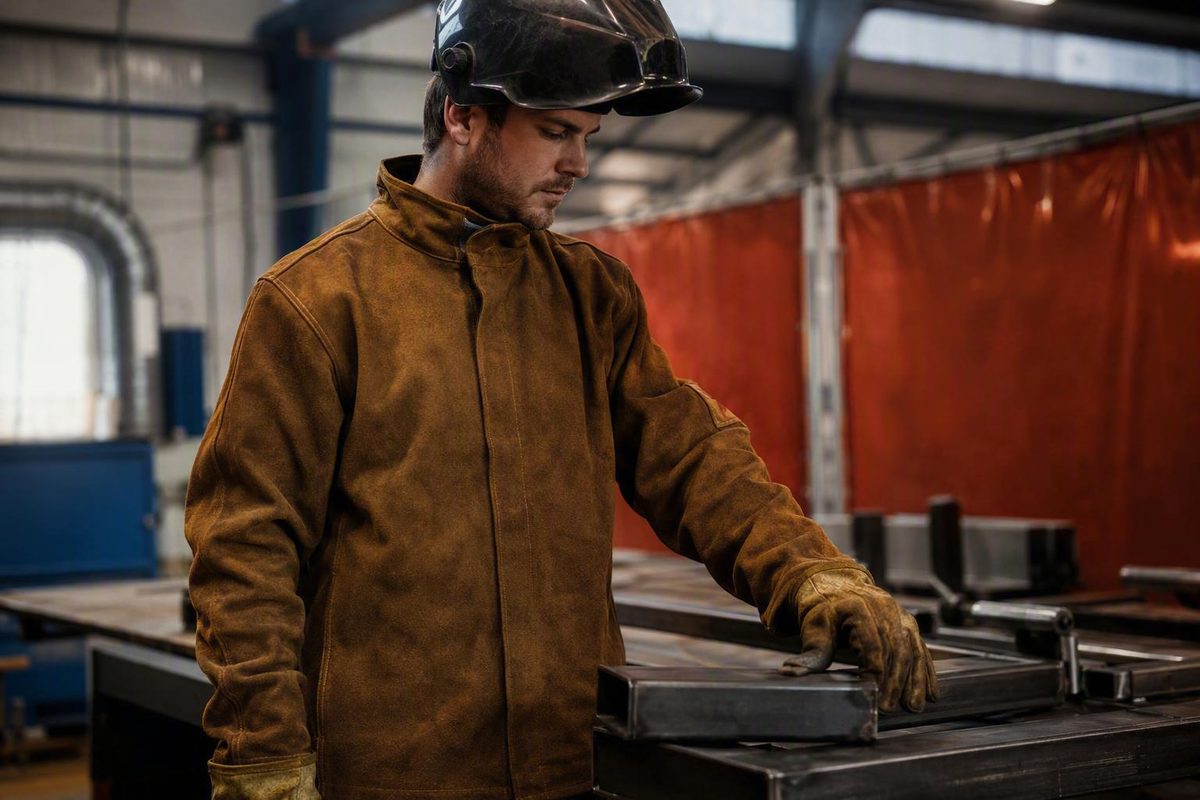
A flame resistant welding jacket is not automatically the right jacket for every welding job. Depending on the evidence supplied for the exact garment, “FR” may describe a documented material property, a treatment, or simply a commercial claim. The label alone does not establish that the jacket suits the heat, sparks, spatter, position, duration, environment, and movement involved.
There is therefore no universally best welding jacket. FR cotton, full leather, and leather-sleeve hybrids offer different trade-offs. Fit, coverage, construction details, model-specific documentation, care requirements, and delivered cost matter alongside the material named in the product title.
This guide is a commercially focused comparison based largely on manufacturer and retailer information. Those sources can document available constructions, features, listed prices, and manufacturer-described trade-offs, but they do not replace occupational-safety guidance, applicable rules, or a workplace hazard assessment.
Start With the Hazard, Not the Product Label
Manufacturers describe welding jackets as apparel intended to shield the upper body and underlying clothing from hazards such as sparks and heat. Miller likewise advises selecting welding apparel for the specific application rather than assuming that one material suits every job.
Start by describing the work rather than naming a product:
- Expected heat: Is exposure intermittent or sustained? How close will the torso be to the work?
- Spark and spatter severity: Are occasional fine sparks expected, or recurring and substantial spatter?
- Welding position: Will the work be performed at a bench, vertically, overhead, inside a structure, or in another restricted position?
- Exposure duration: Is this a brief repair or hours of repeated work?
- Environment: Is the shop hot, cold, confined, windy, wet, or shared with moving equipment?
- Mobility: How far must the wearer reach, crouch, climb, rotate, or work overhead?
- Layering: Will the jacket be worn over a shirt, insulating layers, a harness, or other equipment?
- Other workplace requirements: Are visibility, electrical, respiratory, fall-protection, or site-specific controls also relevant?
This is more useful than choosing solely by process name. MIG, TIG, stick, and flux-core identify welding processes, but not the complete exposure at the jacket. The supplied commercial guides offer different process-to-material recommendations and do not establish controlled exposure thresholds for a rigid rule.
Use this decision sequence:
- Identify the actual exposure and working conditions.
- Determine the coverage the task requires.
- Compare constructions that appear suitable for that exposure.
- Test fit and movement over normal work layers.
- Verify the exact model’s documentation and care instructions.
- Compare the proposed purchase with employer, site, and jurisdictional requirements.
A buying guide should not overrule a hazard assessment. Equipment manuals, employer procedures, site rules, and applicable safety requirements take precedence; Welder Facts’ own terms likewise state that equipment manuals and site rules override its articles.
FR Cotton vs. Leather vs. Hybrid Jackets
FR cotton, full leather, and FR-fabric-body jackets with leather sleeves are repeatedly represented in the supplied catalogs. Specialty and proprietary fabrics also appear, but the available commercial descriptions do not establish a universal performance ranking.
FR cotton
FR cotton is generally positioned as the lighter, more breathable, and less expensive choice. Depending on the exact garment and its care instructions, it may also be washable.
That does not make all FR-cotton jackets interchangeable. Base fabric, treatment, fabric weight, seams, closures, panel layout, wear, contamination, and care requirements can differ. A listing such as “9 oz” or “12 oz” is a fabric specification, not a numerical protection rating.
Miller describes FR cotton as relatively inexpensive, lightweight, breathable, and washable. The manufacturer also says it can char when exposed to sparks, spatter, or molten metal and may not be sufficient for applications involving intense heat or more severe sparks and spatter. These are manufacturer descriptions rather than independent comparative test results, but they illustrate the central trade-off: lower weight and heat burden versus a less substantial barrier than leather.
Full leather
Miller describes leather’s density and thickness as helping to limit heat penetration while providing resistance to abrasion, puncture, sparks, and spatter. The same guide notes important disadvantages: leather can be heavy and poorly breathable, and its weight may increase fatigue or compound heat burden during long or hot jobs. Miller’s apparel guide presents both the FR-cotton and leather trade-offs as application-dependent.
Leather itself varies. Grain leather comes from the outer or top part of a hide, while split leather comes from lower portions. Neither “grain” nor “split” proves that a complete jacket is certified or appropriate for a particular task.
Leather-sleeve hybrids
This may be a practical compromise when the arms receive significant exposure but the weight and limited breathability of a full-leather torso would be difficult to manage.
The compromise must remain clear. Panel placement also matters: the chest, abdomen, back, shoulders, seams, and closure may use a different construction from the sleeves.
Specialty constructions
Some manufacturers and sellers offer CarbonX-based or proprietary fabrics intended to combine lower weight with resistance to heat and sparks. Miller, for example, describes its WeldX material as CarbonX-based. Up In Smoke lists a separate jacket made with CarbonX and FR cotton/nylon twill and equipped with a built-in hood. These are manufacturer or seller descriptions, not independent proof that either construction is superior to cotton, leather, or another proprietary material.
| Comparison point | FR cotton | Full leather | FR-fabric body with leather sleeves |
|---|---|---|---|
| Relative weight | Usually the lightest of these three constructions | Usually the heaviest | Commonly between FR cotton and full leather |
| Breathability | Generally positioned as the more breathable option | Generally limited | Lighter torso may release more body heat than full leather |
| Mobility | Usually easier to move in | Thickness and stiffness may restrict movement | Torso may move more easily, while leather sleeves can remain stiff |
| Likely comparison scenario | Relatively mild sparks and spatter where low weight matters | Sustained heat or substantial spatter, subject to task assessment | Concentrated arm exposure where full-leather burden is impractical |
| Principal limitation | Can char and may be insufficient for more severe exposure | Weight, stiffness, limited breathability, and fatigue | Fabric torso is not equivalent to full leather; panel transitions matter |
| Care dependency | Treatment and laundering instructions matter | Cleaning, drying, conditioning, and storage are model-specific | Mixed materials may introduce additional care restrictions |
| Illustrative price snapshot | About $22–$38 | About $106–$112 for selected split-leather listings | About $52–$61 for selected mainstream listings; specialty products can cost more |
The price figures are dated retail examples, not stable market averages. The table is a trade-off comparison rather than a numerical protection ranking.
Match Construction to Exposure and Working Conditions
A relatively mild, intermittent spark-and-spatter environment in a warm shop may lead a buyer to consider a properly documented FR-cotton jacket. Its lower weight and manufacturer-described breathability can make it easier to wear for longer periods. Ordinary cotton and an identified FR garment are not interchangeable, however, and Miller specifically cautions that FR cotton may char or prove insufficient in more severe conditions.
Sustained heat or substantial spatter is a reason to compare more substantial constructions, including leather. That is not a universal prescription. The decision still depends on the hazard assessment, workplace requirements, fit, and whether the garment can be worn correctly for the task.
A leather-sleeve hybrid may be a middle ground when arm exposure is a primary concern but a full-leather torso would impose excessive weight or heat burden. Before choosing one, consider whether the chest, shoulders, abdomen, and closure line also face direct exposure. The useful coverage of a hybrid depends on where its leather panels are placed.
Position changes what the jacket must cover
Bench work and overhead or out-of-position work should not be treated as identical buying scenarios. During the task assessment, consider whether hot material or debris may reach:
- the collar or neck opening;
- the tops of the shoulders;
- upper sleeves and cuffs;
- the front closure;
- the torso and waist;
- pocket openings;
- gaps or folds created while reaching.
The supplied commercial guidance supports considering torso, neck, arm coverage, pockets, collar design, and movement, but it does not provide controlled performance thresholds for particular welding positions. Treat these as areas to examine during the fit and construction review, not as proof that a specific feature supplies a quantified increase in protection.
Treat visibility as a separate purchasing requirement
High-visibility colors and reflective trim are available on some welding garments. Lincoln, for example, lists high-visibility cloth jackets and mixed-material jackets among its catalog options. The same catalog also uses terms such as “flame retardant” and “arc rated” for different products. Lincoln’s catalog demonstrates the availability of these features and labels but does not, in the supplied listing, document every component’s performance.
Do not assume that reflective tape, logos, fasteners, or other trim have the same stated properties as the base fabric. If visibility and welding exposure both matter, ask for documentation addressing the exact garment and relevant components.
Account for weight, mobility, and heat burden
The useful question is not simply, “Which jacket contains more material?” It is, “Which suitable jacket can be worn correctly for the full task while maintaining intended coverage and movement?”
Compare:
- ambient temperature and radiant heat;
- task duration;
- required work-rest or heat-stress procedures;
- ventilation and other environmental controls;
- climbing, crouching, and overhead movement;
- clothing layers and additional PPE;
- interference with gloves, a helmet, a respirator, or a harness.
These considerations do not justify selecting a barrier that the workplace has determined to be unsuitable. They help compare options that otherwise meet the assessed need.
Fit and Coverage: Test the Jacket in a Welding Posture
A jacket should preserve the intended neck-to-waist and shoulder-to-wrist coverage while allowing the wearer to perform the job. A garment that looks correct while standing still may shift when the wearer raises both arms, bends, or rotates.
Measure before choosing a letter size
Take at least three measurements over the layers normally worn:
- Chest circumference: Measure around the fullest part of the chest while keeping the tape level.
- Sleeve length: Follow the method stated by the manufacturer. Do not use a center-back-to-wrist measurement with a chart expecting a shoulder-seam measurement.
- Torso length: Use the endpoints specified by the manufacturer, then compare the result with the model’s size chart and listed jacket length.
Use the exact manufacturer’s chart for the exact model. A large in one line may not match a large in another, and different cuts from the same brand may fit differently.
A jacket that is too small can pull away at the wrists, collar, or waist during reaching. One that is too large can bunch beneath the arms, interfere with dexterity or other PPE, and create snag concerns. Commercial fit guidance recommends comparing chest, sleeve, and torso measurements with the manufacturer’s chart and then checking coverage through realistic movements. VisonSafety discusses these measurements and the effect of material stiffness, although it is a commercial source rather than an independent safety authority.
Perform a realistic movement test
Try the jacket over normal work layers and secure every closure as it would be worn. Then:
- Reach both arms forward.
- Raise both arms overhead.
- Bend both elbows fully.
- Crouch or kneel.
- Rotate the torso in both directions.
- Simulate the normal welding posture, including any lean over a table or reach into a fixture.
After each movement, check:
- whether the collar remains in the intended position;
- whether the cuffs have pulled away from the wrists or gloves;
- whether the hem has risen and exposed the waist;
- whether closures remain secure and covered as designed;
- whether material bunches where it affects control;
- whether the jacket interferes with the helmet, gloves, harness, respirator, or other equipment.
Leather’s stiffness and thickness may require more ease than lighter FR cotton. The answer is not necessarily a larger letter size; a different cut, shoulder pattern, or sleeve design may work better. Excessive ease can create its own fit problems.
Understand nominal garment length
Catalogs list nominal lengths such as 26, 30, and 36 inches. Black Stallion, for example, lists a 26-inch split-cowhide jacket along with 30- and 36-inch cotton garments and 9-ounce and 12-ounce FR-cotton options. These are product specifications, not fit outcomes or protection grades. The manufacturer’s jacket catalog shows those lengths and fabric weights.
Confirm where the hem lands while the wearer moves rather than relying only on the nominal length.
Catalogs also include women-specific and contoured cuts. One retailer lists the Miller Classic FR Cotton Jacket in sizes from Small through 5XL. Availability does not establish fit, so compare model-specific sleeve, shoulder, waist, and hip measurements rather than assuming that extended sizing merely scales every dimension equally.
Construction Details Worth Checking Before Purchase
The advertised shell material is only one part of a jacket. Product comparison should also account for the collar, cuffs, seams, fasteners, trim, pockets, panel transitions, hem, and any hood. The supplied sources do not establish a universal method for rating those components, so the goal is to identify what is documented and what remains unknown.
Use this pre-purchase checklist:
- Collar height and closure: Does the collar extend to the intended neck area without interfering with the helmet or head movement?
- Cuff adjustment: Can the wrist opening be managed with the intended glove arrangement?
- Front closure: Are snaps, buttons, zippers, or other fasteners exposed or covered?
- Pocket placement: Are openings located where the task assessment indicates debris is less likely to enter?
- Pocket covers: Are pocket openings covered?
- Seam description: Does the manufacturer identify reinforcement or construction in high-wear areas?
- Sleeve design: Does the pattern permit elbow flexion and overhead reach?
- Torso length: Does the hem retain the intended coverage without obstructing movement?
- Hood compatibility: If a hood is included or optional, can it be used with the helmet and other head protection?
- Mobility features: Do pleats, gussets, or articulated panels work in the intended posture?
- Documentation scope: Does available information address the complete garment or only the main fabric?
Adjustable cuffs provide a way to manage wrist openings, while a higher collar extends the garment farther around the neck. Neither feature by itself proves a quantified protection increase. Test both with the rest of the PPE system.
Pocket construction is also a reasonable comparison point. Commercial buying guides identify covered pockets, reinforced stitching, adjustable cuffs, and high collars as features to consider. That guidance does not independently prove how much protection any particular design supplies, so evaluate the exact garment rather than relying on a feature name.
Some listings describe rear-shoulder pleats and two-piece sleeves as mobility-oriented features. Up In Smoke, for example, lists a hybrid with a rear-shoulder pleat and two-piece split-grain leather sleeves; another listed jacket combines CarbonX and FR cotton/nylon twill with a built-in hood. These are seller-described construction details, not independent ergonomic or protective-performance findings.
Built-in hoods, reflective trim, high-visibility colors, longer coats, and reinforced sleeves are task-specific options rather than universal upgrades.
When documentation is available, ask whether it addresses:
- shell and panel materials;
- sewing thread and seams;
- reinforcement;
- snaps, zippers, and other fasteners;
- labels and logos;
- reflective trim;
- pocket bags and flaps;
- drawcords or elastic;
- hood materials and attachments.
The available evidence does not establish that every component must have identical properties or provide a universal complete-garment verification procedure. The practical buying point is narrower: do not infer the properties of undocumented components from a claim made only about the main fabric.
FR, Flame Retardant, Heat Resistant, and Arc Rated Are Not Automatic Equivalents
Commercial catalogs use “flame resistant,” “flame retardant,” “FR,” “heat resistant,” and “arc rated” in different ways. The supplied evidence does not include authoritative definitions that would support treating those terms as interchangeable—or defining their legal significance here.
The defensible conclusion is limited but important: a product title or marketing phrase does not, by itself, prove certification, a particular rating, or suitability for every welding exposure.
For example, Black Stallion’s catalog includes a jacket title referencing NFPA 2112 and NFPA 70E, but the supplied category-page excerpt does not include a certificate, test report, rating, applicable edition, or complete-garment compliance record. The title can prompt further investigation; it cannot complete that investigation.
Documentation checklist
When the workplace requires a stated standard, rating, or other documented property, request:
- the exact manufacturer and model number;
- complete fabric and panel composition;
- the named standard and edition, if applicable;
- the test method;
- the stated rating or performance result;
- a traceable test report or certificate;
- the manufacturer’s identity;
- the testing or certifying organization, where relevant;
- the sizes, variants, and components covered;
- care, laundering, repair, and contamination limitations;
- confirmation of whether the documentation applies to the fabric, selected components, or the complete garment.
Do not use one commercial label as a substitute for documentation addressing another workplace requirement. The supplied catalogs show high-visibility, welding, and arc-rated products as separate or differently labeled offerings, but they do not provide enough authoritative material to define the boundaries among all relevant standards.
If a listing provides only phrases such as “heavy duty,” “heat resistant,” or “FR,” ask the manufacturer or an authorized supplier for supporting documents. Do not rely solely on a marketplace title, image, badge, or seller-written bullet point.
Which documentation or standard is required can depend on the task, workplace, jurisdiction, and hazard assessment. That determination belongs with the employer, safety professional, applicable rules, and site procedures—not a shopping page.
What Flame-Resistant Welding Jackets Cost
The figures below are illustrative U.S.-dollar retail snapshots reviewed for this article on August 29, 2026. They are not stable market averages, and the supplied pages may not reflect a live checkout total. Prices can vary by model, size, color, stock, promotion, seller, and date.
Entry-level FR cotton: roughly $22–$38
Welding Outfitter listed the Miller Classic FR Cotton Welding Jacket from $38, while Revco 30-inch, 9-ounce FR-cotton jackets were listed from $24. The same retailer displayed a $12 flat-rate shipping policy. These were displayed starting prices rather than guaranteed totals for every size or option.
Baker’s Gas supplied a lower example: the Black Stallion TruGuard 200 FR Cotton Jacket was listed from $21.59, while a Miller Classic Cloth Welding Jacket was listed from $34. Together, these examples support an approximate $22–$38 entry-level snapshot, subject to rechecking before purchase.
Hybrids: roughly $52–$61 in selected listings
Welding Outfitter listed Revco FR-cotton-and-cowhide hybrid jackets from $52. Baker’s Gas listed a Black Stallion FR-cotton-and-cowhide hybrid from $60.70. These examples produce an approximate $52–$61 snapshot for selected mainstream hybrids.
Specialty products can cost more and should not be treated as identical constructions at different prices. Up In Smoke, for example, listed an Econ leather hybrid from $94.99 and a CarbonX/FR-cotton-nylon jacket from $194.99. Those were seller-displayed starting prices for differently positioned products.
Split leather: roughly $106–$112 in selected listings
Baker’s Gas listed a Black Stallion split-cowhide jacket from $105.78, while Welding Outfitter listed a Revco 30-inch split-cowhide jacket from $111.50. Those figures support an approximate $106–$112 retail snapshot for the selected models. Baker’s Gas also displayed free shipping beginning at a $150 order threshold.
Manufacturer MSRP can be considerably higher than those retailer examples. Lincoln’s heavy-duty leather jacket had a displayed MSRP range of $210.97–$250.64. MSRP and retailer selling price are different measures and should not be compared as though they were equivalent checkout offers.
Compare like with like
Identify what each displayed figure means:
- Retail sale price: The seller’s displayed selling price at the time of capture.
- Starting price: The least expensive displayed option; another size or color may cost more.
- Crossed-out regular price: A seller-provided comparison figure.
- Manufacturer MSRP: A suggested price, not necessarily the retail checkout price.
- Marketplace price in GBP: A different currency and potentially a different regional market.
- Factory-second price: A reduced price for a product whose defect or grading criteria must be investigated.
- Shipping charge or threshold: A cost or condition that may not be included in the product price.
Higher price does not independently establish greater protective performance.
Calculate the likely delivered cost from:
- the price for the exact model and required size;
- shipping and taxes;
- return or exchange terms;
- required care products or specialist cleaning;
- size or color surcharges;
- disclosed factory-second status;
- replacement implications if approved repair is unavailable.
Marketplace ratings, review counts, recent-purchase counts, sponsored placement, and merchandising badges can indicate customer opinion or popularity. They are not controlled PPE test results. Recheck price, stock, shipping, returns, and documentation immediately before ordering.
Care, Inspection, and the Final Buying Checklist
There is no supported universal cleaning method for every welding jacket. Treated cotton, other FR fabrics, leather, mixed-material hybrids, and proprietary blends may have different limits for washing, detergents, drying, conditioning, storage, and repair.
The supplied commercial guidance illustrates the conflict. Waylander Welding broadly discourages washing welding jackets and recommends spot cleaning, while Miller says its proprietary WeldX material can be laundered without degrading the performance claimed for that material. Neither statement should be generalized to every jacket. Waylander’s advice is retailer guidance, not a substitute for the exact garment’s manufacturer instructions.
For the model under consideration, obtain instructions covering:
- machine washing, hand cleaning, or spot cleaning;
- water temperature;
- approved and prohibited detergents or chemicals;
- drying method and temperature;
- leather conditioning, if permitted;
- storage while wet or contaminated;
- approved repairs and replacement components;
- what to do after contact with oil, grease, solvents, paint, or combustible dust;
- any manufacturer-stated laundering limits.
Check visible condition before use
The supplied evidence does not establish universal retirement thresholds or prove that the same visible condition has the same significance for every material. A practical approach is to flag visible changes for evaluation under the manufacturer’s instructions or workplace procedure, including:
- holes, cuts, or worn-through areas;
- severe charring;
- open or damaged seams;
- missing or unreliable closures;
- embedded metal or spatter;
- visible combustible contamination;
- hardened, cracked, or badly distorted material;
- damaged cuffs, collar, pocket covers, or hood components;
- alterations made with undocumented thread or patch material.
This is a list of conditions to report and evaluate, not a universal pass/fail standard. If the applicable repair, contamination, or retirement guidance is unclear, contact the manufacturer, authorized supplier, employer, or workplace safety authority. Do not improvise a repair and assume that ordinary thread or patch fabric preserves the garment’s documented properties.
Use particular caution with factory seconds. A reduced price is not enough information. Ask the seller to disclose the defect and confirm whether it involves the material, seams, closures, dimensions, or coverage. A cosmetic irregularity and a damaged seam are not equivalent purchasing considerations.
Final buying checklist
Before placing the order:
- [ ] Define the expected heat, sparks, spatter, position, duration, and environment.
- [ ] Identify required torso, neck, shoulder, arm, wrist, and waist coverage.
- [ ] Compare FR cotton, leather, hybrid, or specialty construction against that exposure.
- [ ] Measure chest, sleeve, and torso length using the exact model’s sizing method.
- [ ] Movement-test the jacket over normal work layers.
- [ ] Examine the collar, cuffs, closures, pockets, seams, panels, hem, and hood.
- [ ] Verify documentation for the exact model and determine what it covers.
- [ ] Confirm model-specific cleaning, repair, contamination, and storage instructions.
- [ ] Recheck size availability, current price, shipping, and return terms.
- [ ] Compare the proposed purchase with employer procedures and site requirements.
Frequently Asked Questions
Is an FR-cotton welding jacket enough for MIG or TIG welding?
Sometimes, but the process name alone does not answer the question. Manufacturer guidance positions FR cotton for applications where sparks and spatter are relatively mild and lower weight or washability matters. The same guidance cautions that it may be insufficient for more intense heat, sparks, spatter, or molten-metal exposure.
Assess the actual settings, technique, position, duration, environment, coverage, and layering. Do not assume that all MIG work presents one clothing requirement or that all TIG work presents another.
Is a leather welding jacket automatically flame resistant?
No. Leather is commonly used in welding apparel, and Miller describes its density and thickness as useful against heat penetration, abrasion, puncture, sparks, and spatter. But the word “leather” alone does not prove certification, a complete-garment property, or suitability for a particular task.
Check the exact model’s hide type, construction, seams, closures, coverage, documentation, and care requirements. Treat marketplace and retailer descriptions as commercial claims unless traceable documentation supports them.
Are flame resistant and arc rated the same thing?
Do not assume so. The supplied commercial catalogs use “FR,” “flame retardant,” and “arc rated” on differently described products, but they do not provide authoritative definitions sufficient for this article to declare the terms equivalent or specify their legal application.
If an arc rating or another documented property is required, ask for the exact model’s stated test method, rating, covered variants, and supporting report or certificate. Confirm the workplace requirement with the employer or safety professional.
How long should a welding jacket be?
It should maintain the intended torso and waist coverage in the positions actually used without causing unacceptable interference.
Catalogs include nominal 26-, 30-, and 36-inch garments, but the same listed length can land differently depending on the wearer’s torso and the jacket’s cut. Test the garment while reaching, crouching, and rotating, and check for conflicts with belts, harnesses, pockets, or other PPE.
Can I wash a flame-resistant welding jacket?
Only according to the instructions for that exact model. Some FR-cotton or proprietary garments may be described as washable, while leather and mixed-material jackets can have different care restrictions.
Do not convert a general retailer warning or a manufacturer’s claim about one proprietary fabric into a universal rule. Read the care label, obtain the manufacturer’s instructions, and ask for guidance if contamination or an unlisted cleaning problem occurs.
The defensible purchase works backward from the real exposure. Treat FR cotton, leather, and hybrid construction as trade-offs rather than rankings. Confirm that fit maintains coverage in realistic working postures, examine the complete garment instead of trusting the base-fabric label, and obtain traceable model-specific information where the workplace requires it.
Price, reviews, badges, and an FR claim can help narrow a shopping list. None substitutes for a hazard assessment, equipment instructions, employer procedures, or site-specific safety requirements. This guide is informational and does not replace any of them.