
Alloy Steel vs Carbon Steel: Grade and Heat Treatment Decide the Weld
Compare alloy steel and carbon steel for welding: strength, cracking risk, filler selection, preheat, heat treatment and material identification.
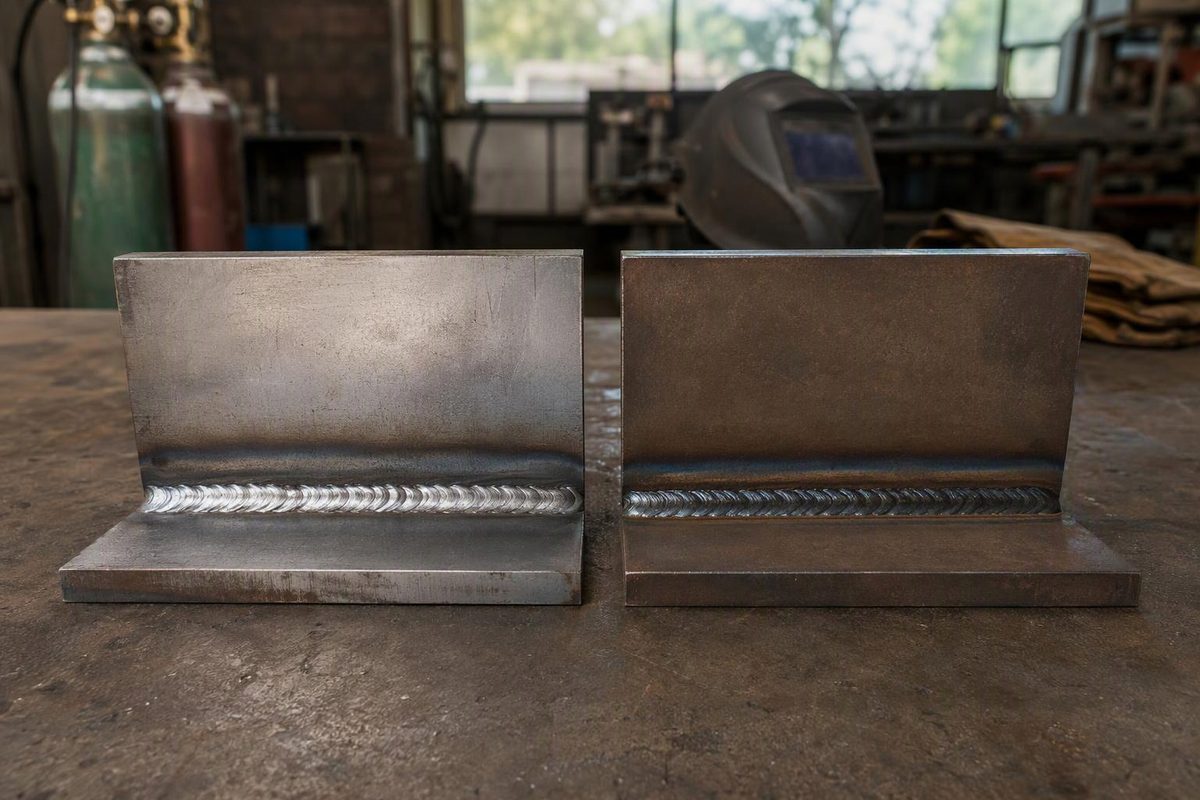
Carbon steel’s properties depend heavily on carbon content and processing; alloy steel uses specified additions such as chromium, nickel and molybdenum to achieve particular properties. For welding, though, the useful comparison is not simply “carbon is easy, alloy is difficult.” The grade, carbon content, heat-treatment condition, thickness and joint restraint determine the precautions.
Low-carbon steel is usually forgiving. Medium- and high-carbon steels can be crack-sensitive even without substantial alloy additions. Some low-alloy steels have excellent weldability; others require closely controlled filler selection and thermal procedures. TWI’s weldability guidance explains those distinctions.
What the names actually mean
Both materials are alloys of iron and carbon. “Carbon steel” does not mean pure iron plus carbon only: it can contain manganese, silicon and permitted residual elements. The classification depends on the specified chemistry, including whether particular elements are required to produce an alloying effect. Total Materia’s classification reference reproduces the AISI definition.
Here, alloy steel means primarily low-alloy engineering steels, rather than stainless steel. For the latter, see carbon steel vs stainless steel.
| Comparison | Carbon steel | Low-alloy steel |
|---|---|---|
| Composition | Carbon level is a major distinction; manganese and silicon may also be present | Specified additions such as chromium, nickel, molybdenum or vanadium |
| Properties | Range from formable low-carbon material to hardenable higher-carbon grades | Can be tailored for strength, toughness, elevated-temperature performance or other service needs |
| Welding behavior | Low-carbon grades are generally readily weldable; higher-carbon grades need more precautions | Varies substantially with chemistry and processing condition |
| Thermal control | Thick or restrained joints may still require preheat | Preheat, interpass limits, heat-input limits and post-weld treatment may be critical |
These are family-level tendencies, not a procedure for an individual grade. TWI and Hobart Brothers describe the grade-specific differences.
Is alloy steel stronger or more corrosion-resistant?
It can be stronger, but the label alone does not establish strength. Alloy additions and processing work together. Nickel can improve low-temperature toughness; chromium and molybdenum can help maintain strength at elevated temperatures. Certain copper-containing weathering steels gain atmospheric corrosion resistance from their particular chemistry—not merely from belonging to the alloy-steel family. Hobart’s material guidance explains these effects.
A useful example is 4130 versus 4140. Both are chromium-molybdenum low-alloy steels, with nominal carbon contents of about 0.30% and 0.40%, respectively. Their AISI/SAE grade designations specify chemistry, not a fixed mechanical-property range. Annealing, normalizing, quenching and tempering change the resulting strength and hardness. Hobart’s 4130/4140 guidance therefore makes the prior thermal treatment a first check before welding or repair.
When choosing stock, compare certified properties in the supplied condition. When comparing cost, include the required welding controls, heat treatment and inspection—not just the material quotation. Do not substitute grades in a load-bearing or pressure-containing design simply because one is advertised as stronger.
Why cracking risk changes
The important area is often the heat-affected zone (HAZ): base metal beside the weld that did not melt but whose microstructure changed during welding.
Higher carbon content and certain alloy additions increase hardenability, meaning the tendency to form hard microstructures during cooling. A rapidly cooled HAZ may become hard and brittle. If diffusible hydrogen and tensile stress are also present, hydrogen cracking can develop, sometimes hours after welding. Thick sections, joint restraint and heat input all influence the risk. TWI’s hydrogen-cracking guidance identifies those interacting factors.
Carbon equivalent (CE) combines the effects of carbon and selected alloying elements into a weldability indicator. It is more informative than carbon percentage alone, but it is not a universal preheat calculator. Thickness, hydrogen level, restraint and the applicable procedure still matter. TWI’s weldability guidance treats composition as one of those interacting factors.
Preheat slows cooling and helps hydrogen escape. However, “more heat” is not always safer: excessive heat input or interpass temperature can degrade properties in heat-treated steels. The welding procedure specification (WPS) may need both minimum and maximum thermal limits. Hobart’s cooling-rate guidance explains this balance.
Also distinguish a post-weld hydrogen bake-out from stress-relief heat treatment: they serve different purposes and are not interchangeable. Follow the specified thermal cycle rather than treating any post-weld heating as equivalent. Hobart’s 4130/4140 guidance makes this distinction.
Choose filler by the required properties
Do not select filler from the word “steel” or assume the strongest available electrode is best.
For mild-steel work, E7018 is a familiar low-hydrogen option; Lincoln lists its Excalibur 7018 MR for mild steel, general fabrication and structural applications. That does not make E7018 suitable for every alloy-steel component. See E7018 uses and storage for the handling considerations.
For low-alloy work, check:
- Required tensile and yield strength, plus toughness at the service temperature.
- Chemistry needed for corrosion resistance or elevated-temperature service.
- Whether the joint will remain as-welded or receive post-weld heat treatment.
- Consumable hydrogen requirements and storage instructions.
Matching filler chemistry exactly is not always necessary or desirable. Conversely, matching tensile strength alone may not satisfy service requirements. Deliberate undermatching can be appropriate in some designs, but it is an engineering decision—not a repair shortcut. Hobart’s filler-selection guidance covers these distinctions.
Before welding either material
Use this order rather than starting with amperage:
- Identify both base metals. Obtain the specification, grade and mill certificate or a suitable chemical analysis. For repairs, establish the original heat treatment and equipment-maker requirements. Chemical analysis alone does not establish the heat-treatment condition. If a safety-critical part’s material or condition cannot be established, stop rather than assume it is mild steel. TWI emphasizes composition, while Hobart’s repair guidance emphasizes prior thermal treatment and original equipment information.
- Check the joint. Record thickness, fit-up, restraint, access and service loading. Welding alloy steel to carbon steel still requires a procedure addressing both materials.
- Verify the WPS and filler. Confirm process, consumable classification, shielding gas where applicable, and required mechanical properties.
- Control hydrogen and temperature. Clean joint faces, handle consumables to manufacturer instructions, and follow preheat, interpass, heat-input and post-weld requirements. Required preheat also applies to tacks and temporary attachments. TWI’s practical precautions support these checks.
- Inspect as specified. A smooth bead cannot establish HAZ toughness or rule out subsurface cracking. For susceptible steels, observe the fabrication code’s required delay before inspection because hydrogen cracking can be delayed. TWI’s detection guidance explains why.
If a weld cracks after cooling, review material identity, hydrogen sources, restraint and thermal history before changing the bead pattern or turning up the machine.