
Low Carbon Steel: Why It Usually Welds Easily—and What Still Goes Wrong
Understand low carbon steel, choose MIG, TIG or stick filler, and check preparation, preheat and joint conditions before changing weld settings.
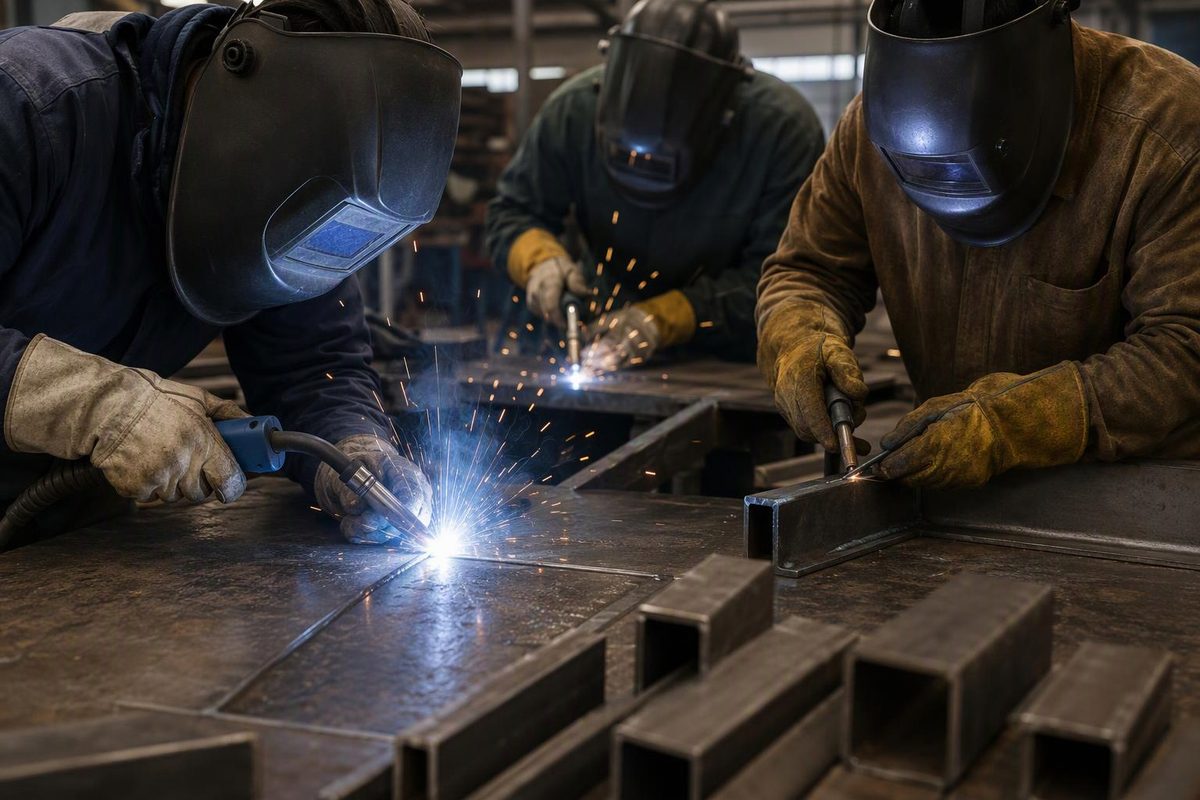
Low carbon steel—usually called mild steel—typically contains roughly 0.05–0.25% carbon by weight. That is a common descriptive range, not a universal grade specification. Its relatively low carbon content makes it easy to form and generally straightforward to weld. It is common in sheet-metal fabrication, construction and manufacturing, but “mild steel” describes a material family, not a complete purchasing or welding specification. Industrial Metal Supply’s material overview gives this typical composition range and its applications.
For welding, the useful question is not just whether the material is low carbon. It is which grade, in what thickness and condition, joined by which procedure.
What low carbon content changes
Carbon influences steel’s hardenability: its tendency to form hard structures during cooling. During welding, the heat-affected zone (HAZ)—the base metal next to the weld that heats without melting—experiences a rapid thermal cycle. Higher carbon and alloy content can produce a harder, more crack-sensitive HAZ. Low carbon unalloyed steel is therefore normally readily weldable in thin sections. TWI explains the relationship between composition, cooling rate and weldability.
That does not mean every mild-steel weld is crack-proof. Nor does low carbon content specify one tensile strength, yield strength or hardness. Obtain the grade and delivery condition rather than applying a generic property chart to every sheet, bar or tube.
As one concrete example, Alro lists 1018 hot-rolled bar with 0.15–0.20% carbon and describes it as readily formed, machined and welded. Those figures identify that product, not all mild steel. Alro’s 1018 material data illustrates why grade-specific information matters.
Also check the context of the term: in sustainability discussions, “low-carbon steel” can mean steel made with lower production emissions rather than lower alloy carbon content. An emissions claim is not a weldability specification. Worldsteel explains that separate usage.
Choose the process and filler for the joint
For identified mild steel, these are common choices—not blanket substitutions for a welding procedure specification (WPS):
- MIG/GMAW: ER70S-6 solid wire is a common mild-steel filler. For short-circuit transfer, 75% argon/25% CO₂ is a common shielding mixture. ER70S-6 contains manganese and silicon deoxidizers, helping it tolerate some light rust or mill scale, but clean steel remains the better starting point. Hobart’s solid-wire guide covers these choices. Gas must match the transfer mode; see MIG shielding-gas selection.
- TIG/GTAW: ER70S-2 cut-length rod is commonly used, as the same Hobart guide notes. Prioritize clean joint faces: Miller’s examples show contamination when hot-rolled mild steel is TIG welded without removing mill scale. Miller’s TIG troubleshooting guide shows the practical difference.
- Stick/SMAW: E7018 is a low-hydrogen option for many mild-steel fabrication and structural applications. Lincoln’s Excalibur 7018 MR, for example, lists those uses and permits all positions except vertical down. Verify the actual electrode’s polarity, current range and handling requirements. Lincoln’s product data supports those limits; our E7018 rod guide covers selection and storage.
“Mild steel” alone cannot determine amperage or voltage. Start with the machine and consumable manufacturer’s guidance for your process, wire or rod diameter, gas, thickness, joint and position. For noncritical practice, test on representative coupons; for specified production work, stay within the applicable WPS.
Does low carbon steel need preheat?
Not automatically—but it is not automatically exempt. Thicker unalloyed sections, especially with flux processes, may need tighter hydrogen control or preheat. Composition, thickness, heat input and restraint all affect the risk. Preheat slows cooling, reduces HAZ hardness and promotes hydrogen escape. TWI’s weldability guidance explains these controls.
Hydrogen cracking requires a susceptible hard structure, hydrogen and tensile stress acting together. Carbon equivalent accounts for alloying effects beyond carbon alone. Consequently, the label “low carbon” is not enough to set a preheat temperature. Follow the applicable procedure’s preheat and interpass requirements, including for tack welds. TWI’s hydrogen-cracking guidance explains these interacting causes.
When the weld goes wrong, check in this order
- Confirm the material and surface. Verify the grade; identify paint, plating or galvanizing. Remove contaminants at the joint rather than expecting deoxidizers to compensate. Rust, grease, poor shielding and damp electrodes can cause porosity. TWI’s weldability guidance describes these sources.
- Check setup and fit-up. Verify filler, polarity, gas, electrode condition and the work-return connection. Then check joint access, root face and root gap. A stable arc cannot compensate for joint geometry that prevents the required root fusion. TWI’s root-fusion guidance explains how fit-up and electrode access affect penetration.
- Adjust within the procedure, then inspect. Review current or wire-feed speed, voltage where applicable, travel speed and arc placement. Do not simply turn up the heat: incomplete root fusion can involve fit-up and technique, while excessive amperage can cause burn-through. The TWI root-fusion guide and Miller’s TIG troubleshooting guide explain these different failure mechanisms.
A smooth bead does not prove internal fusion. TWI notes that inaccessible root imperfections may require radiographic or ultrasonic inspection. Use the project’s acceptance criteria and required testing—not bead appearance alone.
Finally, easy weldability does not mean harmless fumes. Identify coatings, control exposure and keep extraction effective without disrupting shielding. OSHA’s welding-fume guidance notes that even outdoor welding does not guarantee adequate ventilation. Coated stock needs separate preparation and controls; see welding galvanized steel.