
Carbon Steel vs Stainless Steel: What Changes When You Weld
Compare carbon steel and stainless steel for fabrication: corrosion, strength, cost, filler selection, shielding gas, distortion and weld cleanup.
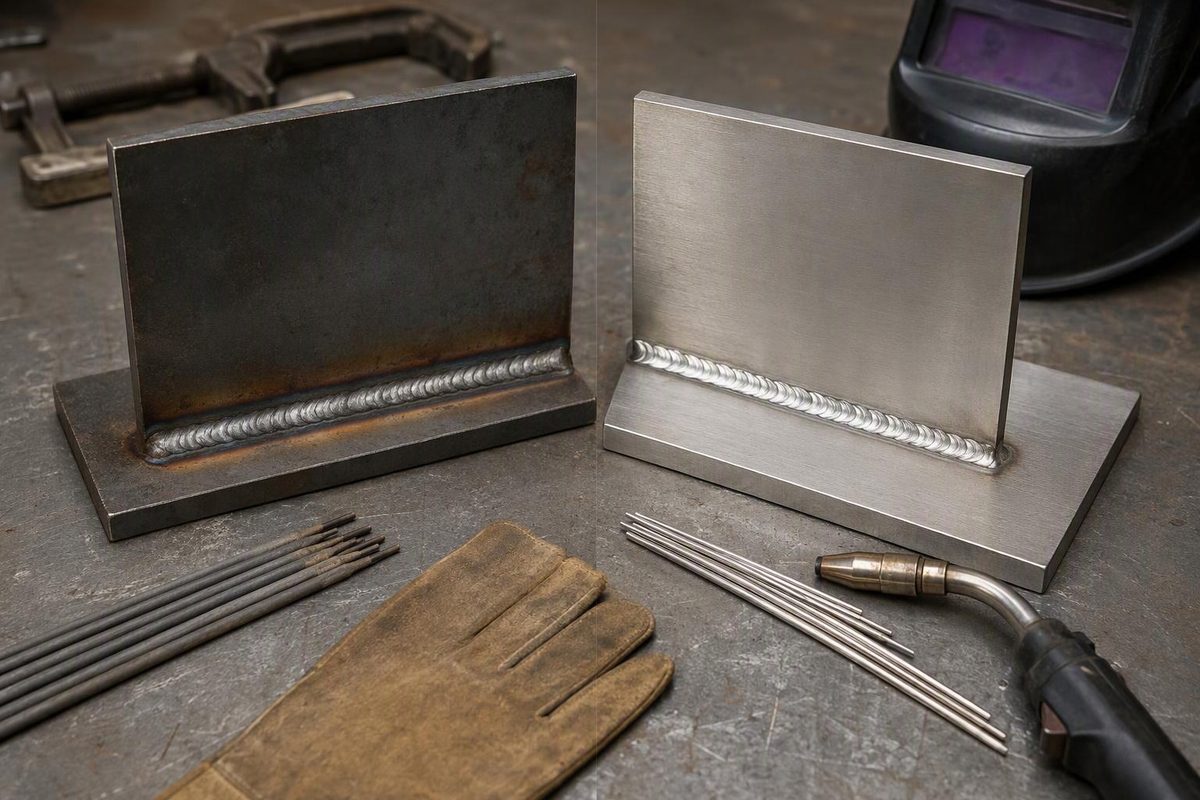
Carbon steel is usually the economical choice when corrosion can be controlled with coatings and maintenance. Stainless steel earns its place when the service requires corrosion resistance, cleanliness or an uncoated finish—but welding must preserve those properties. Neither material family is automatically stronger or easier to weld: the grade, thickness, joint and service conditions decide that.
For everyday fabrication, the useful comparison is low-carbon mild steel versus common austenitic stainless grades such as 304L and 316L. High-carbon steel, martensitic stainless and duplex stainless need different welding controls.
The material differences that matter
Stainless steel contains chromium. At approximately 10.5% chromium or more, a protective passive film can form in oxidizing environments. Stainless still contains carbon; “stainless” does not mean carbon-free. The passive film provides corrosion resistance, but stainless is not immune to corrosion. Grade chemistry and the environment determine whether it performs adequately, according to Outokumpu’s material overview.
| Decision | Low-carbon mild steel | Common 304L/316L stainless |
|---|---|---|
| Corrosion protection | Often needs paint, galvanizing or another protection system in wet service | Relies on a suitable grade and a clean, properly finished surface |
| Welding metallurgy | Generally readily weldable; hydrogen cracking controls become important with thicker, restrained or more hardenable material | Generally readily weldable; hot cracking and preservation of corrosion resistance are major concerns |
| Heat movement | Lower thermal expansion and higher thermal conductivity than common austenitic stainless | Expands more and conducts heat away less readily, increasing distortion risk |
| Finishing | Prepare the weld for the specified coating or finish | Remove contamination and treat weld oxidation as required for service |
| Cost comparison | Consider material, fabrication and corrosion protection | Include material, dedicated preparation tools, shielding/purging and post-weld treatment |
The welding differences above are described in TWI’s guidance on carbon-steel hydrogen cracking and austenitic stainless welding; ASSDA explains the thermal-property differences and distortion consequences.
Strength is not a family-level ranking. Compare the specified grade’s yield strength, tensile strength and toughness in its supplied condition. Stainless properties vary with alloy, cold work and product form; a stronger base material also does not prove that the proposed welded joint meets the design requirements. Outokumpu explains these mechanical-property distinctions.
Likewise, avoid a universal stainless-to-carbon-steel price multiplier. Quote the actual grade, size and finish, then include coating renewal, cleaning, downtime and replacement. These are the relevant inputs in worldstainless’s life-cycle costing guidance, not just the purchase price per pound.
What changes at the welding bench
1. Select filler for both base metals and the service
A familiar wire diameter is not a reason to keep the same alloy when changing materials.
- Mild steel to mild steel: ER70S-6 is a common solid MIG wire, not a universal choice for every carbon or low-alloy steel. Hobart’s selection guidance ties wire choice to the required mechanical and chemical properties.
- 304/304L to itself: 308L-family filler is commonly used. Hobart identifies 308/308L MIG wire as suitable for Type 304.
- Common 300-series stainless to carbon steel: ER309L is a common solid-wire choice. Hobart lists this dissimilar-metal application, and ESAB discusses dilution and cracking considerations.
Dilution means melted base metal becomes part of the weld deposit, changing its chemistry. A stainless-to-carbon-steel joint therefore needs its own filler and procedure selection; it is not simply a stainless weld with one cheaper component. ER309L also does not make the exposed carbon-steel component corrosion-resistant.
The L designation means low carbon. It helps reduce chromium-carbide formation during the welding thermal cycle, which can otherwise leave chromium-depleted regions susceptible to intergranular corrosion. TWI explains why L grades and low-carbon fillers are used for corrosion-resistant weldments.
For other combinations, start with stainless filler selection by base metal and service, then verify the consumable datasheet and applicable welding procedure specification (WPS).
2. Recheck shielding gas and transfer mode
For solid-wire mild-steel MIG, 75% argon/25% CO₂ is common. Do not assume that cylinder is appropriate for stainless simply because the arc runs.
Miller’s gas guidance distinguishes traditional helium-rich tri-mix for stainless short-circuit welding from argon-rich mixtures used with suitable machine programs and transfer modes. The wire construction matters too: a solid-wire recommendation is not automatically valid for stainless flux-cored wire.
Choose gas from the wire datasheet, machine guidance and WPS together. See MIG gas selection by metal and transfer mode for the setup details.
3. Control heat without sacrificing fusion
Common austenitic stainless expands more than carbon steel while keeping heat more localized. The result can be greater shrinkage distortion, especially in thin sheet. Use accurate fit-up, suitable tack spacing, fixtures and a balanced welding sequence; avoid unnecessarily large welds and prolonged heat buildup. ASSDA explains these distortion controls.
“Turn the amps down” is incomplete advice. Insufficient energy can leave lack of fusion. Use enough energy to fuse the joint while staying within the procedure’s heat-input and interpass limits.
Common 304L/316L work normally does not need routine preheat for hydrogen-cracking prevention, as TWI’s austenitic stainless guidance explains. Carbon steel may need preheat depending on composition, thickness, restraint and hydrogen level. Neither rule applies to every stainless grade: TWI describes grade-specific preheat and heat-treatment needs for ferritic and martensitic stainless.
4. Protect the stainless surface and root
Use grinding abrasives dedicated to stainless and clean stainless-steel brushes reserved for that work. Tools previously used on carbon steel can introduce iron contamination; Outokumpu’s cleaning guidance specifies stainless-only grinding tools and clean blasting media.
Where the root needs oxidation protection, establish backing-gas coverage before welding; open-root corrosion-service joints require particular attention. TWI explains the corrosion purpose of back purging.
Post-weld cleaning is not merely cosmetic. Brushing may remove visible heat tint without removing the chromium-depleted layer beneath it. Specify treatment for the intended service rather than assuming “shiny” means restored corrosion resistance. Outokumpu distinguishes brushing, pickling, passivation and electropolishing. Pickling chemicals are hazardous and require appropriate handling and disposal.
If the change to stainless causes trouble
Check in this order before chasing settings:
- Material and consumable: Confirm both grades, filler classification, wire construction and gas—not just spool diameter.
- Preparation and shielding: Check cleanliness, nozzle condition, leaks, drafts and root protection.
- Joint and heat: Check gap, alignment, tack sequence, travel speed and interpass temperature. Distortion is not necessarily an amperage-only problem.
- Acceptance requirements: Evaluate fusion, dimensions and surface condition against the job requirements. Bead color alone neither qualifies nor rejects a weld; see heat tint and acceptance limits.
Finally, reassess fume control when changing materials or fillers. Both steels produce hazardous welding emissions; chromium-containing stainless welding adds a potential hexavalent chromium exposure. OSHA’s welding-fume guidance recommends source extraction and other exposure controls, with respiratory protection where needed. Welding outdoors does not guarantee adequate ventilation.