
Choose Your First MIG Welder by the Work You’ll Actually Do
For indoor light work, choose a gas-capable 120V 140A-class machine. Regular 3/16-1/4-inch jobs point to 190-210A on 240V; outdoors favors flux-core.
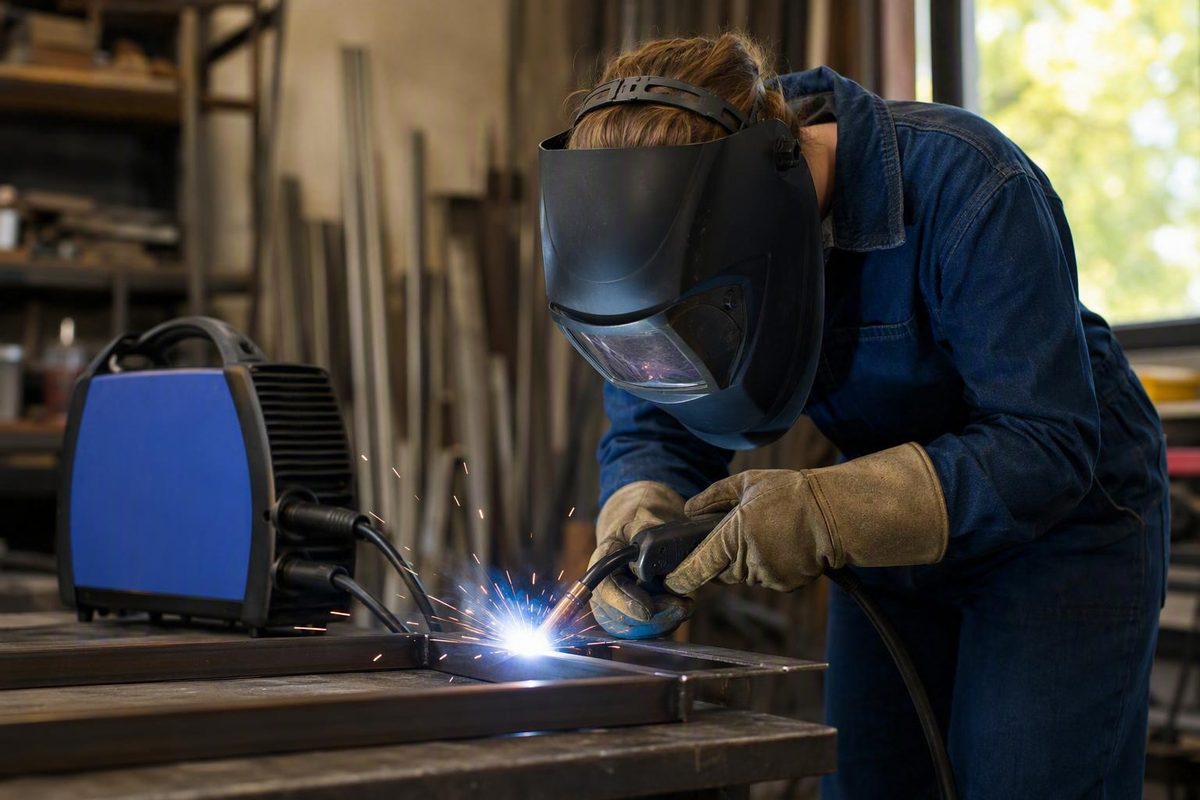
The best MIG welder for beginners is not one particular machine. It is the machine class that fits the metal you expect to weld, the length and frequency of your welds, your workspace, your available electrical supply, your budget, and your credible future projects.
For many US beginners working indoors on automotive sheet metal, home repairs, and intermittent light fabrication, the most sensible starting category is a gas-capable 120V machine in the roughly 140A class. If your plans include recurring work near 3/16 to 1/4 inch, longer beads, or sustained fabrication, compare machines in the roughly 190–210A range and plan around 240V operation. Outdoor repairs introduce a different priority: self-shielded flux-core capability, which does not require an external shielding-gas cylinder and is less vulnerable to wind.
The named machines below are application-specific candidates, not winners from standardized independent testing. Miller’s models have manufacturer-supported specifications in the available evidence. Most other candidates appear in retailer guidance or owner discussions and therefore should be treated as research leads until their current manufacturer pages and manuals have been checked.
The short answer: choose a welder class before choosing a model
Before comparing brands, write down six things:
- The projects you will realistically attempt in the next two years
- The thinnest and thickest material you expect to weld regularly
- Whether you will work indoors, outdoors, or both
- Whether you have suitable 120V power, 240V power, or both
- Whether you will make occasional tacks or long, high-output welds
- What you can spend on the complete ready-to-weld package
That exercise usually points toward one of three machine classes.
| Expected work | Sensible starting class | Why it fits |
|---|---|---|
| Auto-body panels, floor patches, thin brackets, and light home repairs | Gas-capable 120V, approximately 140A | Accessible power, portability, and thin-sheet capability |
| Mixed fabrication with recurring work near 3/16–1/4 inch | Approximately 190–210A, preferably dual voltage | More appropriate output and duty-cycle capacity when operated on 240V |
| Outdoor mower, gate, fence, or farm repairs | Machine configured for self-shielded flux-core | No shielding-gas cylinder and less sensitivity to wind |
The distinction between the first and second classes is a buying boundary, not a universal material limit. Owner discussions commonly associate 120V 140-class machines with sheet metal and intermittent hobby work, while recommending 190–200A equipment and 240V power for regular work around 3/16 to 1/4 inch. Those comments are anecdotal, but they support using workload—not a maximum-thickness headline—as the decision point (Garage Journal discussion).
For protected indoor work, a conventional gas-capable MIG machine gives you the option of running solid wire with shielding gas and, when supported, flux-cored wire. A flux-core-only wire feeder may be useful and inexpensive, but it is not equivalent to a machine that can also perform conventional gas-shielded MIG.
Dual voltage is the most flexible category for someone limited to 120V today who reasonably expects access to 240V later. It allows the buyer to learn and complete lighter jobs now without necessarily replacing the machine when projects become more demanding.
Candidate groups worth investigating include:
- Miller Millermatic 142: A manufacturer-recommended 120V MIG and flux-core candidate
- Hobart Handler 140 and exact Lincoln 140-class models: Frequently discussed light-hobby and automotive candidates
- Miller Millermatic 211 PRO, Lincoln MIG 210 MP or other exact 210/211 models, and Hobart Handler 210 MVP: Higher-cost dual-voltage candidates
- Flux-core-only wire feeders: A separate outdoor-focused or low-cost category
The available evidence does not establish an objective overall ranking. No standardized comparison shows that one candidate has the best low-output arc, wire feed, reliability, service support, or beginner usability under equivalent conditions.
Why MIG is beginner-friendly—and where flux-core fits
MIG is commonly recommended as a first welding process because the machine continuously feeds the consumable wire electrode. Once the trigger is pressed, the operator can concentrate on gun angle, travel direction, travel speed, stickout, and puddle placement.
That does not make MIG automatic or mistake-proof. It reduces some of the electrode handling required by stick welding and some of the simultaneous torch-and-filler coordination associated with TIG. It can also weld quickly and provide useful control on thin material when the machine, wire, shielding, settings, preparation, and technique are appropriate.
Conventional MIG uses external shielding gas
Conventional gas-shielded MIG feeds solid wire through the gun while external gas protects the molten weld pool from the surrounding atmosphere. For protected indoor work, it is generally the cleaner wire-feed choice. Unlike self-shielded flux-core, it does not leave a flux-derived slag layer, although actual spatter and appearance still depend on setup and technique.
Shielding gas affects both startup cost and portability. The complete arrangement may include a compatible cylinder, suitable gas, a regulator or flowmeter, and a hose. Because wind can disrupt the gas around the weld pool, conventional gas-shielded MIG is not the preferred process for exposed outdoor work.
Self-shielded flux-core is related, but different
Self-shielded flux-cored arc welding is also a continuous wire-feed process. The wire contains flux that provides shielding, so it does not require an external shielding-gas cylinder. This makes it practical for outdoor repairs, mobile work, and buyers without convenient access to gas.
Compared with well-configured gas MIG, self-shielded flux-core generally brings more spatter and cleanup. Its advantage is process suitability: it remains useful where wind would interfere with external gas or where transporting a cylinder is impractical. A beginner MIG selection guide summarizes these differences between gas-shielded MIG and self-shielded flux-core.
Do not assume that every product advertised as a “MIG welder” supports conventional gas-shielded MIG. Before buying, confirm:
- Whether the machine has the required gas connection and control
- Whether its manual expressly supports solid-wire MIG
- Whether polarity can be configured correctly for each supported wire
- Whether a regulator and gas hose are included
- Which wire sizes, drive rolls, and contact tips are supported
- Whether the advertised process works out of the box or requires accessories
Sales rank and customer ratings do not answer those questions. They indicate purchasing activity and customer feedback at a particular time, not verified process support, output, weld quality, safety, durability, or suitability for your work.
Multiprocess does not automatically mean beginner-friendly
A multiprocess machine may add stick, lift-start TIG, or other functions. That can be worthwhile if you have a defined use for them, but a larger process count does not prove that the machine has better MIG performance, smoother feeding, clearer controls, or stronger support.
Additional processes may also require equipment not included with the base unit.
Buy the configuration, not the process count printed on the carton.
120V, 240V, or dual voltage: match the machine to your outlet and workload
Input voltage affects portability, accessible output, and how comfortably a machine handles sustained work. It should be treated as a project and workload decision—not as a contest in which the largest number always wins.
When 120V makes sense
A 120V machine is commonly associated with:
- Automotive body panels
- Floor and rocker-panel patches
- Thin exhaust components
- Small brackets and furniture
- Light home-shop repairs
- Intermittent hobby fabrication
- Work requiring frequent machine transport
A 120V machine can be highly useful within its intended range. Its limitations become more important as material gets thicker, joints become less favorable, or welding becomes longer and more frequent.
Roughly 3/16 inch is a useful decision boundary rather than a universal cutoff. Miller rates the 120V Millermatic 142 for single-pass welding of 24-gauge through 3/16-inch mild steel. That is a manufacturer claim, not a guarantee that every beginner will achieve an acceptable result on every 3/16-inch joint (Miller first-welder guide).
Machine design, wire, shielding gas, joint geometry, preparation, input-circuit performance, position, and operator technique all affect practical capacity. Treat a quoted maximum as the edge of a claimed range, not as your ideal recurring workload.
When to move toward 240V
If you expect regular work near 3/16 to 1/4 inch, long fence sections, repeated high-output beads, or fabrication in which cooling interruptions would disrupt progress, compare machines in the approximately 190–210A class and evaluate them on 240V.
A larger machine does not automatically produce an acceptable weld. It provides a more appropriate output and duty-cycle envelope for the work. Fit-up, preparation, wire selection, shielding, position, pass count, and operator ability remain important.
| Project pattern | Power direction |
|---|---|
| Mostly automotive panels and floor patches | Prioritize low-output control and smooth feeding; 120V is often sufficient |
| Light projects now, mixed fabrication later | Consider dual voltage |
| Regular work near 3/16–1/4 inch | Plan around 240V and compare approximately 190–210A machines |
| Long, high-output welds | Compare duty cycle at the amperage and input voltage you will use |
| Portable outdoor repairs | Give process suitability and flux-core support equal weight with voltage |
What dual voltage does—and does not—provide
Dual voltage gives you location flexibility and room to grow. On 120V, the machine can handle lighter projects where compatible power is available. On 240V, it may provide higher output, a broader operating range, or a more useful duty cycle.
It does not turn a 120V receptacle into a 240V supply. A dual-voltage welder connected to 120V remains constrained by its 120V output and duty-cycle specifications. Read the separate performance tables for each input voltage rather than relying on the largest number printed on the machine.
Do not assume that a receptacle is suitable merely because the welder is labeled 110V or 120V. Before purchasing, compare the exact model manual with the available plug, receptacle, and branch circuit. If the existing supply does not meet the stated requirements, include compliant electrical work in the budget rather than improvising with a breaker or adapter.
UK buyers: keep 230V assumptions separate
UK buyers generally encounter 230V machines rather than the US 120/240V split. Retailer guidance says some light-duty equipment may operate from a standard 13A outlet, while higher output from some approximately 200A machines may require a dedicated supply such as 16A (UK beginner MIG guidance).
Treat that as a prompt to check the exact machine documentation and intended output. Do not apply US circuit assumptions to a UK product, and do not assume every setting on a 230V machine is available from every domestic outlet.
The specifications that matter more than peak amperage
Peak amperage is easy to advertise, but it does not show how well a welder starts on thin sheet, feeds wire at low speed, or sustains the output you need.
Duty cycle
Duty cycle states how long a machine may weld within a 10-minute period at a specified output under stated test conditions. A 30% duty cycle means three minutes of permitted welding followed by seven minutes of cooling in that cycle (Emin Academy duty-cycle explanation).
The percentage is meaningful only when the associated amperage and input voltage are stated. A machine rated at 30% at a high output may be more useful for demanding work than another machine showing a higher percentage at a much lower output. The same dual-voltage machine may also have different figures on 120V and 240V.
Duty cycle usually has less influence during spaced auto-body tacks than during long, high-output beads. It can still matter during frequent welding or when there is little cooling time between operations. Treat it as a workload specification, not simply a thickness specification.
Wire-feed quality
A MIG arc depends on consistent wire delivery.
Inspect or research:
- Drive-roll type and available grooves
- Suitability for the intended wire type and diameter
- Tension adjustment
- Spool capacity
- Gun and liner length
- Replacement-liner availability
- Availability of matching contact tips and nozzles
- Whether the torch is fixed or replaceable
- Access to feed-system parts
A low-cost machine can become frustrating if ordinary consumables are difficult to find or a worn liner cannot be replaced conveniently.
Low-output control
Thin-sheet performance depends on more than the minimum amperage printed in a specification range. The machine needs stable low-output behavior, controlled starts, and consistent low-speed wire feeding.
The available evidence does not contain standardized side-by-side tests of low-end arc stability among the shortlisted machines. That means a credible hands-on demonstration, supervised trial, or useful return policy can be more informative than an unsupported claim that one machine is “best for bodywork.”
Controls and protections
Beginner-oriented conveniences can include:
- Clearly labeled voltage and wire-speed controls
- A readable digital display
- Straightforward polarity changes
- Thermal-overload protection
- A settings chart inside the wire compartment
- Synergic or auto-set programs
- Easy access to the spool and drive system
They remain starting points. They cannot correct inadequate input power, contaminated material, poor fit-up, incorrect polarity, damaged consumables, irregular wire feeding, disrupted shielding gas, or undeveloped technique.
Tie-breakers that affect ownership
When two machines fit the same work, compare:
- Weight and carrying design
- Gun length and ergonomics
- Work-lead length
- Consumable availability
- Spool capacity
- Current warranty terms
- Repair arrangements
- Replacement parts
- Manufacturer documentation
- Return policy
These ownership factors may matter more over several years than an additional process you never use.
Beginner welder candidates by use case
This is not an overall ranking. Each entry is labeled by evidence type so you can distinguish manufacturer claims from retailer recommendations and forum anecdotes.
Because the evidence pack does not include current first-party documentation for every non-Miller machine, those models are presented as comparison leads rather than fully verified purchase recommendations.
US 120V gas-capable starting point
Miller Millermatic 142 — manufacturer-recommended candidate
The Millermatic 142 belongs on the shortlist for buyers seeking a 120V machine that Miller recommends for MIG and flux-core use. Miller states that it can single-pass weld 24-gauge through 3/16-inch mild steel.
That claimed range depends on the intended process and operating conditions. A buyer concentrating on auto-body panels should give low-output behavior and smooth feeding at least as much attention as the upper thickness figure.
Model-specific check: Confirm that the current package contains the gun, work lead, regulator, and hose you expect, and read the duty-cycle and circuit requirements for the output you plan to use.
Established light-hobby and automotive candidates
Hobart Handler 140 — retailer and owner-discussion candidate
The Handler 140 recurs in retailer guidance and owner discussions involving home, farm, automotive, and light hobby work. That recurrence makes it reasonable to investigate, but it does not establish superiority.
Some owners report favorable long-term use and light-work capability. These are individual experiences, not controlled evidence about every unit or current production version.
Model-specific check: Confirm the exact current model rather than relying on the family name, then verify gas-MIG and flux-core support, current package contents, and manufacturer-stated input and duty-cycle requirements.
Lincoln 140-class machines — retailer and owner-discussion candidates
Lincoln 140-class machines are also frequently associated with automotive sheet metal and light fabrication. “Lincoln 140” is not a sufficiently precise product identification because exact models and retailer configurations may differ.
A 2020 automotive-welding forum discussion includes competing owner opinions about Lincoln, Hobart, and other 140-class machines, including anecdotal comments about wire-feed design, durability, thermal shutdown, and value. Those comments can help generate questions, but they are not test data.
Model-specific check: Record the complete model and stock number, then compare its manual, gas capability, polarity arrangement, included equipment, spool capacity, and locally available consumables.
Dual-voltage growth options
Miller Millermatic 211 PRO — manufacturer-specification candidate
The Millermatic 211 PRO is a higher-cost candidate for buyers who want to start on 120V and later use 240V for more demanding work. Miller states a 30% duty cycle at 215A on 240V and claims capacity up to 3/16 inch on 120V or 3/8 inch on 240V (Miller first-welder guide).
These figures are manufacturer claims, not universal performance guarantees. Process, material, joint design, wire, shielding, preparation, input supply, pass count, and operator technique all affect results. The 3/8-inch figure should not be converted into a promise that a beginner can routinely complete every 3/8-inch joint in one pass.
Model-specific check: Compare the separate 120V and 240V tables, supplied plug arrangement, gun and lead lengths, included gas equipment, and required accessories for every process you intend to use.
Lincoln MIG 210 MP and other exact 210/211 models — retailer candidates
Retailer guidance identifies the Lincoln MIG 210 MP as a dual-voltage multiprocess candidate with 120V/230V input and MIG and flux-core capability. That commercially interested recommendation does not demonstrate superiority.
Other Lincoln products with similar 210 or 211 names should not be treated as interchangeable. Compare exact model and stock numbers, particularly when shopping through different retailers.
Model-specific check: Determine which processes are usable with the base package and which require additional torches, leads, gas equipment, or accessories.
Hobart Handler 210 MVP — forum-discussion candidate
The Handler 210 MVP appears in owner discussions as a dual-voltage alternative for buyers seeking more capacity than a 140-class machine. The evidence supports putting it on a comparison list, not claiming that it outperforms Miller or Lincoln alternatives.
A 120/240V welder discussion mentions the Handler 210 MVP alongside Miller and Lincoln options. Its performance, parts, repair, and value comments are individual opinions.
Model-specific check: Verify current model status, supported inputs, output and duty-cycle figures at each voltage, gas and flux-core configurations, and package contents.
Inexpensive outdoor or light-repair wire feeders
Harbor Freight Titanium 125 DC — owner-anecdote, flux-core-only candidate
It belongs in a different category from gas-capable MIG machines because the available evidence describes it as flux-core-only.
It may suit a buyer prioritizing outdoor use, low setup complexity, and freedom from a gas cylinder. It is not an equivalent substitute for conventional gas MIG when the principal goal is controlled indoor body-panel work. A beginner light-use discussion illustrates how local gas access, voltage, portability, and future plans can lead buyers toward different machine types.
Model-specific check: Confirm flux-core-only operation, supported wire types and sizes, polarity, input requirements, duty cycle, replacement consumables, and return terms.
Separate shortlist for UK buyers
Retailer guidance identifies the following UK-market research leads:
- Parweld XTE 201C
- Sealey Premier IMIG 160
- Fronius TransSteel 2200C
These are retailer selections, not independently tested winners. The available evidence does not provide enough current first-party documentation to publish full, purchase-ready profiles for them.
For each product, verify the exact current model, 230V input requirements, plug, required supply at the intended output, duty cycle, gas-MIG and flux-core support, included torch and earth lead, gas equipment, warranty, consumables, service arrangements, and availability. The retailer’s UK selection guide provides the recommendation context but has a commercial interest in the products.
No captured prices are reproduced here because prices, promotions, package contents, and inventory can change.
Verification checklist for every candidate
Before treating any candidate as purchase-ready, verify:
- Exact current model and stock number
- Manufacturer-supported processes
- Input voltage, plug, and stated circuit requirements
- Output and duty cycle at the voltage and amperage you expect to use
- Supported wire types, diameters, and spool sizes
- Included gun, work lead, drive rolls, tips, regulator, hose, and adapters
- Required accessories for additional processes
- Current warranty and return terms
- Local or mail-in service arrangements
- Replacement-part and consumable availability
- Current model availability
This common checklist replaces assumptions based on family names, retailer titles, old owner reports, or product photographs.
Match the welder to automotive, home, outdoor, and heavier projects
Project type is a more reliable buying framework than brand popularity.
Automotive body panels, floors, and thin exhaust
For thin automotive work, prioritize:
- Stable low-output performance
- Smooth low-speed wire feeding
- Controlled starts
- Fine voltage and wire-speed adjustment
- Common small-diameter wire and matching consumables
- A manageable gun
- Conventional gas-shielded MIG capability
Maximum amperage is secondary. A machine can advertise substantial peak output yet still lack the low-end behavior you want for thin sheet. Conversely, a suitable 120V machine may fit short welds and patch-panel work well.
The available evidence supports associating 120V 140-class machines with automotive sheet metal and intermittent light work, but it does not establish a standardized winner among them. Practice on representative scrap before working on the actual component.
Furniture, brackets, and intermittent home fabrication
A gas-capable 120V machine in the roughly 140A class is a common starting point when the expected material remains light and welding is intermittent.
If your project list already includes thicker frames, large gates, or repeated high-output welds, buying only for the first small bracket may lead to an early replacement. In that situation, compare the complete cost of a dual-voltage setup with the cost of buying two machines over time.
Mower decks, gates, farm repairs, and windy work
Self-shielded flux-core can be more practical for outdoor repairs because it does not depend on an external shielding-gas envelope. It also avoids transporting a gas cylinder.
That convenience does not make deteriorated sheet easy to weld. Process suitability and material condition are separate questions.
A gas-capable machine that can also be configured for self-shielded flux-core offers the broadest process choice. A flux-core-only machine can reduce initial setup requirements but cannot later switch to conventional solid-wire gas MIG.
Recurring 3/16–1/4-inch work and sustained fabrication
For regular work in this range, compare approximately 190–210A machines and plan for 240V operation. This direction is especially relevant to repeated joints, long fence sections, and projects involving extended high-output welding.
Do not base the purchase on a 120V machine’s maximum-thickness headline. A maximum or single-pass rating describes claimed capability in a particular configuration. A realistic recurring workload also depends on:
- Joint design and fit-up
- Base-metal condition
- Preparation
- Wire type and diameter
- Shielding method
- Welding position
- Input voltage
- Travel speed and technique
- Number of passes
- Time spent near the duty-cycle limit
A machine capable of depositing weld metal on a test piece is not necessarily the comfortable choice for repeating the same joint throughout a long project.
Future-proofing without overbuying
A 120V machine generally offers lower initial cost, easier transport, and wider access to compatible locations. A dual-voltage machine offers a broader growth path but costs more and may introduce additional electrical expense.
Future-proofing makes sense when the future work is credible. It is less useful when a buyer pays for several processes and 240V capacity without a location or project in which to use them.
Machine capacity is not a qualification. This guide does not qualify a beginner to perform structural, vehicle-safety, pressure-containing, lifting, or other critical welds.
Calculate the ready-to-weld cost, not just the machine price
The machine price is only one part of the startup budget. Compare complete packages in the configuration you intend to use.
Core starter-package checklist
Budget for:
- An appropriate welding helmet
- Welding gloves
- Protective clothing and suitable footwear
- Eye protection for preparation and cleanup
- The correct wire
- Contact tips matching the wire diameter
- Spare nozzles and other torch consumables
- A sound work lead and clamp
- Material-cleaning and preparation tools
- Process-appropriate cleanup tools
- The ventilation or fume controls required for the work area
Do not assume the sample spool or installed contact tip is suitable for your project. Confirm wire type, diameter, contact-tip size, and polarity before welding.
Additional gas-MIG equipment
A conventional gas-MIG setup may also require:
- A compatible regulator or flowmeter
- Gas hose
- A shielding-gas cylinder arrangement
- Suitable shielding gas
Some machines include a regulator and hose; others do not. A cylinder shown in a product image is not necessarily included. Confirm the package description and manual rather than relying on photography.
Flux-core costs
Self-shielded flux-core removes the gas cylinder, regulator, gas, and hose from the initial setup. That can reduce setup friction and improve portability.
It does not eliminate the need for wire, matching tips, protective equipment, ventilation, consumables, or cleanup supplies.
Electrical expenses
If the available receptacle and branch circuit do not match the manufacturer’s stated requirements, include compliant electrical work in the purchasing decision. Do not treat nuisance tripping as proof that the machine simply needs a larger breaker.
Any extension cord, adapter, or input arrangement should conform to the exact machine instructions and intended load. If the documentation is unclear, resolve the compatibility question before operating the welder.
Consumables, service, and ownership friction
Before choosing the lowest-priced machine, check:
- Which spool sizes fit
- Whether matching contact tips are stocked locally
- Whether nozzles are standard or proprietary
- Availability of drive rolls and liners
- Whether the gun can be serviced
- Replacement-part availability
- Warranty procedure
- Access to local or mail-in service
- Return-shipping responsibility
A low purchase price can conceal downtime and sourcing difficulty. A higher price does not automatically guarantee convenient support, so verify current terms for the exact model.
Multiprocess labels can create additional costs. Each advertised process may require another torch, lead, gas arrangement, or set of consumables. Price the machine in the complete configuration you will actually use.
There is no useful universal dollar estimate. Machine prices, cylinder arrangements, local electrical costs, and included accessories vary too much for one total to remain dependable.
Pre-purchase and first-setup checklist
Use this checklist before paying and again before striking the first arc.
Confirm the actual process
Determine whether the exact machine supports:
- Conventional gas-shielded MIG
- Self-shielded flux-core
- Both
- Any additional process you genuinely plan to use
Do not rely on a marketplace title. Read the current manual and manufacturer specification sheet.
Confirm material and thickness suitability
Identify the metals and typical thicknesses the manufacturer supports in the intended configuration. Separate a maximum claim from the thickness you expect to weld repeatedly.
If aluminum is part of the plan, confirm the manufacturer-approved configuration, including any required spool gun, liner, rollers, wire, shielding gas, and polarity. Do not infer aluminum readiness from a generic MIG or multiprocess label.
Confirm electrical compatibility
Verify:
- Input voltage
- Plug type
- Receptacle compatibility
- Manufacturer-stated branch-circuit requirements
- Duty cycle at the intended output
- Differences between 120V and 240V performance
- Any adapter supplied or approved for the exact machine
Resolve uncertainty before operation rather than experimenting with improvised connections.
Inventory the package
Check whether the box includes:
- MIG gun
- Work lead and clamp
- Correct drive rolls
- Contact tips
- Nozzle
- Regulator or flowmeter
- Gas hose
- Input adapters
- Electrode holder for stick
- TIG torch or related accessories
- Spool-gun support or the spool gun itself
“Included” and “supported” do not mean the same thing.
Configure the wire path correctly
Use the manual to verify:
- Wire type
- Wire diameter
- Drive-roll groove
- Contact-tip size
- Drive-roll tension
- Liner suitability
- Polarity
- Shielding gas, when applicable
- Recommended starting settings
Inspect the complete circuit
Inspect the gun, cables, liner, drive rolls, work lead, and clamp. Ensure the work connection is secure and made to suitable metal. For a focused inspection checklist, see the Welder Facts article on welding work clamps.
Do not troubleshoot only from the control panel. Consumables, leads, connections, and the wire path are all parts of the system.
Prepare the workspace and yourself
Welding involves electrical current, fumes, ultraviolet radiation, heat, and sparks. Use the protective equipment and ventilation required by the equipment documentation and work environment. Keep unprotected people away from the arc.
Welder Facts’ informational-use and safety notice identifies current, fumes, and ultraviolet radiation as welding hazards and states that equipment manuals and site rules override generalized article guidance.
Practice on representative scrap and seek suitable supervision where possible. Stop if you do not understand the machine configuration, material, ventilation needs, or consequences of a failed weld.
Recheck support immediately before purchase
Confirm current:
- Model and stock number
- Package contents
- Warranty terms
- Consumable availability
- Replacement-part access
- Service arrangements
- Return policy
- Availability
Manufacturer ratings describe claimed capability, not neutral comparisons. Retailers have a commercial interest in the equipment they recommend. Forum discussions can reveal useful ownership questions, but their performance, longevity, repair, and value claims remain anecdotes rather than controlled evidence.
Frequently asked questions
Is a 120V MIG welder powerful enough for a beginner?
Yes, when the work matches the machine. A gas-capable 120V machine in the roughly 140A class is a practical starting category for auto-body sheet, floor patches, brackets, home repairs, and intermittent light fabrication.
Do not turn that into a universal thickness guarantee. Around 3/16 inch, examine joint design, weld length, frequency, machine rating, and available circuit more critically. If you expect recurring work near 3/16 to 1/4 inch or long high-output beads, compare dual-voltage or 240V equipment rather than planning around a light machine’s maximum advertised capacity.
Should a beginner start with gas MIG or flux-core wire?
Choose gas-shielded MIG for protected indoor work where thin-sheet control, no flux-derived slag, and easier cleanup are priorities. Choose self-shielded flux-core when outdoor wind, portability, or avoiding a gas cylinder matters more.
A gas-capable machine that also supports flux-core offers the most flexibility. A flux-core-only unit may suit outdoor repairs at a lower setup burden, but it cannot provide conventional solid-wire gas MIG.
Is dual voltage worth paying for on a first MIG welder?
It can be, especially if you have only 120V now but reasonably expect access to 240V and heavier projects later. One machine can cover lighter portable work and, when properly connected to 240V, potentially provide greater output or more useful sustained performance.
It is not automatically good value. If your work will remain limited to automotive sheet metal and occasional light repairs, a suitable 120V machine may be the more economical choice. A dual-voltage welder does not deliver its 240V performance while connected to 120V.
What does a 30% duty cycle mean on a MIG welder?
It means the machine may weld for three minutes within a 10-minute cycle and must cool for the remaining seven minutes under the stated test condition.
Always identify the amperage and input voltage attached to the percentage. “30% duty cycle” by itself is incomplete because the figure changes with operating output and may differ between 120V and 240V.
Are cheap gasless machines advertised as MIG welders true MIG welders?
They use continuously fed wire, but they cannot perform conventional gas-shielded MIG unless they have the required gas connection and control, solid-wire support, and correct polarity options.
Check the manual rather than the listing title. A gasless flux-core machine may still be useful, but it should not be compared as if it offers the same process choices as a gas-capable MIG welder.
The project-first verdict
For protected indoor sheet metal and intermittent light work, begin by comparing gas-capable 120V machines in the roughly 140A class. For recurring fabrication near 3/16 to 1/4 inch, compare approximately 190–210A dual-voltage machines and plan around 240V operation. For exposed outdoor work, prioritize self-shielded flux-core capability.
The named models are shortlist candidates, not proven champions. Before buying, verify the exact current model, process support, electrical requirements, duty cycle at the output you will use, package contents, consumables, service arrangements, warranty, and complete ready-to-weld cost.