
Choose the Right Process for the Metal, Jobsite, and Finish
Neither process is universally stronger; the finished joint depends on materials, consumables, preparation, design, instructions, defect control and the welder.
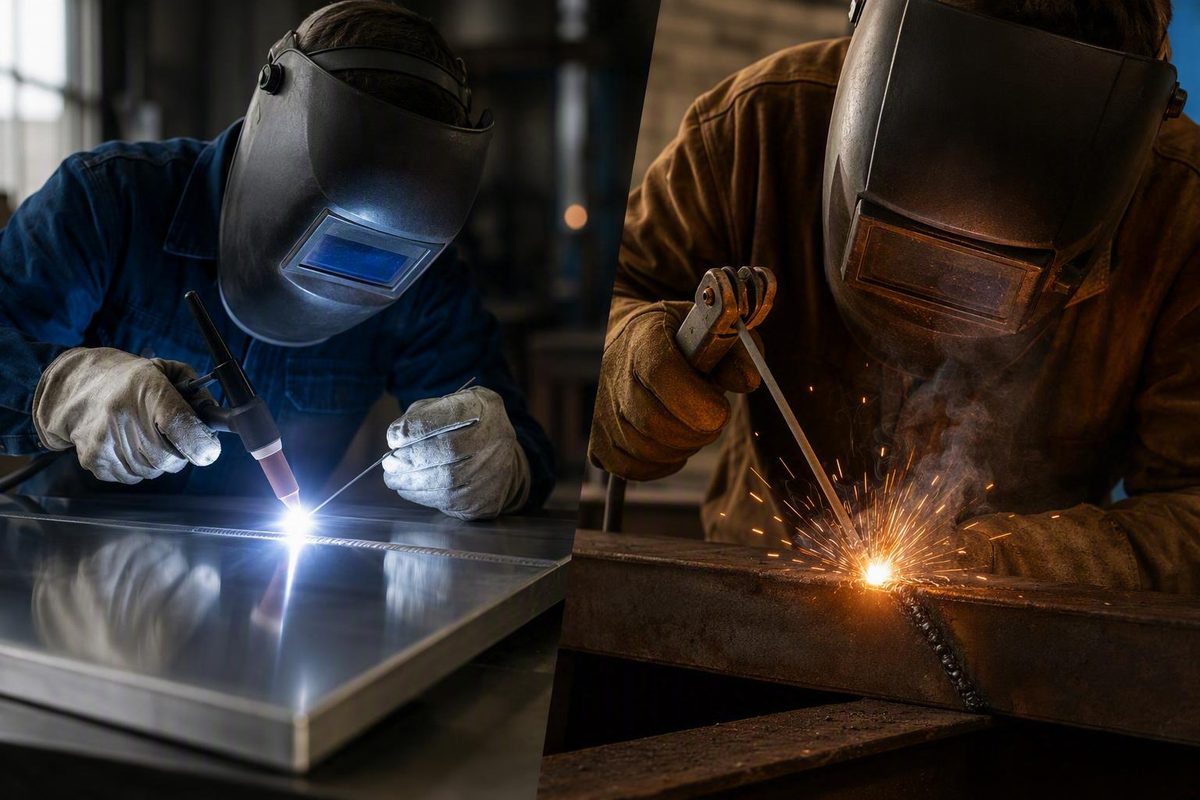
TIG or stick: the short answer
Choose TIG when precise heat control, a clean appearance, minimal spatter, or careful work on thin material matters. Choose stick when portability, outdoor operation, heavy-steel productivity, or rugged repair work matters more.
That conditional answer is more useful than declaring a universal winner. Decorative stainless fabrication and suitable thin-aluminum work commonly point toward TIG. Construction, farm-equipment repair, and heavy-equipment steel repair commonly point toward stick. These are broad process tendencies, not guarantees; commercial comparisons likewise associate TIG with precise, appearance-sensitive work and stick with construction, heavy repairs, and demanding field conditions (Arc Welding Services’ process comparison).
| Factor | TIG/GTAW | Stick/SMAW |
|---|---|---|
| Electrode | Non-consumable tungsten | Consumable flux-coated rod |
| Shielding | Normally supplied by an external inert-gas system | Generated as the electrode coating decomposes and forms shielding gas and slag |
| Filler delivery | Added separately when needed; some welds are autogenous | Electrode core supplies the filler metal |
| Precision | Fine control of the arc, puddle, heat, and filler addition | Less suited to delicate, appearance-critical control |
| Typical speed | Generally slower when substantial filler must be deposited | Commonly more productive for heavy-steel work |
| Portability | Gas cylinder and related equipment add to the setup | Relatively compact field setup without a separate shielding-gas cylinder |
| Wind tolerance | Drafts can disturb shielding-gas coverage | Generally more tolerant of wind |
| Surface-condition tolerance | Rewards thorough cleaning and dependable shielding | More forgiving of imperfect preparation, although cleaning remains important |
| Slag and cleanup | No slag and normally little spatter | Produces slag that must be removed; usually requires more brushing and chipping |
| Learning demands | High coordination demand involving torch position, arc length, heat, visibility, and often filler | Simpler equipment arrangement, but arc length, rod angle, travel, and restarts require practice |
| Common applications | Thin material, stainless fabrication, suitable aluminum work, detailed joints, decorative fabrication | Construction, structural steel, trailers, fences, farm equipment, and heavy repairs |
The answer can change with the alloy, thickness, joint geometry, welding position, machine capability, polarity, consumable, surface preparation, access, procedure, and operator skill.
It also helps to separate outcomes that are often confused:
- Appearance describes what the finished bead looks like.
- Deposition speed describes how quickly filler metal is placed.
- Penetration and fusion concern how the weld joins the joint.
- Mechanical strength concerns whether the completed joint performs as required.
- Productivity includes setup, welding, consumable changes, cleanup, and rework.
A rougher-looking stick weld may be sound, or it may contain defects. Neither appearance nor process name settles weld quality by itself.
How TIG and stick welding actually work
TIG stands for tungsten inert gas welding. Its formal process name is gas tungsten arc welding, or GTAW. The arc forms between the workpiece and a non-consumable tungsten electrode held in the torch. An externally supplied inert gas normally protects the tungsten and molten weld pool from the surrounding atmosphere.
The tungsten establishes and sustains the arc but is not intended to become filler metal. When the joint requires added metal, the welder introduces a separate filler rod or uses another compatible filler-delivery arrangement.
Stick welding is formally called shielded metal arc welding, or SMAW. Its electrode is consumable. As the rod melts, the electrode core supplies filler metal while the flux coating generates shielding and forms a slag layer over the deposited weld. The distinction between TIG’s non-consumable tungsten and external gas and stick’s consumable flux-coated electrode is summarized in WeldingMart’s process guide.
That difference changes the workflow:
- TIG separates arc control from filler addition. The torch controls the arc, while filler is introduced independently when required.
- Stick combines the arc electrode and filler in one rod. The welder consumes and replaces electrodes as work proceeds.
TIG’s separation provides flexibility, but it also increases coordination demands. The operator may need to control torch angle, arc length, travel, heat, visibility, and filler timing as distinct variables.
Stick simplifies filler delivery but adds slag management. Once the weld has cooled sufficiently for the next operation, the slag must be removed so the surface can be examined and finished. In multipass work, slag left beneath a later pass can become trapped in the weld, so interpass removal is an important part of the stick workflow.
Metal, thickness, and finish: where each process fits
TIG is usually the better fit for thinner material, detailed joints, heat-sensitive work, and projects where bead appearance matters. Its controllable arc and independent filler addition help the operator manage small puddles, joint edges, and distortion-sensitive parts. It normally creates little spatter and no slag, reducing post-weld cleanup.
Common TIG applications include mild steel, stainless steel, aluminum, and certain specialty metals. That does not mean every TIG machine, filler, or setup is appropriate for every grade. The alloy, filler compatibility, shielding gas, polarity, joint, available output, and applicable project instructions still determine whether the setup is suitable.
For refined aluminum TIG work, look for equipment with suitable AC capability and manufacturer-stated support for the intended application. Do not assume that a power source can weld aluminum effectively merely because its label says “TIG.” Check the specific manual for supported operating modes, output, controls, torch requirements, and recommended consumables. General process guidance commonly associates AC TIG with thin aluminum and refined finishes (C&O Distributors’ welding-process comparison).
Specialized stick electrodes for aluminum exist, but that does not make SMAW the usual choice for thin, detailed, or appearance-critical aluminum. Any electrode must be compatible with the alloy and application, and stick’s slag-producing workflow offers less appeal when finish and fine puddle control dominate the decision.
Stick is commonly chosen for thicker steel, structural components, construction work, trailers, fences, farm equipment, and heavy repairs. Its relatively simple field setup and practical filler-deposition capability make it attractive when the job involves substantial steel rather than delicate sheet or cosmetic seams.
Avoid universal minimum- or maximum-thickness rules. Practical limits depend on:
- Available machine output
- Duty cycle
- Electrode diameter or filler size
- Base-metal composition
- Joint design and preparation
- Welding position
- Access to the joint
- Polarity and machine capability
- Required joint performance
- Operator technique
Either process can join thick material when joint preparation, equipment, consumables, access, and technique are suitable. Beveling and multiple passes may be necessary. In practice, stick is commonly more productive for heavy-steel work, while TIG may remain useful when cleanliness, control, or material considerations carry more weight.
An informal WeldingWeb discussion about thick steel reflects that practical preference and notes that both processes can be used for multipass work. Its participant-supplied settings and production estimates are anecdotal, however, and should not be treated as universal parameters or controlled test data.
Finally, do not confuse visual smoothness with fusion. TIG makes it possible to create a neat, uniform bead, but a bead can still be undersized, poorly fused, contaminated, or otherwise unsuitable for service. Appearance is an inspection clue, not proof of mechanical performance.
Shop control versus field practicality
TIG relies on an external shielding-gas envelope around the arc and puddle. Drafts can displace that gas, making protection inconsistent. This is why TIG tends to fit controlled shop conditions better than exposed field work.
That does not mean TIG is categorically impossible outdoors. It means shielding must be managed. If dependable gas coverage cannot be maintained in the actual environment, TIG becomes a poor process choice for that location.
Stick is more tolerant of wind because its shielding comes from the electrode coating rather than a separate gas nozzle and cylinder. It is therefore commonly selected for construction sites, farm repairs, and equipment work where environmental control is limited. Commercial process guides broadly recognize this difference between gas-shielded TIG and flux-shielded stick (Alpine Painting’s process overview).
Compare the complete setup rather than the power source alone. A TIG job commonly involves:
- Power source and work lead
- TIG torch and associated parts
- Shielding-gas cylinder
- Regulator or flow control
- Gas hose
- Filler rods when required
- A remote or torch control where used
A basic stick setup may consist of a compatible power source, work lead, electrode holder and lead, and suitable electrodes. That is usually a simpler field package, but process portability does not make the job self-sufficient. Power availability, lead reach, preparation tools, ventilation, protective equipment, and site controls still have to be addressed for the actual location.
Surface condition matters as well. Stick is relatively forgiving when perfect cleaning is impractical, but that tolerance is often overstated. It is not a general instruction to weld indiscriminately through rust, oil, paint, scale, galvanizing, or unidentified coatings.
Identify the material and surface condition before work begins.
The broad safety boundary applies to either process: welding involves hazardous current, fumes, and ultraviolet exposure, and suitable PPE and ventilation are assumed. Equipment manuals and site rules take priority over general article guidance (Welder Facts’ safety notice). For fire prevention, gas-cylinder handling, electrical supply, and coating-specific controls, follow the instructions applicable to the equipment and worksite rather than relying on a general process comparison.
The practical contrast is straightforward:
- Controlled decorative fabrication: TIG usually provides the desired precision, clean finish, and low-spatter workflow.
- Windy farm or equipment repair: Stick commonly provides the more practical field process.
Control, speed, cleanup, and learning curve
TIG generally gives the operator finer control over the arc, puddle, heat, and timing of filler addition. That control is valuable on thin edges, detailed joints, distortion-sensitive assemblies, and visible welds. It is also one reason TIG is generally slower than stick when the task requires depositing substantial filler on heavy steel.
There is no useful universal travel-speed or deposition-rate ratio. Productivity varies with current, filler or electrode size, joint volume, position, fit-up, number of passes, consumable changes, cleaning, and operator skill. The defensible conclusion is narrower: stick is commonly favored for productive heavy-steel welding, while TIG trades speed for control.
TIG’s learning curve comes from simultaneous tasks. The operator must maintain torch angle and arc length, watch the puddle, control travel, manage heat, and often add filler with the other hand. If a remote amperage control is used, that adds another coordinated input.
Practical TIG habits illustrate the challenge:
- Establish a stable, comfortable posture.
- Maintain a clear view of the puddle and intended path.
- Keep the arc short and controlled without touching the tungsten to the work or filler.
- Select settings appropriate to the metal, joint, and machine.
- Maintain suitable shielding-gas coverage for the operation.
- Add filler consistently when the joint calls for it.
Experienced TIG instruction emphasizes posture, visibility, a short controlled arc, and dependable gas protection, while also noting that suitable settings vary by joint, thickness, and equipment (Pacific Arc TIG Welding’s beginner guide). That variability is why an instructor’s rule of thumb should not replace the machine manufacturer’s parameter guidance or project-specific instructions.
Stick has a simpler equipment arrangement, but it does not automatically produce consistent welds. The welder must maintain an appropriate arc length as the rod shortens, hold a suitable electrode angle, control travel speed, read the puddle through slag and arc glare, and restart without leaving defects. Rod changes and awkward positions add difficulty.
Beginner difficulty therefore has two dimensions:
- TIG has greater coordination demands. It asks the operator to manage more independent variables at once.
- Stick has simpler equipment but demanding arc and puddle control. Beginners may struggle with sticking electrodes, changing arc length, limited puddle visibility, poor restarts, and slag-related defects.
Cleanup is another major distinction. TIG normally produces no slag and little spatter, although the completed work may still require cleaning, examination, or finishing. Stick leaves slag and usually requires chipping and brushing. Multipass work adds interpass cleaning, while electrode stubs and frequent rod changes add handling time.
As a result, stick’s productivity while the arc is burning can be partly offset by cleanup. The balance depends on the joint. A large, straightforward steel repair may still strongly favor stick, while a detailed assembly containing many short visible welds may favor TIG because reduced slag and spatter save finishing time.
Is TIG or stick welding stronger?
Neither TIG nor stick is universally stronger.
Weld performance depends on the complete system:
- Base-metal grade and condition
- Compatible filler metal or electrode
- Joint type and dimensions
- Fit-up and preparation
- Fusion into the joint
- Weld size and pass placement
- Heat control
- Defect prevention
- Welding position
- Process settings and project instructions
- Operator skill
- Required service conditions
Commercial comparisons addressing the question directly likewise conclude that application, materials, setup, and operator skill matter more than naming one process as the universal strength winner (Hilco Welding’s TIG-versus-stick discussion).
Strength should not be used as a substitute word for penetration, deposition rate, appearance, or productivity. A polished-looking bead can be inadequate, and an unattractive bead is not automatically strong.
Equal amperage does not make TIG and stick directly equivalent. The processes use different arc characteristics, consumables, polarities, travel speeds, electrode or filler sizes, and joint variables. The display value alone cannot establish equal penetration, fusion, heat input, or productivity.
With stick, slag must be removed before another pass is placed so it is not trapped beneath deposited metal. TIG avoids slag but does not eliminate the need for suitable preparation, pass placement, cleaning, or defect control.
Both TIG and stick can be used for multipass work. Stick is often the practical choice when heavy-steel productivity dominates, while TIG may be selected where material compatibility, controlled heat, or cleanliness matters more. Neither selection guarantees a mechanically adequate joint.
A general comparison cannot approve a load-bearing or safety-critical connection or establish the instructions needed to make one. Before undertaking that work, determine which project requirements, personnel qualifications, documentation, and inspection provisions apply. Generic internet settings, forum comments, and machine marketing claims are not substitutes for instructions specific to the material and joint.
Equipment and total-cost questions to check before buying
Build a project-specific comparison:
| Cost category | TIG questions | Stick questions |
|---|---|---|
| Power source | Does it support the required TIG mode, polarity, output, and controls? | Does it provide the required SMAW mode, polarity, and output? |
| Process equipment | Which torch, work lead, hoses, and remote controls are required? | Which holder, leads, connectors, and electrode sizes are supported? |
| Shielding | What cylinder, gas, regulator, and refill arrangements are needed? | A separate shielding-gas cylinder is not normally required |
| Filler and consumables | Which filler rods, tungsten, cups, collets, and replacement parts are needed? | Which electrode types and sizes are appropriate, and how much stub waste is expected? |
| Preparation | How much cleaning, fitting, and joint preparation is needed? | Can the surface be prepared adequately, and does the joint need beveling? |
| Cleanup | Usually less slag and spatter cleanup | Include chipping, brushing, interpass cleaning, and finishing |
| Labor and time | Include setup, gas handling, controlled welding, and generally slower heavy deposition | Include rod changes, slag removal, and potentially faster heavy-steel deposition |
Stick often uses less field equipment because it normally does not need a separate shielding-gas cylinder. TIG’s gas supply, torch components, and control options add setup considerations. On the other hand, TIG may avoid extensive slag removal or cosmetic finishing on a detailed fabrication. Stick may save substantial welding time on a heavy outdoor repair.
Before buying either machine, use the model-specific manufacturer documentation to verify:
- Output range
- Duty cycle at the output you expect to use
- Input-power requirements
- Supported polarity
- Supported welding processes
- Available torch or remote-control options
- Required leads and connections
- Compatible consumables
- Manufacturer parameter charts
These checks form a general purchasing framework rather than evidence that a particular model can perform a particular job. Model capability must come from that machine’s own manual or specification.
For aluminum TIG, confirm suitable AC capability and explicit manufacturer support for the intended aluminum work. A generic “TIG” label is insufficient.
Confirm that the model provides SMAW operation along with the required output, polarity, connections, and duty cycle. C&O Distributors’ broader equipment guidance similarly recommends checking output, duty cycle, electrical requirements, consumables, polarity, shielding method, and settings before selecting a process or machine.
Gas, electrode stubs, tungsten and torch parts, preparation, cleanup, rework, cylinder handling, and operator time can change the result. Use manufacturer parameter charts and instructions applicable to the project rather than a generic amperage-per-thickness rule.
A project-by-project decision checklist
Use the following sequence to choose between TIG and stick without reducing the decision to “clean versus strong” or “shop versus field.”
-
Identify the metal and alloy. Determine whether the material is mild steel, stainless steel, aluminum, cast material, or another alloy. Confirm that the selected machine and filler or electrode are compatible with it.
-
Assess thickness and joint design. Consider whether the joint is a butt, fillet, lap, corner, or repair configuration. Determine whether access, root preparation, beveling, backing, or multiple passes may be needed.
-
Evaluate the working environment. Is the job indoors and protected, or exposed to changing drafts? If TIG is being considered, can dependable shielding-gas coverage be maintained?
-
Determine how completely the surface can be cleaned. TIG generally rewards thorough preparation. Stick may tolerate imperfect surfaces better, but process tolerance is not a substitute for identifying the material and preparing the joint appropriately.
-
Define finish and distortion priorities. If a visible, low-spatter bead and fine heat control are central requirements, TIG usually has the advantage. If cosmetic finish is secondary to completing a rugged steel repair, stick may be more practical.
-
Consider welding position and access. Flat bench work, confined repairs, overhead joints, and hard-to-reach corners impose different demands. Ensure that the selected consumable, equipment, and project instructions fit the required position.
-
Compare portability and productivity. Include the complete job package: power, leads, gas, tools, consumables, preparation, ventilation, setup time, welding time, and cleanup.
Choose TIG when the material and machine are compatible and the priorities are thin-section control, detailed fabrication, minimal spatter, low cleanup, or a clean visible finish.
Choose stick when the priorities are field portability, wind tolerance, productive heavy-steel welding, or repair work under less controlled conditions.
For thick joints, extend the decision beyond the process name. Confirm that the equipment, joint preparation, access, consumables, duty cycle, pass sequence, and interpass cleaning are suitable.
This checklist selects a general process; it does not establish project-specific welding instructions or confirm that a structural or safety-critical connection is fit for service. Determine what requirements and competent oversight apply before beginning consequential work.
Both processes involve current, fumes, and ultraviolet exposure. Stick also creates slag that must be handled during cleanup, while a typical TIG setup adds a shielding-gas cylinder. Use appropriate PPE and ventilation, and obtain the applicable site instructions for fire prevention, electrical supply, coating hazards, and cylinder handling. Equipment manuals and site rules override general guidance.
The final principle is simple: the better process is the one that can reliably meet the joint’s requirements in the actual working environment—not the one with the best-looking bead, the broadest marketing claim, or the strongest reputation in an unrelated application.
TIG is usually the more suitable process for controlled, precise, thin, or appearance-sensitive fabrication. Stick is usually more practical for portable outdoor repairs and productive heavy-steel work. Neither wins every mechanical-strength comparison; the finished joint depends on its materials, consumables, preparation, design, instructions, defect control, and welder.
Frequently asked questions
Is TIG or stick welding easier for a beginner?
Neither is effortless, and each is difficult in a different way.
TIG usually has the steeper coordination requirement. The beginner must control the torch, arc length, travel, heat, visibility, and often a separate filler rod at the same time. Producing a stable bead also depends heavily on posture, clean material, appropriate settings, and shielding-gas coverage.
Stick has a simpler equipment setup, but consistent welding still takes substantial practice. Beginners must learn to strike the arc, prevent the electrode from sticking, maintain arc length as the rod shortens, distinguish the puddle from the slag, control travel, and make clean restarts.
A learner may find stick quicker to set up but harder to read, while TIG may be easier to observe in a controlled shop but harder to coordinate. The better beginner process depends on the available equipment, instruction, practice material, and intended projects.
Can TIG and stick both weld thick steel?
Yes, provided the machine, joint preparation, consumables, access, duty cycle, and technique are suitable. Thick joints may require beveling and multiple passes rather than one large bead.
Stick is commonly preferred for productive heavy-steel work because it can deposit filler with a relatively simple setup. TIG can also weld thick steel, but it is generally slower when substantial filler must be placed.
With multipass stick welding, remove slag before placing another pass. With either process, do not assume that adding more passes will correct inadequate fusion, poor joint design, insufficient output, or unsuitable filler.
Can TIG or stick welding be used outdoors?
TIG’s external shielding gas can be disturbed by drafts, so the work area must allow dependable gas coverage. Outdoor TIG is therefore a shielding-management problem, not an absolute impossibility.
Stick produces shielding through its electrode coating and is more tolerant of changing wind. That makes it a common choice for exposed construction, farm, and equipment repairs. Complete job portability still depends on power, leads, tools, protective equipment, and site controls.
Which process is better for aluminum?
A suitable AC-capable TIG setup is generally the better choice for thin, detailed, or appearance-sensitive aluminum. It offers fine puddle and heat control, but the machine, filler, shielding gas, alloy, joint, and instructions must be compatible.
Do not assume every TIG machine is suitable for aluminum. Confirm AC capability and manufacturer-stated aluminum support in the model documentation.
Specialized aluminum stick electrodes are available, but stick is generally not preferred for thin material or refined finishes. It may have a role in particular repair conditions when the electrode and equipment are suitable for the application.
Does stick welding eliminate the need to clean rusty or painted metal?
No. Stick is more forgiving of imperfect surfaces than TIG, but that is a relative advantage—not permission to ignore preparation.
Identify the material and coating before welding or attempting removal, and follow the applicable project, equipment, and site instructions. Where the hazards or required controls are uncertain, obtain competent guidance rather than improvising.
The process choice does not remove the need for sound preparation, suitable ventilation, protective equipment, or control of welding fumes.