
Identify and Inspect a Used Lincoln 255 MIG Welder
Identify SP-255, POWER MIG 255, 255C, and 255XT welders, compare output and spool-gun support, and inspect a used Lincoln 255 before buying.
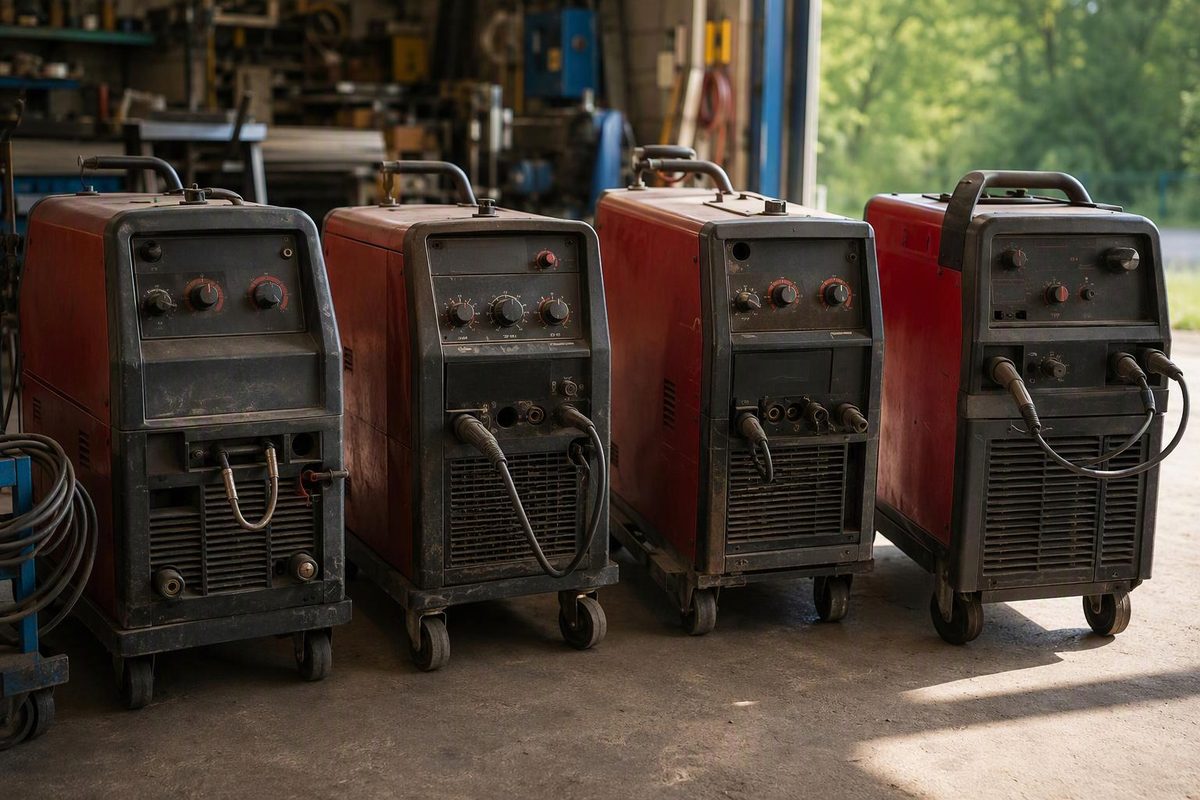
A Lincoln 255 MIG welder can be a good stationary shop machine, but the badge does not identify its output, controls, input requirements or spool-gun hardware. Determine whether it is an IDEALARC SP-255, POWER MIG 255, POWER MIG 255C or POWER MIG 255XT before discussing price or connecting power.
Photograph the complete nameplate. Record the model, product number, code number, serial number and input voltage wherever those identifiers appear. Use them—not the red cabinet or “255” badge—to find the matching manual and parts.
Select the model and intended work; the checker shows the relevant output and hardware limits.
Lincoln 255 Model and Task Checker
IDEALARC SP-255
Earlier model with different accessory numbers from the POWER MIG machines. The archived manual identifies code numbers 10164 and 10165.
POWER MIG 255
Digital voltage and wire-speed displays. Later-family ratings also include 200 A/28 V at 60% and 145 A/26 V at 100%.
POWER MIG 255C
Built-in spool-gun electronics and a second gas solenoid. Listed base units are K2416-1 and K2416-2. Published net weight is about 220 lb (100 kg).
POWER MIG 255XT
Listed base units are K2701-1 and K2701-2. Published net weight is about 220 lb (100 kg).
Source: archived Lincoln Electric manuals and product literature cited in the article. The nameplate and code-matched manual control.
The SP-255 Has Different Ratings and Accessories
These are older, single-phase, transformer-based constant-voltage wire welders, but they are not one interchangeable design.
The IDEALARC SP-255 is the outlier. It is an earlier microprocessor-controlled machine with an automatic setup mode plus spot and stitch modes. Lincoln published a 30–250 A output range, a 50–600 in/min wire-speed range and a rating of 250 A at 26 V at a 35% duty cycle.
Its archived manual identifies code numbers 10164 and 10165, illustrating why the model name alone is insufficient. The SP-255 also uses different accessory numbers from the later POWER MIG machines (Lincoln Electric SP-255 manual).
The original POWER MIG 255 added digital voltage and wire-speed displays. Lincoln published a 30–300 A output range and 50–700 in/min wire feed for the later POWER MIG family. Its headline ratings are 250 A at 26 V at 40%, 200 A at 28 V at 60% and 145 A at 26 V at 100%.
At the 250 A rating, a 40% duty cycle permits up to four minutes of welding followed by six minutes of cooling in a ten-minute cycle. It does not mean continuous 250 A output (POWER MIG 255 operator manual).
The POWER MIG 255C has a cast two-roll drive, digital meters, built-in spool-gun electronics and a second gas solenoid. The 255XT uses the later MAXTRAC drive. Both have the same published 30–300 A range and 250 A at 26 V at 40% headline rating, but they remain separate models.
Archived 255C literature lists base units K2416-1 and K2416-2. The 255XT literature lists K2701-1 and K2701-2. Check accessories by product and code number rather than assuming two similar-looking machines use the same hardware (POWER MIG 255C literature; POWER MIG 255XT literature).
These Are Dedicated MIG and Flux-Cored Welders
The Lincoln 255 machines are DC constant-voltage power sources for solid-wire MIG/GMAW and flux-cored welding. They are not modern multiprocess units. Do not infer stick output, AC TIG capability or a built-in pulsed-aluminum program from the amperage class.
For the 255C and 255XT, Lincoln’s published process table includes:
- .025–.045 in solid mild-steel wire using DC electrode positive and CO2 or an argon/CO2 blend
- .030–.045 in stainless wire using DC electrode positive and a specified shielding-gas blend
- 3/64 in aluminum wire using DC electrode positive and 100% argon
- .035–.045 in gas-shielded flux-cored wire using DC electrode positive
- .035–.045 in self-shielded flux-cored wire using the polarity required by the particular wire; Lincoln’s listed examples use DC electrode negative
These are equipment capabilities, not universal welding procedures. Wire classification, joint design, position, material thickness and the applicable welding procedure determine the usable combination. A machine may accept .035-inch wire, but the consumable manufacturer’s polarity and parameter range override a generic chart.
Lincoln advertised thickness ranges up to 1/2 in for several processes and 3/4 in for selected self-shielded flux-cored applications. That does not establish that every setup is suitable or that those sections can be welded in one pass.
The manufacturer calls for multiple passes on 1/2-in material and limits its .035- and .045-in NR-211-MP example to 5/16 in (255XT process-capability table).
Electrical Service Must Match the Exact Nameplate
North American 255 variants documented in archived manuals include 208/230 V and 230/460/575 V single-phase configurations. A high-voltage version may have no cord or plug. A multi-voltage machine must have its reconnect links configured for the supplied voltage.
For one documented 230/460/575 V POWER MIG 255, Lincoln specifies input currents of 50/24/19 A at the 250 A rating and recommends 60/30/25 A time-delay protection, respectively. Those figures do not automatically apply to another 255 model or input configuration (POWER MIG 255 technical specifications).
Read the nameplate and code-matched installation table. Have the branch circuit and reconnect arrangement checked by a qualified electrician. Do not energize a machine merely because its plug fits an available receptacle.
Portability is limited. Lincoln’s 255C and 255XT literature lists a net weight of about 220 lb (100 kg), before the cylinder, wire and accessories. These are wheeled shop welders, not convenient machines for stairs or frequent loading. The source material cited here does not provide a corresponding weight figure for every SP-255 or original POWER MIG 255 configuration.
Inspect a Used Lincoln 255 in a Fixed Sequence
Verify the Identity and Included Hardware
Require clear photos of the nameplate and front badge. Confirm whether the sale includes the gun, work lead, regulator, drive rolls and any spool-gun adapter. An attached spool gun adds value only when its model and connector match the welder.
The original POWER MIG 255 used the optional K1700-1 spool-gun adapter kit. The 255C has built-in control electronics and a second gas solenoid for a Magnum 250LX or Magnum SG, although the SG requires the specified K2445-1 6-to-7-pin adapter. The 255XT also connects directly to the 250LX but requires K2445-1 for the SG.
“Spool-gun capable” does not mean every Lincoln spool gun plugs directly into every Lincoln 255.
Inspect the Machine Cold and Disconnected
With input power isolated, check accessible areas for:
- burnt or improvised input wiring
- a reconnect-panel setting that does not match the intended supply
- impact damage, missing covers or blocked cooling passages
- heat discoloration at accessible output studs and gun connections
- cracked drive castings, worn roll grooves or damaged guides
- rust on the spindle, wire and internal surfaces visible through the wire compartment
- a cut gun cable, loose neck, damaged liner or incorrect contact tip
- stiff, undersized or heat-damaged work leads and a poor clamp
Do not remove service covers or touch internal components unless you are qualified to service the equipment. A clean clamp jaw cannot compensate for a damaged cable or loose terminal; the complete welding-current return path matters.
Test the Feeder Before Striking an Arc
Fit clean wire with the correct drive-roll groove, guide and contact tip. Keep the gun cable as straight as practical. Feed the wire toward a safe, nonflammable area while keeping hands clear of the gun end.
Wire should feed smoothly from low to high speed without roll slippage, wire shaving or motor hunting. Do not diagnose every feed problem as a failed circuit board.
Lincoln’s troubleshooting sequence first checks for a kinked or dirty gun cable, incorrect roll tension, worn rolls, rusty wire, a damaged tip, excessive spool-brake drag and mismatched liners or guides (POWER MIG 255 troubleshooting table).
Make Controlled Test Welds
Use clean mild-steel coupons of known thickness, fresh matching wire and the correct shielding gas. Start with the code-matched manual or door chart for that wire rather than settings remembered from another machine.
Test first at a low-to-moderate setting and then at a higher practical load while staying within the published duty cycle. There is no reason to force a thermal trip during a buying inspection.
During the test, verify that:
- preset voltage and wire speed adjust through their ranges
- actual voltage displays while welding where the model provides that function
- gas starts and stops with the trigger
- the arc responds normally to voltage and wire-speed changes
- the fan operates according to that model’s control scheme
- the gun connector, output studs and work lead do not heat abnormally
- with four-step trigger/interlock and timer functions disabled, feeding and output stop when the trigger is released
A rounded, cold bead can result from low voltage, incorrect polarity, poor cable connections or mismatched settings. It does not by itself prove that the power source is defective. Conversely, a visually smooth bead does not establish penetration, fusion or code compliance.
A Sound 255 Still Suits a Stationary Steel Shop
A working POWER MIG 255, 255C or 255XT remains practical for a stationary shop that mainly welds steel with MIG or flux-cored wire and already has suitable single-phase power. The duty-cycle ratings, full-size wire compartment and mechanical feeder are better reasons to buy one than the “255” label.
Pass or reduce the price substantially if the data plate is unreadable, the seller cannot demonstrate the machine under load, input-voltage conversion has been improvised, major electrical damage is visible or the required aluminum hardware cannot be identified.
As of September 27, 2026, Lincoln’s regional product page marks the 255XT as not currently available for sale. Treat it as a used-equipment purchase rather than a current new-machine package (Lincoln Electric 255XT product page).
The best example is the correctly identified machine that matches the available power, passes a controlled weld test and includes—or can still be fitted with—the gun, drive parts and adapters required for the intended wire.