
When Pure Argon Is Enough for Aluminum TIG
See when pure argon is enough for aluminum TIG, how machine output changes the decision, and what argon versus helium shielding costs per hour.
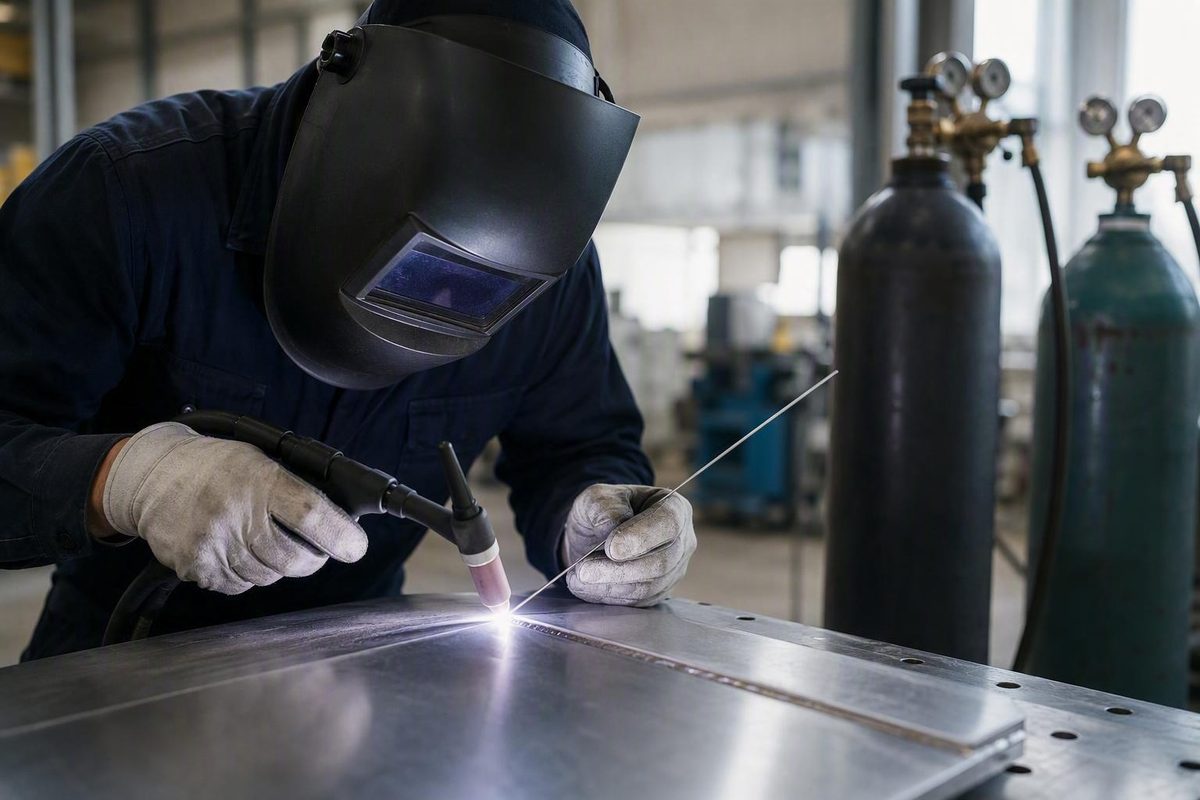
Yes. You can TIG weld aluminum without helium: 100% argon is the normal choice for general aluminum fabrication and repair. Helium is optional when a verified argon procedure cannot deliver enough heat, penetration, or travel speed. There is no defensible universal thickness ceiling for argon-only TIG because machine output, component mass, joint geometry, preheat, and pass count all change the result.
“Without helium” does not mean without shielding gas. TIG still requires a suitable inert gas around the tungsten, arc, and molten pool. Do not substitute carbon dioxide or an argon-CO2 steel mixture. ESAB identifies pure argon as the usual choice for general aluminum work and helium-enriched shielding as an option for applications needing more heat or penetration (ESAB’s shielding-gas guidance).
Enter your machine and procedure limits, then add local gas prices to compare the result and hourly shielding cost.
Compare your machine with a verified procedure current, then calculate hourly cylinder cost. Thickness is recorded as job context; it does not create an unsupported amperage rule.
Pure argon remains the baseline. Thickness alone cannot determine whether helium is needed.
| Observed Condition | Argon-Only Reading | Next Check | Helium Decision |
|---|---|---|---|
| Verified current is within machine output | Electrically feasible | Validate fusion and duty cycle on representative material | Stay with argon unless added speed or penetration has measured value |
| Verified current exceeds machine output | Output shortfall | Review equipment, joint design, approved preheat, and multiple passes | Trial a blend only through an approved procedure |
| Puddle is slow on a massive component | Heat may be leaving the joint rapidly | Confirm actual output, arc length, fit-up, and component mass | A blend may add useful arc energy |
| Porosity or black deposits appear | Not proof of insufficient heat | Check contamination, leaks, drafts, cup, and torch angle | Do not add helium to correct failed shielding |
| Arc is noisy or unstable | Flow may be turbulent | Inspect flow, tungsten, machine mode, and electrical connections | Return to a known argon baseline first |
| Penetration is insufficient | Cause remains undetermined | Check output, joint volume, travel speed, arc length, and pass sequence | Consider enrichment only after these checks |
| Argon meets fusion and production rate | Use argon | Document the working setup | Helium adds cost without solving a defined problem |
| Qualified procedure specifies helium | Argon substitution is not automatic | Consult the responsible welding authority | Follow the approved gas composition |
The calculator deliberately does not derive amperage from thickness alone. The available evidence does not provide a tested thickness-to-amperage formula or a single argon thickness limit. Enter the current established by the machine manufacturer, a qualified procedure, or a representative test coupon.
Pure Argon Works Until the Complete Setup Runs Out of Heat
Pure argon provides a stable, manageable arc and comparatively easy arc initiation. It works with conventional AC aluminum TIG equipment and is widely used for repair, training, one-off fabrication, and routine shop work.
Helium increases arc energy. It can create a hotter, more fluid puddle with greater penetration and may permit faster travel. Those characteristics can help on a large casting, thick joint, broad heat sink, or assembly that conducts heat away faster than the machine can replace it.
Thickness alone cannot identify that point. Two parts with the same wall thickness may behave differently when one is a compact coupon and the other is connected to a massive casting. The practical limit depends on:
- Alloy and temper
- Total component mass
- Joint type, bevel, root opening, and fit-up
- Welding position and travel speed
- Machine output and duty cycle
- Torch cooling capacity
- Required penetration profile
- Whether approved preheat or multiple passes are permitted
- Production-rate requirements
- Applicable drawings, codes, and welding procedures
No sourced figure in the available material establishes a thickness at which helium becomes mandatory. A fixed ceiling would therefore be misleading. The useful test is whether the complete argon-only procedure produces the required fusion and productivity on representative material.
Argon, Blended Gas, and Helium Serve Different Jobs
| Shielding Gas | Best Fit | Main Tradeoff |
|---|---|---|
| 100% argon | General AC aluminum TIG, repair, training, and mixed shop work | Less arc energy than helium-enriched gas |
| Argon-helium blend | More heat while retaining some familiar argon starting and control behavior | Higher cost and changed puddle behavior |
| 100% helium | Specialized procedures needing substantial arc energy | Harder starting, more demanding control, and generally higher cost |
An argon-helium blend is normally the more approachable helium trial. The argon component preserves some familiar starting and arc-control behavior while helium adds heat. Pure helium is more specialized and may be harder to initiate and control.
There is no universally correct blend percentage. The calculator compares a 75% argon/25% helium premix because that is the requested purchasing comparison, not because the ratio is automatically correct for a particular weld. Gas-supplier guidance, machine capability, procedure development, and representative testing must establish the actual composition.
Cylinder price alone also gives an incomplete economic answer. Helium enrichment may pay for itself if it increases travel speed, reduces pass count, or lets a constrained machine complete a joint. It adds cost without benefit when pure argon already produces acceptable fusion at the required rate.
Aluminum Still Requires Cleaning and AC Heat Control
Aluminum develops a tenacious surface oxide with a higher melting temperature than the aluminum beneath it. The base metal also conducts heat away from the arc rapidly. A contaminated or heavily oxidized joint may resist puddle formation even while the underlying material begins to melt.
Shielding gas, polarity, and preparation perform separate functions:
- Shielding gas protects the tungsten, arc, and weld pool from the atmosphere.
- AC alternates between surface-cleaning behavior and useful heat directed into the work.
- Mechanical and solvent cleaning remove contamination before the arc starts.
- Amperage and travel technique regulate fusion as the component heats.
Argon does not replace surface preparation, and helium cannot make an oily or cross-contaminated joint clean. In conventional AC TIG, the electrode-positive portion supplies cleaning action at the work surface. The electrode-negative portion contributes penetration and directs more useful heat into the work.
Start with the machine manufacturer’s aluminum recommendations. Inspect puddle behavior and the cleaning zone, then make small adjustments rather than treating a generic setting as universal.
The Conventional Argon Setup Uses AC TIG
An AC-capable constant-current TIG machine is the normal starting platform for aluminum. Specialized DC procedures exist, but they are not the general-purpose substitute for an AC machine. Current equipment guidance likewise identifies AC as the standard polarity and reserves DC for specialized applications (THG Automation’s aluminum TIG equipment guide).
High frequency is an electrical arc-control feature, not a gas. Depending on machine design, it may start the arc without touching the tungsten and help maintain continuity as AC crosses zero current. It cannot shield the puddle, and adding helium cannot replace an electrical feature needed for reliable starting.
Before welding, verify:
- The cylinder contains welding-grade pure argon, not a steel MIG mixture.
- The regulator or flowmeter is suitable for the cylinder and intended flow range.
- Hoses, fittings, torch seals, the back cap, cup, and gas lens are undamaged.
- Tungsten type, diameter, and preparation follow equipment guidance.
- The clamp is attached to clean, conductive metal.
- Remote amperage control and torch cooling operate correctly.
- Gas pre-flow and post-flow suit the machine, torch, and tungsten.
- The machine is in AC TIG mode rather than a mode left from another job.
For many indoor pure-argon arrangements, approximately 12–20 cubic feet per hour, or about 6–9.5 liters per minute, is an adjustable initial check. It is not a universal prescription. Cup diameter, gas-lens design, tungsten extension, joint geometry, torch angle, drafts, and extraction affect the required flow (Weldmonger’s aluminum TIG settings guidance).
More flow is not automatically better. Excessive flow can become turbulent and pull surrounding air into the shielding stream. If coverage appears weak, inspect the entire gas path before increasing the flowmeter setting.
Establish the Argon Procedure Before Adding Helium
Clean oil, grease, adhesive, paint, and other contamination using products compatible with the material and workplace. Remove oxide with clean tools dedicated to aluminum rather than brushes shared with carbon steel. Keep filler from touching dirty gloves, benches, or other contaminated surfaces.
Prepare the specified bevel, root face, root opening, alignment, and fit-up. Poor geometry creates unnecessary weld volume and heat demand that can be mistaken for a shielding-gas limitation.
Confirm the cylinder label and inspect the gas path from regulator to cup. A damaged hose, loose fitting, failed back-cap seal, clogged gas lens, or chipped cup can compromise shielding while the flowmeter continues displaying the expected reading.
Ventilation remains necessary, but a fan or extraction hood can strip shielding from the puddle. Position extraction so it controls fumes without pulling the inert-gas envelope away from the weld.
Inspect the welding circuit, including the work clamp, lead, connection point, and machine terminal. A poor return connection can contribute to unstable starting or a wandering arc, although it does not determine which shielding gas to use.
Where practical, run a representative coupon using the same alloy, thickness, filler, joint orientation, and position. A bead on unrelated scrap does not validate the production joint. Verify filler selection, tungsten, current, AC balance, frequency, gas timing, and travel technique against the machine manual and applicable procedure.
Add Helium Only After Identifying the Actual Constraint
Consider helium enrichment when one or more of these conditions remain after the argon setup has been verified:
- The component dissipates heat rapidly and the puddle remains difficult to establish.
- The machine cannot provide adequate output at an acceptable duty cycle.
- Penetration remains insufficient after preparation, fit-up, arc length, and settings have been checked.
- Travel speed is too low for the production requirement.
- The required pass count makes the procedure uneconomical.
- A qualified procedure or engineering requirement specifies helium enrichment.
Confirm that the machine reaches its commanded output. Check input power, duty cycle, remote-control operation, and torch capacity. A machine at its output limit may need a different joint strategy or higher-capacity equipment rather than a gas change.
Review approved preheat, welding sequence, backing, joint redesign, and multiple-pass options. The source material supplies no universal preheat temperature, so use only limits established by the applicable procedure, alloy guidance, or responsible welding engineer.
If additional arc energy still offers measurable value, trial an approved argon-helium blend on representative material. Validate penetration, bead profile, porosity, distortion, travel speed, and operator control before production. Use pure helium only when the developed procedure and operator capability justify it.
Argon Problems Often Come From Delivery or Preparation
| Symptom | Check First | Likely Issue |
|---|---|---|
| Porosity | Material, filler, leaks, drafts | Contamination or atmospheric exposure |
| Black deposits | Gas identity, flow, cup, torch angle | Oxidation or lost coverage |
| Noisy arc | Flow, tungsten, mode, connections | Turbulence or electrical instability |
| Poor penetration | Output, mass, geometry, travel | Insufficient energy or excess weld volume |
| Dirty tungsten | Puddle contact, post-flow, seals | Electrode contamination or air exposure |
For porosity, verify that the joint was degreased before brushing and that the filler remained clean. Then inspect fittings, torch seals, and air movement.
For black deposits, trace the gas path from the labeled cylinder to the cup. Excessive torch tilt or arc length may move shielding away from the trailing edge of the puddle.
For an erratic arc, do not immediately increase flow. Return to a known baseline and inspect the tungsten, torch assembly, machine mode, work connection, and gas path. Excessive flow and an electrical fault can produce similar symptoms.
For inadequate penetration, establish whether the machine is delivering the intended output. Consider total component mass, workpiece temperature, joint geometry, arc length, travel speed, and allowed pass sequence before treating helium as the solution.
Helium Supply Pressure Strengthens the Cost Case for Argon
July 2026 reporting described temporary Chinese controls on helium exports announced on July 10. Global Times said the controls could later be adjusted in response to domestic and international supply and demand (Global Times coverage). Separate coverage characterized the action as an immediate temporary export ban with no specified end date (The Deep Dive’s report).
A June 2026 report said Nippon Sanso planned to raise prices for all helium products in Japan beginning in July, with an average increase of more than 30% (DIGITIMES’ helium pricing report).
These reports concern supply and pricing, not welding procedure qualification. They do not establish a thickness at which helium is technically necessary. Pure argon remains the standard choice for most aluminum TIG work, while helium remains an optional performance tool.
If an established production procedure depends on helium, discuss supply continuity and approved alternatives with the gas supplier, welding engineer, and customer before changing it. Do not alter a qualified procedure solely because cylinder pricing changed.
The Working Rule Is Argon First
Use 100% argon with an AC-capable TIG machine for ordinary aluminum work. Verify clean material, sound fit-up, stable gas delivery, work-return integrity, machine output, and permitted preheat or multipass options.
Move to an argon-helium blend only when representative testing shows that added arc energy, penetration, or travel speed solves a defined problem. There is no supported universal thickness cutoff, amperage formula, or preheat temperature that can replace procedure-specific testing.
Welding involves hazardous electrical current, fumes, hot material, and ultraviolet radiation. Use suitable PPE and ventilation, and follow equipment manuals, site rules, and applicable welding procedures (Welder Facts safety notice).