
Use 100% Argon for Most TIG Welding—Change Gas Only for a Reason
Choose TIG shielding gas by metal and thickness, set a practical flow rate, and diagnose contamination without wasting gas.
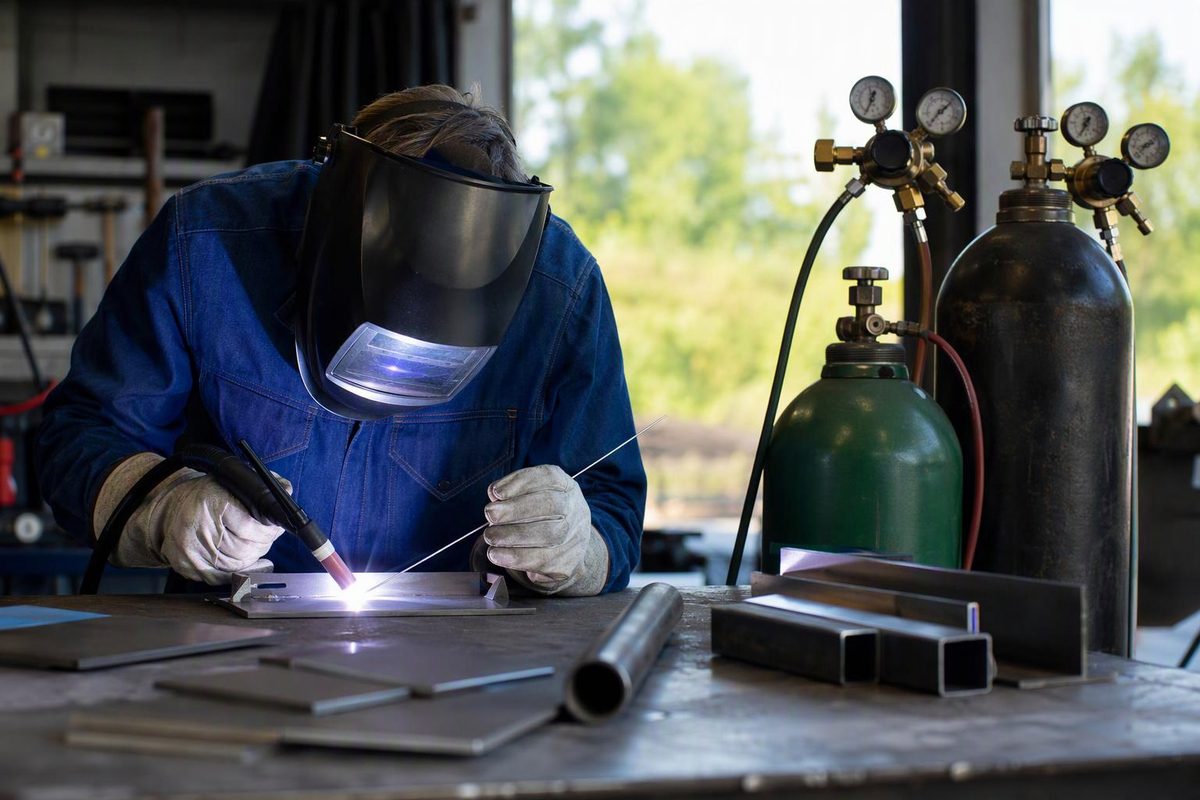
For most manual TIG welding, buy 100% argon. It starts readily, produces a stable arc and can shield carbon steel, stainless steel, aluminum, magnesium, copper and many other metals. Miller describes argon as usable across TIG applications, metals and thicknesses (Miller).
Helium or a helium blend is a deliberate change for more heat—not a requirement for welding aluminum.
Do not substitute a common MIG mix such as 75% argon/25% CO₂. TIG requires an inert shield around both the pool and hot tungsten. Active gases such as CO₂ or oxygen can cause porosity, cracking or electrode damage when used for TIG (ESAB). If a welding procedure specification (WPS) names a gas or blend, use that specified composition.
Which TIG gas fits the job?
| Base metal or condition | Practical first choice | When another gas may help |
|---|---|---|
| Carbon steel and chromoly | 100% argon | Specialty procedures may specify another blend |
| Austenitic stainless steel | 100% argon | A qualified argon/hydrogen blend for specific grades and production work |
| Aluminum and magnesium | 100% argon | Argon/helium for thick sections or limited machine output |
| Copper and other highly conductive metals | 100% argon | Argon/helium or helium when substantially more arc heat is needed |
| General-purpose shop cylinder | 100% argon | Covers the widest range of manual TIG work |
Gas selection does not choose the filler alloy. Match the rod separately to the base metals and service conditions; see TIG welding rod selection.
Why argon is the default
Argon’s relatively low ionization potential supports reliable arc starting and a stable arc at the short lengths used for TIG. It also lets one cylinder serve typical AC aluminum and DC steel or stainless work. Linde recommends argon for manual welding of all materials because of its starting and arc-control characteristics (Linde).
Gas choice does not determine polarity. A typical setup uses DC electrode negative for steel and stainless, while modern TIG welding of aluminum normally uses AC. Gas, polarity, tungsten, filler and machine settings remain separate decisions.
For aluminum, argon is normally enough. Helium becomes useful when a thick or highly conductive part carries heat away faster than the available arc can establish a workable puddle. Before buying another cylinder, confirm that joint preparation, amperage, AC settings and torch capacity are not the real limitation. The detailed aluminum comparison is covered in TIG welding aluminum without helium.
What helium changes
Helium’s higher thermal conductivity creates a hotter, broader arc. On thick aluminum, copper and other conductive material, that can produce deeper penetration or support faster travel. The tradeoffs are less-reliable starting and arc stability, plus higher required flow. A Lincoln TIG manual also identifies argon as lower in cost and consumption while recommending helium or argon/helium where more penetration or travel speed is needed (Lincoln Electric).
Argon/helium blends retain some of argon’s starting behavior while adding heat as helium content rises. Commercial 25%, 50% and 75% helium blends are documented options, but they are not interchangeable settings (Linde). Re-establish amperage, travel and tungsten size on representative coupons rather than expecting an argon setup to transfer unchanged.
The flowmeter must also suit the gas or use the device manufacturer’s correction method. Gas density affects its reading, so helium through an argon-calibrated meter can produce an actual flow substantially different from the indicated value. Harris provides device-specific correction guidance and warns that an uncorrected setup can waste gas or affect weld quality (Harris). Do not invent a correction factor.
Argon/hydrogen is a restricted specialty blend
Small hydrogen additions can increase heat, improve wetting and create a reducing atmosphere in suitable applications. But argon/hydrogen is not a general “stainless gas.” Linde identifies these blends primarily with 300-series austenitic stainless and certain nickel alloys, and warns of severe porosity or cracking on aluminum, copper and most carbon steels (Linde).
Use an argon/hydrogen blend only when the base-metal grade, filler, procedure and gas supplier’s data all permit it. For ordinary manual stainless fabrication, 100% argon remains the conservative starting choice.
Set flow by coverage, not by “more is better”
A practical indoor starting point is 15–20 cubic feet per hour (cfh), about 7–9.5 L/min, with a conventional torch arrangement. Linde lists that range across several TIG alloy groups, while Miller gives a broader normal span of 10–35 cfh depending on consumables and surrounding conditions (Linde; Miller). Cup diameter, collet body or gas lens, tungsten extension, joint geometry and airflow all affect the final setting. The torch manual, WPS and consumable instructions override a generic number.
Too little flow leaves the pool and tungsten exposed. Too much increases gas velocity and turbulence, which can draw room air into the shielding column. Turning the flowmeter higher can therefore make an apparent gas problem worse.
Use this setup sequence:
- Install the cup or gas lens appropriate to the joint and required tungsten extension. A gas lens produces more uniform flow and can support greater extension than a standard collet body.
- Remove direct airflow from fans, doors and compressed-air tools. Position any screen without defeating required ventilation.
- Check the flowmeter while gas is actually flowing, then begin near the equipment maker’s recommendation.
- Adjust on representative coupons to the lowest rate that maintains coverage.
- Set enough pre-flow to purge the torch and protect the start. Miller gives 0.2 second as a general minimum.
- Hold the torch over the crater until post-flow stops. Miller’s general guideline is amperage divided by 10 in seconds, with an eight-second minimum, but the machine manual and procedure control the setting (Miller).
A larger cup, long tungsten extension, helium, an awkward joint or disturbed surroundings may require a different rate. More flow cannot reliably compensate for a leaking hose or cross-draft.
Diagnose bad coverage in this order
A gray or black tungsten, excessive oxidation or discoloration, deposits around an aluminum weld, or porosity can indicate a shielding problem—but none identifies the cause by itself.
- Read the cylinder label. Confirm 100% argon or the specified blend, not an argon/CO₂ MIG mix.
- Verify gas reaches the cup. Check the cylinder valve, regulator or flowmeter, machine solenoid and torch valve where fitted.
- Inspect the delivery path. Look for loose fittings, split hoses, damaged O-rings, a cracked cup, a missing insulator or an incorrectly assembled collet body or gas lens.
- Control drafts. Shield the weld area before raising flow.
- Correct flow and stickout. Excessive stickout with a standard collet body can expose the electrode; excessive flow can entrain air.
- Check pre-flow and post-flow. A start that contaminates immediately points toward inadequate pre-flow or a delivery fault. A tungsten or crater that discolors after the arc stops points toward short post-flow or moving the torch away too soon.
- Check polarity, AC balance and cleanliness. Aluminum oxide, steel contamination on the tungsten and incorrect AC balance can mimic a gas problem.
- Regrind contaminated tungsten and clean the joint. Restoring coverage does not remove contamination already in the electrode.
- Make another coupon and inspect it appropriately. Better color or appearance shows that conditions changed; it does not prove the weld meets a code, WPS or service requirement.
Backside oxidation on a full-penetration stainless joint is a separate coverage problem. Torch shielding does not protect the root, so an argon back purge may be needed to prevent sugaring (Miller).
Argon is a compressed-gas simple asphyxiant: it can displace oxygen and cause rapid suffocation without warning. Use it only with adequate ventilation, and do not enter an inadequately ventilated storage or confined area (Airgas argon SDS). OSHA requires ventilation for confined-space welding and says gas cylinders and welding machines must remain outside the confined space (OSHA 1910.252). Store cylinders upright and secured, protect them from physical damage, close the valve after use, and follow the supplier’s SDS and OSHA’s general compressed-gas requirements (OSHA 1910.101).