
What Flux-Core Welding Means and How It Works
Learn how FCAW uses tubular wire and slag, how self-shielded and gas-shielded variants differ, and why polarity must follow the wire data.
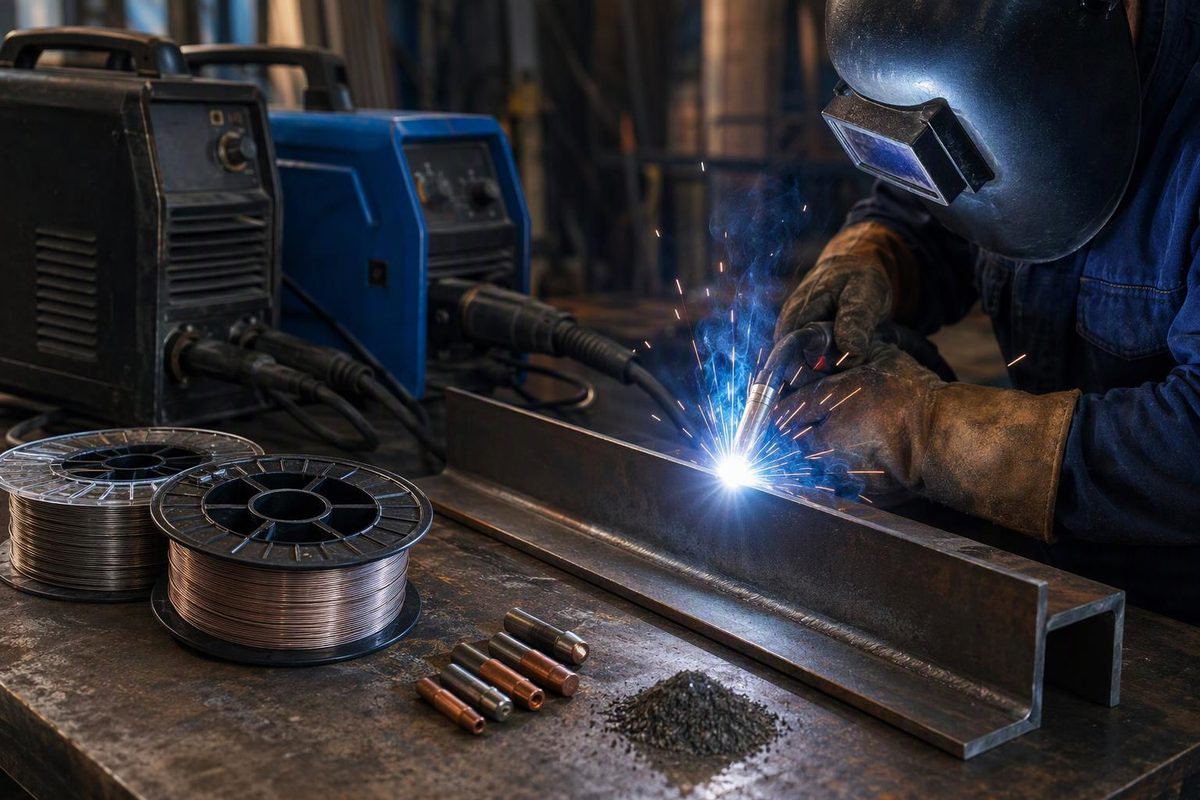
Flux-core welding—properly called flux-cored arc welding (FCAW)—is an arc-welding process that uses a continuously fed, consumable tubular wire electrode containing flux and other ingredients. The arc melts the wire and base metal, while ingredients in the wire’s core condition the molten weld and form protective slag. Depending on the electrode, shielding comes from the core itself or from an external gas supply.
That tubular electrode distinguishes FCAW from conventional solid-wire MIG welding. Flux-core welding is not simply “MIG without gas”: some flux-cored wires require external shielding gas, while others are self-shielded. The American Welding Society identifies self-shielded FCAW-S and gas-shielded FCAW-G as the two main variations (AWS).
Select the wire type to see what its FCAW designation establishes—and what still requires the manufacturer’s data.
FCAW-S Setup Implication
No external shielding-gas supply is required.
- The electrode core provides atmospheric protection.
- Slag forms and normally must be removed between passes.
- Polarity remains product-specific: self-shielded wires can require DCEN or DCEP.
Next check: read the spool label or current datasheet for polarity, permitted positions, pass limits, electrode extension and parameter range.
Source note: AWS process description and the Lincoln Electric and Hobart Brothers product data cited in the accompanying article.
How Flux-Core Welding Works
A feeder pushes the electrode from a spool, through the gun liner and contact tip, toward the joint. Current transfers through the contact tip into the wire. An electric arc between the wire and workpiece melts the electrode and the edges of the joint.
The functions of the core depend on the electrode formulation. Its ingredients can form slag, remove oxygen or nitrogen from the weld metal, supply alloying elements, and influence penetration or deposition characteristics.
With self-shielded wire, reactions in the arc provide atmospheric protection. Gas-shielded wire depends on externally supplied gas for that protection, although the ingredients inside the tubular electrode still perform metallurgical and slag-forming functions (Lincoln Electric).
Slag covers the hot deposit as it cools. It normally must be removed before another pass is placed. Otherwise, trapped slag can become an inclusion rather than harmless surface residue.
Continuous wire feed avoids the frequent electrode changes required by shielded metal arc welding. It can also support high deposition rates. It does not eliminate setup and technique variables: wire-feed speed, voltage, electrode extension, travel speed, gun angle and interpass cleaning still affect the weld.
FCAW-S and FCAW-G Require Different Setups
| Variation | Shielding method | Common fit | Main setup consequence |
|---|---|---|---|
| FCAW-S: self-shielded | Core reactions provide atmospheric protection; no gas cylinder is used | Field erection, outdoor repair and work where carrying gas is impractical | Follow the exact wire’s polarity, electrode-extension and parameter requirements |
| FCAW-G: gas-shielded | External gas shields the arc and weld pool | Shop fabrication and high-deposition production work | Gas composition and flow are required parts of the setup |
Self-shielded wire is commonly loaded into small “gasless” wire-feed machines. Removing the gas cylinder does not convert solid MIG wire into flux-cored wire. The machine must be loaded with an FCAW-S electrode. The gasless wire-welding setup guide covers compatibility, feeder and polarity checks in more detail.
Gas-shielded FCAW still uses a tubular flux-cored electrode and still produces slag. Its external gas is not optional.
Gas requirements are product-specific. For example, Lincoln Electric specifies 75–85% argon with the balance CO2, DCEP polarity and a 40–50 CFH flow rate for UltraCore 71A85 (Lincoln Electric UltraCore 71A85). Those values apply to that product, not to every FCAW-G wire.
Flux Core Is Different From MIG and Stick Welding
FCAW resembles gas metal arc welding, or GMAW, because both processes use a gun and continuously fed consumable wire. GMAW is commonly called MIG welding.
The principal difference is the electrode and its shielding system. Conventional MIG uses solid wire and external shielding gas. FCAW uses tubular wire containing flux and other ingredients. Depending on its classification, flux-cored wire can be self-shielded or used with external gas.
FCAW shares slag-producing behavior with shielded metal arc welding, or SMAW. Unlike stick welding, FCAW does not require the operator to stop whenever a short electrode has been consumed.
Flux-cored wire should not be confused with metal-cored wire merely because both can have tubular construction. The consumable classification and manufacturer documentation determine the process and setup; appearance alone does not.
The Name Does Not Determine Polarity or Parameters
Calling a process “flux core” does not establish:
- whether external shielding gas is required;
- which polarity to use;
- whether the wire permits one pass or multiple passes;
- which welding positions are allowed;
- suitable base-metal thickness or joint design;
- impact-toughness or diffusible-hydrogen designations;
- acceptance under a particular code or specification; or
- the correct voltage, wire-feed speed and electrode extension.
Polarity shows why a generic setup rule can fail. Hobart’s consumable literature specifies DC electrode negative, or DCEN, for its E71T-11 Fabshield 21B. The same literature specifies DC electrode positive, or DCEP, for its self-shielded E70T-4 Fabshield 4 (Hobart Brothers tubular-wire data). “Self-shielded always means DCEN” is therefore not a reliable rule.
Read the spool label and current manufacturer datasheet before connecting the leads. Match the contact tip, drive roll, liner and machine capacity to the wire type and diameter. Begin within the documented parameter range, then make representative test welds before welding the job.
For classification and application limits, see choosing flux-core wire by job and the .035 wire setup checks.
FCAW-S Handles Outdoor Work Better Than Gas-Shielded Wire
Self-shielded FCAW avoids an externally delivered gas envelope that wind can disrupt. That makes it useful for field erection, outdoor repair and locations where transporting a gas cylinder is impractical.
It does not make every FCAW-S wire immune to all wind, moisture, coatings or contamination. The manufacturer’s limits and the applicable welding procedure still govern preparation and use.
Gas-shielded FCAW is commonly used for productive shop welding. Disturbed gas coverage can cause porosity, so the specified gas composition, flow and protection from drafts remain part of the process.
With either variation, prepare the joint as the procedure requires, maintain the specified electrode extension and remove slag between passes.
Flux-Core Welding Requires Strong Fume Controls
Flux-core welding can produce substantial fumes. OSHA lists flux-cored arc welding first among common arc processes presented in decreasing order of fume production.
OSHA recommends keeping the welder out of the plume, using local exhaust where appropriate and using respiratory protection when work practices and ventilation do not reduce exposure adequately. Outdoor or open work does not guarantee adequate ventilation (OSHA welding-fume guidance).
The work also requires the normal controls for arc radiation, electrical hazards, hot metal, fire and compressed shielding-gas cylinders when FCAW-G is used.
“Flux Core” Identifies the Process, Not Weld Quality
Calling a weld “flux core” identifies its process family. It does not establish fusion, penetration, mechanical properties, workmanship or acceptance under a code.
A regular-looking bead does not verify those properties. Where a governing code, contract or specification applies, the work still needs the specified consumable, an applicable qualified procedure, qualified personnel, and the required inspection or testing.