
How to Choose the Right Edge Eyewear for the Work in Front of You
Z87+ addresses high-impact protection, not automatic protection from splash, dust, welding or military ballistic hazards. The exact SKU and markings still matter.
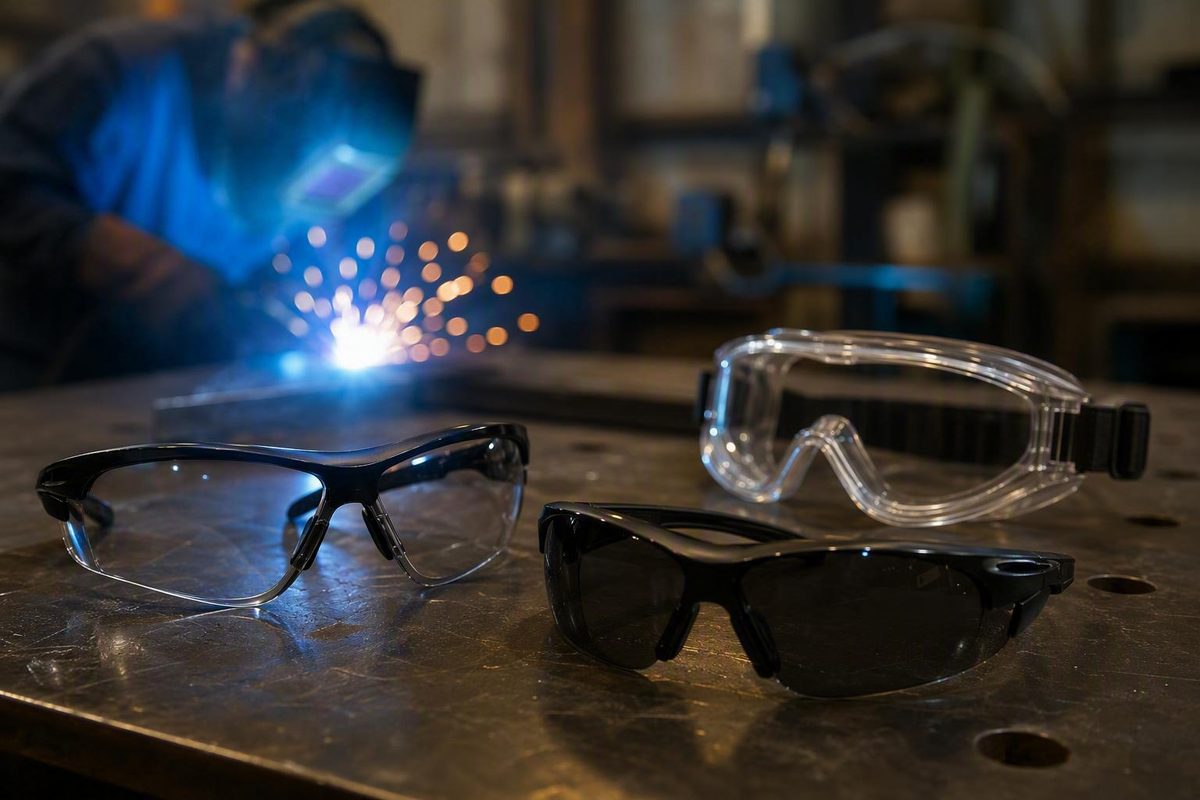
The short answer: start with the hazard, then choose the Edge model
Edge safety glasses are worth considering when the exact frame-and-lens configuration matches the hazard, wearer, and other personal protective equipment. Edge and specialist retailers list clear and tinted safety glasses, polarized lenses, Vapor Shield anti-fog versions, bifocals, over-the-glasses designs, small and XL fits, foam-lined frames, gasketed eyewear, straps, and tactical products.
That breadth creates choice, but the Edge name alone does not establish whether a pair is suitable for a particular job.
Make four checks in this order:
- Identify the hazard. Determine whether the exposure involves impact, dust, fine dust, splash, harmful radiation, glare, ballistic impact, or several hazards together.
- Verify the exact product. Record the full SKU and inspect the frame and lens markings. Do not rely only on a family name, collection page, or marketplace title.
- Confirm fit and coverage. The eyewear should remain stable, sit close to the face, protect the brow and sides, preserve peripheral vision, and avoid painful pressure points.
- Test the complete PPE system. Wear the glasses with the hard hat, respirator, earmuffs, face shield, or welding helmet used for the task. One item should not displace another or create a new gap.
Edge says its safety glasses are independently certified to ANSI Z87+ requirements and identifies COLTS Laboratories as its independent testing laboratory. The supplied manufacturer material does not reproduce certificates, laboratory reports, test dates, or a complete SKU-by-SKU compliance matrix. Edge also directs buyers to individual product pages for frame-specific standards and dimensions, so the selected variant must be checked rather than treated as interchangeable with every other lens and frame in the family. Review Edge’s stated testing, product, and prescription information.
A Z87+ claim addresses high-impact protection. It does not automatically establish protection against splash, dust, fine dust, welding radiation, or military ballistic hazards. Those exposures may require additional markings, a different enclosure, properly shaded protection, or supplemental PPE.
This guide is therefore a catalog overview and pre-purchase verification framework, not a model-level certification directory. It identifies documented families and advertised configurations but does not name a “best overall” Edge model. The supplied independent comparison testing did not evaluate Edge products head to head, and no Edge products were physically tested for this article.
Edge model families and what the available listings reveal
Recurring families across the available manufacturer and retailer material include Brazeau, Dakura, Dawson, Defiance, Kazbek, Khor G2, Pumori, Reclus, Robson, and Zorge G2. Fit- or function-oriented listings also include Kazbek XL, Robson XL, Blade Runner XL, Mazeno Small or Slim, Ossa, Kabru, Taven, Rolling Thunder, and Caraz.
Retailers organize these products into categories such as polarized, Vapor Shield, bifocal, welding, foam-lined, XL, glasses-goggle, and goggle options. A category is useful for finding candidates, but it does not prove that every listed product carries a particular marking or provides the protection suggested by the category name. The exact frame-and-lens SKU remains the relevant unit of comparison. See the documented families and configurations in the Full Source catalog.
The following table is a shopping map, not a certification matrix:
| Family or model | Configurations documented in the supplied listings | Likely reason to investigate it | Fit or enclosure detail | What to verify |
|---|---|---|---|---|
| Brazeau | Vapor Shield, polarized, smoke, and red-mirror variants | Fog-prone work, outdoor glare, or a wraparound style | Dimensions can vary by SKU | Physical markings, tint purpose, measurements, and indoor or outdoor suitability |
| Dakura | Smoke, foam-lined, and general safety-glasses listings | Lower-priced basic or foam-lined options | Foam does not establish a sealed fit | Exact markings, facial gaps, foam condition, and any required dust or splash designation |
| Dawson | Anti-fog and general safety-glasses listings | General work where fog management is important | Current geometry and size must be checked | Coating, markings, coverage, and exact SKU |
| Defiance | Polarized listings | Bright outdoor work and reflected-glare control | Fit depends on the variant | Impact marking, tint, light-transmission data, and dimensions |
| Kazbek | Polarized, Vapor Shield, foam-lined, gasketed, and strapped variants | Fog, glare, retention, or reduced debris entry | Some listings add a gasket and strap | Required Z87+, D3, D4, or D5 marking; gasket fit; dimensions |
| Kazbek XL | XL and Vapor Shield-related listings | Buyers who find regular frames too narrow | A larger-size label does not guarantee fit | Frame width, temple geometry, facial gaps, and PPE interference |
| Khor G2 | Polarized, clear Vapor Shield, and red-lens variants | Fog control, glare reduction, or specialized lighting preferences | Standard-frame measurements should be confirmed | Tint purpose, physical markings, light transmission, and indoor or outdoor designation |
| Pumori | General and tinted variants | Comparison with other wraparound styles | Model-level dimensions are needed | Lens treatment, markings, coverage, and fit |
| Reclus | Polarized and anti-reflective listings | Outdoor glare or reduced reflections | Specifications may differ by lens version | Whether reviews and product details apply to the exact variant |
| Robson / Robson XL | Standard and XL listings; Robson XL with Vapor Shield | A larger anti-fog option | “XL” suggests a roomier frame but does not guarantee it | Measurements, temple pressure, brow and side coverage, and markings |
| Zorge G2 | Clear, mirrored, and retailer-listed bifocal variants | Basic clear eyewear, lower-cost tint, or reader magnification | Bifocals are not individualized prescription lenses | Magnification, segment position, markings, tint, and measurements |
| Mazeno Small or Slim | Small- and slim-fit listings | Narrower faces | The name is only a starting point | Width, temple length, nose fit, coverage, and stability |
| Ossa | Over-the-glasses design | Rated eyewear worn over compatible prescription frames | Intended to accommodate certain prescription frames | Prescription-frame width, clearance, pressure, peripheral vision, and product marking |
| Rolling Thunder | Prescription-insert-compatible design | Buyers who prefer an insert to an OTG frame | Requires a compatible insert and prepared prescription lenses | Insert availability, optical alignment, field of view, and exact occupational or tactical rating |
| Caraz | Clear Vapor Shield, EVA foam gasket, and adjustable strap listing | Retention and reduced debris entry in dirty or confined work | Gasket and strap are retailer-documented features | Required D3, D4, or D5 marking, quality of seal, and PPE compatibility |
Another specialist catalog lists Edge products across general safety, Vapor Shield, OTG, small-fit, XL, bifocal, and shooting-eyewear collections. Its family names include Kazbek XL, Mazeno Small, Ossa, Zorge Bifocals, Kabru, and Taven, but its collection page does not supply detailed certification records for each item. Compare the Edge collections listed by Safety Glasses USA.
A practical first-pass shortlist is:
- Basic clear eyewear: Investigate clear Zorge G2 and other clear standard-frame variants, then verify the required marking and coverage.
- Fog-prone work: Compare Vapor Shield versions of Kazbek, Brazeau, Khor G2, Robson XL, Kabru, and Taven.
- Outdoor glare: Investigate polarized Brazeau, Kazbek, Reclus, Khor G2, and Defiance variants.
- Larger faces: Start with Kazbek XL, Robson XL, or Blade Runner XL, then compare actual dimensions.
- Smaller faces: Consider Mazeno Small or Slim and other narrow-fit listings.
- Prescription accommodation: Compare Ossa OTG, Rolling Thunder with an insert, and Zorge bifocals.
- Gasket or strap retention: Investigate exact Kazbek and Caraz variants while checking the markings required for the assessed hazard.
These are products to investigate, not predetermined winners. Two versions of one family can differ in lens color, coating, gasket, dimensions, and the markings relevant to the work.
What the ratings mean—and what Edge’s claims do not prove
Safety ratings answer specific questions. They should not be read as a universal seal covering every type of exposure.
UCLA Environment, Health & Safety summarizes several markings relevant to protective-eyewear selection:
- Z87+ indicates high-impact protection.
- D3 indicates splash and droplet protection.
- D4 indicates dust protection.
- D5 indicates fine-dust protection.
- W plus a shade number identifies welding protection at the marked shade.
UCLA also advises selecting eyewear according to the actual hazard and checking fit, stability, visibility, nose contact, facial spacing, and coverage. See UCLA’s explanation of safety-eyewear markings and fit.
The practical distinction is important. An open, impact-rated wraparound frame may address certain flying-fragment risks while still allowing liquid, fine particles, or radiation to reach the eye around or through the lens. Similarly, a dark-looking lens is not necessarily a welding lens.
Edge’s brand-level position is that its safety glasses are independently certified to ANSI Z87+ requirements. It names COLTS Laboratories as the independent laboratory and separately refers to MIL-PRF-32432 and Ballistic MCEPS GL-PD 10-12 in connection with tactical or ballistic eyewear. The supplied material does not clearly map both military standards to every tactical model, nor does it include the underlying reports, certificate dates, or a complete standards list for every SKU.
That missing material does not prove that a product lacks certification. It means buyers should not extend a broad brand statement to a particular frame-and-lens configuration without checking the current product information, packaging, and physical markings.
Use this compact verification checklist:
- Exact SKU: Record the complete frame-and-lens product number.
- Impact marking: Verify Z87 or Z87+, according to the protection required.
- Enclosure marking: Look for D3, D4, or D5 when splash, dust, or fine dust is part of the hazard assessment.
- Welding marking: Require the applicable W marking and shade, or other task-specific rated protection.
- Tactical documentation: If ballistic performance is required, identify the exact military standard and obtain documentation for the specific model.
- Workplace approval: Confirm acceptance under the employer, site, agency, or range safety program.
- Delivered-product match: Check that the SKU, lens, frame, and markings received match what was ordered.
Customer reviews cannot prove these points. Neither can labels such as “tactical,” “welding,” “anti-scratch,” “foam-lined,” or “gasketed.” Those terms can help locate candidates, but compliance depends on the exact product and its supporting documentation.
Choose by task: impact, fog, glare, dust, chemicals, welding, and tactical use
The most reliable way to narrow the Edge catalog is to begin with the exposure and only then compare frame and lens features.
Ordinary indoor impact work
For drilling, assembly, fabrication, or other work involving ordinary flying-particle risks, begin by investigating a clear, close-fitting model carrying the required impact marking. Clear lenses are generally the logical starting point where reducing ambient light would be unhelpful.
Check:
- The marking on the exact product
- Brow, side, and lower-edge coverage
- Stability while looking up, down, and sideways
- Peripheral vision
- Whether the frame remains in position during normal movement
- Compatibility with the tools and other PPE used for the task
Do not select by a product photograph alone. A frame that appears close-fitting online may leave significant gaps or create pressure points on the individual wearer.
Humidity and temperature transitions
Fog-prone conditions can make otherwise appropriate eyewear difficult to use. Buyers moving between indoor and outdoor environments, working in humidity, or wearing a respirator may want to compare documented Vapor Shield variants of Kazbek, Brazeau, Khor G2, Robson XL, Kabru, and Taven.
The presence of Vapor Shield does not prove that a model will outperform every conventional anti-fog coating under every cleaning routine, temperature range, or PPE combination. Fit and airflow still matter.
Where practical, test the full setup during realistic movement and temperature changes before approving it for extended use.
Outdoor glare
Polarized variants appear in the Brazeau, Kazbek, Reclus, Khor G2, and Defiance families. Polarization is intended to reduce reflected glare, making it most relevant around bright pavement, water, vehicles, roofing, or other reflective outdoor surfaces.
Polarization does not add splash, dust, welding, or ballistic protection. The exact product still needs the markings and enclosure required by the task. A dark lens can also be unsuitable when workers repeatedly move into shaded or indoor areas.
Dusty or confined work
Gasketed and strapped Kazbek or Caraz configurations may be worth investigating when retention and reduced debris entry are priorities. One specialist retailer lists a Kazbek with a strap, gasket, and clear Vapor Shield lens, plus a Caraz with an adjustable strap, clear Vapor Shield lens, and EVA foam gasket. The available descriptions do not provide D4 or D5 markings for those products. Review the listed Kazbek and Caraz configurations.
Where dust protection is required, verify D4; for fine dust, verify D5 and assess the fit on the individual wearer. If the hazard assessment requires sealed goggles, do not substitute hybrid-looking glasses simply because they include foam or a strap.
Liquid chemicals and splash
Do not assume that ordinary wraparound or gasketed glasses are adequate for liquid chemicals. Consult the chemical’s Safety Data Sheet and the site hazard assessment. Commercial safety guidance in the evidence pack recommends snug protective goggles for chemical work and notes that a face shield may be added where the procedure requires broader facial protection; it should not be treated as a substitute for suitable primary eyewear. Review the hazard-first chemical and welding guidance.
Employer requirements and the chemical-specific Safety Data Sheet control over a general product guide.
Welding and nearby welding work
Ordinary clear, smoke, mirrored, red, or polarized Edge safety glasses do not replace a welding helmet or properly shaded welding protection. Lens color alone does not establish a welding shade.
Welding exposure requires protection rated for the process and exposure. Where the ANSI marking system applies, check for the appropriate W marking and shade number. The equipment manual, employer PPE program, and site rules should determine the complete system.
Safety glasses may still be used beneath a welding helmet as underlying impact protection when required. In that arrangement, the helmet provides the task-specific welding protection; the glasses do not become welding lenses merely because they are worn underneath.
Nearby workers also need controls appropriate to their exposure, which may include screens, barriers, distance, or designated shaded protection. General articles cannot determine the correct arrangement for every process or site. Welder Facts expressly states that its material assumes proper PPE and that equipment manuals and site rules take precedence. Read the site’s narrow safety limitation.
Shooting and tactical use
For shooting or tactical applications, begin with the exact tactical model rather than an occupational collection. Identify the military or ballistic standard required by the range, employer, agency, or intended use, then obtain model-level documentation.
Do not treat Z87+ and a military ballistic standard as interchangeable. A product can carry one relevant claim without satisfying every other standard mentioned on a brand page.
Vapor Shield, polarization, tint, and other lens choices
Lens treatments can improve visibility and usability, but they do not replace the protection established by the product’s markings, frame, and enclosure.
Vapor Shield anti-fog lenses
Edge describes Vapor Shield as its proprietary anti-fog lens technology. The company reports that Vapor Shield lenses resisted fogging during transitions between -44°F and 76°F and during exposure to 80% humidity at 125°F. The supplied material does not include the laboratory report, detailed method, test duration, repeated-cleaning protocol, or an independent comparison with competing coatings. Vapor Shield therefore should not be described as universally superior or assumed to remain effective indefinitely. See Edge’s Vapor Shield and care claims.
Vapor Shield is most relevant when fogging is a predictable problem. Its practical value depends on frame fit, ambient conditions, airflow, cleaning, respirator use, and the consequences of temporary obscuration.
A lens can advertise one without the other, and no safety lens should be treated as scratch-proof. Scratches can interfere with visibility and eventually make replacement appropriate even if the frame remains usable.
Clear, smoke, mirrored, red, and other tints
Treat tint primarily as a lighting decision:
- Clear: Usually the starting point for indoor or lower-light work.
- Smoke or gray: Intended to reduce brightness in suitable outdoor conditions.
-
Polarized: Intended to reduce reflected glare, primarily outdoors.
-
Red or other colored lenses: May be marketed for contrast or particular lighting preferences, but their purpose and light transmission require model-level verification.
-
Welding shade: Must carry the correct marking and shade for the exposure. Color alone is insufficient.
The available catalog material does not consistently provide visible-light transmission, UV claims, tint purpose, or indoor/outdoor designation for every Edge variant. Ask for those specifications when lighting conditions are central to the purchase.
Lens-selection matrix
| Lens option | Main shopping question | What it does not prove | Verify before buying |
|---|---|---|---|
| Clear | Do I need ordinary visibility indoors or in lower light? | Splash, dust, fine-dust, welding, or ballistic suitability | Markings, optical clarity, coverage, and intended environment |
| Polarized | Is reflected outdoor glare a recurring problem? | Broader impact protection or suitability for chemicals, dust, welding, or ballistic exposure | Impact marking, tint level, light transmission, and interaction with displays or instruments |
| Vapor Shield | Does fogging occur during exertion, humidity, respirator use, or temperature changes? | Universal fog immunity or superiority to all competing coatings | Exact model, care restrictions, fit, and performance in the complete PPE system |
| Mirrored or tinted | Is the lens appropriate for the actual lighting environment? | Welding-shade performance | Tint purpose, visible-light transmission, indoor/outdoor use, and markings |
| Bifocal | Is fixed reader magnification needed for close work? | A complete or individualized prescription | Magnification strength, segment position, distance vision, and working posture |
| Welding shade | Does the product carry the required shade and marking for the process? | That ordinary dark glasses can replace a welding helmet | W marking and shade where applicable, process requirements, helmet compatibility, and employer approval |
The key distinction is between light management and hazard protection. Polarization, tint, mirror finishes, and anti-fog treatments may improve vision in particular conditions. Markings, enclosure, fit, and the complete PPE system determine whether the hazard is addressed.
Fit, prescription options, and compatibility with other PPE
A correctly rated product can still perform poorly if it slides, leaves substantial gaps, pinches the wearer, restricts vision, or is pushed out of place by other PPE.
UCLA’s fit guidance says safety glasses should remain in place during head movement, avoid uncomfortable pressure points, preserve vision in all directions, contact the nose without pinching, sit close to the face, and cover the eyebrows, surrounding tissue, eye sides, and temples. It recommends keeping the space between the frame and face below 1 centimeter as general guidance, although hazard-specific sealing requirements may be stricter. Use UCLA’s safety-glasses fit checklist.
Match the frame category to your face
Edge listings can be organized into three broad fit groups:
- Small or slim: Mazeno Small, Mazeno Slim, and similar narrow-fit labels
- Standard: Regular Brazeau, Dakura, Kazbek, Khor G2, Pumori, Reclus, and Zorge G2 versions
- Large or XL: Kazbek XL, Robson XL, and Blade Runner XL
These labels are starting points, not measurements. “XL” does not guarantee adequate temple width, and “Small” does not guarantee close coverage on every narrow face. Edge says model-specific dimensions are available on individual product pages, so compare actual frame, lens, bridge, and temple measurements where provided.
After checking dimensions, perform a movement test:
- Look down without holding the frame.
- Turn your head in both directions.
- Look overhead and to the sides.
- Bend into a normal working posture.
- Check for eyelash contact, nose pressure, and temple pinching.
- Confirm that the lenses continue to cover the brow and sides of the eyes.
- Reject a frame that repeatedly slips or requires adjustment during the task.
Prescription accommodation
Edge says it does not currently sell direct prescription lenses. It describes Ossa as an over-the-glasses model that accommodates prescription frames up to 135 millimeters wide, while Rolling Thunder accepts prescription inserts. Retailers also list Zorge bifocals as reader-style safety eyewear rather than individualized prescription lenses.
None of these options suits every wearer:
-
OTG eyewear must clear the prescription frame without pressing it into the nose or temples.
-
Bifocals provide fixed magnification only in a selected part of the lens.
- Ordinary safety glasses should not be improvised over prescription frames unless designed for that use.
Prescription wearers should evaluate clearance, peripheral vision, optical alignment, close-work posture, comfort, fogging between lens layers, and contact between the protective and prescription frames.
Test compatibility with the rest of the PPE
Try the complete setup before extended use:
- Hard hat: The temples should not conflict with the suspension or lift the glasses.
- Welding helmet: Raising and lowering the helmet should not pull the glasses forward.
- Respirator: The eyewear should not interfere with the sealing surface or be displaced by the nose area.
- Earmuffs: The temples should not create excessive pressure or disrupt the intended fit.
- Face shield: The shield should move without contacting or shifting the eyewear.
Repeat the movement test while wearing every required item. Check for pressure points, unstable temples, increased facial gaps, restricted vision, and redirected airflow that promotes fogging.
The supplied evidence does not show that a particular Edge model has been tested with named hard hats, respirators, welding helmets, earmuffs, or face shields. Compatibility therefore has to be assessed with the actual equipment.
Price tiers and what a higher price appears to buy
The prices below are historical figures from the supplied retailer captures, not current list prices. No common observation date was provided, so every figure should be rechecked against the exact SKU before purchase. Promotions, clearance status, inventory, shipping, and variant selection can all change the delivered cost.
Entry tier: below $20 in the supplied listings
The lower-priced examples included selected Zorge G2, Dakura, Brazeau, Khor G2, and clearance variants. In the supplied Full Source capture, clear-lens Zorge G2 DZ111-G2 was $5.79, red-mirror Brazeau XBAP139 was $16.89, and clear Vapor Shield Khor G2 SDK111VS-G2 was $18.39. Some displayed clearance products were lower still.
This tier may include basic clear or tinted products, sale stock, and selected frame styles. Low cost does not prove inadequate protection, just as a higher price does not prove broader protection.
Midrange: high teens through low $30s
The supplied listings placed several Vapor Shield, foam-lined, gasketed, and strapped products in this range. Full Source displayed Vapor Shield Kazbek and Brazeau variants at $23.19 each and Robson XL at $21.39. A separate specialist retailer displayed a strapped and gasketed clear Vapor Shield Kazbek at $31.99 and a Caraz with a strap and gasket at $24.99.
This price band may correspond to a branded anti-fog treatment, foam or gasket components, strap retention, a larger fit, or a different frame design. It does not establish a D3, D4, or D5 rating.
Higher-priced polarized tier: approximately $34 to $62
Polarized variants generally appeared above many basic clear and tinted products in the supplied captures. Full Source displayed Kazbek TSK236 at $34.09. Other retailer and marketplace listings placed polarized Brazeau, Kazbek, Reclus, Khor G2, and Defiance variants from roughly the mid-$30s into the low-$60s. Compare the selected models and supplied Full Source price capture.
A higher-priced polarized product may be useful for outdoor glare while being less suitable than a lower-priced clear product for indoor work.
Customer ratings are separate from compliance. Reviews may provide clues about comfort, slipping, scratches, fogging, or perceived durability, but they cannot establish impact, splash, dust, welding, optical, or ballistic performance. Some retailer ratings may also be grouped across several variants.
Stock labels deserve similar caution. One supplied retailer page displayed conflicting “Product Currently Unavailable” and “In stock” messages on certain listings. Confirm availability before relying on a catalog label, especially when buying a specific lens and frame combination.
Use this value checklist:
- Does the exact SKU carry the markings required for the hazard?
- Does the frame fit securely and provide appropriate coverage?
- Is the lens feature relevant to the work?
- Can the product be returned if the fit is poor?
- What warranty or remedy applies?
- Are replacement lenses available, or will damage require a complete replacement?
- What is the delivered cost after shipping and tax?
- Is the required configuration actually in stock?
The best value is the least expensive product that reliably meets the hazard, fit, visibility, compatibility, and workplace requirements—not necessarily the cheapest listing or the model with the most features.
Cleaning, replacement, and the final pre-purchase checklist
Edge advises cleaning its lenses with water and a suitable microfiber bag or cloth while avoiding harsh chemicals. The company also advises against applying anti-fog spray to Vapor Shield lenses. Follow the instructions supplied with the exact pair because abrasive materials or unsuitable cleaners may damage the lens or treatment.
Store the eyewear in a protective case when it is not being worn. Avoid placing it loose in a toolbox, vehicle compartment, or bag with metal objects or grit. “Anti-scratch” does not mean scratch-proof.
Edge recommends replacing eyewear when scratches obscure vision or frame damage affects comfort or fit. The company also says it does not currently sell replacement lenses, so substantial lens damage may require replacement of the complete pair. That limitation belongs in the total-cost calculation, particularly in abrasive work environments.
Before purchasing, work through this checklist:
- [ ] Define the exact impact, dust, fine-dust, splash, radiation, glare, or ballistic hazard.
- [ ] Identify the complete SKU rather than only the family name.
- [ ] Verify Z87 or Z87+ and every additional required physical marking.
- [ ] Require D3, D4, D5, W and shade, or tactical documentation where applicable.
- [ ] Choose a lens suited to the lighting and fog conditions.
- [ ] Determine whether open glasses, gasketed eyewear, sealed goggles, or supplemental face protection is required.
- [ ] Compare actual frame measurements instead of relying on Small, Standard, or XL labels.
- [ ] Test stability, facial gap, coverage, pressure points, and peripheral vision.
- [ ] Try the eyewear with every hard hat, respirator, earmuff, face shield, or welding helmet used on the job.
- [ ] Review current price, stock, shipping, warranty, and return terms.
- [ ] Inspect the delivered SKU, lens, frame, and markings against the order.
- [ ] Confirm occupational choices with the employer’s PPE program or another competent safety authority where required.
Before each use, make a brief condition check. Look through the lenses for scratches, cracks, clouding, or anything else that impairs clarity. Check that the frame still retains the eyewear and that any strap or gasket remains attached. Clean the lenses according to the manufacturer’s instructions, and remove the pair from service if damage prevents clear vision or stable fit.
Frequently asked questions
Are all Edge safety glasses ANSI Z87+ rated?
Edge says its safety glasses are independently certified to ANSI Z87+ requirements, but the supplied material does not provide a complete model-by-model certificate set. It also directs buyers to individual product pages for frame-specific standards. Verify the exact SKU and inspect the markings on the physical eyewear rather than automatically applying the brand-level statement to every occupational, tactical, frame, and lens variant. Review Edge’s stated certification information.
Z87+ indicates high-impact protection. It does not by itself establish D3 splash, D4 dust, D5 fine-dust, welding-shade, or military ballistic protection.
Which Edge safety glasses are available with Vapor Shield anti-fog lenses?
The supplied retailer listings document Vapor Shield versions of Kazbek, Brazeau, Khor G2, Robson XL, Kabru, and Taven. Gasketed or strapped Kazbek and Caraz configurations with clear Vapor Shield lenses also appear in specialist listings.
Availability and features can change. Confirm the complete SKU, frame size, lens color, coating, physical markings, and current stock before ordering.
Can Edge safety glasses fit over prescription glasses?
Some are intended to. Edge describes Ossa as an over-the-glasses model that accommodates prescription frames up to 135 millimeters wide. Rolling Thunder accepts prescription inserts. Retailers also list Zorge bifocals, which provide fixed reader-style magnification rather than an individualized prescription.
Measure the prescription frame and evaluate clearance, pressure points, field of view, optical alignment, fogging, and interaction with other PPE. None of these approaches can be assumed to fit every wearer or prescription.
Can Edge safety glasses be used for welding?
Only an exact product carrying the protection and shade required for the exposure should be considered for a welding application. Ordinary clear, smoke, mirrored, red, or polarized glasses do not become welding protection because of their color.
For arc welding, ordinary safety glasses cannot replace a properly selected welding helmet. They may serve as underlying impact protection when the selected PPE system or site rules require them. Verify the applicable W and shade marking where that system applies, and follow the equipment manual, employer program, and site rules.
Can replacement or prescription lenses be purchased from Edge?
Edge says it does not currently sell direct prescription lenses or replacement lenses. Prescription wearers can investigate Ossa OTG eyewear or Rolling Thunder prescription inserts, while retailer-listed Zorge bifocals may suit limited reader-style needs. The manufacturer also advises replacement when scratches obscure vision or frame damage affects comfort or fit. See Edge’s care, prescription, and replacement statements.
Because replacement lenses are not offered directly, substantial lens damage may require replacing the complete pair. Confirm current policy, warranty coverage, and any prescription-insert pathway before buying.
Edge’s catalog provides many ways to tailor fit, tint, glare control, fog resistance, retention, and prescription accommodation. Those features become useful only after the hazard is defined. Choose an exact SKU, verify its physical markings and dimensions, and test it with the rest of the PPE. Where ordinary safety glasses do not cover the exposure, move to suitably rated goggles, supplemental face protection, properly shaded welding protection, or the task-specific system required by the workplace.