
ESAB Renegade VOLT EMP 200i: Output, Kits and Limits
Compare the ESAB Renegade VOLT EMP 200i’s battery, mains and AMP+ output, spool-gun packages, runtime and practical limits for field repair.
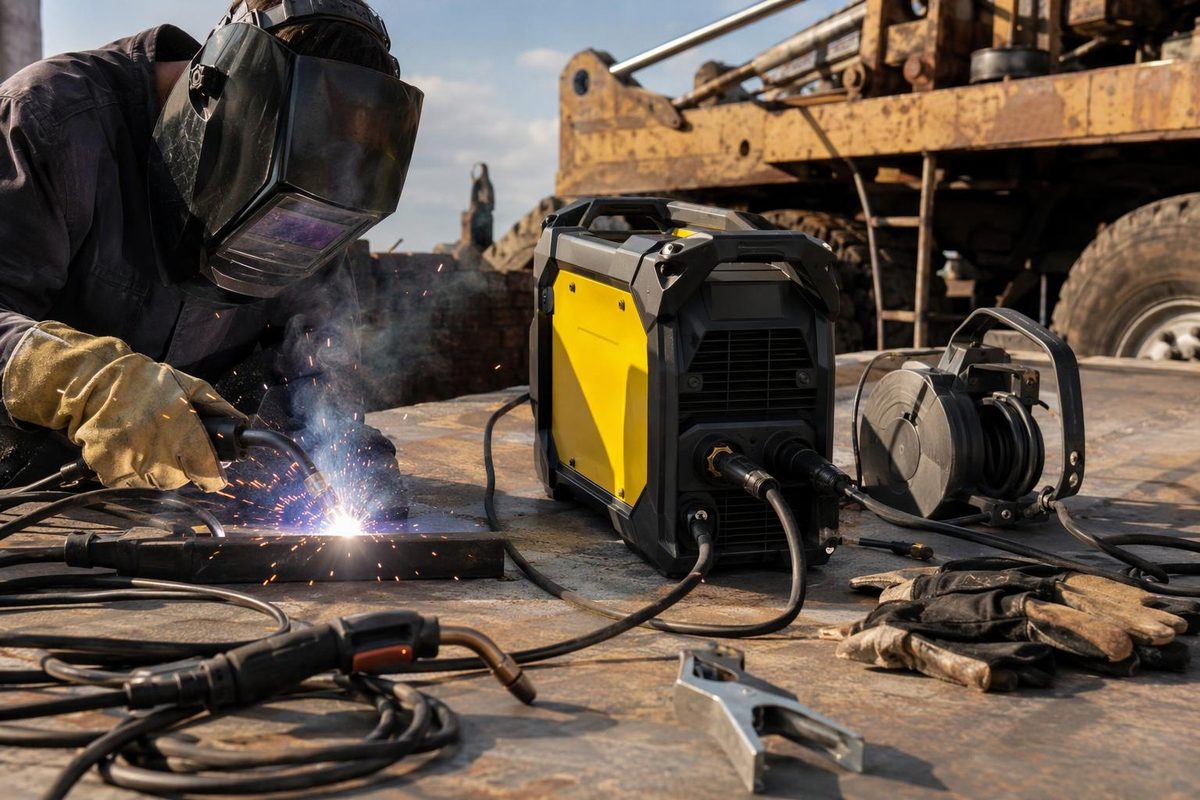
The ESAB Renegade VOLT EMP 200i makes the most sense when getting power to a repair takes more effort than making the weld. It runs from four DeWALT FLEXVOLT batteries, 120/230 V mains, or a combination of mains and batteries. It supports stick and Live TIG, plus MIG and self-shielded flux-core through an optional spool gun—not a conventional built-in wire feeder. ESAB’s product page identifies field repair and maintenance as its intended work.
The buying question is whether that mobility offsets its battery-mode output limits, recharge logistics and process accessories. This is a specifications-based assessment, not a hands-on test.
Output depends on the power source and process
“200i” does not mean 200 A in every configuration. ESAB’s August 2026 fact sheet gives these maximum-current ratings:
| Power mode | Stick: current / duty cycle | Live TIG: current / duty cycle | MIG: current / duty cycle |
|---|---|---|---|
| 120 V mains | 110 A / 25% | 140 A / 25% | 120 A / 25% |
| 120 V mains plus AMP+ | 150 A / 25% | 180 A / 25% | 160 A / 25% |
| 230 V mains, with or without AMP+ | 200 A / 25% | 200 A / 25% | 200 A / 25% |
| Battery only | 140 A / 18% | 150 A / 18% | 150 A / 18% |
Source: ESAB EMP 200i fact sheet. These are rated output points, not recommended weld settings.
The cordless stick limit is 140 A, not the general “up to 150 A” headline. Battery-only output also has a lower duty cycle at maximum current. At the fact sheet’s 100% duty-cycle points, battery-mode ratings drop to 60 A stick and 70 A TIG/MIG; on 230 V mains, all three processes are rated at 100 A. That difference matters more for extended seams than for short, intermittent repairs. These ratings do not state how long a battery charge lasts. ESAB’s output specifications.
AMP+ supplements wall power with battery power. ESAB says it can help prevent nuisance breaker trips or provide additional output. The table shows its clearest output benefit on 120 V; it does not raise the listed 230 V maximum above 200 A. It is not permission to use an unsuitable circuit or adapter. Check the machine instructions and supply requirements; our welder outlet guide explains the separate plug, breaker and wiring questions.
Buy the right package for wire welding
ESAB lists two materially different packages:
- 0448756880 — base EMP 200i package: power source, detachable battery box, four 12 Ah FLEXVOLT batteries, four-port fast charger, 10 ft electrode-holder and work-return leads, shoulder strap and 120/230 V power adapter.
- 0448856880 — spool-gun kit: the base equipment plus a Tweco Spool Gun 250 with 12.5 ft cable, Victor GF250 regulator and a 2 lb spool of .035 in. Sureweld 70S-6 wire.
Those contents come from ESAB’s ordering information. A shielding-gas cylinder and TIG torch are not listed among either package’s included items.
The base machine’s MIG capability therefore does not make it ready to MIG weld out of the box. Match quotations by part number and included accessories, rather than comparing the base price with a wire-ready kit. Baker’s Gas likewise identifies its 0448756880 listing as the base package and describes the spool gun as optional.
For solid-wire MIG, plan for the appropriate shielding gas. Self-shielded flux-core avoids that cylinder requirement, but still needs the spool gun and a compatible wire setup. Check wire classification, diameter, polarity and gun consumables before setting voltage and wire speed; the MIG versus flux-core guide explains why those setups are not interchangeable.
Live TIG is DC TIG—not AC aluminum TIG
ESAB identifies the TIG process as DC Live TIG, specifies a valve-bodied torch and lists an optional foot control, part W4014450. The torch and pedal are separate purchases. ESAB’s product FAQ confirms those requirements.
The fact sheet’s “TIG (AC)” heading refers to operation from an AC mains supply, not an AC welding waveform. Do not buy this machine expecting conventional AC TIG capability for aluminum. ESAB’s advertised aluminum application is MIG through the spool gun. ESAB’s fact sheet.
Battery runtime needs a job-specific check
ESAB’s electrode-consumption figures show why “rods per charge” needs a size and classification attached. With four 12 Ah batteries, the fact sheet lists:
| Electrode size | E6013 | E7018 | E6010 |
|---|---|---|---|
| 3/32 × 9.8 in. | 33 | 26 | 31 |
| 1/8 × 13.8 in. | 14 | 10.5 | 12 |
These are manufacturer consumption figures, not guaranteed field results. ESAB notes that operating parameters and battery selection change consumption. Use a demonstration with your intended electrode or wire, current, joint and weld length to judge whether one battery set covers the repair.
The batteries do not charge inside the welder when it is plugged in. They must go on the external DeWALT charger. ESAB’s FAQ lists a 100-minute charge time with the included DCB104 four-port charger, allows 6, 9 and 12 Ah FLEXVOLT packs, and explicitly excludes 15 Ah packs. Smaller packs shorten runtime. Battery and charging guidance.
Where it fits—and where to look elsewhere
Short repairs away from an outlet are the strongest fit: the machine can remove the need to bring a generator solely for welding. For carrying, ESAB’s fact sheet lists 51 lb with four 12 Ah packs and dimensions of 19 × 9 × 19 in. with the battery box. Its product-page graphics instead show 54 lb loaded, so confirm the configured carrying weight if access involves long walks or restricted spaces. Fact sheet; product page.
Look elsewhere if the primary task is prolonged high-current welding, conventional AC aluminum TIG, or shop MIG work where you prefer a standard gun and larger spool arrangement. Before ordering, settle three things: the output required in the mode you will actually use, the complete process package, and enough charged battery sets for the work interval. Those—not the 200 A headline—determine whether the EMP 200i solves your field-repair problem.