
Lincoln AC-225-S: Check Power, Rods and Duty Cycle Before Buying
Check Lincoln AC-225-S specifications, AC-compatible rods, input power and duty cycle, plus practical setup and used-welder inspection steps.
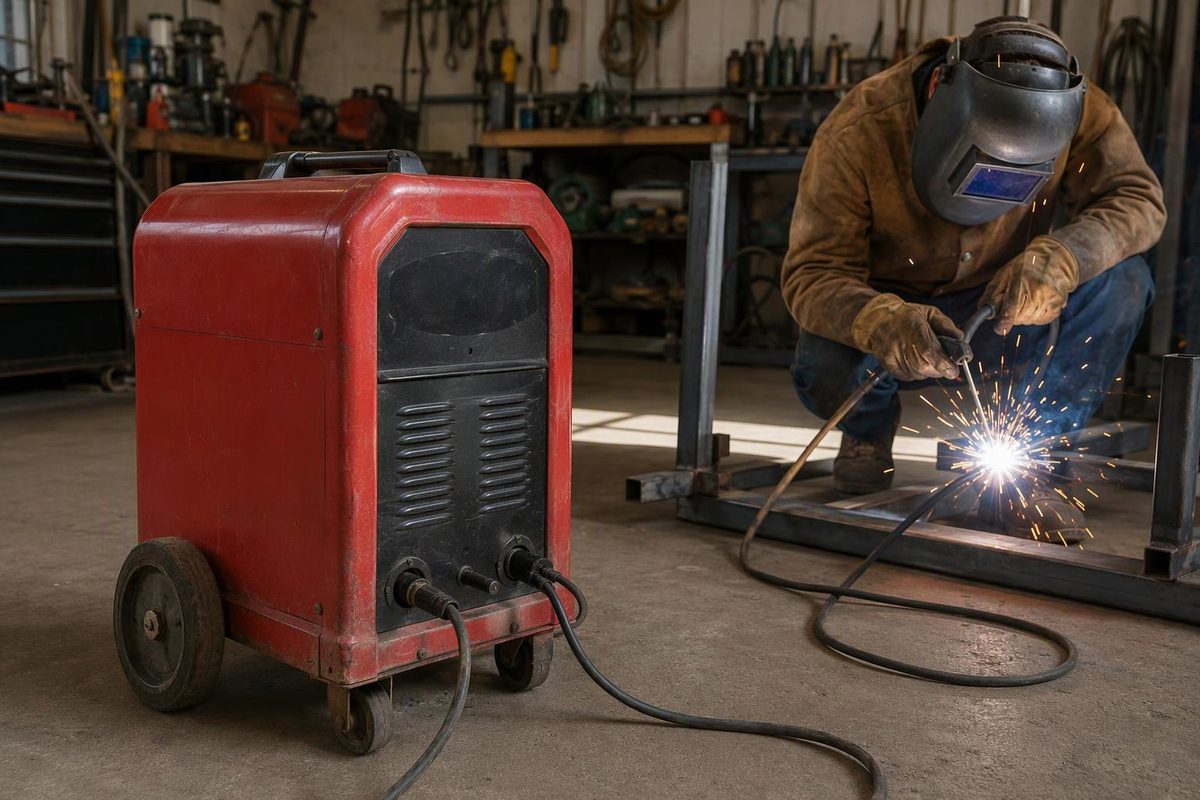
The Lincoln Electric AC-225-S is an AC-output stick welder, suited to intermittent steel repair and fabrication when the electrode supports AC. Its main limitations are straightforward: it needs the correct shop power, has stepped rather than continuously variable current adjustment, and does not provide DC polarity selection.
Before buying one—or blaming it for a stubborn arc—check the nameplate, available electrical supply and exact rod. The similar-looking AC/DC 225/125 is a different machine with additional output choices; its DC instructions do not apply to the AC-only model. Lincoln covers both in its AC-225-S and AC/DC 225/125 operator’s manual.
Specifications: identify the version first
For the U.S. K1170 AC225, Lincoln’s published specifications are:
| Item | Published specification |
|---|---|
| Input power | 230 V, single-phase, 60 Hz |
| Welding output | AC, 40–225 A |
| Rated output | 225 A at 25 V, 20% duty cycle |
| Input current at rated output | 50 A |
| Maximum open-circuit voltage | 79 V |
| Current adjustment | Marked selector-switch positions |
| Weight | 109 lb / 49.5 kg |
| Dimensions, H × W × D | 24 × 17.25 × 12 in. |
| Factory input plug | NEMA 6-50P |
These figures come from Lincoln’s AC225 specification sheet, updated December 2012, not a guarantee that every older AC-225-S has identical specifications. That sheet also lists a different 220 V, 50 Hz K1290 version. Use the machine’s product, code and serial numbers when selecting its manual or ordering parts.
The 225 A figure describes welding output—not the required branch-circuit amperage and not a universal material-thickness capacity. Joint preparation, electrode, position and number of passes still determine whether the machine fits a particular weld.
Input power and duty cycle matter more than the maximum dial setting
The K1170 is not a 120 V household-outlet welder. Lincoln’s installation instructions call for a NEMA 6-50R receptacle and installation by a qualified electrician, with the supply checked against the nameplate and applicable electrical codes. Do not treat an adapter or matching receptacle shape as proof that an existing circuit is suitable. The equipment-grounding connection protects the machine frame; the work clamp completes the welding circuit and is not a substitute for it. See the manual’s input-power and grounding instructions.
A 20% duty cycle means two minutes of arc time within a ten-minute period. Lincoln’s November 2013 manual rates the covered 60 Hz machines at 20% at each marked current position and says to leave the machine on so its fan can cool it during the remaining time.
There is a document discrepancy worth checking: the December 2012 specification sheet lists an exception allowing one hour of continuous operation at the 75 A setting, but the November 2013 manual does not state that exception. Do not assume it applies to your machine. Follow its code-matched manual, and confirm any extended-duty allowance with Lincoln before relying on it.
The normal operating pattern can suit short repairs with fitting and slag-cleaning pauses. It is a poor match when the job requires sustained arc time.
Choose an AC-compatible rod before adjusting amps
An electrode classification alone is not enough: read the actual product’s current type, position limits and amperage range. Lincoln’s AC225 selection chart includes E6011, E6013, E7014 and AC-capable low-hydrogen products, but that does not make every rod bearing those classifications interchangeable. Source: Lincoln electrode selection chart.
Two product-specific examples illustrate the difference:
| Electrode product | Diameter | Published AC range |
|---|---|---|
| Lincoln Fleetweld 180, E6011 | 3/32 in. / 2.4 mm | 40–90 A |
| Lincoln Fleetweld 180, E6011 | 1/8 in. / 3.2 mm | 65–120 A |
| Lincoln 7018 AC, E7018 H8 | 3/32 in. / 2.4 mm | 75–120 A |
| Lincoln 7018 AC, E7018 H8 | 1/8 in. / 3.2 mm | 105–150 A |
Sources: Fleetweld 180 datasheet, April 2026 and Lincoln 7018 AC datasheet, May 2016.
These are operating ranges, not prescribed settings for every joint. Select a marked machine setting inside the product’s range and test on representative scrap, accounting for thickness, fit-up and position. Lincoln 7018 AC excludes vertical-down welding; low-hydrogen work also requires the manufacturer’s storage and handling instructions. A smooth bead does not establish weld qualification or internal soundness. For broader selection, see stick welding rods and machine compatibility.
If the arc sticks or runs unevenly, check in this order
- Electrode compatibility and condition. Confirm AC operation and inspect the coating. Changing amperage cannot make a DC-only electrode suitable for this machine.
- Work connection and leads. With the machine unplugged, inspect the clamp, holder, connections and insulation. Connect the work clamp to clean metal close to the weld. A poor connection adds resistance and can create an unstable welding circuit.
- Supply suitability. If performance changes with an extension cord or the supply protection trips, stop and have the supply checked. Do not increase breaker size to mask the problem. See welder extension-cord selection.
- Current and technique. Once the circuit and rod are correct, adjust within the electrode’s range and maintain its recommended arc length. Change one variable at a time on a test coupon.
Lincoln requires sound insulation and good work connections, and specifically warns: do not turn the current selector while welding—it damages the contacts. Source: Lincoln safety and operation instructions.
Buying a used AC-225-S
Inspect it unplugged first. Look for a legible nameplate, damaged input cord or plug, cracked lead insulation, loose connections, exposed holder hardware and obstructed cooling openings. Have suspect wiring or internal faults assessed by qualified service personnel before a powered test.
If it passes inspection, test it on a verified supply with a known AC-compatible electrode. Confirm fan operation and consistent output at more than one current setting, stopping the arc before moving the selector and staying within duty cycle. A brief successful bead is not proof of electrical safety or full-load condition. Include replacement leads, holder, clamp and any circuit installation in the buying decision.
This is not a machine for electrically hazardous welding conditions. Lincoln’s AC225 safety note advises against using it in damp locations, wet clothing, on metal structures or in cramped positions. The manual explains the contact risk, including working on metal floors, gratings or scaffolds, or where cramped positioning makes contact with the workpiece or ground likely. Use the specified safer equipment and a site-specific safety assessment instead. Normal operation still requires welding PPE, ventilation and fire precautions.