
What to Wear—and What an FR Label Does Not Prove
Choose welding FR clothing by spatter, position, heat and construction—not the FR label alone. Compare FR fabric, leather, hybrids and ratings.
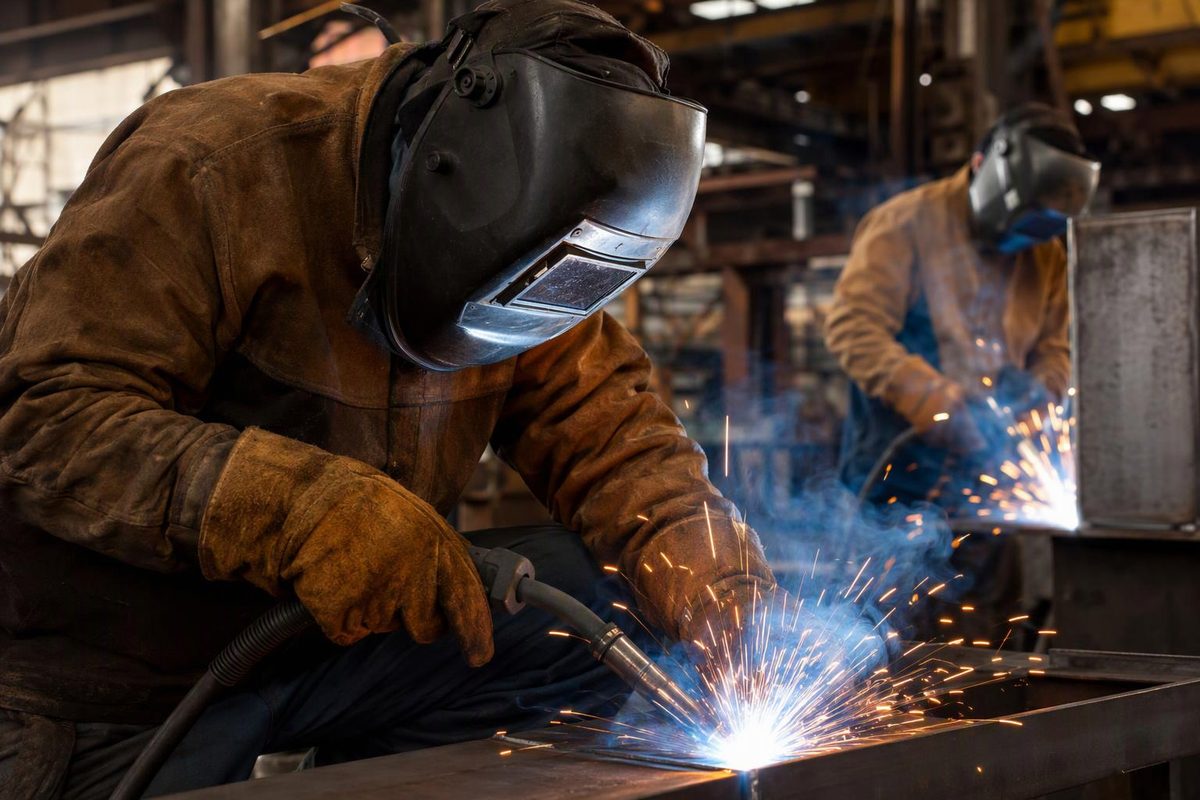
FR clothing for welding should cover exposed skin, resist ignition, avoid melting and prevent sparks or slag from becoming trapped. It is not fireproof, and an “FR” label alone does not establish how a garment will perform against welding spatter.
The right setup may be an FR shirt and pants for controlled, lower-spatter bench work or leather with additional guards for heavy, overhead or out-of-position welding. OSHA does not prescribe one outfit for every weld: protective clothing must match the size, nature and location of the work, as determined through the employer’s PPE assessment (OSHA 1910.252).
Select the process, position and spatter path to identify a practical starting point.
Welding Clothing Starting Point
This result identifies a clothing configuration to assess, not a garment rating or mandatory site rule.
Use a documented FR shirt or jacket with FR pants, full sleeves and complete neck and leg coverage. TIG’s low spatter does not remove the ultraviolet exposure to uncovered skin.
Close the collar and cuffs, cover pockets, overlap gloves and sleeves, and wear uncuffed pants over boot tops.
Rating limit: The available facts do not establish an exact ISO 11611 class for an individual job. Confirm the exact garment through the employer’s PPE assessment and site requirements.
Sources: OSHA 29 CFR 1910.252; CCOHS welding PPE guidance; AWS Fact Sheet No. 33; ISO 11611:2024.
Start With the Exposure, Not Fabric Weight
Assess where sparks, spatter, slag and arc radiation can reach the body. Process matters, but position, joint access and weld duration can change the answer:
- Controlled TIG at a bench: Generally produces little spatter, but the arc still exposes uncovered skin to ultraviolet radiation. Full arm, neck and leg coverage remains necessary.
- Short-circuit MIG: Can direct repeated spatter at the chest, forearms and lap. An FR shirt or jacket may need leather panels, sleeves or an apron in those areas.
- Stick and flux-cored welding: Slag and heavier spatter often justify leather or hybrid protection, particularly for vertical and overhead work.
- Overhead welding, gouging and cutting: Call for protection around the neck, shoulders, ears, lap and boot tops because hot material can fall, roll and lodge in clothing.
This is a selection sequence, not a fixed prescription. Increase protection as the amount, temperature or direction of hot material reaching the welder increases. Repositioning the work or using a suitable shield can also reduce exposure; CCOHS specifically notes that a shield can help keep spark spray off clothing (CCOHS welding PPE guidance).
Choose FR Fabric, Leather or a Hybrid
| Garment Material | Practical Use | Main Limitation |
|---|---|---|
| FR-treated cotton | Relatively light coverage for lower-to-moderate heat and spatter | Treatment and fabric can deteriorate through wear or incorrect laundering |
| Inherently flame-resistant fabric | Flexible coverage where the exact garment is documented for the hazard | “Inherent FR” does not document welding-spatter performance by itself |
| Leather | Concentrated sparks, slag and spatter; useful for sleeves, aprons, capes and jackets | Heavy, less breathable and potentially restrictive |
| FR fabric with leather panels | Places leather over the chest, arms or shoulders while limiting total weight | Panel placement must match the direction of exposure |
| Ordinary synthetic or synthetic-blend workwear | Not appropriate unless the exact garment is designed and documented for the hazard | Common synthetics can melt and worsen a burn |
The American Welding Society recommends oil-free, non-melting protective clothing and says heavier leather or FR material is harder to ignite than lighter material. It also recommends adding leather aprons, leggings, capes and sleeves as the application requires (AWS Fact Sheet No. 33, November 2025).
Heavyweight, tightly woven wool or cotton does not melt like common synthetic workwear, but fiber content alone is not proof of flame resistance. For workplace purchasing, select a documented garment through the employer’s hazard assessment rather than treating any 100% cotton shirt as equivalent to tested FR clothing. CCOHS warns that synthetic fabrics and blends can burn vigorously, melt and cause severe skin burns (CCOHS).
For a closer look at construction and material tradeoffs, see the flame-resistant welding jacket guide.
Construction Can Matter as Much as Material
Suitable fabric can still make a poor clothing system if hot metal has somewhere to collect. Check the complete outfit while standing, reaching and assuming the actual welding position:
- Close the collar and cuffs.
- Use covered pockets; do not leave open chest pockets facing the arc.
- Choose pants without cuffs and wear them over—not tucked into—boot tops.
- Maintain overlap between the shirt or jacket and pants when both arms are extended.
- Avoid gaps and loose folds that can trap spatter.
- Use dry, hole-free welding gloves with cuffs that overlap the sleeves.
- Add an FR cap, hood, ear protection, spats or other guards where falling material can enter.
AWS calls for long pants without cuffs, coverage over boot tops, protected pockets and enough shirt or jacket coverage to shield the arms and neck. Its guidance also says to change wet clothing because moisture increases electrical-shock risk (AWS Fact Sheet No. 33).
If only one area receives concentrated spatter, a welding arm guard or leather apron may be more workable than making the entire outfit heavier.
Fit should permit normal torch or electrode control without pulling a sleeve above the glove or opening a gap at the waist. Excessively loose clothing can snag and form spark-catching folds; clothing that is too tight can restrict movement and lose overlap.
Verify the Exact Garment and Its Ratings
Read the exact model’s label, technical sheet, intended-use information and care instructions. A product-page claim is not enough unless its documentation identifies the garment, applicable standard and performance class.
ISO 11611:2024 is a product standard specifically for protective clothing used in welding and allied processes. It sets minimum requirements and test methods covering hazards that include welding spatter at two risk levels, brief flame contact, radiant heat and harmful optical radiation. It does not cover hand, face, eye or general footwear protection, so compliant clothing is only one part of the PPE system.
ISO 11611 marking provides more welding-specific information than an unexplained “flame resistant” listing. It is not a substitute for the workplace hazard assessment or site rules.
An arc rating concerns electrical arc-flash exposure. It should not be treated as evidence of a welding-spatter class unless the garment also carries suitable welding-specific documentation. Conversely, clothing selected for welding spatter is not automatically adequate for energized electrical work. OSHA identifies arc-rated clothing and associated PPE as protection for the separate electrical arc-flash hazard (OSHA electric-arc flash guidance).
Where flash-fire hazards also exist, such as in some oil and gas operations, the clothing system must address that separate exposure. OSHA has explained that welders exposed to flash fires or short-duration flame need FRC selected for that hazard, while also noting that heat stress must be considered (OSHA interpretation letter, January 12, 2012). Site rules may therefore require clothing beyond what welding spatter alone would justify.
Inspect and Maintain the Clothing
Inspect welding clothing before each use. Remove it from service when holes, open seams, frayed edges or damaged closures break the protective coverage. Keep it clean and free of oil, grease, solvents and other combustible contamination. Change wet clothing rather than continuing to weld in it.
Follow the garment manufacturer’s washing and repair instructions. AWS warns that chemically treated FR clothing can lose some protective characteristics after repeated washing or cleaning. CCOHS notes that products such as chlorine bleach or hydrogen peroxide may damage some FR fabrics or their protective properties. Do not use an ordinary patch or undocumented alteration on a rated garment unless the manufacturer’s instructions permit that repair.
The finished clothing system must cover every exposed area without causing avoidable heat strain or loss of movement. Use targeted leather panels, sleeves, aprons or guards when exposure is concentrated. When hot material is widespread or falling from above, increase full-body coverage rather than relying on a lightweight FR shirt alone.