
What Miller’s Copilot Builder With Blue iQ Adds—and What to Verify
See what Blue iQ adds to Miller’s Copilot Builder, its published welding envelope, subscription requirements, and the checks to make before buying.
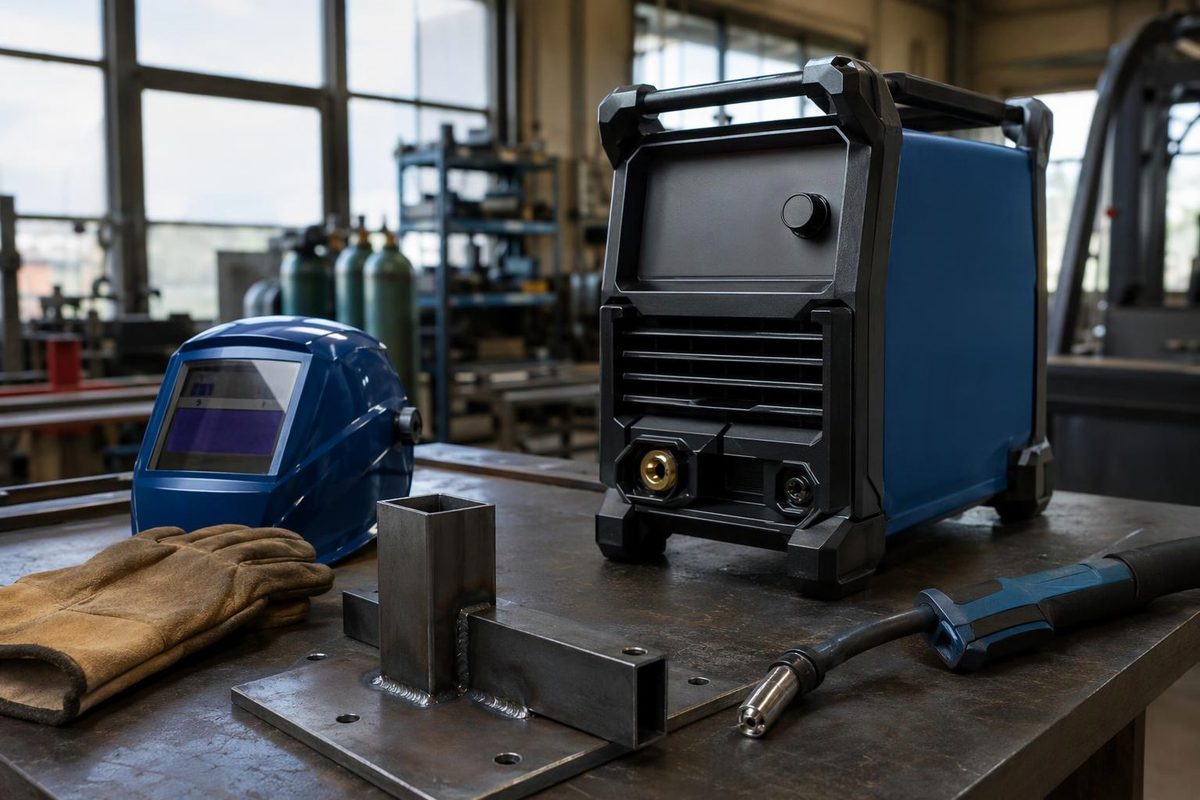
Miller’s Copilot Builder with Blue iQ is a configurable welding cobot with camera-based adaptive control—not simply another power source. Powered by Novarc’s NovAI, Blue iQ is designed to respond in real time to changes in joint location and fit-up. Its intended value is for shops whose production parts vary enough to make a taught robot path unreliable.
The important limit: adaptive welding has a defined application envelope. It is not a promise that the robot can weld any gap, material or position. Miller’s October 2026 specification sheet identifies the supported process, wire, gas and joint positions, plus a separate subscription required for the adaptive services. Miller’s Blue iQ specification sheet
What Blue iQ adds to ordinary Builder functions
Copilot Builder supplies the reconfigurable platform: components arrive on a pallet and can be detached and rearranged around the application. AccuGuide helps position the torch during programming; IntelliSet simplifies choosing and revising settings; touch sensing locates the workpiece before welding; multipass programming supports joints requiring multiple passes.
Blue iQ adds a camera and processing cabinet that connect the robot and Auto Deltaweld power source for live adjustments. Miller describes three capabilities:
- Seam tracking: following a joint whose location changes.
- Fit-up adaptation: changing welding conditions in response to gaps, bevel-angle variation and mismatch.
- Tack-weld adaptation: detecting tacks and changing parameters as the weld crosses them.
These are related but different tasks. Finding a shifted part before striking the arc does not, by itself, account for a gap that changes along the joint. Tracking the joint keeps the torch on course; fit-up adaptation also responds to the changing welding conditions. Miller’s feature descriptions
Do not confuse Blue iQ with the optional amperage-feedback seam tracking described elsewhere in the Copilot family. Miller describes that system as weaving across the joint and correcting position from live amperage feedback. Blue iQ uses an added vision system. Likewise, the family’s 70-inch FANUC-arm option is a separate configuration—not a reach specification to assume for Blue iQ. Miller’s Copilot comparison
The published adaptive welding envelope
As of November 4, 2026, Miller’s October specification sheet lists the following setup:
| Item | Published Blue iQ specification |
|---|---|
| Welding process | Accu-Pulse pulsed MIG |
| Wire | .045-inch ER70S-6; Hobart Quantum Arc 6 recommended |
| Shielding gas | 90% argon / 10% CO₂ |
| T-joints | 1F, 2F, 3F: flat, horizontal and vertical fillets |
| Lap joints | 1F, 2F: flat and horizontal fillets |
| V-grooves | 1G, 2G: flat and horizontal grooves |
| Power source | Auto Deltaweld 500, rated 500 A at 39 V, 100% duty cycle |
| Torch | Water-cooled Tregaskiss CA3 |
| Power-source input | 208/230/460 V, three-phase, 60 Hz; 575 V model available in Canada only |
The Builder controls also require 110 V. The power-source rating is equipment capacity, not a recommended weld setting. Miller’s current specification sheet
This published envelope does not establish adaptive capability for aluminum, stainless steel, other wire sizes, overhead welding or every multipass procedure. Miller’s family comparison says additional Builder processes are available with adaptive mode off; that does not make those processes adaptive. Copilot process comparison
Miller lists seam-following capability of ±3 degrees, described as more than 5/8-inch variation over a 12-inch weld. That is a tracking figure, not a maximum bridgeable joint gap. The sheet does not give a universal maximum gap, thickness range or tack-size limit. Obtain application-specific limits before accepting parts outside your normal fit-up tolerance. Published tracking specification
Subscription and installation costs matter
Blue iQ is not solely a hardware purchase. Miller says an active Novarc subscription is required for adaptive models, model enhancements, updates, remote technical support and NovHub access. The listed services also include a yearly supply of cabinet air filters and camera cover windows. Standard subscriptions are one or three years; a five-year education option is also listed. Subscription charges are excluded from the base price unless the commercial proposal specifically includes them.
NovHub provides weld traceability, process-window monitoring, productivity reporting and remote monitoring. Ask the quotation to identify the subscription term, renewal cost, data-access arrangements and precisely what remains available if the subscription expires. Subscription terms and NovHub functions
Budget for application tooling and safety integration too. The base Builder manual requires a customer safety review and holistic risk assessment after installation because added fixtures and equipment can introduce hazards. Collaborative robot controls do not remove live-arc hazards: plan for welding PPE, protective screens for nearby personnel, fume control and fire prevention. Copilot Builder owner’s manual
Make the demonstration match your production problem
For a useful acceptance trial, bring representative parts—not only ideal coupons:
- Define the joint: material, thickness, position, required weld size, applicable procedure and inspection criteria.
- Include normal variation: measured minimum and maximum gaps, shifted parts, typical tacks and actual torch-access restrictions.
- Verify the response: ask which variables Blue iQ changes, their permitted ranges, and what happens when variation exceeds the model’s limits.
- Measure the whole cycle: programming, sensing, loading, welding, consumable service, recovery and rework—not just arc-on speed.
- Inspect against the job requirements: a consistent-looking bead or stored weld video does not establish internal soundness. See how to assess bad welding beyond appearance.
Blue iQ deserves an application trial when joint variation is the obstacle to robotic welding. Buy against demonstrated performance on your parts, a written operating envelope and a complete installed-and-subscription quotation—not the word “adaptive” alone.