
When Welding Respirators Require Medical Clearance
See whether a welding PAPR helmet, tight-fitting PAPR, half-mask, or N95 needs OSHA medical clearance and fit testing now and under the proposal.
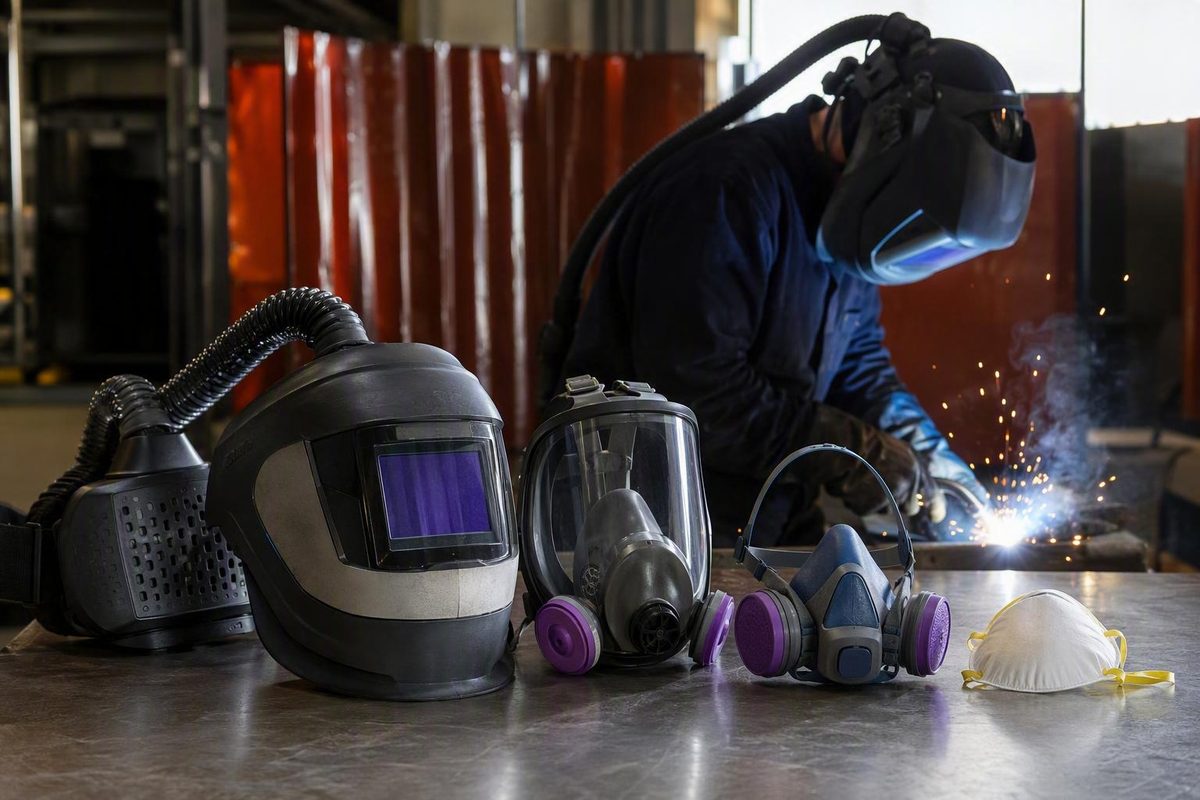
A welding helmet with a loose-fitting PAPR hood is included in OSHA’s proposed medical-evaluation exemption because the proposal covers loose-fitting powered air-purifying respirators. Under the current federal rule reflected in the supplied record, however, an employer-assigned welding PAPR still requires medical evaluation before use. A tight-fitting PAPR or elastomeric half-mask remains subject to medical evaluation under both the current rule and the proposal. Required tight-fitting respirators also require fit testing; loose-fitting PAPR hoods do not.
Choose the respirator and whether its use is required; the result shows medical-evaluation and fit-testing duties under both rules.
Select the equipment and whether the employer requires it. “Proposal” means the limited change described in Docket OSHA-2025-0006, not a confirmed final rule.
Required Loose-Fitting PAPR Hood
Current rule: medical evaluation required; fit test not required. Proposal: medical evaluation not required; fit test not required.
Complete Required-Use Comparison
| Respirator | Current Medical Evaluation | Medical Evaluation Under Proposal | Required-Use Fit Test | Reason |
|---|---|---|---|---|
| Loose-fitting PAPR hood or helmet | Yes | No | No | Proposal covers loose-fitting PAPRs; no facial seal |
| Tight-fitting PAPR | Yes | Yes | Yes | Not within the proposed categories; relies on a seal |
| Elastomeric half-mask | Yes | Yes | Yes | Not within the proposed categories; relies on a seal |
| N95 filtering facepiece | Yes | No | Yes | Proposal covers filtering facepieces; fit remains separate |
For permissible voluntary use, filtering-facepiece-only users are excepted from the limited medical-ability program provision. Voluntary users of the other listed respirators generally remain subject to that provision under the current rule. Fit testing is not generally required solely for permissible voluntary use.
Source: 29 CFR 1910.134 and OSHA rulemaking Docket OSHA-2025-0006, RIN 1218-AD48. The supplied record runs through the July 6, 2026 comment deadline and does not confirm a later final rule.
The Proposal Covers Loose-Fitting Welding PAPRs
The exemption turns on the respiratory inlet covering, not whether the equipment is marketed as a welding helmet. A PAPR uses a blower to move air through its filters, but its hood or facepiece can be either loose-fitting or tight-fitting.
A welding helmet system qualifies for the proposed exemption when its PAPR hood or helmet is loose-fitting and does not depend on a face-to-facepiece seal. Under the proposal, required users of that category would no longer need the medical evaluation specified by 29 CFR 1910.134(e). They would still be covered by the remaining applicable respiratory-program requirements.
A blower does not automatically make a respirator loose-fitting. A PAPR connected to a tight-fitting half-mask or full facepiece remains a tight-fitting respirator. The proposal described in the supplied record does not remove its medical-evaluation requirement.
An elastomeric half-mask worn beneath a conventional welding hood also remains outside the proposed exemption. The same is true of full-facepiece respirators, supplied-air respirators and self-contained breathing apparatus.
A filtering facepiece, such as an N95 worn under a hood, is the proposal’s other covered category. If required, it currently needs medical evaluation and fit testing. The proposal would remove the medical evaluation, but not the fit test, because the N95 still relies on a facial seal.
The Proposal Was Not Yet an Operative Exemption in the Supplied Record
OSHA proposed removing the medical-evaluation requirement for two categories: filtering facepiece respirators and loose-fitting PAPRs. The rulemaking identifiers are Docket OSHA-2025-0006 and RIN 1218-AD48.
OSHA’s June 3, 2026 Federal Register notice reopened the record, with comments accepted through July 6, 2026. The supplied evidence does not establish whether OSHA issued a final rule, withdrawal, correction or later notice after that date.
The July 1, 2025 proposal therefore should not be treated as an operative exemption without checking the current official sources. The FederalRegister.gov location supplied for that proposal also returned a server error during the underlying research and cannot alone establish the proposal’s terms or present legal status.
Until the current eCFR, OSHA docket and official Federal Register show that a final rule has taken effect, employers should continue following the operative version of 29 CFR 1910.134. State-plan rules and stricter site or employer requirements may also apply.
Required Use Controls The Current Medical-Evaluation Duty
Federal OSHA does not require medical clearance merely because someone welds. Under the current framework, an employer must provide a medical evaluation before an employee who is required to wear a respirator is fit-tested or uses it at work.
The employer must provide required respirators, medical evaluations and associated training at no cost to the employee. Required use also places the worker within the employer’s written, worksite-specific respiratory-protection program.
A respirator is required when it is necessary because of the hazard, mandated by an applicable standard or made mandatory by the employer. Calling respirator use optional does not make it voluntary when workplace conditions or employer instructions make it necessary.
The federal sequence is:
- Identify the airborne contaminants and their physical and chemical forms.
- Measure exposure or develop a defensible reasonable estimate.
- Apply feasible engineering and work-practice controls.
- Determine whether respiratory protection remains necessary.
- Select a NIOSH-certified respirator for the identified conditions.
- Complete the applicable medical evaluation, fit testing and training before use.
“Welding fumes” is not a sufficient respirator-selection description. The process, electrode or wire, flux, base metal, coating, cleaner, shielding gas, nearby work and ventilation can change the hazard. Respirator selection must also account for contaminant concentration, oxygen conditions, work rate, heat, humidity, duration, other protective equipment and compatibility with the welding hood.
OSHA treats feasible engineering controls as the primary means of preventing atmospheric contamination. Enclosure, confinement, substitution, local exhaust and general ventilation may be relevant. A respirator is not an automatic substitute for effective fume control, while the presence of ventilation alone does not prove that respiratory protection is unnecessary.
Welding in tanks, vessels, pits, compartments and other confined areas requires separate analysis. The atmosphere and applicable welding, respiratory-protection and confined-space rules must be evaluated before selecting equipment. The general provisions appear in OSHA’s welding, cutting and brazing requirements.
Voluntary Use Produces Different Results
When the employer has determined that respiratory protection is not required, it may permit voluntary use only if that use does not create a hazard.
Permissible voluntary use limited to a filtering facepiece, such as a disposable N95, is excepted from the written-program requirement in 29 CFR 1910.134(c)(2)(ii), including the limited medical-ability provision that otherwise applies to voluntary use of other respirators. This exception does not cover a required N95.
Voluntary use of an elastomeric half-mask, tight-fitting PAPR or loose-fitting PAPR generally retains limited program duties under the current rule, including determining that the worker is medically able to use it. Fit testing is not generally required solely for permissible voluntary use, although the respirator must not create a hazard.
The proposed change would remove the medical-evaluation requirement for a filtering facepiece or loose-fitting PAPR. It would not extend that treatment to a voluntarily used elastomeric half-mask or tight-fitting PAPR.
Medical Evaluation And Fit Testing Are Separate
Medical evaluation determines whether a worker can safely bear the physiological and psychological demands of respirator use. Fit testing determines whether a particular tight-fitting facepiece seals adequately to that individual.
| Requirement | Medical Evaluation | Fit Test |
|---|---|---|
| Purpose | Ability to use the respirator safely | Adequacy of a facial seal |
| Timing | Before fit testing or required use | After medical clearance and before required use |
| Applies by type | Depends on use and operative medical rule | Required tight-fitting facepieces |
| Repetition | Trigger-based | Before initial use and at least annually |
For covered use, the order is medical evaluation, fit test if the respirator is tight-fitting, and then workplace use after all applicable steps are complete.
A loose-fitting welding PAPR hood does not rely on a facial seal, so it does not require tight-facepiece fit testing. That remains true whether or not the medical-evaluation proposal takes effect. The employer must still address selection, training, inspection, cleaning, storage, maintenance and program evaluation.
A required N95 does rely on a facial seal. Even if the proposal removes its medical evaluation, the fit-testing requirement must be analyzed separately and would remain under the proposal described in the supplied evidence.
Tight-fitting respirator fit testing is generally required before initial use, at least annually, after a facepiece change and when applicable physical changes could affect the seal. Medical reevaluation does not have an automatic annual interval under the general federal framework reflected in the evidence.
Medical reevaluation is instead triggered when:
- The employee reports signs or symptoms related to respirator use.
- The physician or other licensed health care professional recommends reevaluation.
- A supervisor or program administrator determines that reevaluation is needed.
- Fit-testing or program-evaluation information indicates a possible need.
- Workplace conditions substantially increase the physiological burden.
For a welder, a greater work rate, longer wear time, higher heat or humidity, heavier equipment, different protective clothing or a change in respirator type may increase that burden.
The Appendix C Review May Be Enough By Itself
OSHA’s mandatory Appendix C questionnaire is reviewed by a physician or other licensed health care professional. An examination that obtains the same information may be used instead.
Every covered employee completes Part A, Section 1 and answers questions 1 through 9 of Part A, Section 2. Questions 10 through 15 are mandatory for employees selected to use a full-facepiece respirator or self-contained breathing apparatus and voluntary for users of other respirators. Questions from Part B may be added at the health care professional’s discretion; Part B is not universally mandatory.
Appendix C includes a discretionary question concerning tungsten or cobalt grinding or welding. That makes welding-related exposure relevant to some evaluations, but it does not create a separate clearance rule for every welder.
The reviewing professional may issue a recommendation from the questionnaire alone. A physical examination, pulmonary-function test, chest X-ray or other clinical procedure is not automatic. Follow-up is required when the professional decides that more information is necessary.
The result may be clearance, clearance with restrictions, a request for additional evaluation or a determination that the employee cannot safely use the proposed respirator. A supervisor should not reinterpret a restriction or substitute an informal judgment.
Medical Information Remains Confidential
The employer must pay for a required initial evaluation and necessary follow-up. The employee must be allowed to complete the questionnaire during normal working hours or at another convenient time and place.
Completed answers go directly to the reviewing health care professional. Supervisors, foremen, safety managers and human-resources personnel must not review them. A secure direct system, sealed envelope or private clinic appointment can preserve that separation.
The employer supplies the evaluator with the respirator’s type and weight, expected frequency and duration of use, physical work effort, other protective equipment, temperature and humidity extremes, the respiratory-protection standard and the written program. For welders, the description should accurately cover heat, work rate, awkward positions, protective clothing and expected wear time.
The employer receives a written recommendation addressing whether the worker can use the respirator, applicable limitations, required follow-up and any recommended reevaluation. It does not receive questionnaire answers, diagnoses or other confidential medical details.
Employers Should Verify The Rule Before Changing A PAPR Program
A shop considering a welding PAPR should first identify whether the hood is loose-fitting or whether the system uses a tight-fitting facepiece. Product names and the presence of a blower do not resolve that distinction.
For an employer-assigned loose-fitting welding PAPR, the current framework requires medical evaluation but not fit testing. The proposal would remove that medical evaluation while leaving other applicable program duties intact.
For a required tight-fitting PAPR or elastomeric half-mask, both medical evaluation and fit testing remain. For a required N95, the proposal would remove medical evaluation but leave fit testing. Permissible voluntary use follows the separate rules shown in the decision tool.
Before changing a program, check Docket OSHA-2025-0006, the current eCFR text of 29 CFR 1910.134, OSHA’s rulemaking materials and the official Federal Register on govinfo.gov. Also check state-plan, substance-specific, construction, shipyard, confined-space and site requirements. The supplied evidence does not establish a post–July 6, 2026 final action.