
PPE Gloves for Welding: Heat, Cut and Chemical Protection
Choose welding PPE gloves by process, heat, spatter, cuts, chemicals and fit—then verify the exact model’s ratings and inspect it before use.
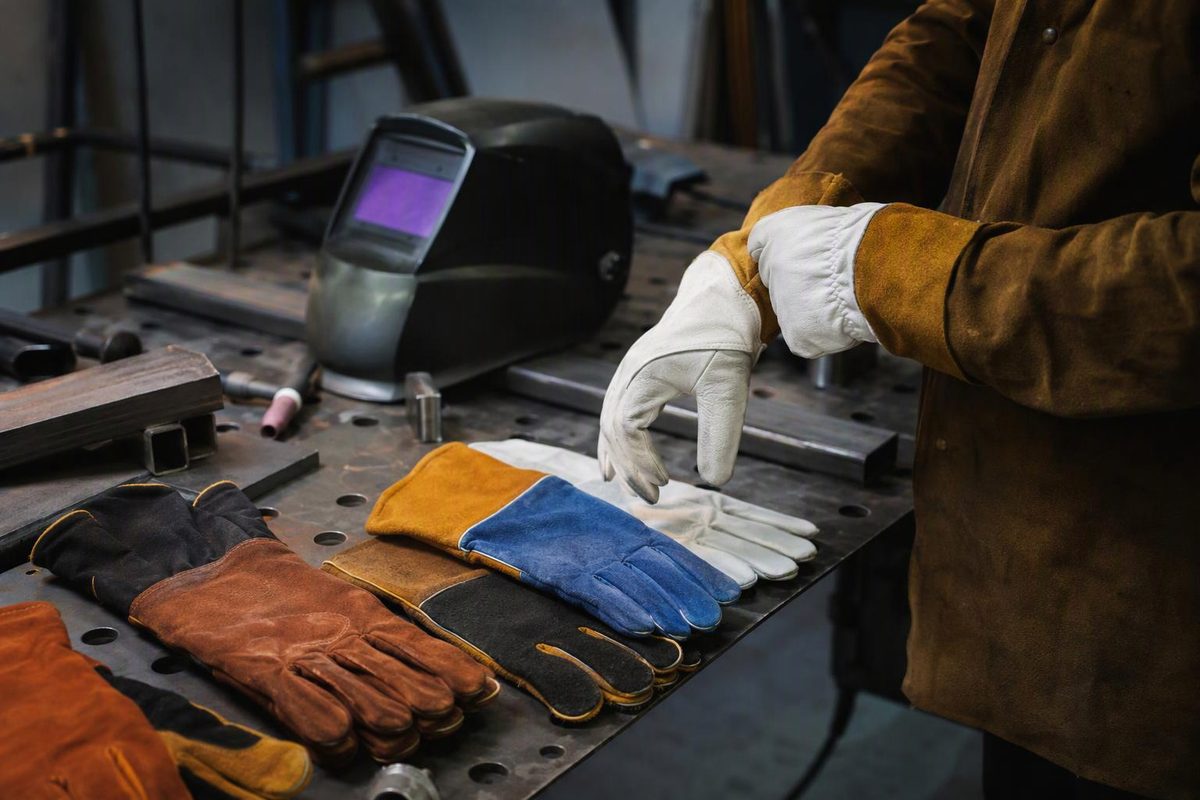
There is no single “best” PPE glove for every welding-shop task. A thin TIG glove can provide good torch and filler control but too little insulation for sustained high-heat work. A heavily insulated stick glove can resist more heat and spatter but make precise fitting difficult. Neither is automatically suitable for solvents, sharp sheet edges or rotating machinery.
For U.S. general-industry workplaces, OSHA requires employers to select hand protection according to its performance relative to the task, conditions, duration and identified hazards—not merely by job title or glove material. Covered hazards include cuts, punctures, severe abrasion, chemical and thermal burns, and harmful temperature extremes (OSHA 29 CFR 1910.138).
Select the glove in this order
- Identify the operation: TIG, MIG, flux-cored, stick, oxyfuel cutting, plasma cutting, grinding, material handling or chemical cleanup.
- Identify every hand hazard: radiant heat, hot metal, spatter, sharp edges, abrasion, chemicals, electrical contact and possible entanglement.
- Check documented performance: look for applicable heat, cut, puncture, abrasion or chemical-resistance data for the exact model.
- Check coverage and fit: the glove should cover the hand, wrist and required portion of the forearm without compromising grip or becoming loose enough to snag.
- Inspect its condition: do not weld in a wet, burned-through, torn, oil-soaked or otherwise damaged glove.
This sequence matters because “leather,” “cut resistant” and “heat resistant” describe different properties. A glove may perform well against one hazard and poorly against another.
Practical glove choices by welding task
| Task | Useful starting point | Main limitation to check |
|---|---|---|
| Low-amperage GTAW/TIG | Close-fitting, supple leather with sufficient cuff coverage | Thin construction may transmit heat quickly |
| GMAW/MIG and FCAW | Insulated leather welding glove with a gauntlet cuff | Bulk can reduce trigger, gun and fit-up control |
| SMAW/stick | Insulated leather welding glove with sufficient forearm coverage | Heat and spatter can damage seams and fingertips |
| Oxyfuel, plasma or air-carbon-arc cutting | Heavier flame- and heat-resistant glove selected for the actual exposure | A general welding glove may not tolerate intense radiant heat or molten metal |
| Handling sheet, plate or sharp coupons | Glove with documented cut, puncture and abrasion performance | A cut rating does not establish welding heat or flame performance |
| Solvent, acid or caustic cleanup | Chemical glove supported by permeation, degradation and breakthrough data for the exact chemical | Leather welding gloves are not chemical-resistant gloves |
AWS guidance makes a similar process distinction: close-fitting goat-, deer- or sheepskin gloves can provide needed dexterity for GTAW and low-amperage work, while GMAW, SMAW and air-carbon-arc cutting call for thicker insulated leather with melt-through and cut resistance. It also recommends coverage of the hand, wrist and lower forearm (American Welding Society). For a closer comparison of hides, cuffs and construction, see how to choose leather welding gloves.
Treat these categories as starting points, not guarantees. High-amperage TIG on a preheated part may demand more insulation than light bench TIG. Short-circuit MIG on thin sheet and high-current spray transfer do not create the same heat and spatter exposure. Position matters too: overhead welding puts the cuff, sleeve interface and back of the hand in the path of falling spatter.
Read ratings as separate performance claims
ANSI/ISEA 105-2024 classifies hand and arm protection for mechanical hazards, including cut, abrasion and puncture. It also addresses chemical permeation and degradation and several heat and flame properties. Its marking requirements standardize how key protective classifications are displayed (International Safety Equipment Association).
The familiar A1 through A9 scale applies to cut resistance: a higher level represents greater resistance in the specified test. It is not an overall glove-safety score. An A5 glove is not necessarily more heat resistant than an A3 glove, and neither cut level establishes whether the glove provides suitable protection from welding heat or spatter.
Use the performance data tied to the hazard:
- Cut resistance for sharp sheet, plate edges and burrs
- Puncture resistance where wire ends or sharp projections are present
- Abrasion resistance for repeated contact with rough stock
- Conductive-heat, ignition or other relevant thermal data for hot-work exposure
- Chemical permeation, degradation and breakthrough data for cleaners, solvents and pickling products
OSHA’s nonmandatory PPE-selection guidance says no glove protects against every potential hand hazard. It recommends requesting manufacturer documentation showing that a glove meets appropriate test standards for the anticipated hazards (OSHA PPE selection guidance).
Welding gloves must stay dry and serviceable
AWS currently lists ANSI Z49.1:2021 as its safety standard for welding, cutting and allied processes (AWS free resources). Separately, AWS glove guidance calls for heat resistance and appropriate coverage, while CCOHS recommends leather gauntlet gloves or similar protective sleeves and notes that leather is a useful electrical insulator when kept dry (CCOHS welding PPE guidance).
That does not make an ordinary leather welding glove a voltage-rated electrical glove. Nor are gloves the primary control for damaged welding equipment. Keep the work area dry, inspect leads and connections, follow the power-source manual and correct electrical faults rather than relying on glove thickness. This distinction matters because an electrical welding fault is not the same hazard as the eye injury commonly called welding arc flash.
Remove a glove from service when it has:
- holes, split seams or worn-through fingertips;
- stiff, scorched or carbonized areas;
- a wet lining or absorbed sweat that has not dried;
- oil, grease, solvent or other combustible contamination;
- embedded wire, grinding debris or sharp metal; or
- a damaged cuff that no longer provides the required coverage.
OSHA states that defective or damaged PPE must not be used (29 CFR 1910.132). Follow the glove manufacturer’s cleaning instructions; unapproved washing or treatment can alter fit or protective performance.
Fit is a protection feature
A properly sized glove should let the fingers reach the ends without excess material folding over. It should remain secure while the hand opens, closes and rotates, yet not compress the fingers or restrict circulation. Test the motions the task requires: holding a TIG filler rod, changing torch angle, operating a MIG trigger, gripping an electrode holder and repositioning work.
Cuff and sleeve overlap must remain intact when reaching. If the process exposes more of the forearm than the glove covers, add compatible welding arm protection rather than trying to stretch a short cuff beyond its design.
Do not carry one glove choice blindly into every adjacent task. Chemical cleanup requires compatibility and breakthrough information for the exact product and expected contact. A welding glove may also create an entanglement hazard at rotating equipment; CCOHS advises against wearing gloves while using revolving power tools (CCOHS powered-tool guidance). Follow the machine manufacturer’s instructions and the shop’s task-specific procedure.
The correct PPE glove is documented for the hazards actually present, sized for the user and still serviceable—not simply the thickest glove on the shelf.