
Choose Face Protection That Actually Matches the Job
The same broad retail label may refer to cutting shields, grinding shields, handheld masks or replacement lenses.
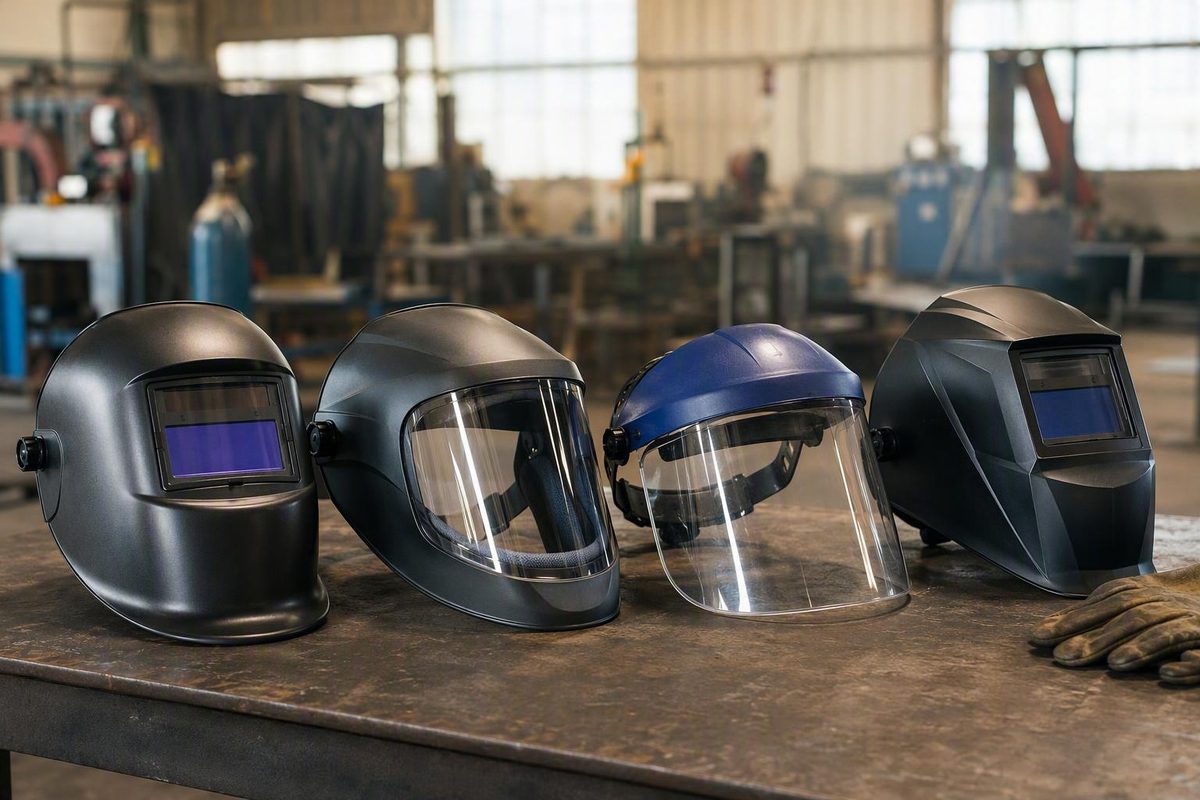
A product labeled “welding face shield” is not automatically suitable for every welding-related task. The phrase can describe an arc-welding helmet, a clear grinding shield, a lightly shaded cutting shield, a handheld mask, a replacement window, or a powered respirator system.
Those products address different needs. A clear shield may provide face coverage during grinding without documenting a filter for viewing an arc. A Shade 3 or Shade 5 shield may be marketed for brazing or oxyfuel cutting rather than arc welding. A low-priced item in a face-protection collection may be only a replacement lens, not a complete protective assembly.
Use this buying order:
- Identify the process and hazards.
- Select the correct category of protection.
- Determine the shade needed for the process and operating amperage.
- Verify the exact model’s intended use and documented protection.
- Check fit, controls, compatibility, and replacement-part support.
- Follow the exact product manual, employer program, and site rules.
Do not let a retailer title, green lens, safety badge, or placement in a welding category substitute for those checks.
What “Welding Face Shield” Can Mean
Retail terminology is inconsistent.
| Product term | What it usually describes | Typical role | Critical buying question |
|---|---|---|---|
| Arc-welding helmet | Head-mounted shell with a passive or auto-darkening welding filter | Arc welding when the exact helmet and filter are appropriately specified | Is the filter documented for the process and operating range? |
| Clear grinding face shield | Clear visor with headgear or a carrier | Face coverage during grinding and finishing | What does the documentation say about impact protection and underlying eye protection? |
| Low-shade cutting or brazing shield | Tinted shield, commonly offered in lower shades | Certain cutting, brazing, or related hot-work applications | Which shade is specified for this exact task? |
| Handheld welding mask | Mask held in front of the face | Work where one-handed use is practical | Are the shade, intended process, and protection claims documented? |
| Replacement lens or window | Clear or shaded component without a complete shell or headgear | Replacement part for a compatible assembly | Which exact helmet or carrier accepts it? |
| Grinding helmet | Head-mounted clear face enclosure | Grinding, polishing, and material finishing | Is it strictly a grinding product, or does it include a documented welding filter? |
| PAPR face system | Face protection integrated with powered respiratory equipment | Work for which a selected respiratory system is required | Does the exposure assessment support this configuration? |
Retail collections demonstrate why the distinction matters. Cyberweld’s face-protection collection includes complete shields and grinding helmets alongside replacement windows, headgear, gaiters, and PAPR equipment. It also includes clear, Shade 3, Shade 5, anti-fog, and respiratory products. Placement in that collection does not establish that every item is intended for direct arc viewing.
Dedicated helmet categories can be more informative. Airgas separates its listings into passive and auto-darkening helmets rather than treating every face-protection product as equivalent, as shown by its welding-helmet category.
The central screening rule is:
Do not infer arc-welding suitability from a product name, lens color, retailer category, or isolated safety claim. Verify the exact product and filter.
Before putting a product on a shortlist, identify:
- Intended application: Arc welding, oxyfuel cutting, brazing, grinding, finishing, or another stated use
- Filter shade: Fixed shade or adjustable range, not merely “tinted” or “green”
- Mounting style: Head-mounted, handheld, hard-hat-mounted, or integrated with respiratory equipment
- Product scope: Complete assembly or replacement component
- Stated requirements: The specific compliance or certification claims made for the model
- UV/IR documentation: What the manufacturer states about the exact filter
- PPE compatibility: Space and approved configurations for required eyewear and other equipment
- Manual and model number: Documentation that corresponds to the product and filter being purchased
A clear grinding shield and a lightly shaded cutting shield may be appropriate for their documented applications. That does not make either one interchangeable with an arc-welding helmet.
Match the Protection to the Task Before Comparing Features
Start with the operation, not the helmet’s feature list. The category to investigate changes with the task.
| Task | Category to investigate | What to verify | Do not infer |
|---|---|---|---|
| Arc welding | Documented passive, fixed-shade auto-darkening, or variable-shade auto-darkening helmet | Intended process, appropriate shade, filter documentation, limitations, and required secondary PPE | That any tinted shield is suitable |
| Oxyfuel cutting | Cutting goggles, shield, or other protection documented for the operation | Task-specific shade, coverage, and product limitations | That arc-welding instructions apply automatically |
| Brazing | Brazing eyewear or shield with a documented filter | Shade specified for the heat source and operating conditions | That green color proves suitability |
| Grinding | Clear face shield or grinding helmet documented for the debris hazard | Intended use, coverage, condition, fit, and required underlying eyewear | That a clear visor provides an arc-viewing filter |
| Material finishing | Clear shield, grinding helmet, or integrated system appropriate to the work | Debris exposure, visibility, and other required controls | That full-face coverage provides respiratory protection |
| Work involving a respiratory hazard | Respiratory equipment selected through the applicable workplace process | Contaminant, exposure, approved configuration, and compatibility | That a PAPR should be selected by price or coverage alone |
For arc welding, investigate a helmet with a filter documented for that use. Shade selection depends on the process and amperage and should come from applicable guidance and the exact equipment manual. A broad helmet category or adjustable range does not identify the correct setting for a particular weld.
For grinding and finishing, clear shields and grinding helmets may provide useful face coverage. Their listings should not be treated as evidence that they contain a filter for direct arc viewing. Require an explicit intended-use statement for the exact product.
For brazing and oxyfuel cutting, lower-shade products may be relevant. Phillips Safety markets one green polycarbonate shield in Shades 3, 4, and 5 for grinding, brazing, and oxyfuel cutting. Those are seller-stated applications, not a universal shade rule; the task and selected shade still need to match the applicable instructions and operating conditions on the Phillips shield listing.
Plasma work requires precise classification. Plasma cutting and plasma arc welding are different processes. Establish which operation is being performed, its current, and which protection the relevant guidance and equipment documentation specify.
Do not extend ordinary arc-welding advice to laser welding. Do not assume that an arc helmet is intended for oxy-acetylene work either. The King Shield auto-darkening document, for example, excludes both laser welding and oxy-acetylene work. Those product-specific restrictions illustrate why the exact manual must be checked rather than replaced with general category advice in the King Shield guidance.
The greater coverage and higher price do not determine whether it is appropriate.
Warning: A clear impact shield, Shade 3 shield, or Shade 5 shield should not be accepted for direct arc viewing merely because it appears in a welding-related category. Require documentation for the exact product, filter, process, and operating range.
Passive, Fixed-Shade Auto-Darkening, or Variable-Shade?
After identifying arc welding as the task, compare helmet designs against the work pattern.
A passive helmet has a permanently dark lens. Miller’s commercial selection guide describes Shade 10 as typical, but it does not present that shade as correct for every process or amperage. The same guide defines a fixed-shade auto-darkening helmet as one that changes from a light state to a fixed dark state, while a variable-shade auto-darkening helmet allows the operator to select among welding shades; it describes Shades 8–13 as a typical variable range in its helmet-selection guidance.
| Factor | Passive | Fixed-shade auto-darkening | Variable-shade auto-darkening |
|---|---|---|---|
| Pre-arc visibility | Lens remains dark | Light state before the arc | Light state before the arc |
| Hood movement | Commonly raised for setup and inspection | Less lifting may be needed | Less lifting may be needed |
| Controls | Few or none | Limited | More settings to understand |
| Power dependence | No electronic switching | Uses the model’s power arrangement | Uses the model’s power arrangement |
| Routine attention | Lens and cover components | Cover components, sensors, power, and function | Cover components, sensors, power, function, and settings |
| Purchase cost | Generally lower in the supplied commercial comparison | Usually more than a basic passive design | Often higher as features increase |
| Process flexibility | Limited by the installed fixed shade | Limited by its fixed welding shade | Adjustable within the model’s documented range |
| Setup risk | Wrong fixed lens for the task | Wrong model or unchecked function | Wrong shade, sensitivity, delay, or operating mode |
Auto-darkening filters can make positioning and repeated tacking more convenient because the lens is light before the arc and changes to its selected dark state when the arc is detected. This may reduce repeated lifting of the helmet. It does not remove the need to choose the appropriate shade, confirm the operating mode, and follow the model’s prescribed checks.
Passive helmets are mechanically simpler. Commercial comparisons also generally present them as less expensive. Those differences do not establish that passive helmets are universally safer, more durable, or more reliable.
Experience sidebar — preferences, not safety evidence
An informal discussion among welders contains mixed preferences. Some participants favored auto-darkening helmets for TIG, MIG, tacking, precision work, and pre-arc positioning. Others preferred fixed shades for stick welding, large viewing windows, simplicity, or familiarity. Several reported keeping both styles and selecting according to the work. These are personal experiences, not controlled testing or authoritative selection rules, in the WeldingWeb discussion.
Neither design is universally best. A passive helmet with the correct filter may suit consistent work. A variable auto-darkening helmet may better accommodate changing processes and frequent tacking. The defensible choice is the correctly specified, inspected, and understood helmet—not a design selected by reputation alone.
Understand Shade, Sensors, Sensitivity, Delay, and Grind Mode
Feature lists become useful only after the product category is correct. No single specification establishes overall suitability.
Shade describes filter darkness. Select it according to the process, amperage, applicable guidance, and exact manual. Commercial sources describe common variable ranges such as 8–13 or 9–13, but those ranges show what some filters offer; they do not identify the correct setting for an individual operation.
Light state is the filter condition before arc detection. Dark-state range is the welding-shade range available after activation. As a product-specific example, the King Shield document lists DIN 4 in the light state, DIN 9–13 in the dark state, a light-to-dark switching time of 0.3 milliseconds, and UV/IR protection up to DIN 16. Those figures apply only to the helmet described in that manufacturer document.
Sensitivity controls how readily the filter responds to an arc. Follow the model instructions rather than copying another operator’s knob position.
Delay controls how long the filter remains dark after the arc ends. The available range and recommended setup are model-specific.
Sensors detect the arc. More sensors may increase detection coverage in some positions, but the supplied evidence does not establish one sensor count as universally necessary or optimal.
Switching speed is the stated interval between detection and darkening. Treat a retailer or manufacturer figure as a product claim unless it is supported by documentation for the exact filter. A shorter advertised time does not independently prove that the helmet is appropriate for the process.
Grind mode holds an auto-darkening filter in a light state, commercially described as commonly being Shade 3 or 4. It is not the selected welding state. Commercial operating guidance says it must be switched back to welding mode before an arc is struck and notes that sensitivity, delay, batteries, and power arrangements vary by model in its auto-darkening helmet guide.
They may affect usability, but they do not independently document intended process, selected shade, UV/IR claims, or the complete assembly’s other protective characteristics.
Do not rely on a universal sunlight, lighter, or improvised arc test. Prescribed checks vary by model, and the supplied evidence does not establish one procedure for every filter. Use the procedure in the exact manufacturer’s manual.
Verify Protection Claims Instead of Trusting the Listing Title
A product title is marketing metadata, not a protection specification. The same caution applies to search filters and phrases such as “professional,” “true color,” or “for every type of welding.”
Miller’s commercial buying guidance says welding helmets used in the United States need to meet applicable ANSI requirements and helmets used in Canada need CSA compliance. The supplied material does not identify exact standard numbers, marking rules, or certification scope, so buyers should confirm those details through the applicable workplace requirements and model-specific documentation rather than treating the general statement as a complete compliance determination in the Miller guidance.
Claim-verification box
- Applicable requirement: What current rule, employer program, or site requirement applies to the task and location?
- Certification document: Is a declaration, certificate, test record, or recognized marking tied to the exact model and filter?
- Manufacturer specification: What intended use, shade range, protection claims, exclusions, and replacement parts are documented?
- Retailer or marketplace claim: Can the statement be traced to model-specific manufacturer documentation, or does it appear only in a listing?
Do not convert an isolated ANSI Z87.1 or Z87+ statement into a broader claim than the seller provides. Cyberweld describes Z87.1 as an impact-resistance claim for certain visible shields, while the Phillips seller separately identifies Shades 3–5 and specific grinding, brazing, and oxyfuel-cutting applications. Neither type of listing, by itself, establishes suitability for an unlisted arc process.
Verify the exact model and filter, not just the brand or series. Product families can contain passive and auto-darkening models, different shade ranges, different viewing areas, and different sensing or grinding features.
A useful product file should include:
- Exact model and filter identification
- Manufacturer’s intended-use statement
- Fixed shade or adjustable shade range
- Product-specific UV/IR documentation
- Stated impact claim and scope
- Certification or declaration document, where applicable
- Current instruction manual
- Exclusions and operating limitations
- Identified cover plates, batteries, filters, and headgear parts
- Documented compatibility information for the intended configuration
The Phillips shield is an example of bounded seller documentation. Its listing identifies green polycarbonate, Shades 3–5, a Z87+ claim, and grinding, brazing, and oxyfuel-cutting applications. It also provides links to specification, certification, and care documents. Those details make the claims easier to investigate, but they do not turn the product into a general-purpose arc-welding helmet.
The Longevity handheld mask illustrates missing information. The seller lists a polypropylene body, glass lenses, a 92 × 44 mm window, and a price of $14.99, but the supplied page does not state a shade, UV/IR rating, impact standard, or safety certification. Those omissions prevent a process-specific recommendation based on the Longevity listing.
Marketplace statements require the same discipline. A visible YESWELDER listing claims optical class 1/1/1/1, a response time of 1/30000 second, light and dark shades of 3.5 and 9–13, and ANSI Z87.1 certification. These are marketplace claims rather than independent findings; verify the exact model manual and supporting documents before relying on the Amazon search result.
Fit, Visibility, Mounting Style, and Other Practical Buying Factors
A correctly specified filter still has to work in the intended position and configuration.
Use this buying checklist:
- Headgear adjustment: Does the available adjustment fit the operator and hold its setting?
- Balance: Does the helmet remain stable as the operator moves?
- Weight: Is a model-specific weight available, and how is it distributed?
- Viewing area: Does the window provide suitable downward and peripheral visibility?
- Glasses clearance: Is there enough room for the eyewear required by the applicable program?
- Shell coverage: Does the documented design suit the position and task?
- Sensor position: Are sensors likely to be obstructed in the intended work geometry?
- Control access: Can shade, sensitivity, delay, and mode be identified and adjusted reliably?
- Equipment combination: Is the exact helmet configuration documented for use with any required hard hat or other equipment?
- Replacement support: Are the correct cover plates, batteries, headgear, and filters identifiable?
A larger viewing area can broaden visibility, especially for out-of-position work, but commercial selection guidance notes that it may also add weight. Evaluate window dimensions together with balance, shell design, headgear, and verified total weight.
Mounting style changes workflow.
Longevity’s seller-described example is a handheld polypropylene mask with glass lenses and a 92 × 44 mm viewing window. Because its supplied page does not state a shade, UV/IR rating, impact standard, or certification, its physical dimensions and low price are not enough to establish suitability for a defined process.
Headgear fit is functional rather than merely cosmetic. Check whether the adjustment range and pivot arrangement hold the helmet in the intended position without instability or excessive tightness. Where possible, assess the complete configuration in the actual working posture.
Phillips lists multi-axis headgear, cushioned front and rear bands, a contoured lens, and a lens thickness of 0.077 inch for its shield. The same seller listed the shield at $39.50. These are seller-provided specifications, not independent proof of comfort, coverage, or durability, on the product page.
Do not assume that components work together merely because each is sold for industrial use. Confirm the exact combination and any specified adapters or limitations in the relevant documentation.
The supplied evidence is not sufficient to rank products by comfort. A defensible ranking would require comparable weights, balance measurements, fit ranges, work-position trials, and representative user testing.
Inspect, Set Up, and Maintain the Equipment
Inspection and setup instructions are model-specific. The following sequence is a framework for checking the manual, not a replacement for it.
Chronological pre-use checklist
- Identify the task. Confirm the process, operating range, environment, and required equipment.
- Confirm the product. Match the helmet, filter, and cover components to the manual and intended task.
- Inspect the assembly as directed. Apply the manufacturer’s criteria for the shell, filter, headgear, and installed components.
- Check the filter and cover plates. Confirm that required inner and outer plates are present and meet the manual’s condition criteria.
- Check the sensors. Keep them clean and unobstructed using the prescribed care method.
- Confirm power status. Follow the model-specific procedure for batteries, indicators, solar assistance, or automatic power behavior.
- Run the prescribed function check. Use the exact manufacturer’s procedure.
- Set the shade. Use the process, amperage, applicable guidance, and manual.
- Set sensitivity and delay. Follow the model’s instructions for the task and environment.
- Confirm operating mode. Verify that the selected mode is appropriate before starting work.
- Adjust the headgear. Establish stable positioning and the required clearance.
- Check the work position. Confirm that hands, fixtures, the workpiece, or confined geometry will not obstruct the sensors.
The King Shield instructions state that dirty or obstructed sensors can interfere with arc detection and that nearby welding can affect activation if sensitivity is not appropriately adjusted. The same document requires its inner and outer protection glasses to remain installed and directs replacement when they are broken, damaged, or obscured by spatter.
Some auto-darkening helmets combine solar cells with replaceable batteries; other power arrangements differ. Battery type, replacement procedure, indicators, automatic shutoff, and fault behavior should therefore come from the exact manual rather than instructions for another helmet.
Cover plates are replaceable components, but replacement thresholds and part specifications should be taken from the manufacturer. Commercial guidance describes replacing an outer cover lens when it becomes pitted or cloudy, while the King Shield document also mentions broken, damaged, or spatter-obscured plates. Use only the criteria and parts specified for the exact assembly.
For cleaning and storage:
- Follow the product’s care instructions.
- Keep electronic equipment dry where its manual requires this.
- Protect the filter and sensors from contamination and damage.
- Avoid any cleaning, storage, or repair method that conflicts with the manual.
- Record battery and replaceable-part changes when equipment is managed by a shop.
Remove equipment from service when it fails the manufacturer-prescribed check or meets the manual’s damage or replacement criteria. If the shade, filter identity, or component compatibility cannot be established, resolve that uncertainty before use.
The exact equipment manual, applicable workplace program, and site rules override this general framework.
How to Compare Listings Without Comparing Apples to Replacement Lenses
Price comparisons are meaningless until products are placed in the same category. A replacement window, a low-shade cutting shield, an auto-darkening helmet, and a PAPR system are not competing versions of one product.
The following table is not a ranking. It records seller claims and important gaps from the supplied page extracts.
| Example | Product category | Seller-stated application | Mounting | Material | Shade or range | Stated standard | Important missing or unverified information | Listed price | Evidence type |
|---|---|---|---|---|---|---|---|---|---|
| Phillips fixed-shade shield | Low-shade face shield | Grinding, brazing, oxyfuel cutting | Head-mounted | Green polycarbonate | 3, 4, or 5 | Z87+ claim | Task-specific shade selection, independent verification, weight | $39.50 | Seller product page cited above |
| Longevity mask | Handheld mask | Broad welding-use claim | Handheld | Polypropylene body; glass lenses | Not stated | Not stated | Shade, UV/IR rating, impact standard, certification | $14.99 | Seller product page |
| Hobart replacement lens | Replacement component | Compatible carrier application | Requires compatible headgear | Polycarbonate | Shade 3 | Not established in category extract | Complete assembly and task suitability | $8.10 | Retail category listing |
| Hobart clear shield | Complete conventional face shield | General face protection | Head-mounted | Not fully established in extract | Clear | Not established in extract | Arc-viewing filter not documented in extract | $16.45 | Retail category listing |
| Miller Face Shield PAPR II | PAPR face system | Grinding, polishing, material finishing | Integrated system | Not fully established in extract | Not established in extract | Not established in extract | Exposure-assessment fit, complete configuration, consumable cost | $1,220 | Retail category listing |
| YESWELDER LYG-L600A | Auto-darkening helmet | Listing claims TIG, MIG, arc, and grinding use | Head-mounted | Not established in extract | 3.5 and 9–13 claimed | ANSI Z87.1 claimed | Model-specific documentation and independent verification | Price absent from extract | Marketplace search listing cited above |
The Cyberweld examples show the scale of the category problem. Its supplied listings include an $8.10 Shade 3 replacement lens, a $16.45 clear face shield, and a PAPR system listed at $1,220. Those retailer snapshots do not establish comparative protection, quality, or value.
The Phillips listing is more detailed: it identifies green polycarbonate, head mounting, Shades 3–5, a Z87+ claim, specified applications, and a $39.50 price. The stated applications are grinding, brazing, and oxyfuel cutting—not general arc welding.
The Longevity listing provides a $14.99 price, body material, lens material, and viewing-window size but omits the shade and protection documentation needed for a defined process. The missing information is more important than the initial price.
Similarly, the marketplace claims of optical class 1/1/1/1, a 1/30000-second response, Shades 3.5 and 9–13, and ANSI Z87.1 certification remain claims awaiting model-specific support. Optical clarity and switching speed do not, by themselves, document the complete product’s suitability for a task.
Listing red flags
- No stated shade or adjustable range
- No intended application
- No exact model or filter number
- Unclear certification language
- No manual or model-specific documentation
- No UV/IR information for the filter
- No identifiable compatible replacement parts
- Contradictory model or SKU information
- A replacement lens presented like a complete assembly
- Broad claims such as “for every type of welding”
- No stated limitations or exclusions
- Unclear manufacturer, seller, or warranty support
All cited prices, inventory statements, ratings, promotions, and product counts are retailer snapshots and can change. Recheck them before ordering. Compare total ownership cost, including cover plates, batteries, filters, headgear, adapters, respiratory consumables where applicable, and shipping.
Purchase worksheet
Before approving a purchase, record:
- Process or task:
- Expected amperage range:
- Other identified hazards:
- Required product category:
- Exact manufacturer:
- Exact model and filter:
- Manual URL or document number:
- Manufacturer’s intended-use statement:
- Documented fixed shade or adjustable range:
- Applicable marking or certification claim:
- Supporting certificate or declaration:
- UV/IR documentation:
- Impact documentation:
- Required underlying eyewear:
- Other required equipment:
- Verified weight and viewing area:
- Headgear adjustment range:
- Approved outer cover-plate number:
- Approved inner cover-plate number:
- Battery type and part number:
- Replacement headgear or filter number:
- Current equipment price:
- Current consumable and replacement-part cost:
- Site approval or sign-off:
Choose by task, not by the phrase printed in a listing. Determine whether the work involves arc welding, cutting, brazing, grinding, finishing, or a respiratory hazard. Then verify the exact model’s intended use, shade, documented protection, controls, fit, configuration, and replacement parts.
Frequently Asked Questions
Is a welding face shield the same as a welding helmet?
Not necessarily. “Welding face shield” is a broader and less reliable retail phrase that may also retrieve cutting shields, grinding shields, handheld masks, replacement lenses, and PAPR systems.
Identify whether the listing describes a complete assembly, its intended application, and the exact filter before comparing price or features.
Can I use a Shade 3 or Shade 5 face shield for arc welding?
Do not assume that you can. The supplied Phillips listing markets Shades 3–5 for grinding, brazing, and oxyfuel cutting. It does not establish those products as general arc-welding helmets.
For arc welding, investigate a documented welding helmet and select the shade using the applicable process-and-amperage guidance and exact helmet manual.
Should I wear safety glasses under a welding helmet or face shield?
Follow the applicable workplace program and equipment instructions. Miller’s helmet-selection guidance states that safety glasses should be worn under the helmet and also calls for evaluating ventilation and respiratory protection.
A helmet or shield should not be treated as evidence that every other required control or item of protective equipment has been addressed. Confirm the complete required configuration for the task and site.
What is the difference between sensitivity, delay, and grind mode?
Sensitivity controls how readily an auto-darkening filter responds to an arc. Delay controls how long it remains dark after the arc stops. Grind mode holds the filter in a light state for grinding.
These settings perform different functions and vary by model. Follow the exact manual for setup and confirm the appropriate operating mode before starting the task.
Is a handheld welding mask a practical alternative to a head-mounted helmet?
Only when the task, documented protection, and workflow support it. A handheld mask occupies one hand, while a head-mounted helmet generally leaves both hands available.
Do not select a handheld mask on price alone. Verify its shade, intended process, UV/IR documentation, stated impact or compliance claims, viewing area, and coverage. If those specifications are absent, the listing does not provide enough information for a process-specific decision.
The final buying rule is straightforward: identify the job first, then verify the exact product. Seller specifications are claims to investigate—not substitutes for the equipment manual, applicable safety requirements, or site rules.