
Choose Welding Wire by Process, Metal and Machine—not Diameter Alone
Choose welding wire by construction, base metal, classification, gas and polarity. Then check diameter, feeder compatibility, storage and arc problems.
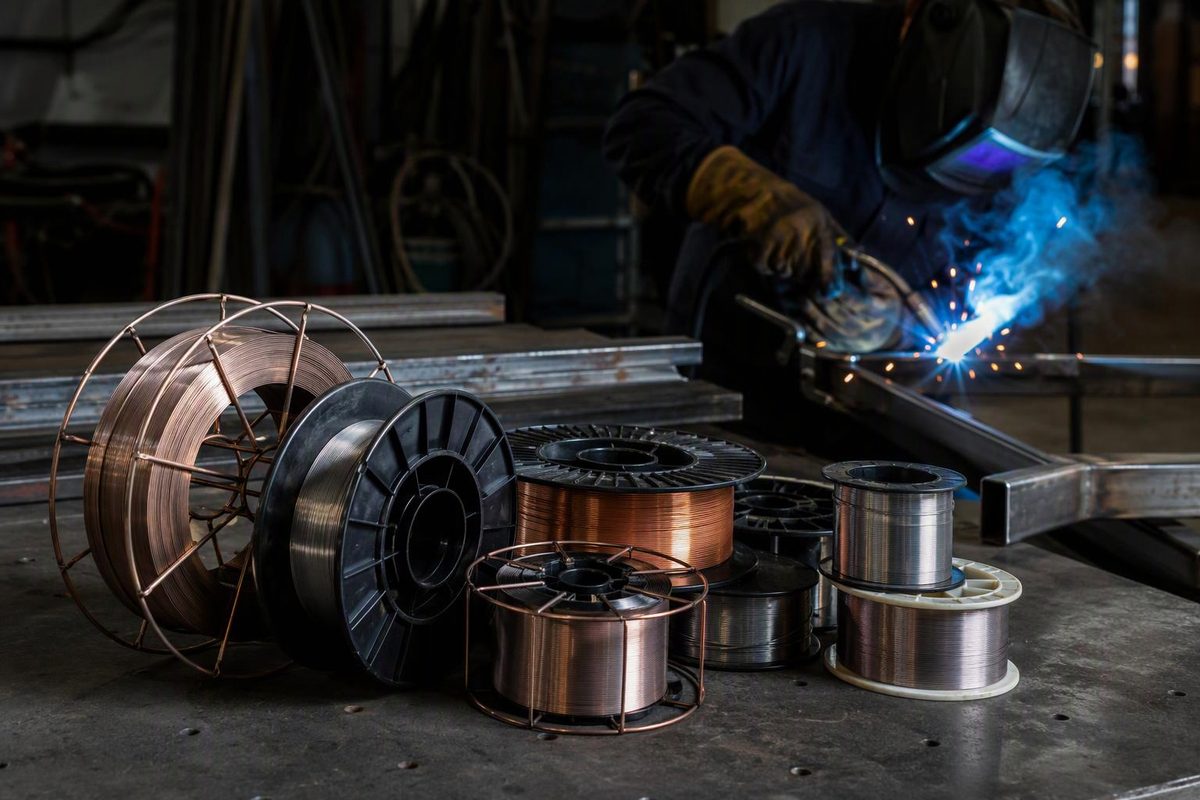
Choose welding wire in this order: process, base metal and service requirements, classification, then diameter and package size. A spool marked “.035 inch” tells you its diameter—not whether it needs shielding gas, which polarity it uses or which metal it can weld.
For ordinary mild-steel fabrication in a sheltered shop, solid ER70S-6 is a common starting candidate. For work without an external gas supply, investigate a compatible self-shielded flux-cored wire instead. Neither choice is universal: the joint, position, machine output and applicable welding procedure still govern.
Which type of welding wire do you need?
In MIG/GMAW and flux-cored welding, the continuously fed wire is both the consumable electrode and a source of deposited filler metal. The important distinction is how the wire is constructed and how the molten weld is protected from the atmosphere.
| Wire type | Shielding | Where it may fit | Main setup consequence |
|---|---|---|---|
| Solid wire—GMAW, commonly called MIG | External shielding gas | Sheet metal and general fabrication; steel, stainless or aluminum with the appropriate alloy | Match gas to the alloy and transfer mode; protect shielding from drafts |
| Self-shielded flux-cored—FCAW-S | No external gas required | Outdoor repair and field fabrication where the specific wire is suitable | Follow wire-specific polarity, operating range and application limits; remove slag |
| Gas-shielded flux-cored—FCAW-G | External gas plus flux-generated protection | Heavier fabrication and out-of-position work with a suitable classification | A flux core does not mean gasless; remove slag between passes |
| Metal-cored wire | External shielding gas | Production fabrication where travel speed and reduced cleanup can justify a process change | Verify gas, transfer mode, equipment and position capability; it is not gasless wire |
Miller’s solid-versus-flux-cored guide explains the shielding distinction. Hobart’s cored-wire comparison describes metal-cored wire’s production uses and the interpass slag cleaning required with flux-cored wire.
Self-shielded wire is useful outdoors because it does not depend on shielding gas delivered from a cylinder. That does not make every self-shielded product suitable for every field weld. For the process distinction, see FCAW-S versus FCAW-G.
Match the classification to the metal and job
Start with the identity of both base metals. Then establish what the finished weld must withstand: loading, temperature, corrosion exposure and any specified toughness requirements. On procedure-controlled work, use the filler classification and consumable requirements permitted by the welding procedure specification (WPS).
For mild steel, Hobart identifies its HB-28 as ER70S-6, a solid wire with high deoxidizer content, used with CO₂ or specified argon/CO₂ mixtures. That is a specific steel-wire example—not permission to use it on stainless or aluminum. HB-28 product information
Deoxidizers help manage oxidation during welding; they do not replace joint preparation. Remove oil, paint, rust and other contamination rather than selecting a wire as a workaround for dirty material. Miller’s preparation guidance
For stainless, use the separate stainless-steel welding wire selection guide. For aluminum, filler selection also depends on the base alloy and service conditions. Soft aluminum wire is commonly fed using a spool gun or push-pull system, so changing the spool alone may not produce a workable setup. Miller’s aluminum MIG guide
Check polarity, gas and machine fit before buying
Read the exact product datasheet, not just the broad wire category.
For example, Hobart’s Fabshield 21B, E71T-11, specifies no external shielding gas and DCEN—direct-current electrode negative. In that setup, the electrode/gun is negative and the work connection is positive. Conventional MIG commonly uses DCEP—electrode positive. Do not carry a polarity setting from one process to another without checking the wire instructions. Fabshield 21B datasheet; Miller’s MIG setup guidance
Before ordering, verify:
- Diameter and output: the wire’s operating range must overlap the machine’s capability and suit the joint and position.
- Package fit: check spool dimensions, hub arrangement and any required adapter—not merely spool weight.
- Feed path: match drive-roll groove, guides, liner and contact tip to the wire type and diameter.
- Shielding: confirm the specified gas composition and transfer mode, or that the wire is genuinely self-shielded.
Use the welding wire size guide to narrow diameters. A machine accepting a diameter does not prove it has enough output to weld the intended section: insufficient output can leave lack of fusion even when a bead is deposited. Miller’s wire-selection guidance
If the arc is poor, check the setup before blaming the wire
1. Confirm wire identity, polarity and shielding. Pinholes suggest investigating shielding loss and contamination before changing brands. Miller’s porosity guidance; Hobart’s contamination guidance
2. Check feeding. Look for a kinked gun cable, a worn or obstructed tip, an unsuitable liner, incorrect rolls or excessive roll pressure. Too much pressure can crush wire and contribute to liner blockage. ITW’s wire-feeding troubleshooting guide Disconnect input power before working on the machine or changing components, following the owner’s manual. Miller/Hobart safety guide
3. Only then tune settings. Start from the machine or consumable chart for that wire, gas and application. Test on representative material and change one variable at a time. For solid-steel MIG, wire-feed speed affects amperage, while voltage must be coordinated with it; a chart for solid wire is not a universal flux-core chart. Miller’s parameter guidance
A stable arc and tidy bead are useful observations, not proof of internal fusion or code compliance. Subsurface lack of fusion requires appropriate inspection; required qualification and inspection remain separate from setup checks. TWI’s lack-of-fusion guidance
Keep usable wire clean and dry
Protect open spools from moisture, cutting dust, oil and grease. Hobart recommends returning unused wire to a secured clean bag and its original box in a dry area; rust and debris can disrupt feeding and contribute to weld problems. Replace wet or contaminated wire rather than trying to recover it by baking: Hobart’s handling guide says welding wires should not be reconditioned, and Fabshield 21B explicitly says re-drying is not recommended. Hobart’s handling guidance; Fabshield 21B datasheet
“No external gas” does not mean “no fumes.” Use appropriate welding PPE and enough ventilation or local exhaust to keep fumes out of the breathing zone, and follow the equipment manual, consumable SDS and site rules. Miller/Hobart safety guide